 SUNSET:

 0
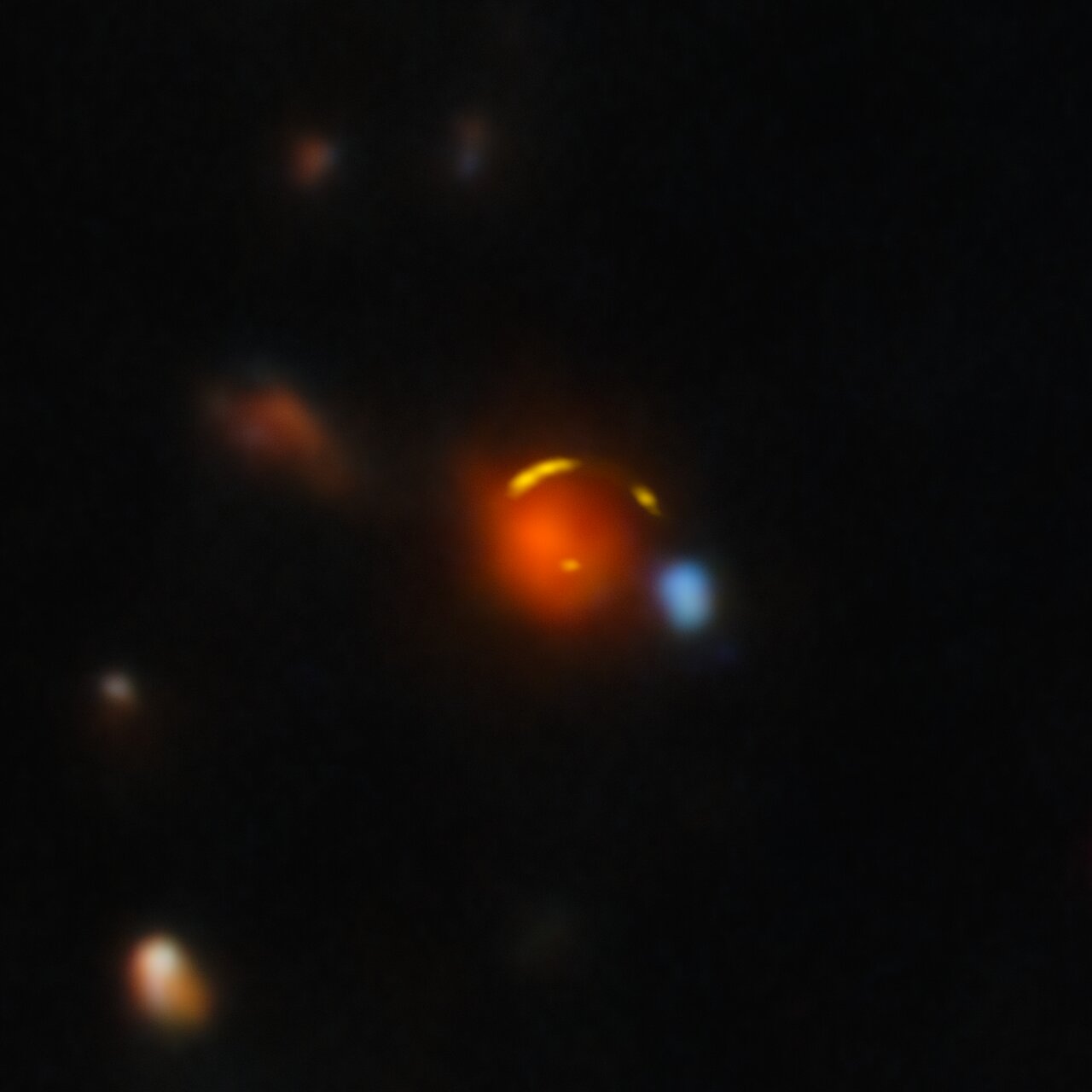
0Astronomers have discovered a bridge of gas and dust between two protostars, the signature of a close encounter 15,000 years ago.
Bill Saxton, ALMA (ESO / NAOJ / NRAO), NRAO / AUI / NSF
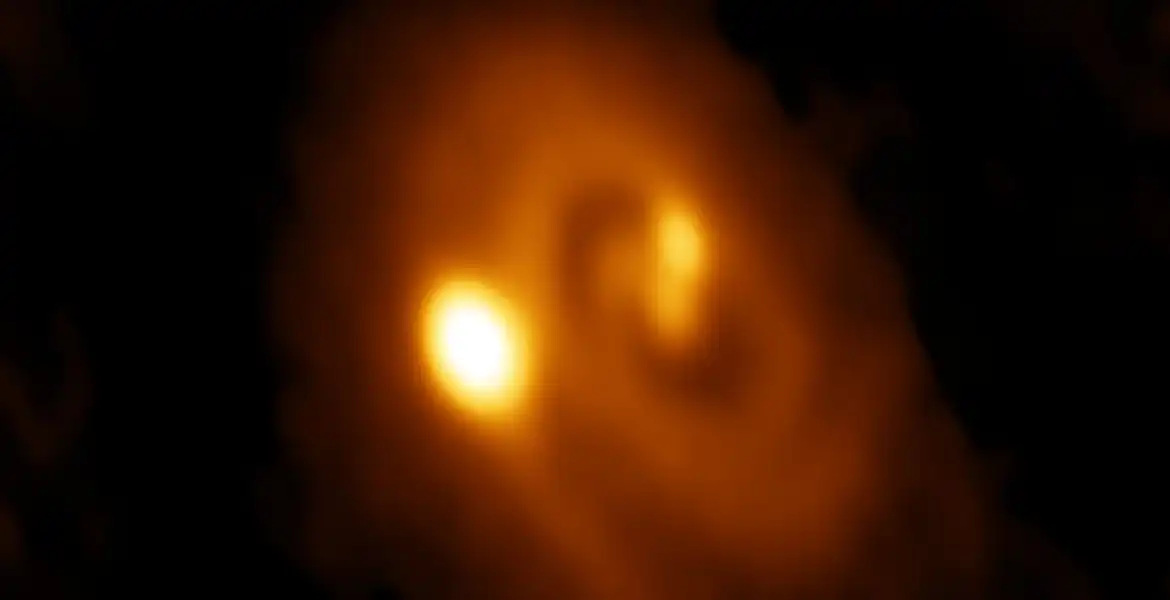
Astronomers using the Atacama Large Millimeter/submillimeter Array (ALMA) have spotted a bridge of gas and dust connecting two newborn stars. The bridge, a spiral arm that appears to link the stars, may constitute the clearest example of a stellar flyby observed so far.
Young stars still crammed in their birth clusters frequently swing past each other at close range. In fact, in stellar nurseries, “stellar flybys occur for at least half of the stars in the cluster,” says Nicolás Cuello (Université Grenoble Alpes, France), who has created computer simulations of this phenomenon. Such close passages are thus an important part of understanding the birth of stars and their planetary systems.
Flybys between young stars may draw out the dust and gas that still encircle them, forming curved arms linking them. Such features disperse after a few millennia, making the chance of witnessing flybys as they’re happening small. Besides, for many systems, “it is difficult to tell whether bridge material comes from an interaction or whether it was simply part of the original cloud,” says Leslie Looney (University of Illinois).
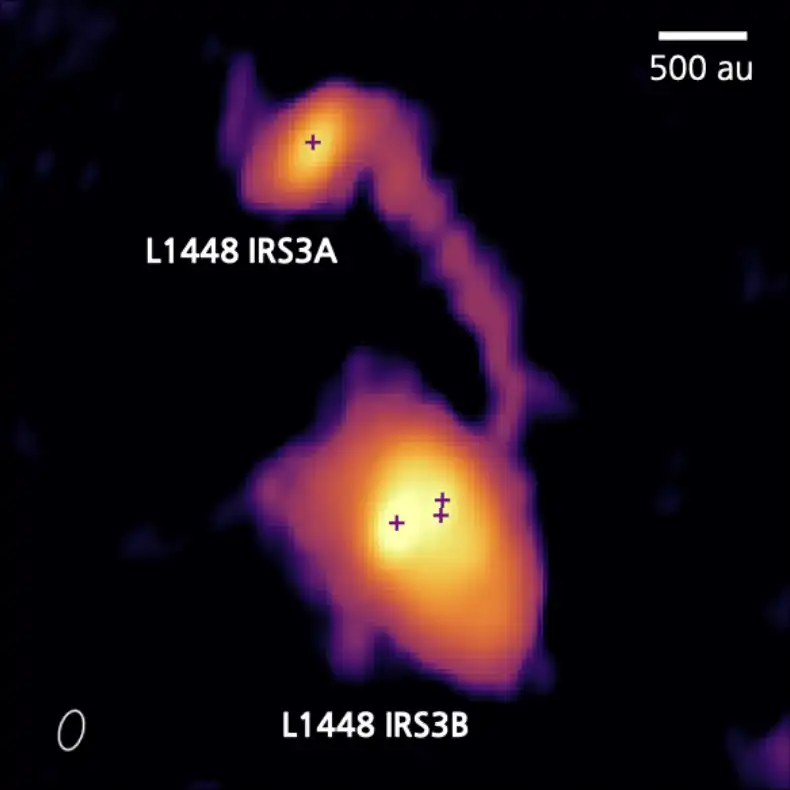
Now, a study forthcoming in Astrophysical Journal Letters, led by Youngwoo Choi (Seoul National University, South Korea), has captured just such a bridge between infant stars, two protostars named L1448 IRS3A and L1448 IRS3B. Still accumulating gas and dust from their natal cloud in Perseus, these protostars lie approximately 1,000 light-years away. At present, they appear to be 2,100 astronomical units (au) apart, or about 2,100 times the average distance between Earth and the Sun. That’s less than a tenth of the separation between the Sun and our nearest stellar neighbor, Proxima Centauri.
Looney, a team member on the new study, has been studying IRS3B on and off for 25 years. In 2021, he was part of a team that identified a spiral arm protruding from the star’s disk. Still, the bridge's discovery was serendipitous, notes Woojin Kwon (Seoul National University, South Korea), another team member of the new study. He says he noticed the structure a few years ago, while preparing ALMA datasets for a course he teaches.
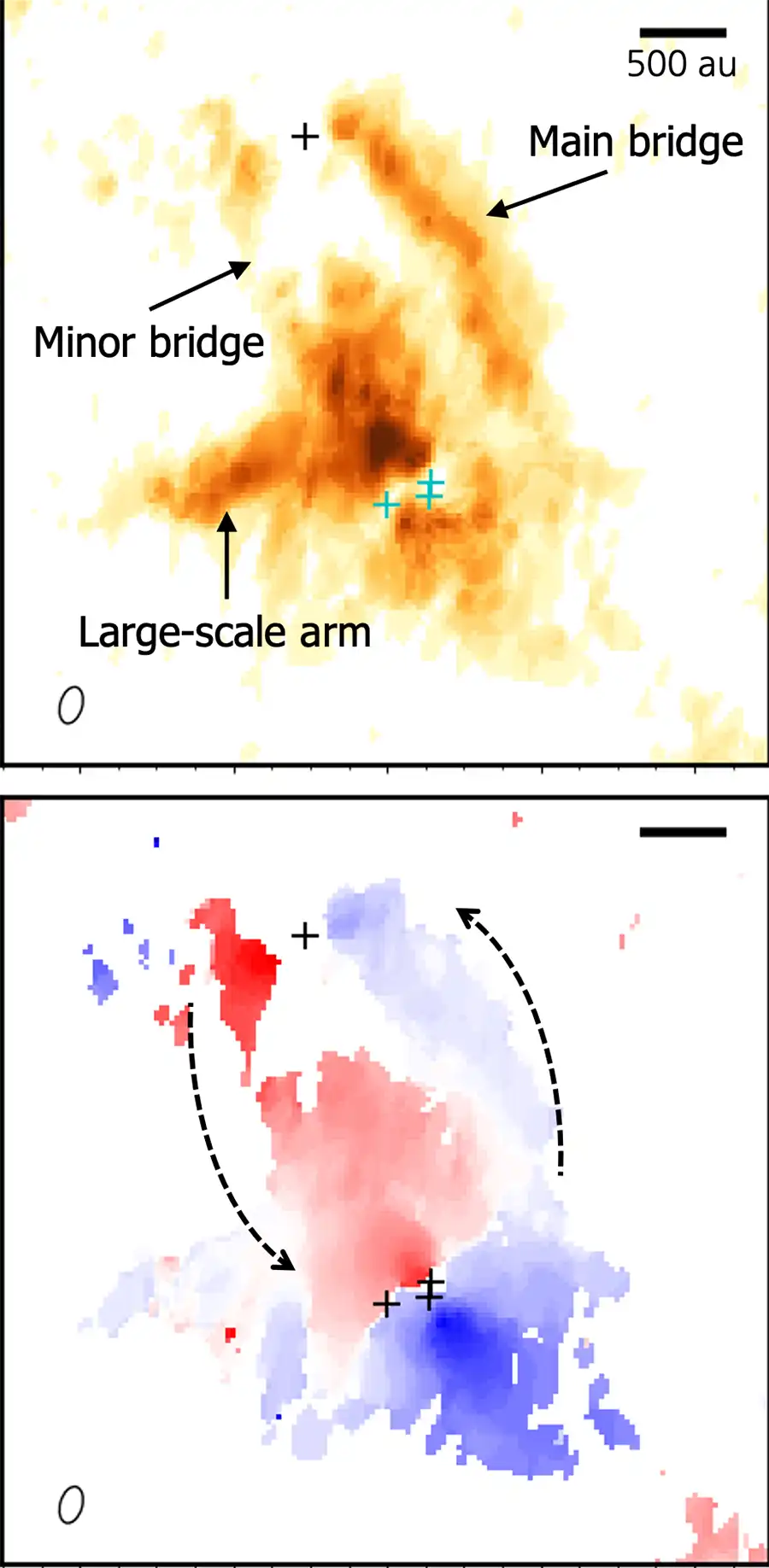
The ALMA observations, which are in the submillimeter-wavelength range, capture warm dust in a bridge that’s about 1,800 au long and 240 au wide. The bridge likely emerged when the stars’ strong gravitational tugs stripped and stretched dust and gas from each other’s planet-forming disks. Spectroscopic data hint at two such bridges, each one extending between the stars; however, the one from IRS3A to IRS3B is much fainter — and consequently, more speculative — than the main bridge. The submillimeter-wavelength observations also show that the disk around IRS3A has an enormous S-shape spiral structure.
Y. Choi et al. / https://arxiv.org/pdf/2512.14299
The researchers make the case that the main bridge and the stars’ individual spiral arms suggest a past close encounter. The structures’ spatial arrangement imply that IRS3A zipped past and disturbed IRS3B’s disk. Cuello, though not on the team, agrees, saying “the ongoing stellar flyby between young stars constitutes the most plausible explanation” for the main bridge.
However, Jeremy Smallwood (University of Oklahoma), who was also not involved in the current study, suggests the system might be a bound pair. Looney agrees that this is possible, noting that distinguishing flybys from wide binaries is difficult when orbital motions are very slow. However, he adds, “future high-sensitivity ALMA observations could help constrain the system’s large-scale kinematics.”
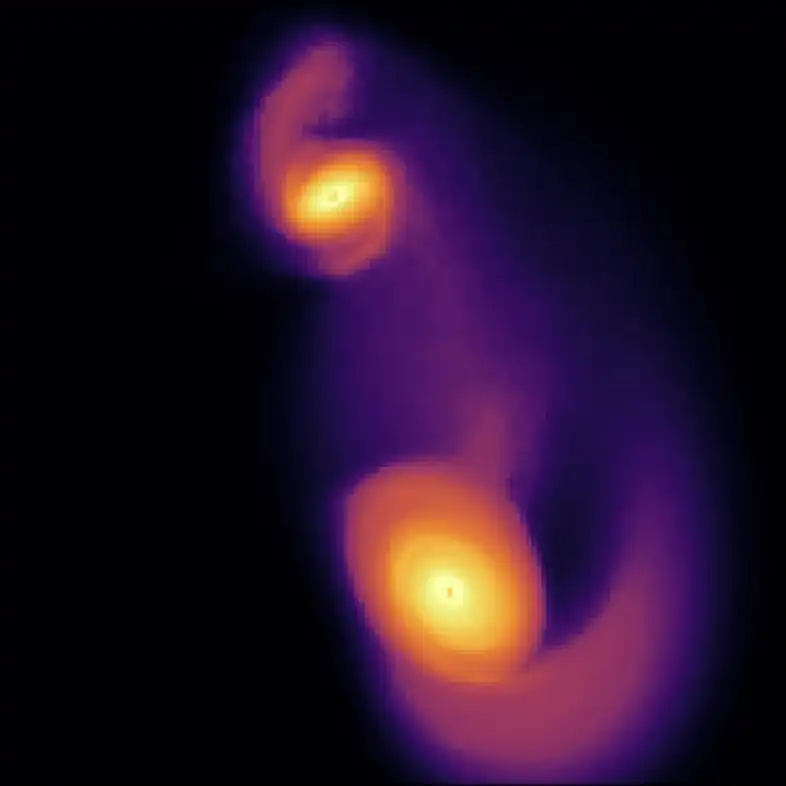
To cross-check their hypothesis, Choi’s team ran hydrodynamical simulations of what a stellar flyby would look like, directing a virtual IRS3A to parabolically swoop within 1,500 au of IRS3B. These simulations, which reproduce most of the observed features, suggest that we’re witnessing the system just about 15,000 years after the flyby occurred — a blink on the cosmic time-scale. However, the simulations did not recreate the fainter bridge and IRS3B’s free spiral arm that the team observed. The researchers didn’t model the protostars’ own gravity nor the dense matter surrounding the pair in their simulations; including those elements in future work might help explain the discrepancies, they say.
Y. Choi et al. / https://arxiv.org/pdf/2512.14299
Y. Choi et al. / https://arxiv.org/pdf/2512.14299
Kwon and Looney say they intend to continue studying the system to further elucidate the bridge’s structure and — if they get lucky — spot other bridges.
About Abha Jain
Abha Jain is a freelance science writer specializing in planetary and stellar astronomy.



Comments
You must be logged in to post a comment.