 SUNSET:

 1
1Early July is a great time to catch multiple passes of the International Space Station passes in a single night. Here’s why.
Dave Dickinson
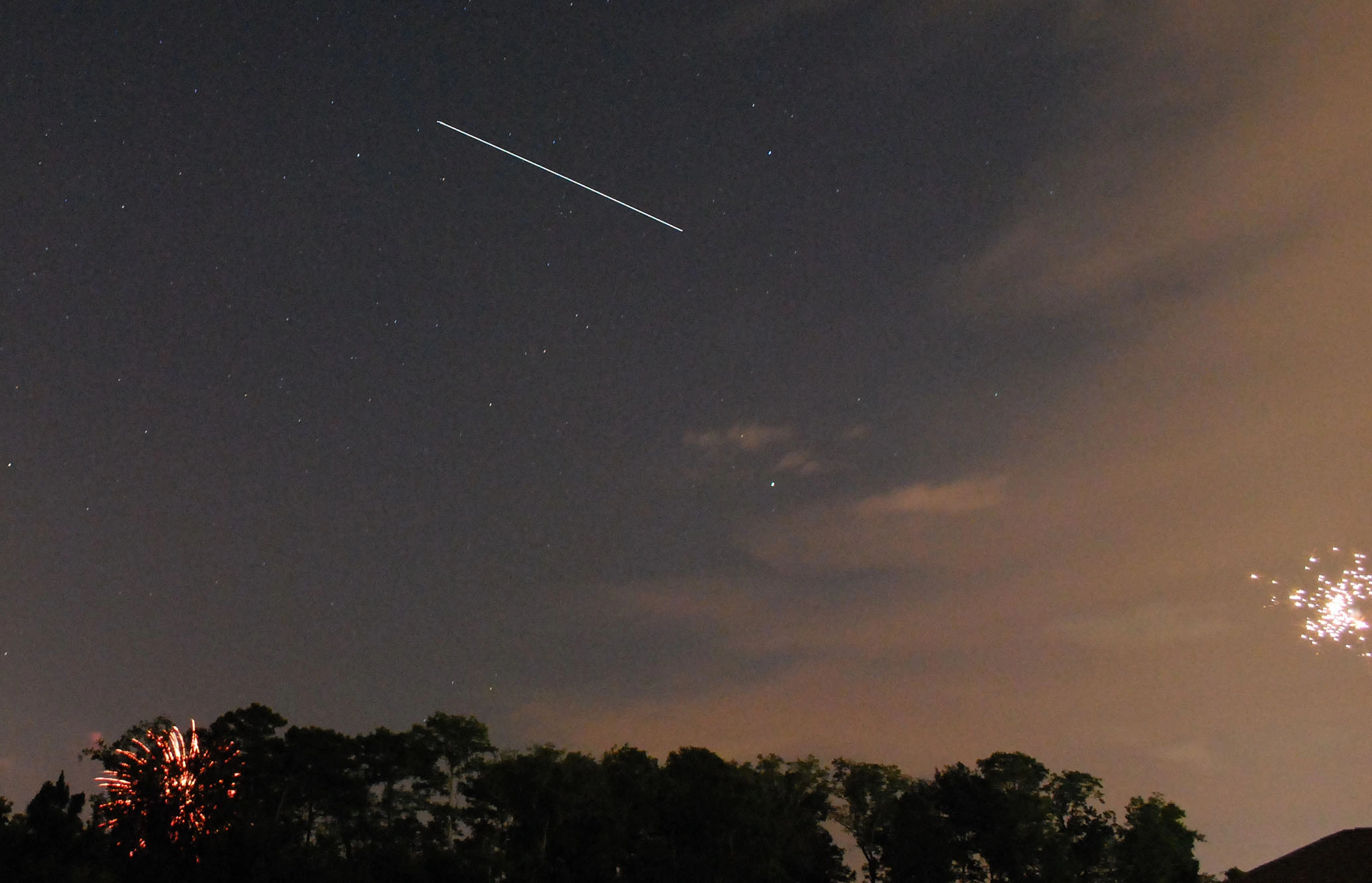
It’s often the hit of the star party. The International Space Station (ISS) shines like Venus when it's at the right angle to still be illuminated by the Sun while it's dark on the ground. "Here it comes!" someone shouts from down the line, and all heads turn skyward. A good, bright pass of the International Space Station is quite the sight — and this week, we have the opportunity to watch passes all night long.
Spot the Station
Dave Dickinson
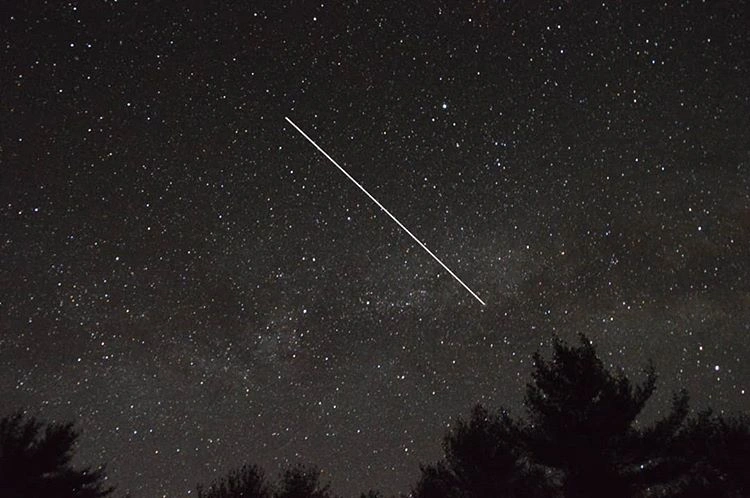
At 358 feet (109 meters) across along its longest axis, the International Space Station is the largest human-made object in Earth orbit. It shines via sunlight reflecting off the modules and the large solar panels; depending on the angles involved, it can reach a brilliant -5.6 magnitude during dawn and dusk passes, about a magnitude brighter than Venus at its best.
To the unaided eye, it looks like a surprisingly bright star moving at a slow, steady pace across the sky. In binoculars, I can just make out a hint of a boxy-looking structure as the ISS passes overhead — if it's in a face-on configuration, it looks like a tiny, glowing Star Wars TIE fighter. Orbiting at an average of 415 kilometers (258 miles) up, the ISS appears about 54" across at its maximum on an overhead pass (slightly larger than the visual size of Saturn with rings).
Seeing the ISS in your sky is just a matter of knowing when and where to look. NASA's Spot the Station tool or other online tools like the venerable Heavens-Above can help with that any time of the year. The station is often only visible for a short period in the evening or dawn hours, perhaps for a pass or sometimes two.
But during the weeks around the summer solstice (and around the winter solstice, too), observers have the chance to see multiple passes in a single night.
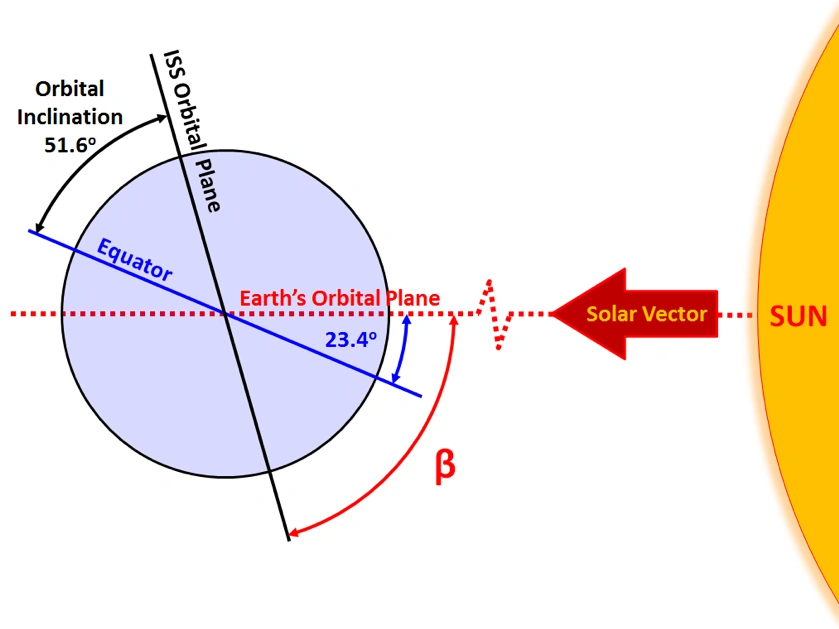
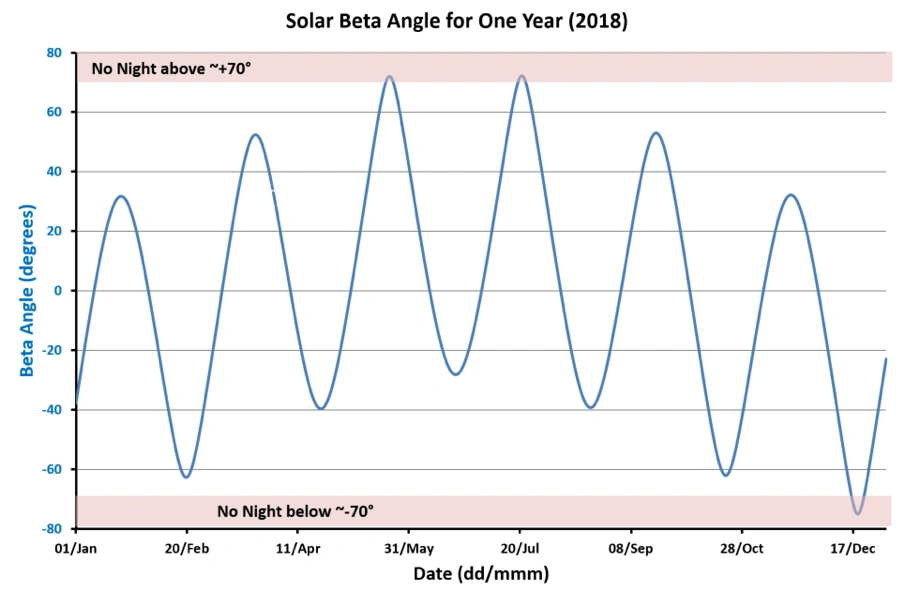
In June, the Northern Hemisphere is favored for full-illumination passes for the ISS, due to a large angle between the station's orbit and the Sun (known as the beta angle). These high-beta-angle periods of full illumination happen around the solstice because the station’s orbit is tilted 51.6 degrees relative to Earth’s equator. This setup has a practical purpose: It offers launch sites worldwide access to the station. Also, during these times, the solar-powered station remains in sunlight for days at a time, which offers continuous power supply, but also challenges engineers to keep the station cool.
NASA / ISS / AMS
NASA/ISS/AMS
Fortuitously, station passes during these times are visible for most of humanity, making for a truly international experience.
This year, the full-illumination period starts July 6th. The station doesn’t enter Earth’s shadow again until July 11th. Observers between latitudes of 40°N to 60°N might see the station four to five times in one evening. Even in the days before and after, though, chances are good to see multiple passes in a single night.
Challenge Yourself: Viewing Opportunities
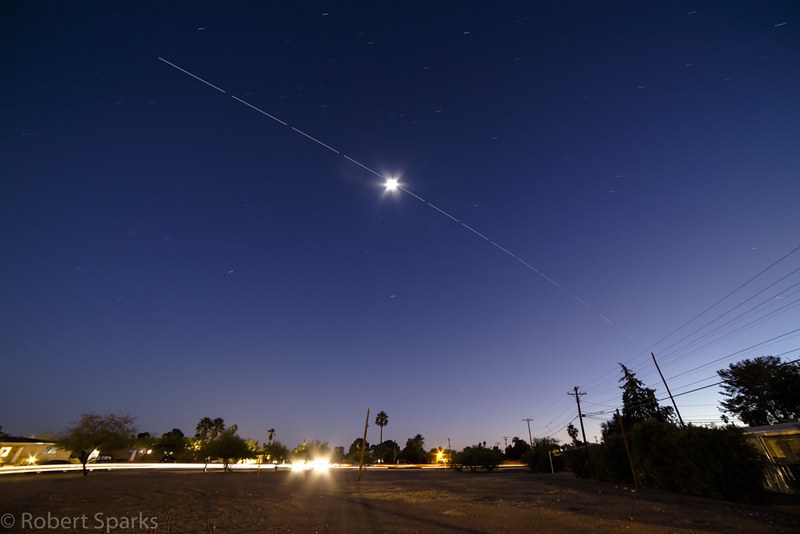
Rob Sparks
The station may sometimes nick Earth's shadow, entering the shadow and dimming, only to exit (and brighten again) only a few minutes later. Another challenge is to catch China’s Tiangong along with the International Space Station. If you see that sight, you'll be seeing all the humans in space. Tiangong is in a shallower 41.5° inclination orbit, and the two seem to sync up once every two weeks or so.
The station is about to become a busy place in early July, offering additional viewing opportunities. Spacecraft shuttling cargo and crew can appear as tiny ‘stars’ chasing the bring station. On July 1st, a Russian Progress resupply MS-29 will undock from the station, while on July 5th, a Progress MS-31 will launch toward the station. I use Next Spaceflight to keep track of launches and updates worldwide.
This season also offers a chance to see the illuminated station as it crosses the Moon. Transit finder is a great site to see if the Sun, the ISS, the Moon, and Earth line up in the right way for this to become visible for your location.
The Future of the International Space Station
After the first module launch in 1998, and the first arrival of crew in 2000, the International Space Station's time is soon coming to an end. Current plans see NASA operating the ISS until it's carefully decommissioned in 2030. Vacating the station will be a lengthy process, and will be expensive as well, costing an estimated $1 billion (yearly operations cost $3 billion). Like Russia’s Mir, which was deorbited in March 2001, the ISS will make its terminal deorbit over Point Nemo, the spacecraft graveyard over the remote South Pacific.
What's to follow isn’t immediately clear, although more than one commercial venture has plans to set up a sort of residence in low-Earth orbit. The first of these is Vast’s Haven-1, set to launch in early 2026.
About David Dickinson
David Dickinson is a freelance science writer, high school science teacher, retired enlisted U.S. Air Force veteran and avid stargazer. He currently resides with his wife Myscha in Bristol, Tennessee. David also writes science fiction in his spare time. He posts as @AstroDave on BlueSky about space news and sky-watching worldwide.



Comments
Ludovicus
July 5, 2025 at 12:14 am
I think that the station should be converted into a fueling and operations station as we head to the moon and elsewhere... It can provide a platform for (after conversion) pre-fabrication and other services as needed. De-orbiting this is a waste.
Even renting to commercial interests' use for materials engineering, pharma or food development, or other low-gravity work makes sense. It IS an international effort, and as such may be a bastion for international cooperation continuing as humankind continues to venture forth. Even conversion or addition of a data module and space telescope system (smaller, but functional) for further solar system studies or NEO detection can be done as well.
I know to has had a good run, but until a replacement of sorts that fulfills an international and non-commercialized use of space sciences can be achieved, we NEED it. Intact.
...end of an era I guess!
You must be logged in to post a comment.
You must be logged in to post a comment.