 SUNSET:

 2
2One of two Nobel Prize-winning LIGO sites is on the budgetary chopping block.

LIGO-Virgo / Aaron Geller / Northwestern University
In 2015, two giant, spindly-armed detectors called the Laser Interferometer Gravitational-Wave Observatory (LIGO) enabled astronomers to detect ripples in spacetime for the first time, confirming Einstein’s theory of gravity and taking home the ultimate honor: a Nobel Prize. Now, just one decade later, the Trump administration has proposed shuttering one detector in its National Science Foundation (NSF) budget request, stunning a scientific community whose field has only continued to grow.
Closing one facility would be a “senseless, irrational thing to do,” says astrophysicist Maya Fishbach (University of Toronto). “It’s like trying to fly a plane with only one wing.”
LIGO took two decades to catch the first gravitational wave signal from the time it broke ground at its two sites in Hanford, Washington, and Livingston, Louisiana. Both facilities work by splitting a laser beam in half, sending each ping-ponging through separate vacuum-pressured arms four kilometers in length, then checking to see if gravitational waves shortened one arm relative to the other by as little as 10-19 meters. While one site can detect a gravitational wave on its own, the signal is fuzzy; two sites of the same sensitivity enable astronomers to determine where the waves came from and thus what kind of cosmic event created them.
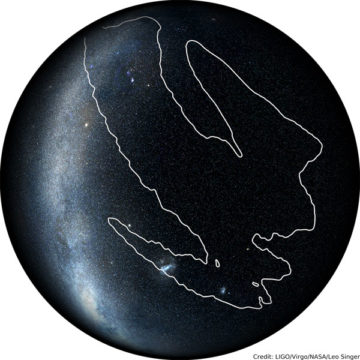
LIGO / Virgo / NASA / Leo Singer (Milky Way image: Axel Mellinger)
But this unparalleled physics and engineering experiment may come undone in mere months. The White House’s 2026 NSF budget proposal suggests a 39.6% funding reduction down to $29 million, commensurate with operating only one site and a “reduced level for technology development.”
“It's going to be near-impossible to carry out our mission at any kind of high productivity level with the budget that's coming down,” says David Reitze (California Institute of Technology), a physicist and the director of LIGO.
Although LIGO’s leaders expected some strain from the “skinny” budget request released last month, the full decision, all of one sentence, came as a shock. In its decades of funding from the NSF, the agency “hasn’t made a peep” about reducing LIGO to a single site, says physicist Joseph Giaime (Louisiana State University), the observatory head at Livingston. “We wouldn’t have even wildly guessed they were going to ask us to close one.”
Speculations about the cause are rumbling through the community, from political motives to a de-prioritization of science. But Reitze thinks the explanation is simple: the proposal writer “probably didn’t have a deep understanding of the science behind LIGO,” he says.
That fact in itself unsettles scientists, who typically consult on the budgetary process. “You wouldn’t expect people writing a budget request to be experts in gravitational waves,” says physicist Gabriela González (Louisiana State University), “but they were writing things without consulting experts. And that worries me.”
When asked for comment, an NSF spokesperson said via email that the budget “reflects a strategic alignment of resources in a constrained fiscal environment in which NSF prioritizes investments that can have the greatest national impact.”
The White House proposal is not the final say; Congress will have to write and pass its own budget for the agency, influenced by the President’s asks. But since LIGO receives all of its funding from the NSF, its leaders, including Giaime and Reitze, have already begun mocking up plans to abide by different levels of funding cuts. Above all, they are trying to keep both sites open — a stipulation that would require significant job losses across each facility.
“I can’t explain to my staff why this is being contemplated,” says Giaime, who fears that the loss of skilled laborers would take years to build back, even if funding were restored in the future. He also worries about the preservation of the science centers at each site, which provide STEM education to thousands of K-12 children in rural areas every year, some of whom have gone on to science careers. Researchers at institutions country-wide might also be impacted; more than half of U.S. states receive LIGO-related grants, says González.

Scientific visualization: T. Dietrich (Potsdam University and Max Planck Institute for Gravitational Physics), N. Fischer, S. Ossokine, H. Pfeiffer (Max Planck Institute for Gravitational Physics), T. Vu. Numerical-relativity simulation: S.V. Chaurasia (Stockholm University), T. Dietrich (Potsdam University and Max Planck Institute for Gravitational Physics)
LIGO works in partnership with Virgo, a gravitational wave detector in Italy; KAGRA, a detector in Japan; and GEO600, a detector in Germany. However, none of the other facilities are powerful enough to record any but the loudest gravitational waves on their own. Instead, the international facilities help LIGO to localize the source of the waves, most often to colliding black holes or, occasionally, to a pair of neutron stars. The non-LIGO detectors wouldn’t have seen the Nobel-winning 2015 event, says González. And they can’t “pick up the slack” in the future, adds Fishbach.
With a single LIGO facility, only the most dramatic of gravitational waves will be detected. Combined with a proposal in the President’s 2026 budget request for NASA to pull out of the Laser Interferometer Space Antenna (LISA), the future ESA-led gravitational wave observatory in space, scientists worry the U.S. isn’t just ceding American leadership but stifling the whole field.
“We're still at the tip of the iceberg of the potential that gravitational waves have to teach us about our universe,” says Fishbach. The signals carry information about a variety of physics, from how often black holes merge, to the heaviest elements the universe makes, to how galaxies like the Milky Way evolve.
The LIGO team hasn’t given up yet. Reitze says they are in talks with congresspeople, as well as collaborating with larger campaigns by the American Astronomical Society and the American Physical Society to ensure federal science funding. One of the points he emphasizes to lawmakers is that LIGO supports the local economics in eastern Washington and southwestern Louisiana, employing people from mechanics to landscapers.
“I've heard that there is sympathy and support for science on both sides of the aisle in Congress,” he says. If not, LIGO is preparing to branch out from nearly 40 years of publicly funded science and ask private donors for support. “Desperate times call for desperate measures,” says Reitze.
About Hannah Richter
Hannah Richter is a freelance Earth, space, and science policy journalist based in Washington, D.C. In addition to Sky&Telescope, her work has appeared in Science, Nature, Scientific American, Popular Mechanics, Smithsonian, WIRED, Science News, Ars Technica, and Sierra, among others. She has also written an e-book for NASA's Fermi Gamma-ray Space Telescope and is an alumna of MIT's Graduate Program in Science Writing.



Comments
Brian of DRAA
July 6, 2025 at 8:34 am
In his 2016 acceptance speach Donald Trump declared he "loved the poorly educated". Welcome to Trump University deux.
You must be logged in to post a comment.
Brian of DRAA
July 6, 2025 at 8:47 am
Note: the second detector allows verification of potential signals, so false signals generated by noise can be eliminated. Basically if one detector sees a signal, it never happened unless verified by a second detector. Thank you for explaining the lack of sensitivity of VIRGO and KAGRA and GEO600.
You must be logged in to post a comment.
You must be logged in to post a comment.