 SUNSET:

 0
0James Webb Space Telescope observations of two young planets 326 light-years away show a series of surprises.
Ellis Bogat
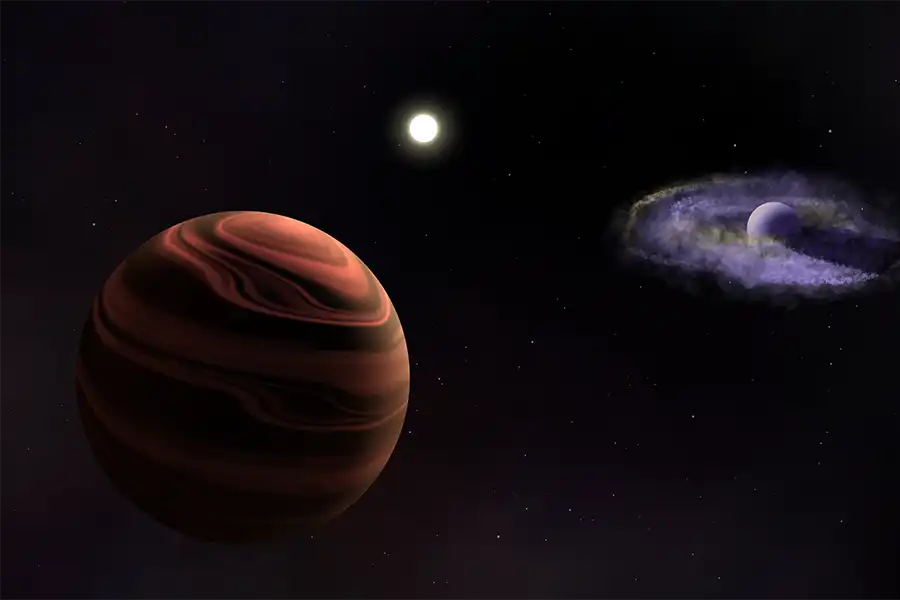
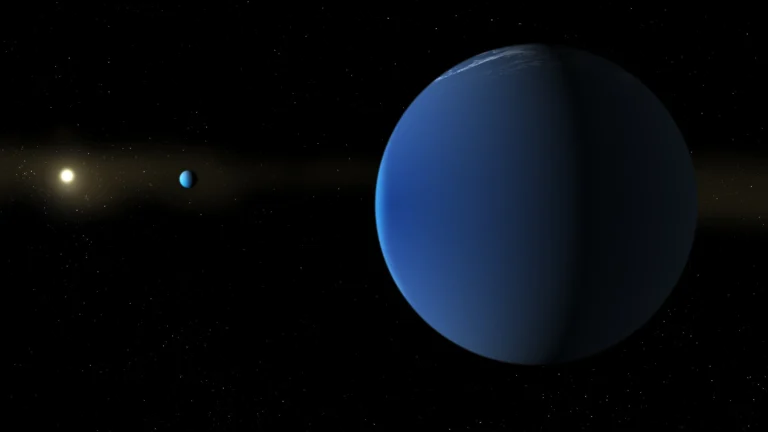
Around 326 light-years away, two gas giants sweep out large orbits around a Sun-like star. But unlike our system, this one is young, only 16 million years old, and bears remnants of active planet formation. New observations from the James Webb Space Telescope (JWST) have shed light on the juvenile system, revealing silicate clouds in one planet and a disk of planet-forming material around the other.
First discovered in 2020 with the Very Large Telescope in Chile as part of the Young Suns Exoplanet Survey (YSES), the YSES-1 system features two hefty, Jupiter-size planets that orbit their star at 30 times Jupiter’s distance. Their distance makes the system a prime candidate for directly imaging them.
In a result published in Nature and announced at a press conference during the 246th American Astronomical Society (AAS) meeting in Anchorage, Alaska, a team of astronomers used JWST to characterize the atmospheres of planets YSES-1b and YSES-1c. They found that YSES-1c had clouds of silicate particles, while YSES-1b contained a swath of dusty material known as a circumplanetary disk. The observations also mark the first detection of silicates in a circumplanetary disk — fine, hot grains that might have been produced during collisions between planetary embryos or moons.
Webb Observes a Jovian System
Young exoplanet systems can help astronomers learn more about how planets form and acquire an atmosphere. To that end, a team led by Kielan Hoch (Space Telescope Science Institute) used the Near-Infrared Spectrograph and Mid-Infrared Instrument on JWST to capture spectra of the YSES-1 planets, measuring the light over a range of infrared wavelengths. Certain molecules in the planets’ atmospheres absorb or emit light at particular wavelengths, leaving their chemical fingerprints in the spectra.
Previous ground-based observations of YSES-1 indicated that the planets were still forming, gathering gas from their surroundings. With JWST, the team is able to directly study young giant planets at mid-infrared wavelengths for the first time, peering through dust that obscures visible light from forming planets. Young planets also emit more strongly in the mid-infrared range.
The planets appear redder than other exoplanets and even larger worlds known as brown dwarfs, which suggests unique atmospheric conditions. In addition to capturing novel features, JWST also detected signatures of carbon monoxide, carbon dioxide, water, and methane on the Jovian worlds.
Silicate Clouds on YSES-1c
The outer planet, YSES-1c, is six times the mass of Jupiter and sits at a distance from its host star that’s around 320 times Earth’s average orbit (or 320 astronomical units). The JWST observations showed it likely contains clouds of silicates — rocky minerals with silicon and oxygen.
To analyze YSES-1c’s atmosphere, the team first modeled the wavelengths that different silicate-cloud compositions would absorb. The team then compared their models to the observations, tweaking the clouds’ properties and abundances to produce the best match. They found that the clouds are most likely enriched with small amounts of iron. Alternatively, they might be made up of a mixture of magnesium silicate minerals.
YSES-1c is below the threshold between planets and brown dwarfs, but it appears distinct from both. “Theories have suggested that brown dwarfs should start to lose their clouds around 900K [1160°F],” said Hoch at the AAS press conference. However, she adds, YSES-1c’s estimated temperature is higher than that, around 1250 to 1520°F, yet it hasn’t lost its clouds.
What’s more, the silicate features in the planet are visually distinct from the silicates astronomers have found in brown dwarfs. “These two distinct classes of objects might have different [types of] clouds,” Hoch said.
The Disk That Feeds the Planet
Meanwhile, the inner planet YSES-1b is still actively coming together at the center of a swirling disk of hot, dusty material. Orbiting at 160 astronomical units, YSES-1b is 14 times Jupiter’s heft, hovering at the edge of becoming a brown dwarf. Its atmosphere is too hot to form clouds, reaching scorching levels between 2420 and 3180°F.
The JWST spectrum reveals that some of that material is emitting light at longer wavelengths than expected, which might come from fine dust grains. Those grains might include olivine, a green magnesium silicate that had never been discovered in a circumplanetary disk.
Astronomers typically expect such fine dust grains to grow into larger particles by the time a star reaches 2 to 5 million years of age. “With our current theories, these grains should not still be around at 16 million years,” Hoch said.
The particles might instead be second-generation grains, perhaps forming from baby planets or moons colliding in the disk. “Evidence for collisions or exomoon formation could be possible, or we just have to put in a little more work to reveal all the complexities that are happening with JWST,” Hoch cautioned.
To improve our understanding of disk formation, planet formation, and the timescales on which they occur, the team hopes to perform follow-up observations of the system with JWST and ground-based telescopes such as the Atacama Large Millimeter/submillimeter Array in Chile, which could help map the gas component of the disk and measure its size and extent.
“The disk really shouldn’t be here right now, so maybe there’s some proof for substructures, moon formation, things like that,” Hoch said. “But this is all a brand-new field that’s starting to be revealed with JWST, so stay tuned!”
But Hoch also notes that any success depends on the efforts of early-career researchers — many of whom rely on federal grants now threatened by the administration’s proposed cuts. Without this support, gaining new insights into exoplanet formation and other open questions in astronomy — and empowering the researchers who aspire to do so — becomes a lot more difficult.
About Arielle Frommer
Arielle Frommer is a science writer for Sky & Telescope and astronomy PhD student at Yale, where she studies exoplanets. In her free time, she enjoys hiking, crocheting, drinking coffee, and reading and writing fiction.


Comments
You must be logged in to post a comment.