 SUNSET:

 9
9
Eclipses always come in pairs: A solar eclipse occurs either about two weeks before or after a lunar eclipse.
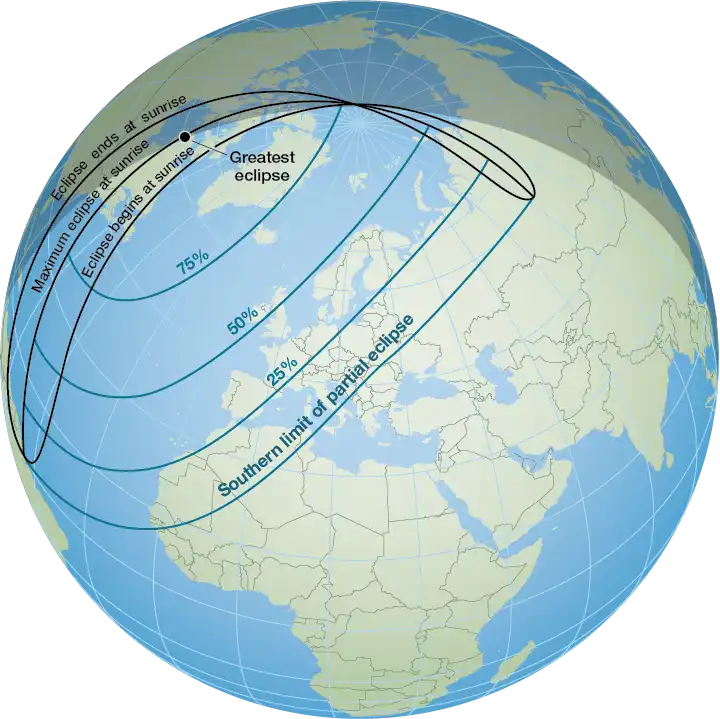
During a lunar eclipse, the Moon crosses the Sun-Earth orbital plane at full Moon phase. With Sun, Earth, and Moon in near-perfect alignment, the Moon slides into Earth's shadow. It did this in majestic and colorful fashion during the recent total eclipse on March 13–14. Two weeks later at new phase, the Moon will still lie close enough to the Sun-Earth plane to stoke a deep partial solar eclipse on Saturday, March 29th, for observers in the northeastern U.S., eastern Canada, Greenland, Iceland, Europe, Northwest Africa, and northwestern Russia.
Sky & Telescope diagram
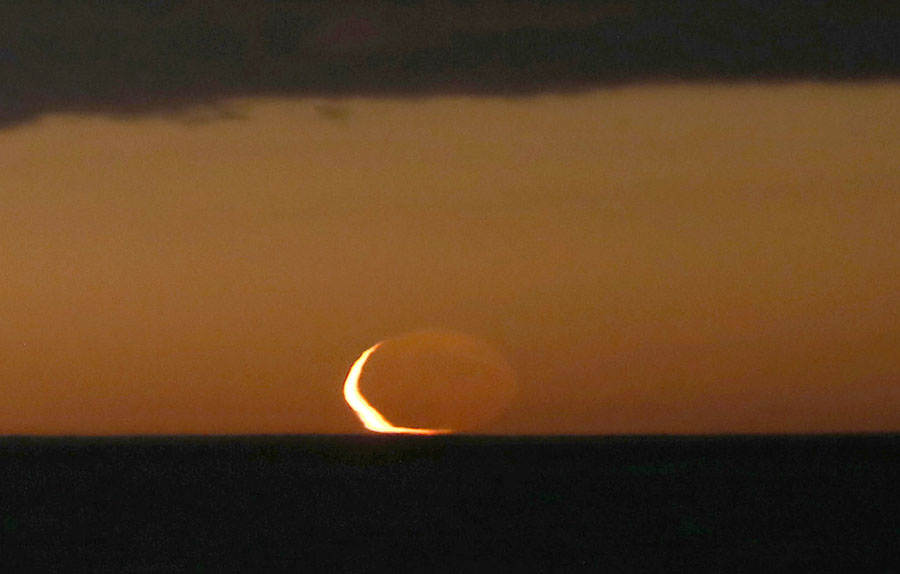
At greatest eclipse, the Moon will cloak 93.1% of the Sun from Nunavik, which comprises the northern third of Canada's Québec province. Northern Maine will have similarly impressive views with 86% of the Sun covered — the maximum possible from the U.S. — shortly after local sunrise. Weather permitting, eclipse-goers will thrill to a thin solar crescent rising "horns first" around 6:15 a.m. local time. For all U.S. locations, the Sun will rise already in eclipse and, from most locations, moving out of eclipse. Finding an unobstructed east-northeast horizon will be a priority if you want to catch as many precious minutes as possible.
The Moon will cover varying amounts of the Sun depending on location. The farther south along the Eastern Seaboard you are, the smaller the obscuration. Bostonians will see just over half the Sun (57%) eclipsed, while in New York City, the percentage drops to 27%. Farther south and west in Washington D.C. the Moon consumes just 3% — barely a nibble! Check the table below for additional cities and times.

Stellarium

Xavier M. Jubier
In the eastern Canadian Provinces, Iceland, and Europe, the eclipse begins after sunup. The farther east you travel, the shallower the eclipse will be. In St. John’s, Newfoundland, the Moon blots out 83% of the solar disk. Dubliners will see 41% covered at maximum, while in Vienna, the Moon takes just a 6% bite. To obtain detailed information for any locale, consult Xavier Jubier's interactive eclipse map.
Bob King
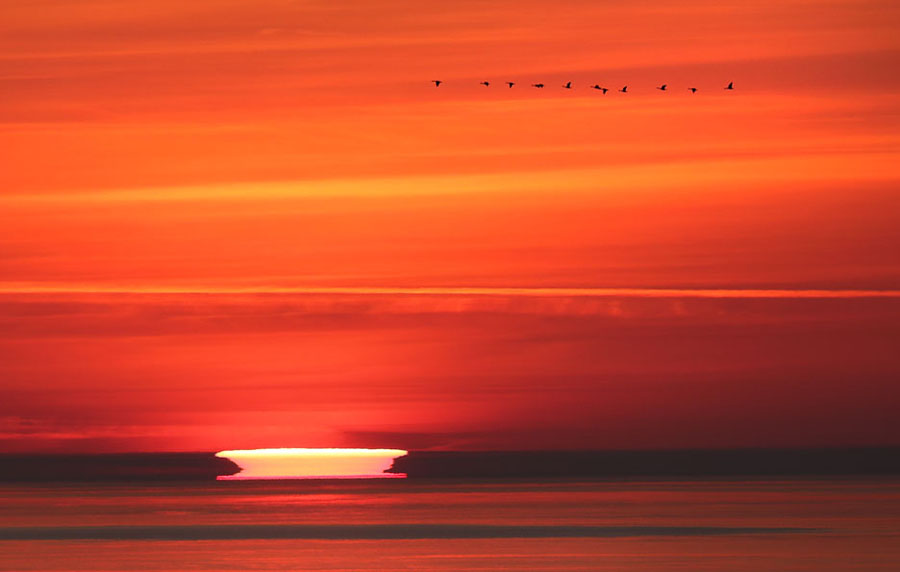
There should be some incredible photo opportunities of the eclipsed Sun at sunrise for U.S. and Canadian observers. Not only does refraction near the horizon flatten the solar disk, but mirages and other distortions induced by atmospheric layers of different density can create additional images, scalloped edges, or even stacked layers like a cosmic lasagna. If you can observe from along the ocean or a large lake with a flat horizon, you'll have access to the greatest diversity of low-altitude phenomena, including the Sun's reflection and potentially the green flash.
Bob King
Whether observing or photographing the solar eclipse, always use a safe, undamaged solar filter to protect your eyes from direct sunlight. That said, you can briefly photograph the Sun safely with a DSLR or mirrorless camera within a couple minutes of sunrise, when the atmosphere most strongly attenuates the Sun's light. Warning — do NOT look through the viewfinder. Instead, set your camera to live view and focus and compose using the camera's backscreen. That way you're not staring directly into the Sun. A few fast-shutter-speed exposures of the Sun will not damage your sensor. Although I can't speak to every camera, I've used both Canon DSLR (model 5D Mark IV) and mirrorless (R6) bodies to photograph sunrises and sunsets without any issues.
But beware. Once the Sun climbs more than a degree or two above the horizon, it becomes overwhelmingly bright, so please revert to using a safe filter to protect your camera and your eyes at that time.
Circumstances around the Planet
| City | Sunrise | Max. eclipse | Obscuration | End of Eclipse |
| Presque Isle, ME | 6:17 a.m. | 6:21 a.m. | 85.4% | 7:16 a.m. |
| Bangor, ME | 6:21 a.m. | — | 82.2% at sunrise | 7:13 a.m. |
| Boston, MA | 6:32 a.m. | — | 56.7% " " | 7:08 a.m. |
| Hartford, CT | 6:39 a.m. | — | 40.9% " " | 7:07 a.m. |
| Buffalo, NY | 7:03 a.m. | — | 5.4% " " | 7:09 a.m. |
| New York, NY | 6:45 a.m. | — | 26.7% " " | 7:05 a.m. |
| Allentown, PA | 6:51 a.m. | — | 16.4% " " | 7:05 a.m. |
| Philadelphia, PA | 6:50 a.m. | — | 16.0% " " | 7:04 a.m. |
| Washington D.C. | 6:58 a.m. | — | 3.1% " " | 7:02 a.m. |
| Newport News, VA | 6:56 a.m. | — | 1.4% " " | 6:59 a.m. |
| Hatteras, NC | 6:54 a.m. | — | 0.8% " " | 6:55 a.m. |
| Moncton, NB | 7:05 a.m. | 7:20 a.m. | 84.5% | 8:15 a.m. |
| St. John's, N.L. | 7:16 a.m. | 8:23 a.m. | 82.5% | 9:22 a.m. |
| Reykjavik, IS | — | 11:06 a.m. | 67.6% | 12:07 p.m. |
| London, UK | — | 11:03 a.m. | 30.6% | 12:01 p.m. |
| Paris, FR | — | 12:02 p.m. | 23.5% | 12:56 p.m. |
| Prague, CZ | — | 12:18 p.m. | 10.4% | 1:01 p.m. |
| Venice, IT | — | 12:09 p.m. | 6.4% | 12:47 p.m. |
| Tunis, TN | — | 11:51 a.m. | 0.3% | 12:05 p.m. |
Source: Xavier M. Jubier
In addition to horizon phantasms and watching the Moon gradually cover and uncover potential sunspot groups present at eclipse time, observers should also be alert for twilight effects. In northern Maine and along the Canadian border where obscuration will be maximal, morning twilight may appear to lag or seem darker than normal. Once the Sun is up, if more than about half of it is covered, daylight will have a distinctly different feel. Some call it "thin." I describe it as Mars-like, since it always feels like I'm on a more distant planet, where sunlight is weaker.
Will the birds, normally vociferous around sunrise this time of year, react to the slender Sun by turning down the volume? During the March total lunar eclipse, a male woodcock in a nearby open field was silent until the outgoing penumbral phase. As the light returned, he resumed his vocal and acrobatic flight display, ever hopeful to find a mate. May your hope for clear skies at eclipse time be met with success.
About Bob King
I love the sky (day and night) and have been a skywatcher and amateur astronomer since childhood. I'm also a long-time member of the American Association of Variable Star Observers (AAVSO) and Astronomical League. I pen the Astro Bob blog and have written four books: Night Sky with the Naked Eye (2016); Wonders of the Night Sky You Must See Before You Die (2018) and Urban Legends from Space (2019) and Magnificent Aurora, published in 2024. The universe invites us on an adventure every single night. To accept the invitation, we only need look up.




Comments
Anthony Barreiro
March 19, 2025 at 9:27 pm
Eclipses *usually* come in pairs. Sometimes they come in triplets: a slight lunar eclipse, then a central solar eclipse, then a slight lunar eclipse; or a partial solar eclipse, then a total lunar eclipse, then a partial solar eclipse. The Moon crosses the ecliptic twice every sidereal month, every 27 days, the time it takes the Moon to orbit around the Earth relative to the stars. Since the Earth and Moon are also orbiting the Sun, the time from new Moon to new Moon is 29 and a half days. So once in a while three eclipses can squeeze into 27 days during the 29 and a half days between new Moon and new Moon, or between full Moon and full Moon.
The last triplet was in June and July 2020. The next one will be in June and July 2029. I'm guessing it is not a coincidence that nine years is about half of the 18.6 saros cycle, but I'm not sure.
Best wishes to everyone who will be watching for the March 29 eclipse!
You must be logged in to post a comment.
Anthony Barreiro
March 19, 2025 at 9:37 pm
Correction: sometimes three *nodes* can squeeze in between two successive new Moons, or two successive full Moons.
You must be logged in to post a comment.
Bob KingPost Author
March 20, 2025 at 2:41 pm
Excellent point, Anthony! Of course, that makes sense. Thank you for "squeezing" that in.
You must be logged in to post a comment.
misha17
March 22, 2025 at 6:04 am
Right now, the location of the lunar nodes coincide with locations of the equinoxes.
The Spring Equinox, when the Sun appeared to cross the Celestial Equator heading North, occurred on March 20th at 5:01am EDT.
The recent lunar eclipse occurred at the Moon's descending node, and occurred in the part of the sky where the Sun lies during the Autumn Equinox. The instance of Full Moon, when the Moon was exactly opposite the Sun, occurred at March 14, 2:54am EDT
(6 days, 2 hrs before the Spring Equinox)
The instance of New Moon, when the Moon passes closest to the Sun occurs/occurred at March 29, 6:57 am EDT
(9 days, 2 hrs after the Spring Equinox)
The Full Moon was closer to its nodal passage than the New Moon is/was to its nodal passage, so the lunar eclipse was a total umbral eclipse.
All of the Moon was within the Earth's inner shadow, but the Moon had not quite reached its descending node (where Moon crosses the Ecliptic heading south) yet, so the Moon passed through the northern part of the Earth's shadow.
For the solar eclipse, the Moon has already passed its ascending node (where Moon crosses the Ecliptic heading north), and is farther from its node, so the Earth did not pass through the Moon's inner shadow, as it does during a total solar eclipse.
Because the Moon is well past its ascending node during the eclipse, its outer shadow only crosses Earth's upper (northern) latitudes.
You must be logged in to post a comment.
AB
March 27, 2025 at 9:42 pm
Wellll.... enjoy, y'all. My corner of the Maritimes has a forecast of cloud and 60% chance of flurries.
I hate this bleepin climate :'(
You must be logged in to post a comment.
Fred Espenak
March 28, 2025 at 4:17 pm
EVERY solar eclipse is either preceded of followed by a lunar eclipse (and vise versa). Occasionally there is even a triple of eclipses within a 34-day eclipse season (two lunar and one solar eclipse OR two solar and one lunar eclipse).
Take a look at this catalog of solar eclipses for the 21st century:
https://www.eclipsewise.com/solar/SEcatalog/SE2001-2100.html
The parameter labeled "QLE" tells you whether a solar eclipse is preceded and/or followed by a lunar eclipse, and what type of lunar eclipse.
The "QLE" (Quincena Lunar Eclipse) parameter identifies the type of lunar eclipse that precedes and/or succeeds a solar eclipse where:
n = penumbral lunar eclipse (Moon passes partly or completely within Earth’s penumbral shadow)
p = partial lunar eclipse (Moon passes partly within Earth’s umbral shadow)
t = total lunar eclipse (Moon passes completely within Earth’s umbral shadow)
You must be logged in to post a comment.
misha17
March 28, 2025 at 5:06 pm
"p = partial lunar eclipse (Moon passes partly within Earth’s umbral shadow)
t = total lunar eclipse (Moon passes completely within Earth’s umbral shadow)"
"p", and "t" actually indicate partial ~umbral~ and total ~umbral~ lunar eclipse, respectively.
As noted above, a penumbral eclipse ("n") can be either partial penumbral or, very rarely, total penumbral - when, at mid eclipse, the Moon is completely within the Earth's penumbra but never enters the Earth's umbra.
You must be logged in to post a comment.
Fred Espenak
March 28, 2025 at 4:24 pm
By the way, the next "triplet" of eclipses involves the Total Solar Eclipse of 2027 August 2. This eclipse is "bookended" by two penumbral lunar eclipses, one before and one after the August 2 solar eclipse.
You must be logged in to post a comment.
bob kelly
April 1, 2025 at 6:46 am
Got some breaks in the clouds viewing from Rye Beach, NY out over Long Island Sound.
https://bkellysky.substack.com/p/partial-solar-eclipse-of-march-29
You must be logged in to post a comment.
You must be logged in to post a comment.