 SUNSET:

 11
11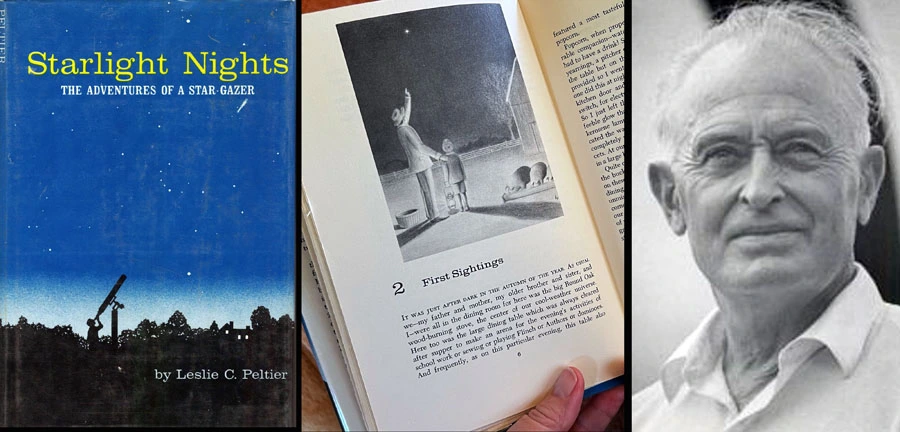
Bob King; Peltier image courtesy of the AAVSO
The late Leslie Peltier inspired me to observe variable stars. He penned Starlight Nights, one of the most eloquent books ever written about what it's like to be an amateur astronomer. Love for the night sky and its inhabitants — comets and variable among them — flows from every page. Peltier was a consummate amateur, discovering a dozen comets and contributing more than 132,000 variable star observations before his passing in 1980. Although the book is out of print, you can still get a copy on Amazon and Abebooks.
In the first chapter, Peltier describes an exceptionally transparent fall night and summarizes what he observed that evening through his 12-inch refractor:
"Tonight I glimpse an old and now long-quiescent nova at slightly below sixteenth magnitude and then I faintly glimpse a recently reported outburst of another star in a stellar universe far removed from ours. My next effort is even more successful as I watch a close pair of faint pulsating stars in Cassiopeia sparkling side by side [italics are mine] as sharp and distinct as two tiny diamonds set against the velvet of the sky."
Although we don't know the date the Ohio amateur scanned the sky that long-ago, fall night, we do know that it happened sometime after July 1959 — when he received a phone call from Miami of Ohio University offering to gift him their 12-inch — and 1963, during the time he was writing the book. We also know he observed the pair in October because earlier in the chapter Peltier describes seeing Vega that evening half a year after its April rising.
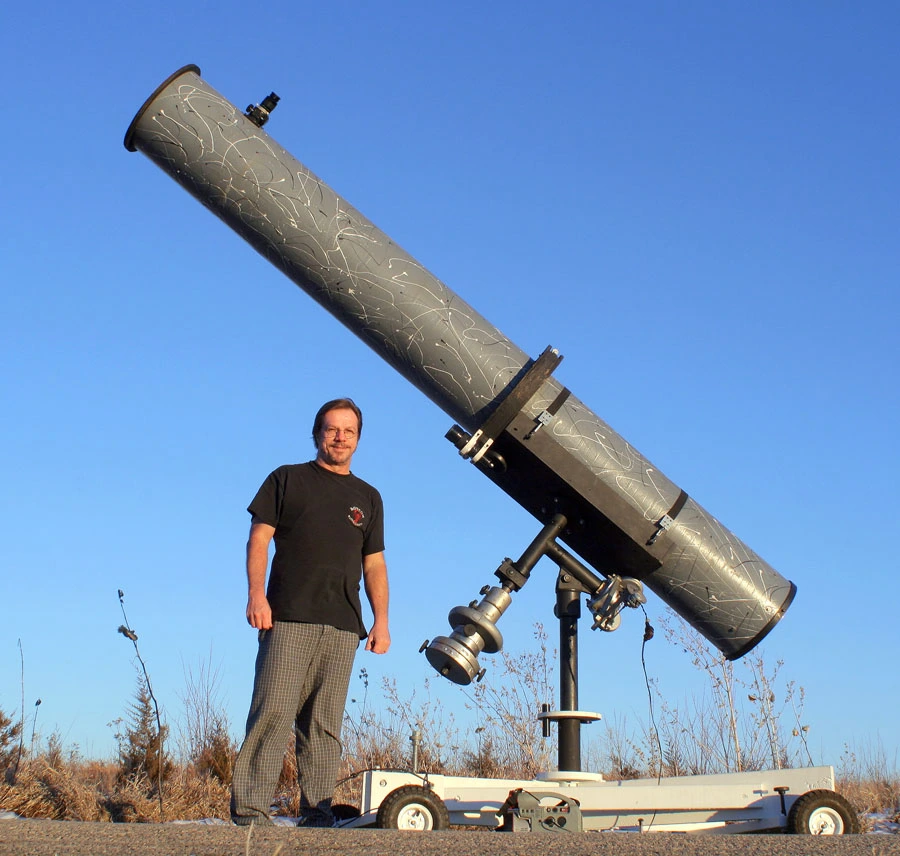
Courtesy of Doug Zubenel
But what about those tiny diamonds? Enter Doug Zubenel, formerly Doug Brown, an accomplished amateur astronomer living in De Soto, Kansas with a deep affection for Peltier's writings. He's a regular contributor to Sky & Telescope and Astronomy magazines and likely has the record for the number of times he's read Starlight Nights — somewhere between 40 and 50 times!
If his last name rings a bell, it should. When Doug remarried, he and his wife decided to pick a new family name. He jokingly suggested Zubenelgenubi — also known as Beta (β) Librae — and she approved. The couple shortened the multi-syllabic moniker to the more manageable Zubenel. For years, Zubenel had wondered about the identity of Peltier's "tiny diamonds". Then in 2016, he had an aha moment, when he realized he could plumb the entire archive of variable star observations on the American Association of Variable Star Observers' (AAVSO) website.
"After I discovered that I could look at anyone's observations from any year and figured out that Leslie's ObsCode [Observing Code] was "P," PRESTO — I was looking at Leslie's digitized variable star observations!!," said Zubenel.
Parsing 132,000 estimates would have been a formidable task. Zubenel narrowed his search by starting in January 1959 several years before the book was published. If nothing turned up, he would expand the search backwards in time until he hit "pay dirt," an expression Peltier was fond of.
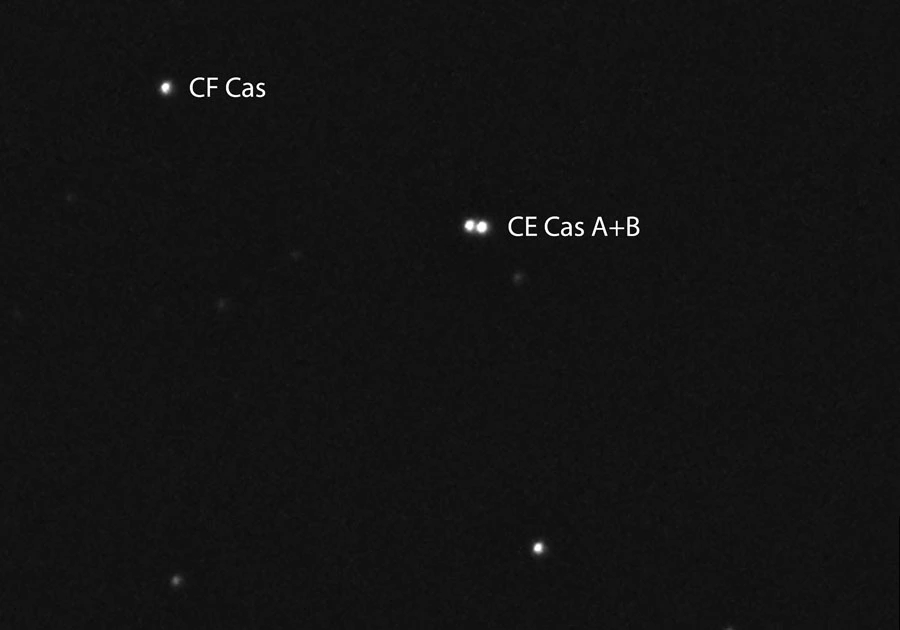
"So, that was when I decided I would look at ALL of his estimates between January 1st of 1959 and December 31st of 1962," said Zubenel. " I figured I could expand the bracket if nothing turned up. Well, 2,537 observations and just 30 minutes in, I spot CE Cas A and CE Cas B. I was initially puzzled — how could two different pulsating variable stars have the same designation of CE Cas? Well, the answer, of course, was staring right at me . . . A and B!! Kind of like double and multiple star component designations."
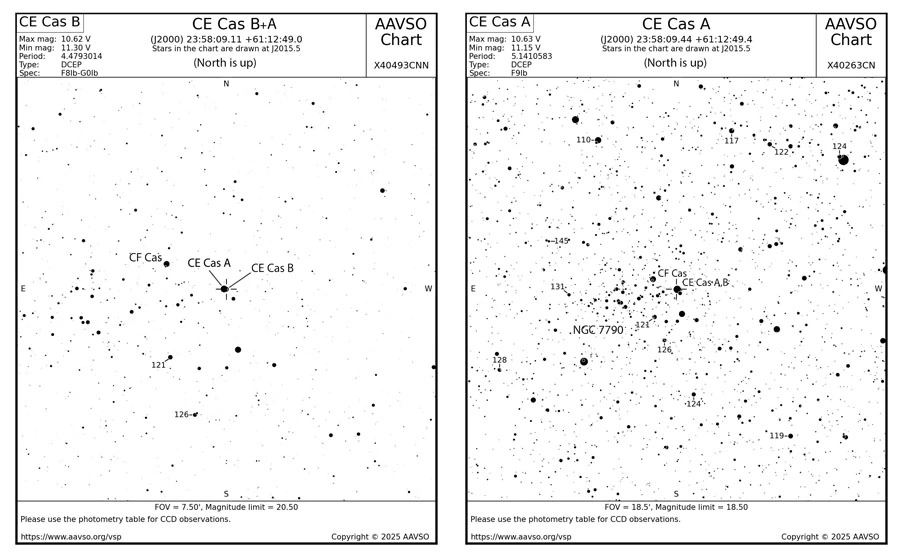
The Kansas sleuth next looked up a chart for the pair and saw that their positions were almost identical, indicating a very close pair. Indeed CE Cas A and CE Cas B are both classical pulsating Cepheid variable stars like Delta Cephei. Could they be the putative pair described by Peltier?
"Imagine how I felt seeing this!," said Zubenel. I quickly decided to then search ALL the years Leslie observed this double-cepheid, and it turned out the observations from 1961 were the ONLY ones!! I had my first look some time in October of 2016, and my view matched Leslie's description, except I couldn't split them. Later on, just before dawn when Cassiopeia was high in the NW sky, I had great seeing, and easily split them at 353x."
After Doug shared his story with me I asked around and posted in variable star groups to see if anyone knew the identity of the suspected pair. Of those who responded, none did.
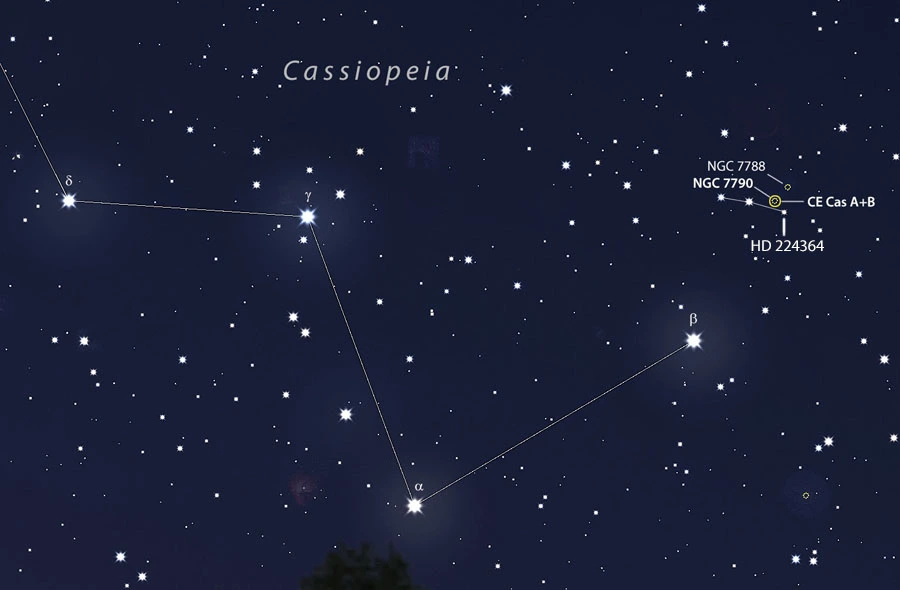
Stellarium with additions by Bob King
Of course, we can't be absolutely certain of their identity unless someone with direct knowledge of Peltier's observation confirms it. (Do let us know!) But Zubenel's pair seems to fit the bill. They're close. They're pulsating stars visible in the fall, and most importantly, we know Peltier observed the pulsating pair in exactly the right time frame to have included them in his book. According to AAVSO data, he submitted observations of both CE Cas A and CE Cas B in the year 1961 (and only that year), observing both 13 times in the month of October.
Further, Zubenel identified V476 Cygni as a possible candidate for the "now long-quiescent nova" also described by Peltier. The Ohio amateur had followed the nova since its eruption in 1920. By the early 1960s its magnitude hovered around 16.2, exactly as described. I checked on a possible supernova candidate for the third object in the passage and hit on 1961V in NGC 1058 in Perseus. In October 1961 it shone dimly at magnitude 14, but later surged to 12.5 in early December.
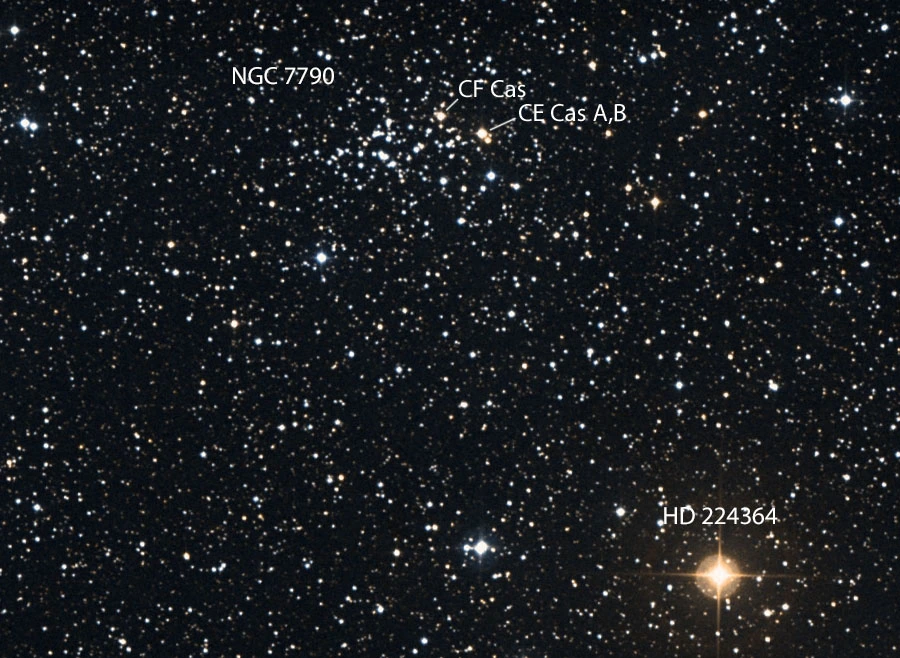
DSS2, Aladin Star Atlas
Once learning of Doug's detective work, I couldn't wait to get my eyes on the duo. The next clear night I stayed up late waiting for Cassiopeia to climb up the northeastern sky. It turns out that the pair is a true (physical) double star and also a member of NGC 7790, a moderately rich, 8.5-magnitude open cluster located 2.5° northwest of Beta (β) Cassiopeia.
I quickly spotted the pretty bunch at 64x in my 15-inch Dob. The fainter members bunch up along the cluster's east side, while CE Cas, along with two other 11th magnitude stars, bracket its western border. CE Cas sits in the middle and is the brightest of the trio.
At magnifications below 150x it looks like a single star. But upping to 266x and (especially) 400x, two exquisite, equally bright gems separated by just 2.5″ blossomed into view. Wow! Amazing to think that my original mentor passed this way back in '61. Equally incredible — I was looking at two Cepheids in orbit about each other. I attempted to estimate their magnitudes just as Peltier once did, but being so squeaky tight, the challenge was too much for my tired eyes at the time.
I want to thank Doug for his tireless work in pursuing the stars' identities and sharing the story. A second thank you goes to Tom Wildoner for his superb close-up of the pair. If nothing else, the sight of these two "beating hearts," both far more massive and luminous than the Sun, show us how a nagging question can take one on a quest to something wondrous.
About Bob King
I love the sky (day and night) and have been a skywatcher and amateur astronomer since childhood. I'm also a long-time member of the American Association of Variable Star Observers (AAVSO) and Astronomical League. I pen the Astro Bob blog and have written four books: Night Sky with the Naked Eye (2016); Wonders of the Night Sky You Must See Before You Die (2018) and Urban Legends from Space (2019) and Magnificent Aurora, published in 2024. The universe invites us on an adventure every single night. To accept the invitation, we only need look up.


Comments
Anthony-Mallama
August 21, 2025 at 10:51 pm
The word “eloquent” describes Starlight Nights perfectly. The book describes an amateur astronomer’s dream that came true. After its publication in 1965 there was a gathering at Mr. Peltier’s house. I was honored to meet him and he signed my copy of the book. Thanks for this great article, Bob.
You must be logged in to post a comment.
Bob KingPost Author
August 23, 2025 at 5:49 pm
Thank you, Anthony. I couldn't have done it without Doug Zubenel's essential contribution. I would have loved to have met Leslie, but I'm happy to have known him through his lucid writing.
You must be logged in to post a comment.
OwlEye
August 25, 2025 at 12:24 pm
Hi Bob,
I wanted to thank you again for your help and writing to bring this information to light.
A few words to your readers. If any of you have not heard of Leslie Peltier, or not read his beautiful anthem to amateur astronomy, "Starlight Nights: The Adventures Of A Star Gazer," I strongly encourage you to do so. It just might change your life! Bob has provided links above to places you might buy a copy. I would also implore Sky & Telescope and AAS Sky Publishing to consider reprinting it!
On a final note, I would strongly urge you all to get out there, have a look at CE Cas A + B, and decide for yourself if this pair of Cepheids fits Leslie's description. I would love to hear from anyone who does observe this pair and get their impressions, and would also throw out a challenge: What is the least aperture and/or magnification you can use and still cleanly split them?
Regards,
Doug Zubenel
[email protected]
AAVSO
TWAN
You must be logged in to post a comment.
Bob KingPost Author
August 26, 2025 at 11:51 pm
Hi Doug,
My pleasure! And CE Cas A+B is a nice addition — sprinkled with history — to the amateurs' double-star pantheon.
You must be logged in to post a comment.
OwlEye
August 27, 2025 at 7:54 pm
Hi Bob,
Well, I believe your readers need to know that the article you posted here in S&T back in April of 2016 about T Coronae Borealis possibly getting ready to go nova inspired me to re-join the AAVSO, and in their amazing database I uncovered CE Cas A + B. I doubt it would have happened otherwise!
DZ
You must be logged in to post a comment.
Alan MacRobert
August 27, 2025 at 3:32 pm
Doug,
The book changed my life too. Or at least helped to. At age 15 in 1966 I came across it in the astronomy section of the Newton, Mass., public library. I was a new amateur astronomer and was totally enthralled. I think it helped keep me going. And here I am now after being a Sky & Telescope editor (now semi-retired) for 42 years.
Alan MacRobert
You must be logged in to post a comment.
OwlEye
August 27, 2025 at 7:47 pm
Alan,
No surprise to me, that book will do it! I was 11 in the fall of 1968, and became an amateur astronomer on the morning of November 17th when I accidentally witnessed the Leonid meteor shower. A little over two years later, I read Lloyd Mallan's, "Exploring Space With Astronomy," and he quoted a man named LCP from Delphos, Ohio. I was in southern CA at the time, but was from Delphos! It was for me, as I described it to Bob on the phone, "a tectonic shift." Then I find out a few months later that we would be moving back to Delphos!! He was still living, and I found out he had written a book. The first chapter of SN spoke to me in a way wholly new, and at the same time, very familiar!
I miss him to this day.
DZ
You must be logged in to post a comment.
Tom-Laskowski
August 25, 2025 at 1:01 pm
A number of years ago my friends and I were returning home from the Apollo Rendezvous in Dayton, OH when we passed through Delphos, OH. On a whim we decided to see if we could find the house in town where he lived.
A quick stop at a pay phone and search through the phone book (remember those?) we came up with a possible address. Somehow we quickly found the house and saw the observatory in the large yard. We also saw a woman doing yardwork so we stopped and asked her if we could take some pictures of the observatory. She replied "why don't you knock on the door and ask Mrs. Peltier".
Mrs. Peltier still lived in the house and she answered the door. Even though we were complete strangers to her she invited us into her living room and we sat and talked to her for a good half-hour. She was somewhat reluctant to let us photograph the observatory due to its condition but let us do so. What a great memory!
Starlight Nights would be one of my "Desert Island" books along with a star atlas (and binoculars).
You must be logged in to post a comment.
Bob KingPost Author
August 26, 2025 at 11:17 am
Hi Tom,
That's a great story with an unexpected punchline! Thanks for sharing it.
You must be logged in to post a comment.
OldDogZeroOne
August 31, 2025 at 9:45 pm
Just a short comment about Starlight Nights. My father never really had been able to understand my fascination with stars and astronomy. I gave him SN to read. After reading the book, he told me "I get it now". Dad has been gone for 40 years now, but I still feel that he approved of his son's unusual hobby after reading that book!
You must be logged in to post a comment.
Bob KingPost Author
September 1, 2025 at 1:39 am
OldDog,
That says a lot about how well Peltier communicated the message. Thanks for sharing it.
You must be logged in to post a comment.
You must be logged in to post a comment.