 SUNSET:

 3
3Spain’s offer to host the powerful observatory, mired in funding obstacles and local controversies, might promise a new path forward.
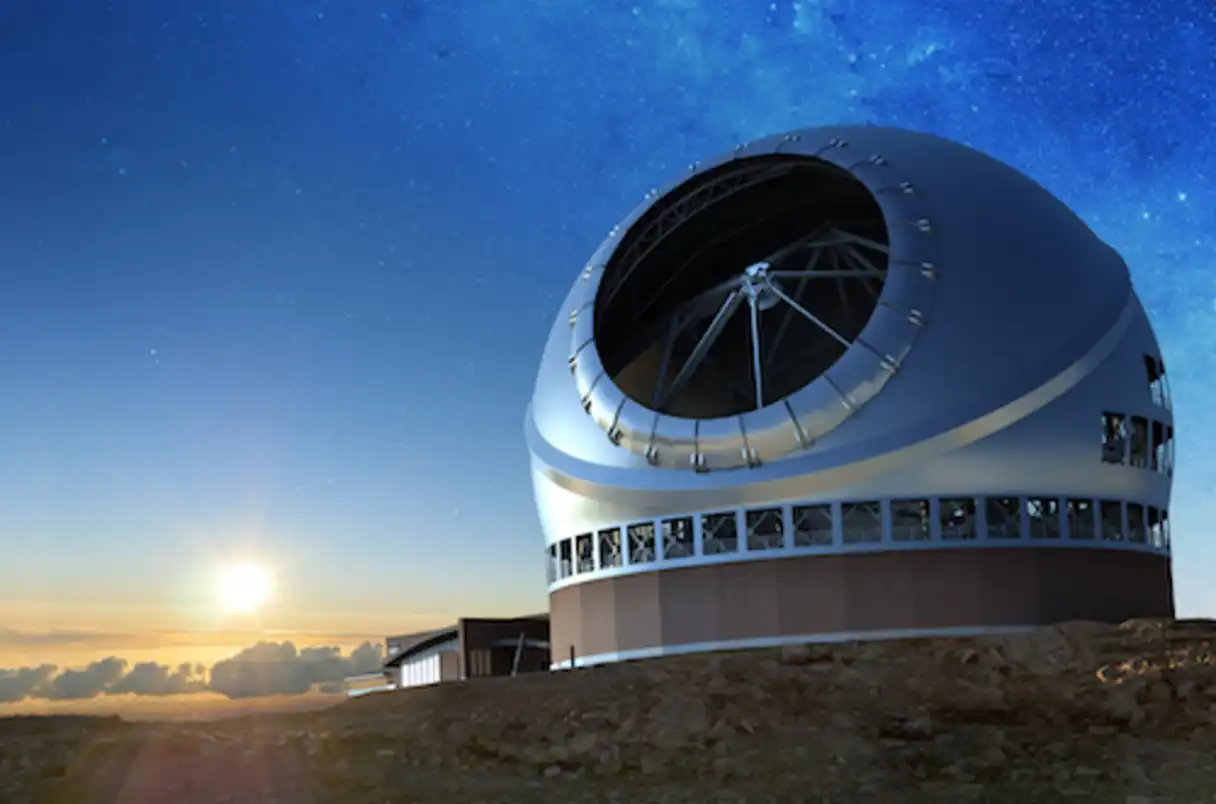
The Thirty Meter Telescope International Observatory
The Thirty Meter Telescope (TMT) was conceived more than two decades ago as the largest and most advanced telescope in the Northern Hemisphere. However, the telescope has encountered significant roadblocks, from funding uncertainties — now heightened by President Trump’s proposed budget cuts — to local resistance to building the telescope on Mauna Kea, a volcanic mountain in Hawai‘i that’s sacred to native communities.
Now, the telescope might find a new home in La Palma on the Canary Islands of Spain. In July, the Spanish government offered to host the telescope, with an investment of up to €400 million ($460 million) to help cover some of the costs. In a brief statement posted on November 11th, the TMT announced that it is officially considering the move to La Palma.
While the observatory’s governing members are still in active discussions, the offer “represents a prospective opportunity to allow [the TMT project] to proceed,” the statement reads. With Spanish officials, the TMT staff plans to develop “a detailed roadmap toward the potential realization of the TMT” at Roque de los Muchachos Observatory on La Palma.
“Spain wants to be, and can be, the headquarters for the future of astronomy and astrophysics,” said Diana Morant, the Spanish Minister of Science, Innovation, and Universities, when she announced the offer back in July. “We have the capacity and the political will to do so.”
A Struggle for Funding
The TMT, along with Europe’s Extremely Large Telescope (ELT) and the U.S.-based Giant Magellan Telescope (GMT), is part of the next generation of megatelescopes, powerful observatories with mirrors the size of baseball diamonds that will survey the sky with up to 200 times more power than current ground-based telescopes. As the only one of these located in the Northern Hemisphere, the TMT will serve as a natural counterpart to the GMT and ELT, both currently being built in Chile.

US-ELTP (TIO / NOIRLab / GMTO)
Astronomers are interested in these extremely large telescopes for a reason — their large, segmented mirrors will collect more light, while advanced adaptive optics techniques correct for atmospheric fluctuations in real time. These powerful instruments will investigate key scientific questions from dark matter and cosmology to exoplanets and the search for life.
But these investments don’t come cheap — the GMT will cost around $2.5 billion, and the TMT is now costing astronomers $3.9 billion. The projects are supported by wealthy institutions and global partners, but they require federal funding to cross the finish line.
But in 2024, an NSF panel found that even funding one extremely large telescope would strain their budget. Then in May, Trump budget cuts slashed the NSF budget by 56% percent, and with not enough money to go around, the NSF chose to back the GMT.
It was a devastating blow to the TMT, and one that prompted Spain to step in. “Faced with the risks of this major international scientific project coming to a standstill, the Spanish government has decided to act,” Morant said, “with a redoubled commitment to science and major scientific infrastructures for the benefit of global knowledge.”
A New Home in Europe
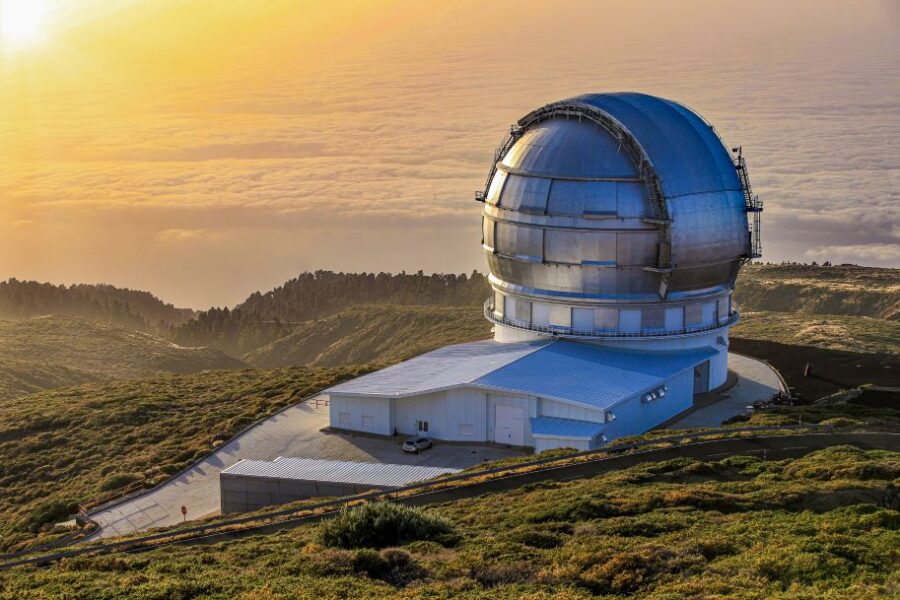
Christian Offenberg / Dreamstime.com
The Canary Islands are no stranger to astronomical observatories. Roque de los Muchachos Observatory hosts more than 20 astronomical telescopes and instruments already, and the Spanish government had already expressed interest in hosting the TMT on La Palma back in 2019, when years of protests had halted construction in Mauna Kea.
In terms of site location, however, Mauna Kea has an edge. The volcanic mountain has a high altitude, with less air for telescopes to peer through; clear nights; and a cold, dry atmosphere with less water vapor to absorb light at infrared wavelengths. A 2016 survey of alternative sites found that La Palma would be the next-best fit for the TMT; however, given its lower altitude and warmer, wetter climate, astronomers would have to observe for 16-19% longer on average.
“Mauna Kea is slightly better, and when you’re trying to decide where to put a 30-meter telescope, small improvements matter,” says Paul Robertson (UC Irvine), an astronomer whose research focuses on discovering exoplanets that might host life. However, he emphasized the importance of building a telescope no matter what, and especially building one in the Northern Hemisphere. “I would hate to cut our chances of finding the right planet in half by not having TMT in the north.”
While the TMT’s woes started long before the Trump-era funding cuts, the move is indicative of a larger shift of scientific resources away from America as a result of these uncertainties. “I hear almost every day of targeted efforts to recruit American scientists, and of colleagues moving to Europe,” says Tommaso Treu (UCLA), who serves as deputy chair of the TMT’s Scientific Advisory Committee. “The funding and environment for science in Europe is just incredibly more favorable than in the US at this time.”
Morant’s original statement reaffirmed this shift: “While some countries are cutting investments in science and even denying its existence, Spain is a haven for science, a home for scientists seeking to advance and develop their projects,” she said. But American astronomers at TMT-affiliated institutions would remain involved in the TMT no matter where the telescope is located, given that the U.S. institutions have already made “substantial technical and financial contributions to TMT,” says TMT Executive Director Robert Kirshner.
While American astronomers are not giving up on scientific research in the U.S., collaboration with Spain could offer more opportunities. “Collaboration does not mean compromising scientific leadership,” Treu says.
The Trouble with Hawai‘i
The path to building the TMT hasn’t been easy, and astronomers may continue to grapple with the environmental and cultural impact of their giant telescopes. It’s worth noting that a Canary Islands environmental group, Ben Magec-Ecologists in Action, has historically opposed the building of telescopes on La Palma, including the TMT, arguing that they disturb natural biodiversity and archeological sites of aboriginal Canary Islanders. The TMT may well have to contend with a similar backlash, though no significant opposition has yet emerged compared to the Hawaiian site.

Babak A. Tafreshi
The Protect Mauna Kea movement, which aims to raise awareness of the mountain’s spiritual significance and prevent the TMT’s construction, tentatively supports the telescope’s relocation. “If the people of La Palma have no objections, that option will be supported from here,” a post on their Instagram reads. “However, the stance has always been ‘not on our mountain,’ without advocating for it to go to a place where the people of that land object to it.”
An independent risk assessment report in 2007 highlighted potential challenges in building on Mauna Kea, due to the mountain’s revered status and historic disregard of native Hawaiian perspectives. “Potential funders and supporters of the project must be prepared to be extremely patient and pay a premium in social, political, and legal transaction costs,” the report states. “There are serious risks to TMT’s proposed schedule.” As those risks became a reality over the last decade, La Palma may well promise a new path forward for the beleagured observatory.
About Arielle Frommer
Arielle Frommer has been writing for Sky & Telescope since April 2024. She covers news stories ranging from newly-discovered exoplanets to local astronomy events. She is a recent graduate of Harvard University, where she obtained her bachelor's degree in Astrophysics and Physics and researched massive star formation and exoplanets. Arielle is currently studying extrasolar atmospheres at Leiden Observatory in the Netherlands. In her free time, she enjoys hiking, crocheting, drinking coffee, and reading and writing fiction.



Comments
Lawrence-Faltz
November 25, 2025 at 5:41 pm
Maybe Pele and the other Hawaiian deities actually like the idea of the telescope. How do the protestors know that they don't?
You must be logged in to post a comment.
Antonio-Soffici
November 29, 2025 at 12:13 am
Because it’s always the same with religious bigots: their made up gods always say what their inventors want them to
You must be logged in to post a comment.
mxyzptlk
December 1, 2025 at 4:27 am
The Protect Mauna Kea group have forfeited any perceived right to an opinion on the TMT project's adoption by Spain. The silly superstition of the Hawaiians has made them pariahs. Good riddance at last.
You must be logged in to post a comment.
You must be logged in to post a comment.