 SUNSET:

 2
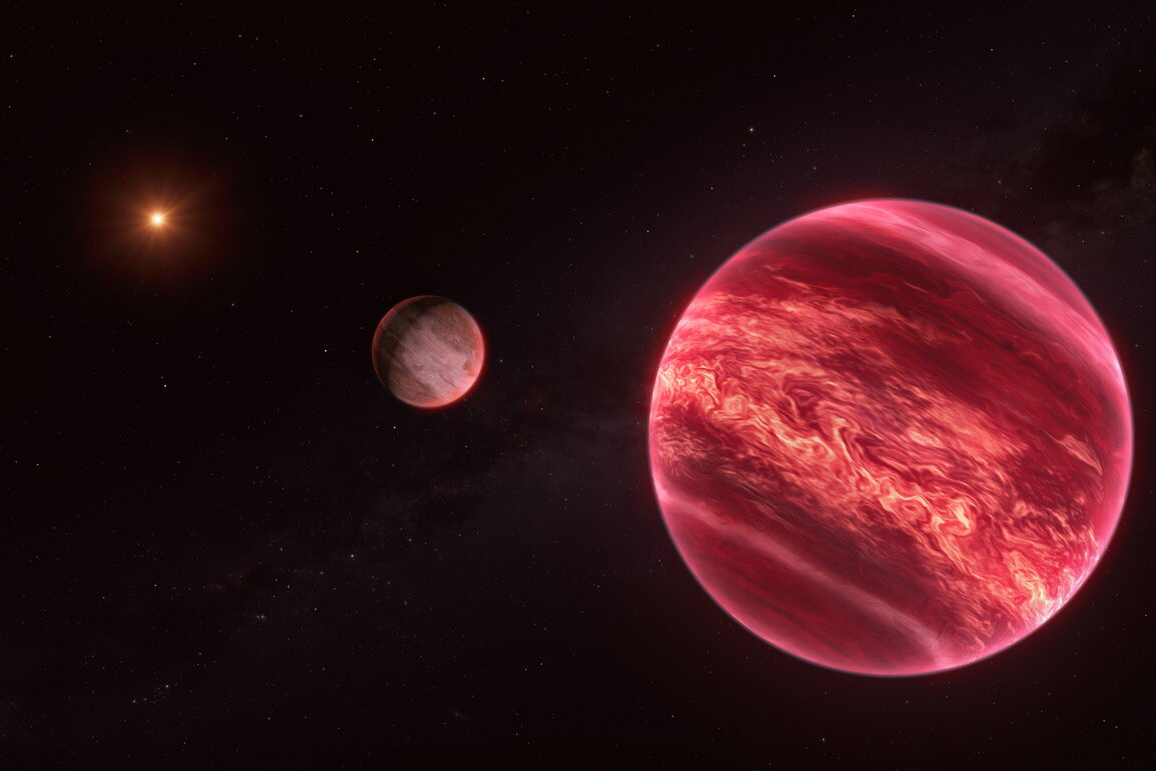
2A team of astronomers has obtained high-resolution images of all known protoplanetary disks in the Lupus star-forming region.

ESO / L. Calçada
Most protoplanetary disks are small and will spawn compact systems of so-called super-Earths according to a comprehensive survey carried out with the Atacama Large Millimeter/submillimeter Array (ALMA) in northern Chile.
Protoplanetary disks are flattened, rotating disks of gas, dust, and pebbles surrounding newborn stars. Over time they evolve into full-grown planetary systems. Most disks studied in detail so far are large, with radii of hundreds of astronomical units (1 au is the average distance between the Sun and Earth, about 150 million kilometers). Many show concentric gaps, indicating that giant planets may already have formed and swept up material along their orbits.
An international team of astronomers has now obtained high-resolution images of all known protoplanetary disks (73 in total) in the Lupus star-forming region, just 400 light-years away. Until now, only brightness measurements had been available for most of them, says team leader Osmar Guerra-Alvarado (Leiden University, The Netherlands).
The observations were carried out at a short wavelength of 1.3 mm with the 66 ALMA antennas in their widest configuration, yielding an unprecedented spatial resolution of just 0.03 arcsecond. Two-thirds of the Lupus disks — in general the ones around low-mass stars — turned out to have radii smaller than 30 au, the radius of Neptune’s orbit. Some measure just 10 au across; the smallest would even fit inside Earth’s orbit. “We knew most of the disks would be small,” says Guerra-Alvarado, “but we didn’t expect the majority to be that small.”
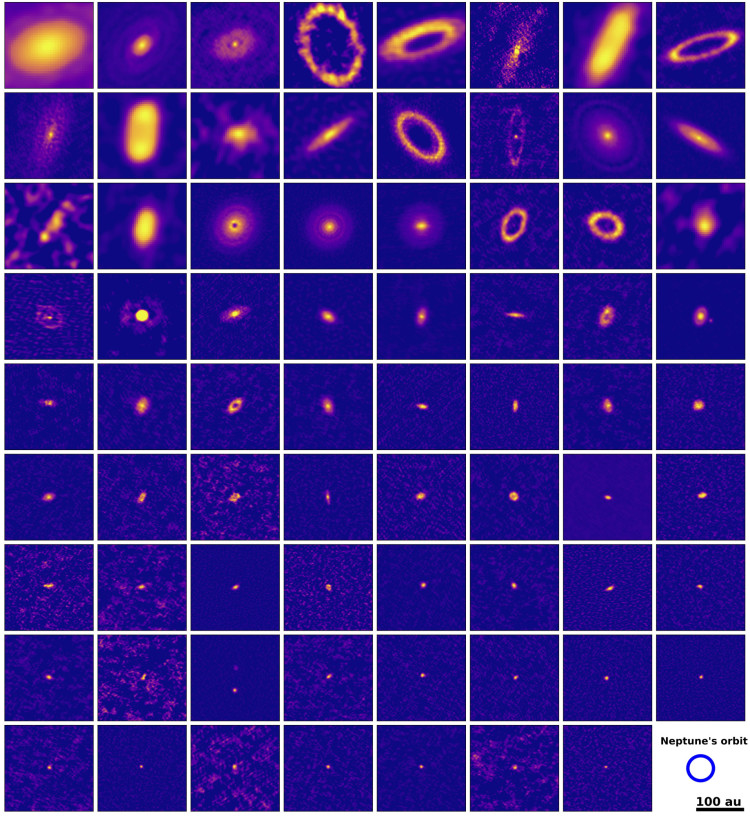
O. Guerra-Alvarado et al. / NOVA
The new results, accepted for publication in Astronomy & Astrophysics, also reveal that the smaller disks lack conspicuous substructure like the concentric rings and gaps seen in many larger systems. According to the authors, these disks probably are not massive enough to form giant planets. As a result, dust can keep drifting inward, accumulating closer to the star. “These compact disks provide optimal conditions for the formation of super-Earths,” says team member Mariana Sanchez in a press release from the Netherlands Research School for Astronomy (NOVA).
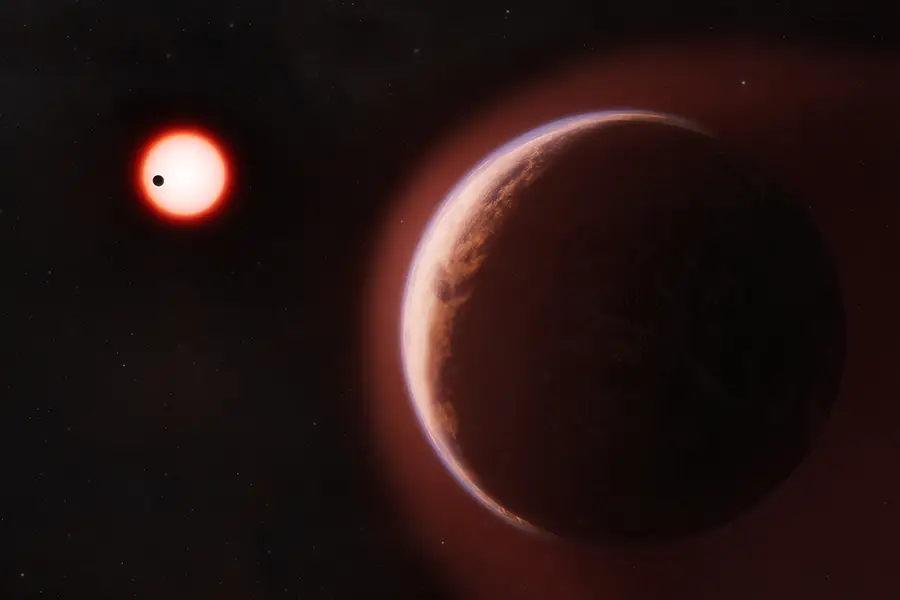
Super-Earths — rocky planets about twice as large and up to 10 times as massive as Earth — are among the most common planets in the universe. By studying a complete sample of protoplanetary disks in one star-forming region, it is now possible to draw a comparison to the known exoplanet populations, says Guerra-Alvarado.
In many cases, the ALMA data suggest “that the bulk of the pebbles may have already been converted into boulders or even planets,” the authors write. Indeed, the dimensions of the central cavities found in a number of disks are compatible with those of the many compact planetary systems discovered by recent surveys.
“This is an important study,” comments Carsten Dominik (University of Amsterdam), who was not part of the team. Dominik stresses that our own solar system may be something of an outlier, since we do not have any super-Earths — most likely thanks to the formation of giant planets that prevented most of the mass in the original protoplanetary disk from drifting inward. The new study “gives a view into the small disks, which are the most numerous ones,” says Dominik, “and therefore into the ‘standard evolution’ of a planetary system.”
About Govert Schilling
Sky & Telescope Contributing Editor Govert Schilling lives in The Netherlands but loves to explore his home planet. In May 2022, Harvard University Press published The Elephant in the Universe: Our Hundred-Year Search for Dark Matter. His latest book is Target Earth - Meteorites, Asteroids, Comets, and Other Cosmic Intruders That Threaten Our Planet.



Comments
Daniel Crowe
March 30, 2025 at 7:31 pm
The figure caption says, "Images of all 73 protoplanetary disks;" however, there are only 71 images. Do one or two of the images contain more than one protoplanetary disk? I'm not seeing the other two disks.
You must be logged in to post a comment.
Monica Young
April 7, 2025 at 12:58 pm
Good catch! You're of course right about the image and I've corrected that caption. Interestingly, the paper likewise refers to 73 disks total but only shows 71 disks in Figure 1 (as well as close-ups of 33 disks in Figure 2): file:///Users/youngm/Downloads/Guerra-Alvarado-et-al-2025.pdf. I've only glanced quickly at the paper but didn't find an explanation for the discrepancy.
You must be logged in to post a comment.
You must be logged in to post a comment.