 SUNSET:

 2
2Now that Comet 3I/ATLAS has emerged from the Sun’s glare, its behavior is being monitored by every available observatory.
Now that it’s back in view after having been hidden behind the Sun, interstellar Comet 3I/ATLAS, only the third known object to have come from outside the solar system, is being intensely observed by telescopes around the world as well as in near and distant space.
NASA Results Released
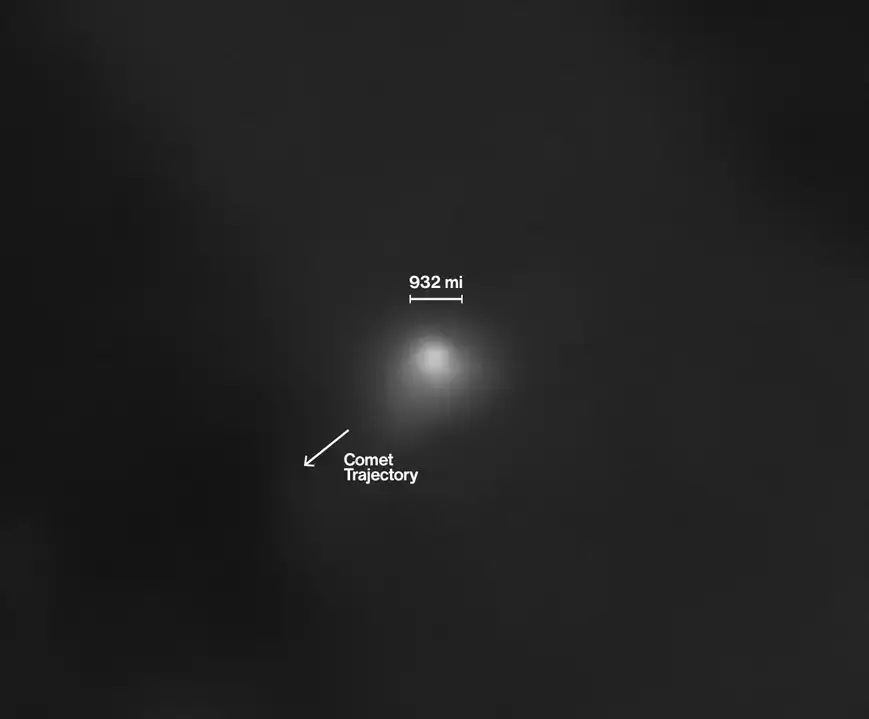
NASA / JPL-Caltech / University of Arizona
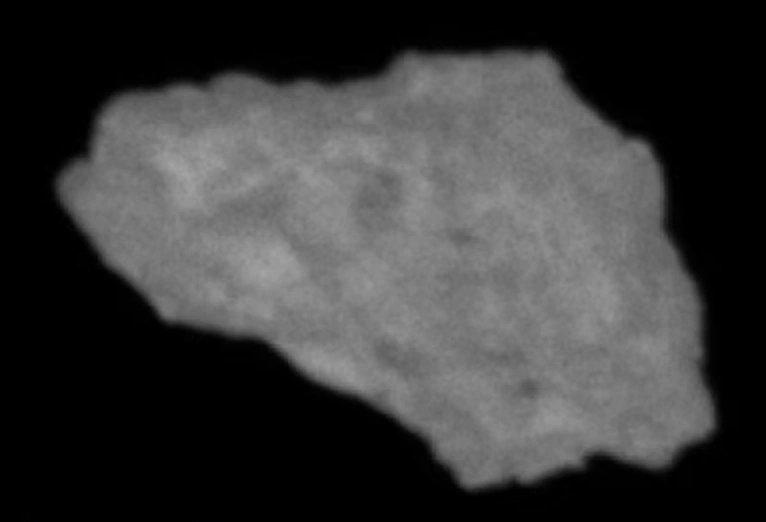
On November 19th, NASA released the highest-resolution images of the comet around the time of perihelion yet — those taken by the half-meter telescope on the Mars Reconnaissance Orbiter.
“Boy, were they ready for this event!” said Nicky Fox (NASA), associate director of NASA’s Science Mission Directorate. She spoke at a press conference announcing the results of observations from at least 20 different instruments in space and on Earth, which “pushed our science instruments beyond their normal capabilities.”
Carrying out these observations from various spacecraft — looking from different vantage points in Earth orbit, Mars orbit, or traveling between planets, was like having various people in a baseball stadium all trying to take pictures of a ball in flight with different cameras, a tricky feat of coordination and precision aiming, said Tom Statler, Lead Scientist for Solar System Small Bodies in NASA’s Planetary Science Division.
Any object that we discover from outside the solar system “is a new piece of the puzzle,” Statler said, in terms of understanding how planetary systems form and develop. They are like “frozen fossils,” he said.
The long-awaited images from the Mars Reconnaissance Orbiter’s High Resolution Imaging Science Experiment (HIRISE), whose release was delayed due to the government shutdown, can now be used to refine the size of the comet’s nucleus. Results will have to await further analysis, according to scientists at the press conference. Meanwhile, images taken by the Mars Atmosphere and Volatile Evolution (MAVEN) spacecraft, also at Mars, “truly are incredible,” said Shannon Curry (University of Colorado, Boulder) in a NASA release.
Fox noted at the press conference that all data will be publicly available: “We make a big effort not just to release the data, but also to make sure it’s usable, so you can get the tools and things to actually analyze the data as well. And we invite everyone to look at this comet with us.”
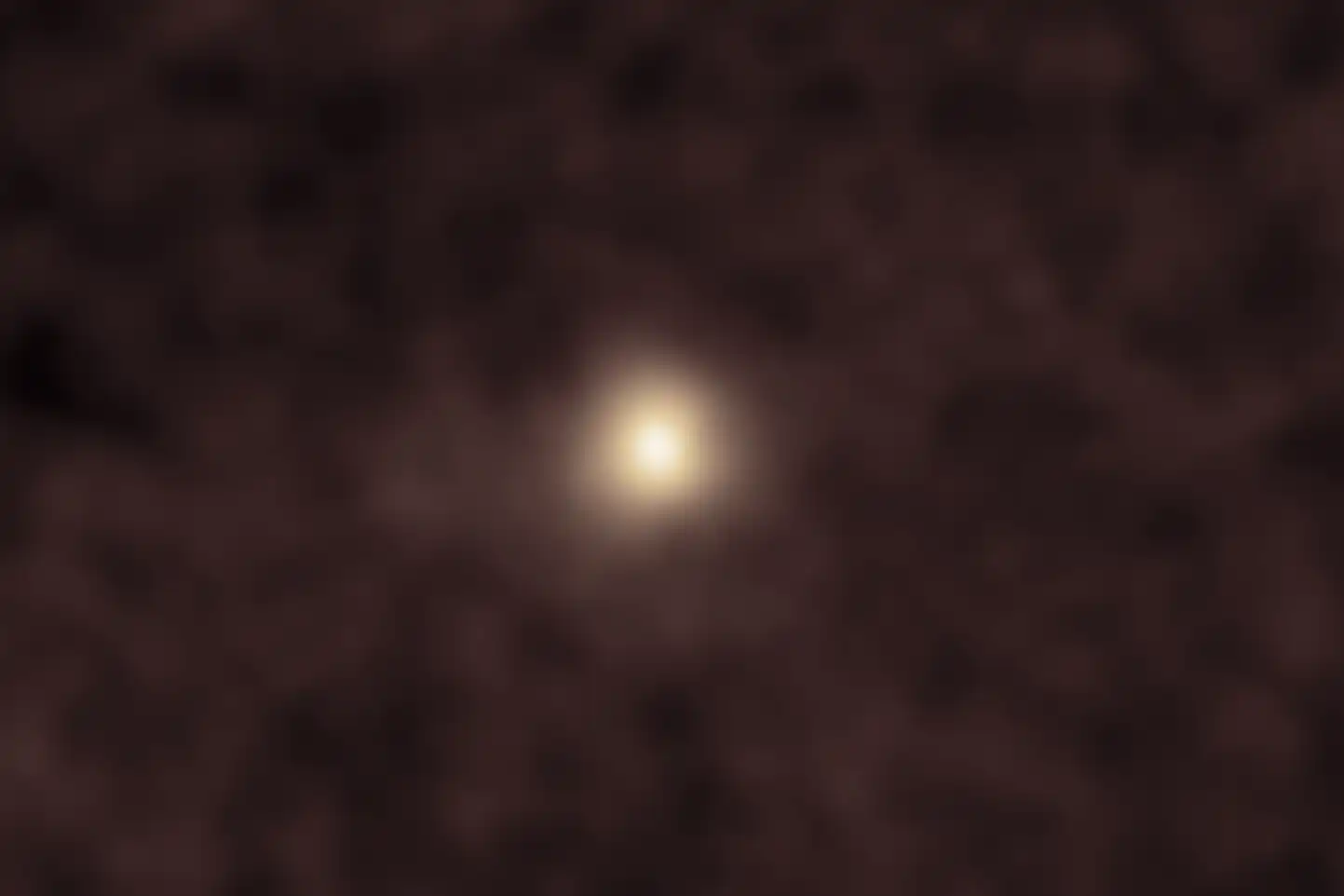
Lowell Observatory / Qicheng Zhang
The object has attracted widespread attention, with non-astronomer celebrities ranging from Elon Musk to Kim Kardashian being asked, and offering, their opinions about it. Meanwhile, real data is continuing to pour in, and we’re learning more and more about the nature of this unique object.
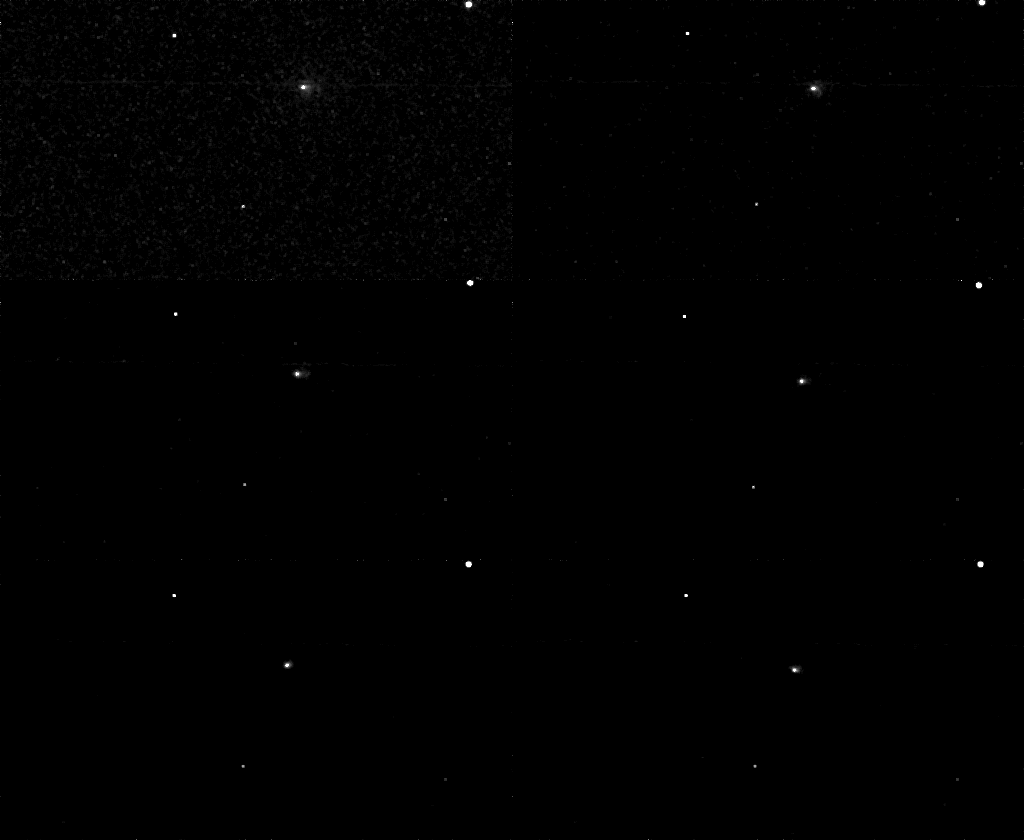
The European Space Agency’s ExoMars Trace Gas Orbiter obtained images between October 1st and 7th that, in a new result released last week, provide the most detailed fix yet on the comet’s exact position. The calculated trajectory improved on previous determinations by a factor of 10, thanks to the triangulation between observations from Earth and those from Mars. The improved positional accuracy should help in allowing future observations to be aimed more precisely.
Incoming: Comet Approaches Earth
The comet is nearing its closest approach to Earth on December 19th, when it will be 1.8 astronomical units (270 million km) away. Now that it’s emerging from the Sun’s glare, amateur astronomers around the world have been taking the lead in monitoring its evolving tail, since it’s still too close to the Sun for major observatories to risk pointing at it. On Tuesday night, the nonprofit Virtual Telescope Project, based in Italy, hosted a live webcast of observations of the comet through a 10-inch remotely operated telescope.
While there has been much public attention to suggestions by Avi Loeb (Harvard University) that the object could possibly be alien technology, virtually all astronomers see no need to invoke such an explanation to account for the comet’s characteristics.
“It’s doing the things comets do,” says David Jewitt (UCLA), a longtime observer of comets and asteroids. One of these things is the display of an anti-tail that points toward the Sun instead of away from it. But such tails, while unusual, have a ready explanation.
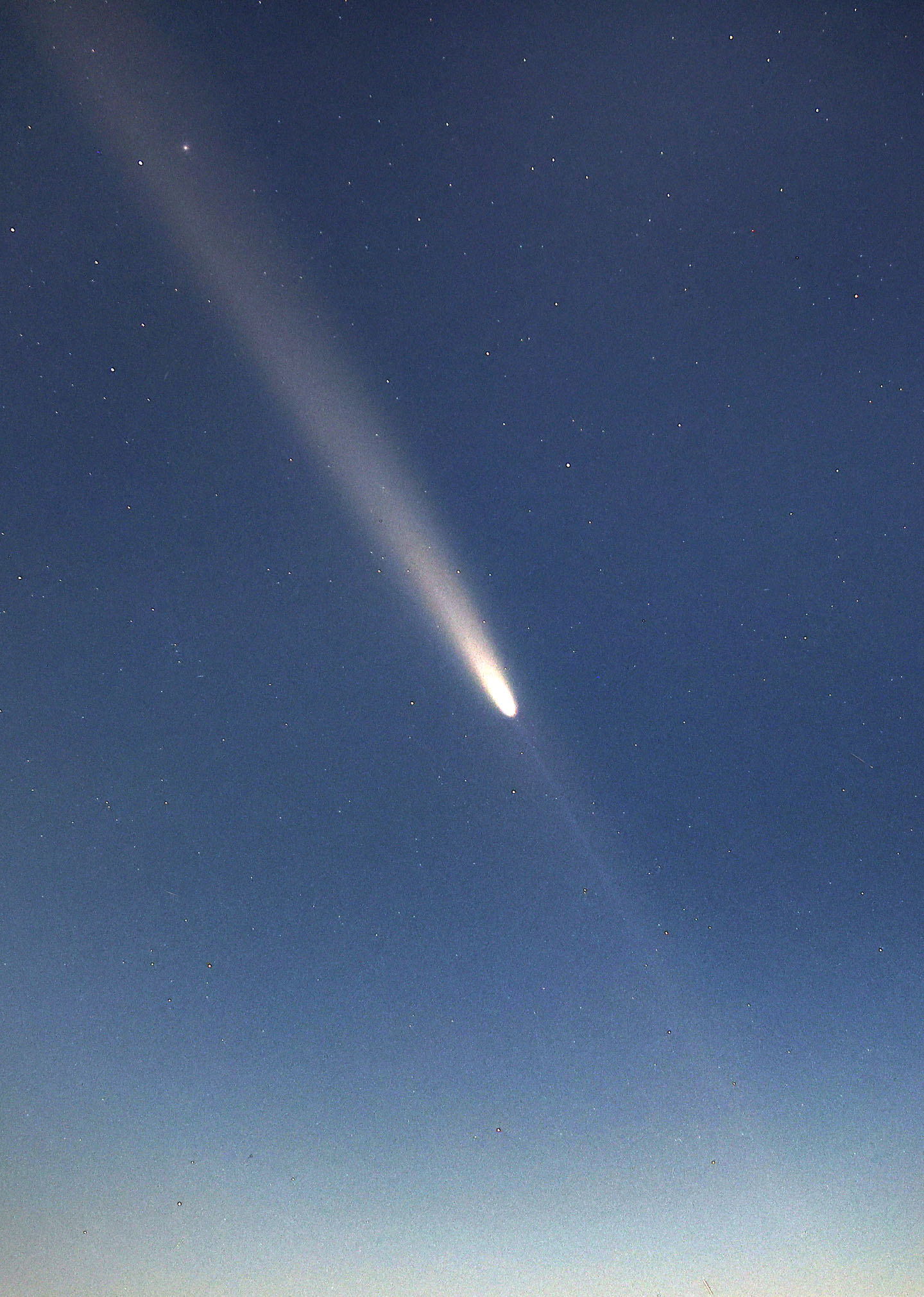
Bob King
“It’s ejecting dust particles towards the Sun, because the day side of the nucleus is the hot side,” Jewitt explains. These particles tend to be large, so they are only slowly affected by the Sun’s radiation pressure. Eventually that pressure will push them into a tail that points away from the Sun, but their slow motions mean that right now they are still directed toward the Sun. Judging by the extent of the anti-tail, Jewitt estimates they must be about 100 microns across, making them “100 times bigger than what people often assume to be the size of dust particles in comets,” he says.
Amateurs have also captured fantastic images showing multiple tails spouting off the comet. “All these things are consistent with a comet nucleus of typical size or smaller, sublimating in sunlight and blowing out dust particles,” Jewitt adds. “Nothing really shocking there.”
How Unusual Is Comet 3I/ATLAS?
There have also been claims of possible non-gravitational acceleration. That’s common for comets, but the first interstellar object, 1I/‘Oumuamua, displayed significant non-gravitational acceleration despite not showing cometary activity. Limited observations of that object means that astronomers never settled on a clear explanation as to why. But 3I/ATLAS isn’t following the same modus operandi.
Indeed, Dan Green (Center for Astrophysics, Harvard & Smithsonian) tells Sky & Telescope that non-gravitational forces aren’t necessarily there. “Now that more Earth-based observations are being made (astrometry), with the comet pulling away from the Sun in the morning sky,” he says, “we'll look more closely this week at the possibility of small non-gravitational forces.”
Statler says that the data do show “that there are some changes to the orbit, but the uncertainties are still fairly large.” That’s because, until astronomers can clearly resolve the nucleus, it’ll be difficult to pin down exactly how it’s moving. “This is being monitored very closely,” he adds.
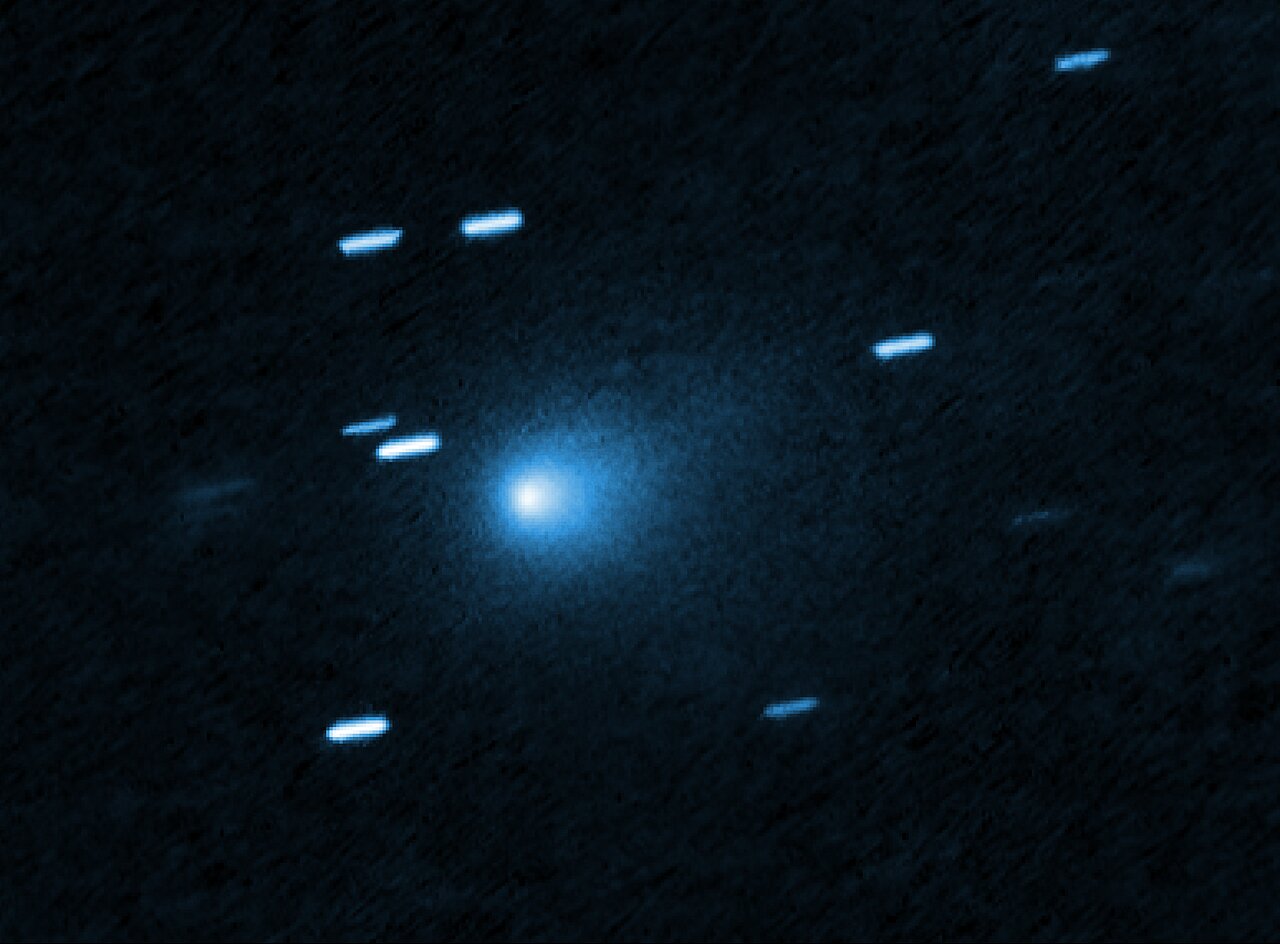
NASA / ESA / D. Jewitt (UCLA); Image Processing: J. DePasquale (STScI)
Attempts to resolve 3I/ATLAS’s nucleus, and settle the question of its size and motions, have thus far been unsuccessful. Even the Hubble Space Telescope, which imaged the comet in July, could only suggest a nucleus smaller than 8.4 km (5.2 miles) in diameter. “If it had a big nucleus, there would be a blip in the middle” of the image, Jewitt, who took those measurements, says. The absence of a central spike in brightness constrained the size of the nucleus, but couldn’t measure it directly.
Knowing the size of 3I/ATLAS would also help quantify the sizes of interstellar objects more generally. Astronomers were able to determine the mass of 1I/‘Oumuamua, but the nucleus of the second known interstellar object, 2I/Borisov, was never resolved.
Now that the comet has passed perihelion, astronomers are eagerly looking to see what gases it’s ejecting. Previous observations showed unexpectedly high amounts of carbon dioxide flowing off the comet and into its tail, though still within the range of compositions measured for solar system comets. Jewitt expects that now the water production should become stronger than the carbon dioxide.
Additional observations, now through December, will tell us more about what this comet looks like and how it behaves.




Comments
Anna Curtis
November 26, 2025 at 6:15 am
The best photos from NASA? Those look like streetlights on a foggy morning.
You must be logged in to post a comment.
Monica Young
December 1, 2025 at 8:58 am
To clarify, these are the best photos we have of the comet around the time of perihelion. However, given that the comet was photographed by instruments tailored to imaging the surface of Mars, they certainly are fuzzy compared to what we can see of the comet now — now that it's visible post-perihelion.
You must be logged in to post a comment.
You must be logged in to post a comment.