 SUNSET:

 14
14We’re now seeing the first images after years of effort and frantic last-minute fixes that pushed the new observatory to completion.
H.Stockebrand / RubinObs / NOIRLab / SLAC / DOE / NSF / AURA
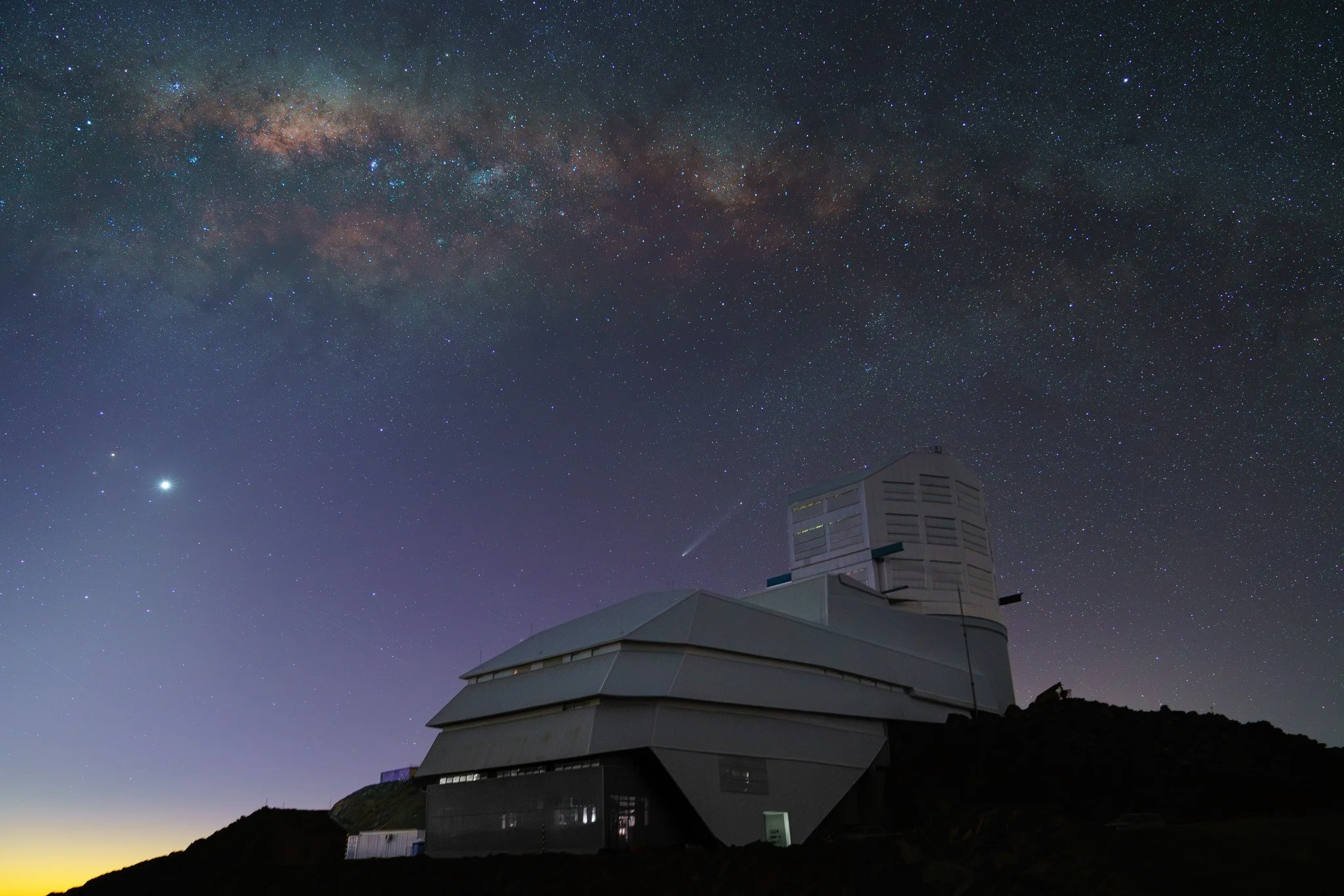
At the summit of Cerro Pachón, the Chilean mountain home to the newly constructed Vera C. Rubin Observatory, fatigued yet focused scientists gather in the observatory’s control room. They’re monitoring the systems around the 8.4-meter telescope while waiting to troubleshoot a problem: The telescope’s camera is overheating. And it's May, just weeks before the observatory is set to release its first images to the public.
Those images, now unveiled during a June 23rd “first look” event, are just the beginning. Every three nights for the next 10 years, the fast-moving and unprecedentedly sensitive telescope will complete a scan of the Southern Hemisphere’s sky, generating 60 million gigabytes of data. Named for the astronomer Vera Rubin, well known for her discovery of firm evidence for dark matter, the observatory will generate survey images that consist of a exposures of 15 or 30 seconds, using six filters to cover the full visible range as well as near-infrared wavelengths (330–1080 nanometers).
Eventually, those scans will help create a time-lapse “movie” of the universe known as the Legacy Survey of Space and Time (LSST). Its goals include demystifying dark matter and dark energy, catching fast-moving or ever-changing objects in the night sky, and mapping the universe around us.
NSF / DOE / Vera C. Rubin Observatory
But taking these initial images is no small feat. Since construction began in 2015, highly customized components built in labs around the world have been coming together on the remote mountaintop, with technical problems solved on-site.
“The last month was a crazy month, working very hard,” Fernanda Urrutia, an astrophysicist working on Rubin’s education and public outreach team, tells me soon after I arrive at the summit. The scientists’ work during my visit is focused on trying to fix the cooling systems for the Rubin digital camera, the largest in the world.
K.R. Callaway
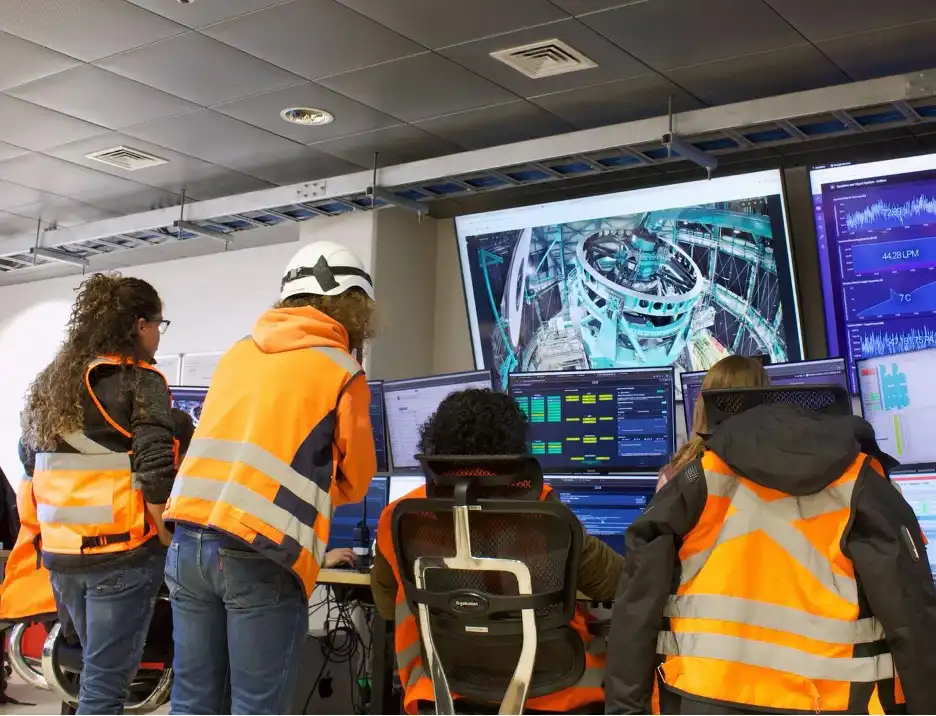
The cooling systems have always been “the big pickle” for engineers working on the LSST Camera, says research engineer Claire Juramy (French National Institute of Nuclear and Particle Physics). Different parts of the camera need to be kept at different temperatures and, if any of their separate cooling systems malfunction, the camera can overheat relatively quickly. So, when on-site scientists saw the camera’s temperature climbing even as the outside air temperature dropped in the middle of the night, they were quick to shut it down and start problem-solving.
“Admittedly, there is not a good understanding of the situation today,” says Kevin Fanning, a member of the commissioning science and camera teams. But Fanning and the rest of the group on-site did not seem bogged down by this uncertainty — even so close to taking the first images. Shutting down the camera provides a great opportunity to conduct engineering tests they can’t do while actively observing the sky. “It’s definitely stressful, but I love these days,” Fanning added.
By evening, the temperature graphs on the screens in the summit control room are stabilizing, and engineers establish a plan for the night. They want to wait until the outside temperatures drop again before operating the camera, to determine if the cold air outside is responsible for the cooling system’s malfunction. This test is expected to be a slow one, and some of the observing scientists settle around to play Uno as night falls on the mountain.
But behind us, the many graphs on screen suggest the outside temperature is not falling at all — it's getting hotter. “Weather forecasts for mountaintops are notoriously difficult to do,” Fanning explains.
NSF / DOE / Vera C. Rubin Observatory
As it became clear they would have to wait another night to complete the test, the scientists recount the camera’s installation in March, when they had to place the camera at just the right place relative to the primary and secondary mirrors to capture in-focus images. “By dead reckoning, we placed this camera within maybe three millimeters [of where it should be],” says Robert Lupton, who works with scientific software at Rubin as the LSST’s pipeline scientist. But due to the very wide (3.5 degrees) field of view, if the camera is just slightly out of place, the engineering images turn up donuts of light where there should be stars. Commissioning images provided the information needed to tweak the camera’s placement until it was just right.
Slow and steady seems to do well as a guiding principle for the observatory. The same principle applies to fixing the cooling system, notes Aaron Roodman (Stanford University), who leads the camera team. “Take a step and then discuss,” he advises the others via video call the next morning as they formulate a new plan.
It turns out the cold night air was involved. In the following weeks, the team further insulates the cooling systems and explores heating options to keep parts of the camera warm on cold nights. The fixes bring the observatory one step closer to the first-look images.

NSF / DOE / Vera C. Rubin Observatory
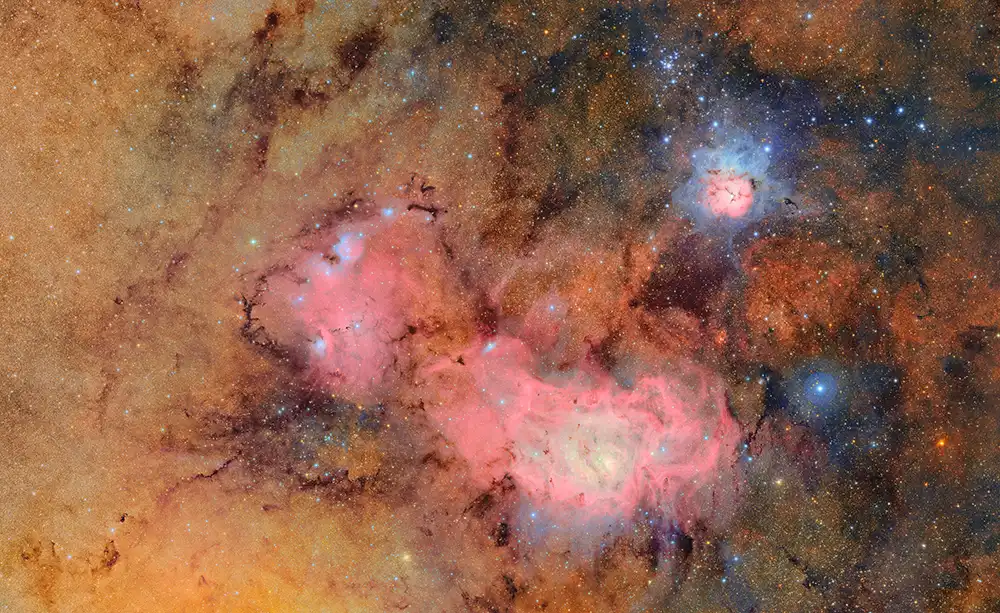
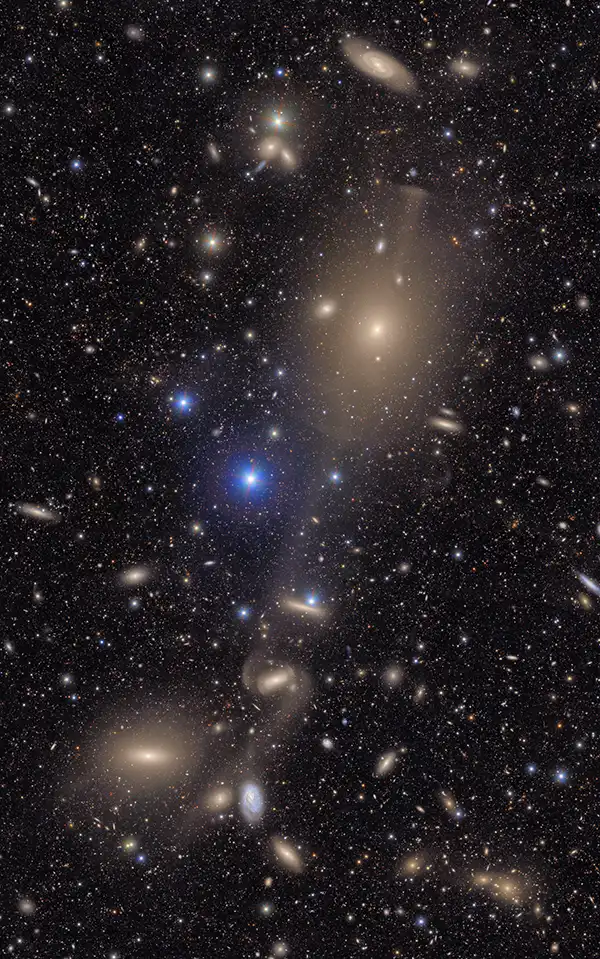
Now, those images showcase the observatory’s potential. Wide fields that are an astounding 3.5° across focus on patches of sky full of galaxy clusters and nebulae, showing not only how deeply the camera can gaze into the universe but also giving a taste of how many objects there still are to discover and understand. The full survey of the Southern Hemisphere sky is slated to begin later this year.
In Chile, the celebrations are just one more step in the continuing collaborative process of getting the high-profile observatory up and running.
The reporting for this article was partially supported by a grant from the National Science Foundation.




Comments
Andrew James
June 24, 2025 at 10:34 pm
Amazing.
You must be logged in to post a comment.
Andrew James
June 24, 2025 at 10:36 pm
"Named for the astronomer Vera Rubin, well known for her discovery of firm evidence for dark matter,..."
Statement is just false and misleading.
You must be logged in to post a comment.
Andrew James
June 24, 2025 at 10:41 pm
Dark matter, being likely invisible gas and dust surrounding the galaxy halos, was proposed by Fritz Zwicky in the 1930s. Rubin just confirmed this by observation. Dark matter, as a separate entity from normal matter, has yet to be found. Experiments into determining what it is made up of is still unknown. There are still possible alternatives to its existence.
You must be logged in to post a comment.
Brian of DRAA
July 5, 2025 at 11:52 am
I agree with Enrico. Zwicky was first to identify the need for Dark Matter (DM) and is the discoverer of it, however, his proof was too esoteric and too far away to be conclusive for most astronomers. Rubin and Ford's novel evalutions of the nearby Andromoda galaxy required Dark Matter in order to make sense. She measured the effect of DM with a new/novel method and made Zwicky's case more robust.
George Gamow had proposed the CMB more than a decade before Wilson and Penzias unwittingly discovered it. Note: Gamow proposed the CMB, and then imediately determinded it wasn't worth looking for because the signature would be lost in the "noise" of the stars.
I guess my point is, science takes time, is often made up of theories that wait for emperical evidence. Science is full of false starts and slow evolution, and always, extrodonary claims, such as DM, require extrodinary proof. Rubin did provide that for Zwicky.
You must be logged in to post a comment.
Andrew James
June 24, 2025 at 10:42 pm
Vera Rubin IMO is mostly being commemorated not on a scientific basis but because it is justified on her gender. Vera Rubin was a brilliant astronomer. We just need to make sure that her contributions are placed in the right perspective.
You must be logged in to post a comment.
Enrico the Great
June 25, 2025 at 1:31 pm
That observation is unfortunately actually correct---but she did in fact do the work that confirmed that there is an actual phenomenon. This is obvious to anyone that reads an accurate account. Guess this says more about us than it does about Vera Rubin.
You must be logged in to post a comment.
Bob Jones
June 27, 2025 at 5:30 pm
Like a lot of things in the history of science, that may be a matter of perspective. In his book, "Zwicky, the outcast genius who unmasked the universe," author John Johnson states on page 77, "While he lived long enough to see his neutron star prediction verified, he had been gone four years when Vera Rubin offered convincing proof that dark matter existed."
I have no personal knowledge one way or the other, but apparently Zwicky's biographer would agree with the statement you take issue with. I think the key words are "firm evidence." Good ideas are one thing. The hard work to back them up is another.
You must be logged in to post a comment.
Andrew James
June 28, 2025 at 4:52 am
Truth can be offered, but for some reason the system prevents me from doing so. I have tried several times, and it hasn't worked. I can't do anymore regarding this. Sorry.
You must be logged in to post a comment.
Andrew James
June 28, 2025 at 4:53 am
Test. Vera Rubin.
You must be logged in to post a comment.
David-Wickholm
June 25, 2025 at 9:35 am
I'd like to know what are the major galaxies in these two images.
You must be logged in to post a comment.
David-Wickholm
June 27, 2025 at 5:03 pm
These do not look like any part of the Virgo cluster I am familiar with. Anybody else know what the images are?
You must be logged in to post a comment.
Enrico the Great
June 25, 2025 at 1:23 pm
Chile has a great resource in th skies of its northern territories. Hope to visit there!
You must be logged in to post a comment.
Enrico the Great
June 25, 2025 at 1:33 pm
Looking forward to reading more articles about the results obtained by this observatory.
You must be logged in to post a comment.
mxyzptlk
June 29, 2025 at 2:03 am
"Robert Lupton, who works with scientific software at Rubin as the LSST’s pipeline scientist"
Would you please explain to a layperson the meaning of (non-petroleum!) "pipeline" scientist as it pertains to computer instructions (software).
You must be logged in to post a comment.
You must be logged in to post a comment.