 SUNSET:

 0
0Astronomers have obtained the first sharp images of winds blowing from gaseous disks around young stars, paving the way for improved models of planet formation.
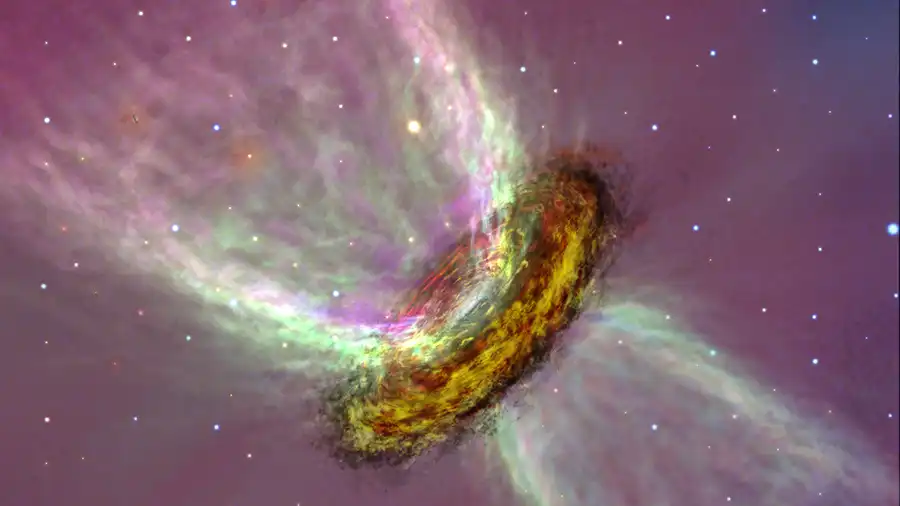
National Astronomical Observatory of Japan (NAOJ)
An infant star begins its life swaddled in a cloud of gas and encircled by a gaseous disk, also known as protoplanetary disk. Both the cloud and the disk feed the star for the first few million years, raising it to full adulthood.
The same mechanism that feeds the star also shapes the formation of planets in the disk. If we are to understand how planets like ours got here, we need to pin down this cosmic nurturing process that has so far eluded astronomers.
Now, thanks to the exceptional performance of the James Webb Space Telescope (JWST), a team of astronomers has observed structured streams of gas blowing away from four protoplanetary disks. The findings, published recently in Nature Astronomy, strongly support existing predictions and mark an important step toward a better understanding of planet formation.
Layers of wind
A protoplanetary disk is a mix of gas, dust, and magnetic fields. Magnetic fields pull on the ionized atoms and molecules of the gas, which in turn help drag neutral material away from the disk, creating winds. Astronomers have calculated that these winds would enable the feeding process of the star. Furthermore, they expect the winds to form a unique nested structure, with a narrow jet flowing from the center of the disk being surrounded by several cone-shaped envelopes. However, these nested winds have never been directly observed.
To search for this type of wind, astronomers pointed JWST at four stars in the Taurus molecular cloud, a star-forming region 450 light-years away. They selected young stars with estimated ages between 1 and 2 million years old, whose protoplanetary disks appear edge-on when observed from Earth. Disks in this orientation partially obscure stellar light that would otherwise outshine the faint light emanating from the winds.
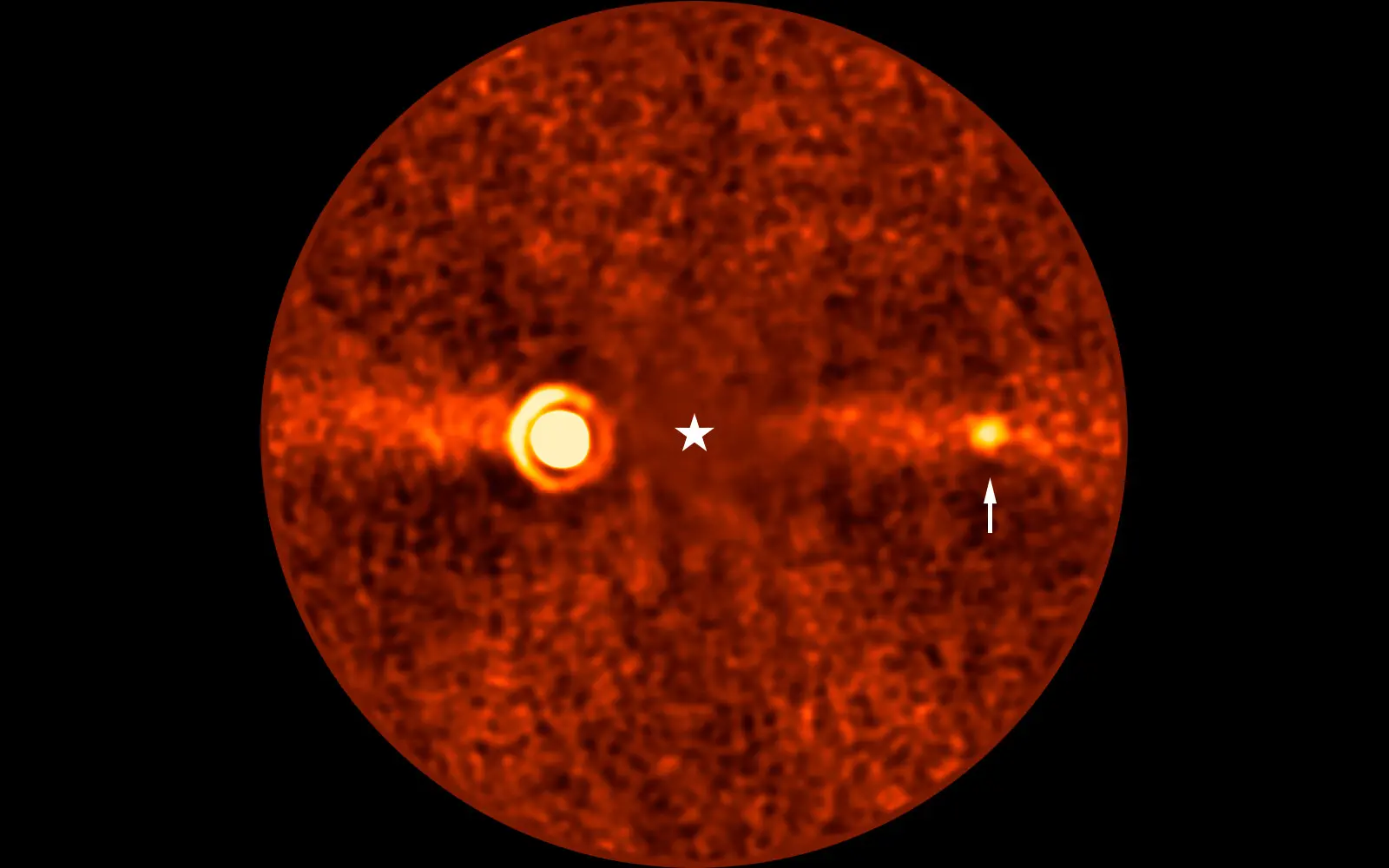
Molecules and atoms in the winds leave signatures in the spectrum of light. Astronomers used JWST’s near-infrared spectrograph to look for those signatures in the area above the disks. Using signals from different molecules and atoms, they reconstructed images of the winds. In all four cases, they found the winds display a nested structure just as the magnetic scenario predicts.
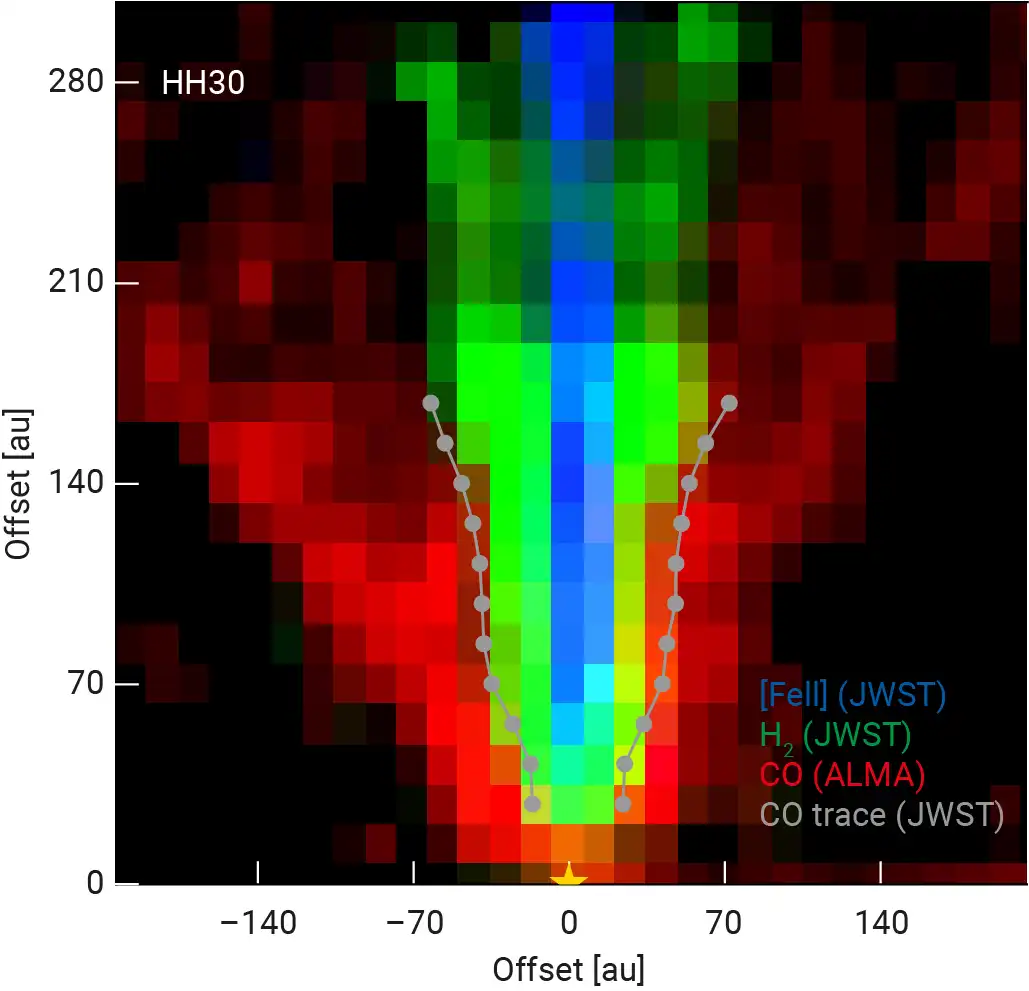
I. Pascucci et al. / MPIA
"The work confirms what a huge body of work has been pointing to for, say, over the last 10 years," says Emma Whelan (Maynooth University, Ireland) who wasn't involved in the study.
Effects on Planet Formation
Thanks to the resolution and sensitivity of the JWST, astronomers were able to pinpoint the location where the winds arise from the disk. "The region from which the winds emerge is inside 10 astronomical units, so really inside the planet-forming region," says team lead Ilaria Pascucci (University of Arizona).
With the wind-driving mechanism pinned down, scientists can now develop more detailed models of how the structure of the disk changes over time as planets form. “[The mechanism] affects how much material is available for the planets to form, determines the chemistry of the disks, and sets the foundations for what kind of planets will form,” says Whelan.
The ubiquity of such disk winds remains to be seen. Pascucci and her colleagues plan to search for winds around additional stars, especially those with very low masses, which represent the bulk of the stellar population in the Milky Way.



Comments
You must be logged in to post a comment.