 SUNSET:

 2
2New data from the James Webb Space Telescope suggest a planet fell into its parent star.

NASA / ESA / CSA / Ralf Crawford (STScI)
When astronomers discovered a star that had swallowed its own planet in 2023, they pointed their telescopes to witness the meal. What they found instead was a surprise — that the planet may have spiraled into its own demise instead.
Some 12,000 light years away in the constellation Aquila, the Eagle, an unusual flash of light occurred around a Sun-like star. Astronomers detected it using the Zwicky Transient Facility (ZTF) at Palomar Observatory in California. The sudden brightening was characteristic of a red nova, a flare-up that occurs when two stars merge. But based on the small size of the stellar burp, astronomers at the time suggested the star had instead merged with a planet roughly 10 times the mass of Jupiter, an event facilitated by the star swelling as it exhausted its hydrogen fuel.
However, new data from the James Webb Space Telescope (JWST) reveal that the star could not have grown large enough to swallow its planet. Instead, they now suspect that the planet fell into its parent star, blasting away clouds of gas and dust spotted by Webb.
Disk of Debris
The detection, labeled a subluminous red nova (SLRN) or ZTF SLRN-2020, was the first of its kind. Astronomers used the Mid-Infrared Instrument (MIRI) and the Near-Infrared Spectrograph (NIRSpec) on the James Webb Space Telescope to follow up on the engulfment. With Webb’s enhanced sensitivity and resolution, the team found that the star in question was not as bright as it would have been had it expanded and evolved into a red giant.
“It was originally thought that the star eating the planet was more massive than the Sun, and more massive stars evolve more rapidly.” says Colette Salyk (Vassar College), a coauthor on the study published in The Astrophysical Journal. “However, our observations showed that the star is actually less massive than the Sun, and has therefore not yet reached its red giant stage and gotten larger.”
“So,” she adds, “we have to invoke another mechanism — tidal interactions — for the star to engulf the planet.”
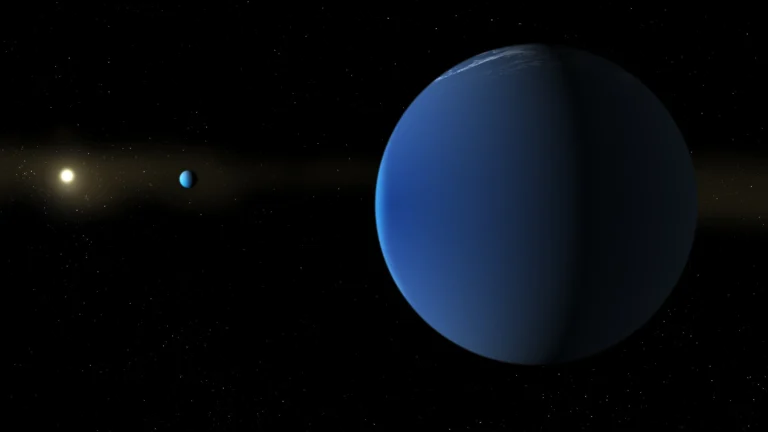
The team speculated that the planet’s orbit gradually migrated inwards, closer than Mercury is to our own Sun, before gravitational forces started a runaway process, pulling it into the star’s atmosphere. As it plunged into its star, the planet would have blasted away gas from its outer layers, leaving a shell of cold dust around the star as heavier elements cooled and condensed.
Using NIRSpec, the team also detected a hot circumstellar disk of gas closer in. The researchers think it formed from ejected gas that is now falling back into the star. The disk is not unlike the protoplanetary disks of gas and dust that swirl around newborn stars and form planets — even though this disk formed in the aftermath of a planetary death, astronomers can similarly analyze its composition to determine how the planet might have formed and evolved.
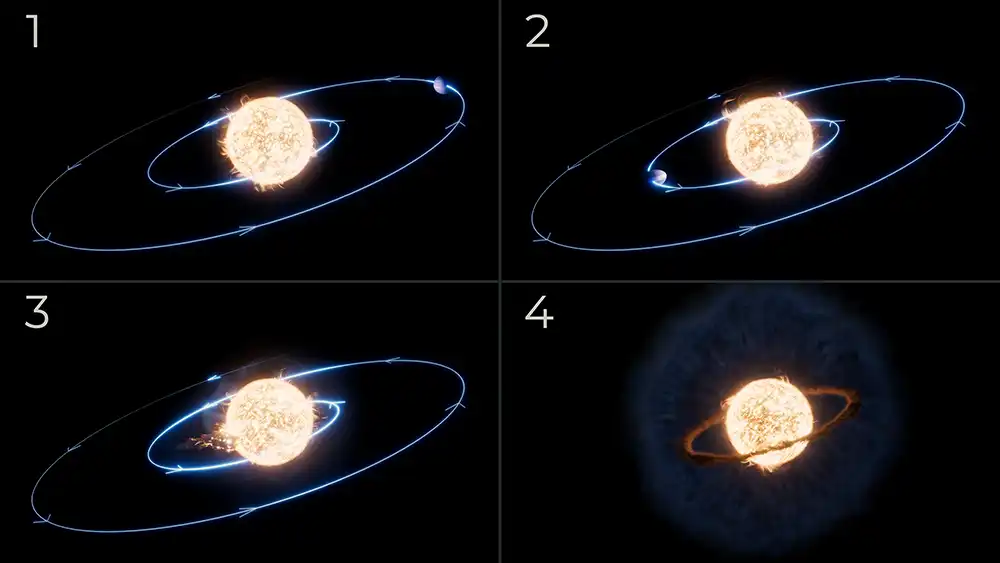
NASA / ESA / CSA / Ralf Crawford (STScI)
The team was able to identify emission from carbon monoxide and even a hint of phosphine in the disk, which surprised the team. Although the compound is famous for a disputed observation in the clouds of Venus, it’s also found throughout our solar system.
“It's very intriguing that we see phosphine, as phosphine is observed in Jupiter and Saturn’s atmospheres, and so its presence seems at least consistent with giant planet engulfment,” Salyk says. However, the team can’t completely rule out other possibilities for the signal, including instrument calibration error or a potentially stellar origin.
Stellar MealS
“Engulfment events offer a critical opportunity to learn more about the bulk composition of planets and to understand the long-term evolution of planetary systems,” says Melinda Soares-Furtado (University of Wisconsin-Madison), who was not involved in the study. ZTF SLRN-2020 is currently the best detection of such an event.
The observations suggest that the decay of the planet’s orbit is what led to the engulfment, but other scenarios are possible, too: The planet may have been scattered off-course in a collision or perturbed by other gravitational interactions.
“I think these results are strongly suggestive of an engulfment scenario,” Soares-Furtado says, though she adds that the cause of death might not be entirely solved. Determining the exact mechanism that led to the destruction can shed light on the characteristics of different systems. “There is still a lot to understand about the exact dynamics of orbital decay,” Soares-Furtado adds.
The current observations are “groundbreaking” but “limited in terms of [necessary] spectral and temporal coverage,” according to Soares-Furtado. Further Webb observations could better capture the evolution of the engulfment event.
“We would love to follow it up again with JWST, but perhaps with different instrument modes to probe longer wavelengths, to learn more about its dusty aftermath and to see if it has any more surprises for us,” says Ryan Lau (NOIRLab), who led the study.
Detecting additional engulfed planets is also crucial to learning more about the processes at play as well as the composition of the planets being destroyed. “I think that is an exciting area of research,” Soares-Furtado says, “one in which the destruction of planets provides critical insights into their formation histories.”
“[ZTF SLRN-2020] provides us with a better picture on how planets will meet their final fates — but it’s only one event,” says Lau. “We need to observe and study many more of these to truly understand what's going on and what are the dominant mechanisms at play.”
The team will get to study more of these events with the Vera C. Rubin Observatory starting up this year, and the Nancy Grace Roman Space Telescope that could launch in the next year or so. “We’ve only just opened this new field of study that is likely to greatly expand in the coming years,” says Salyk.
About Arielle Frommer
Arielle Frommer is a science writer for Sky & Telescope and astronomy PhD student at Yale, where she studies exoplanets. In her free time, she enjoys hiking, crocheting, drinking coffee, and reading and writing fiction.



Comments
[email protected]
December 13, 2025 at 12:17 am
"When astronomers discovered a star that had swallowed its own planet in 2023, they pointed their telescopes to witness the meal. What they found instead was a surprise — that the planet may have spiraled into its own demise instead."
So, could you explain how this planet came to orbit its star at the outset?
You must be logged in to post a comment.
Monica Young
December 15, 2025 at 9:48 am
Planets form from the nebula of gas and dust around newborn stars. But interactions with that gas and dust — or with other planets — can cause a planet to migrate inward toward the host star.
You must be logged in to post a comment.
You must be logged in to post a comment.