 SUNSET:

 0
0A new look at the galaxies swarming around the Andromeda Galaxy shows that their asymmetric arrangement is rare.

Smaller galaxies swarm around the Andromeda Galaxy like moths to a flame — a fact that’s not in itself unusual, as most large galaxies have such entourages. But a new look at those galaxies shows that the flock has taken a rare asymmetric shape that’s difficult to explain.
Astronomers have noted for the past two decades that the dwarf galaxies around Andromeda (M31) appear to be arranged in an unbalanced way. The asymmetry is such that more of them lie between Andromeda and our Milky Way Galaxy, so it remained possible that we see more dwarfs on that side simply because they’re easier to see. However, recent developments, including better distance measurements to those dwarfs and analysis of how they’re detected, have made clear that the unbalanced arrangement is real.
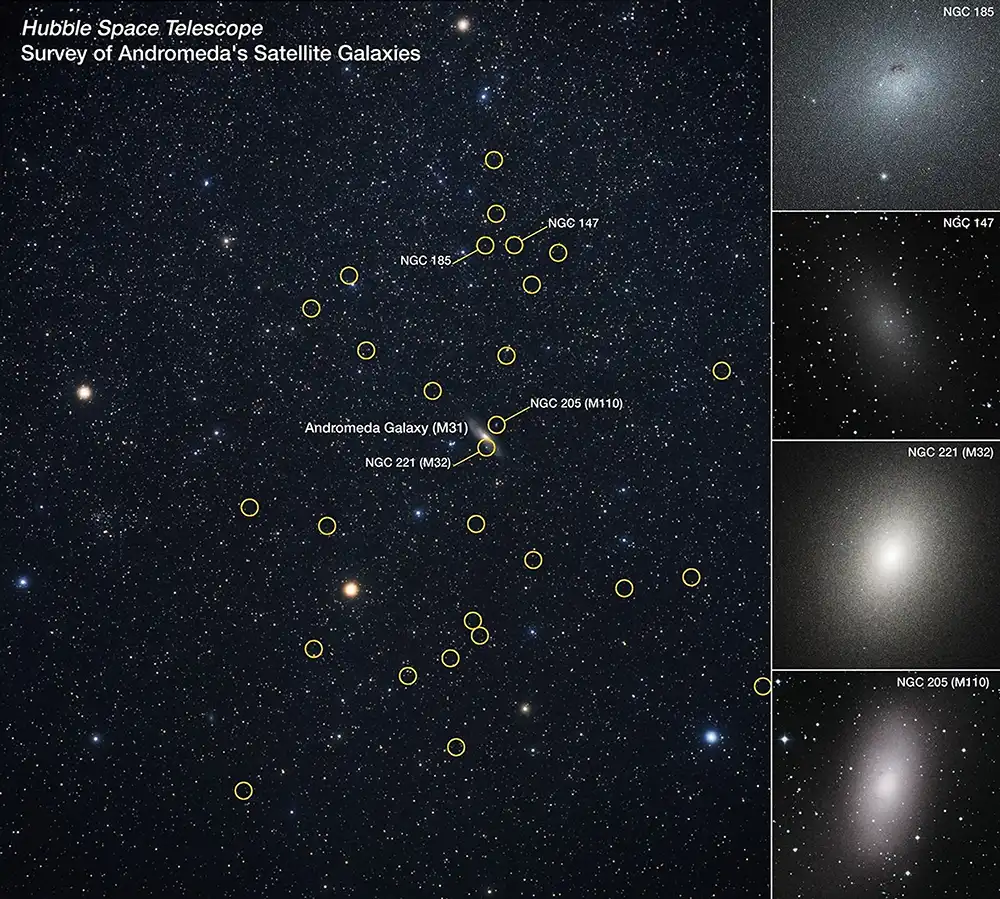
NASA / ESA / Alessandro Savino (UC Berkeley) / Joseph DePasquale (STScI) / Akira Fujii DSS2
One question has remained, though: Is this one-sidedness really unexpected? After all, galaxies are known to grow along giant, hard-to-see filaments of dark matter and gas, so it’s perhaps not that surprising that dwarf galaxies should form in those filaments and fall in along certain directions.
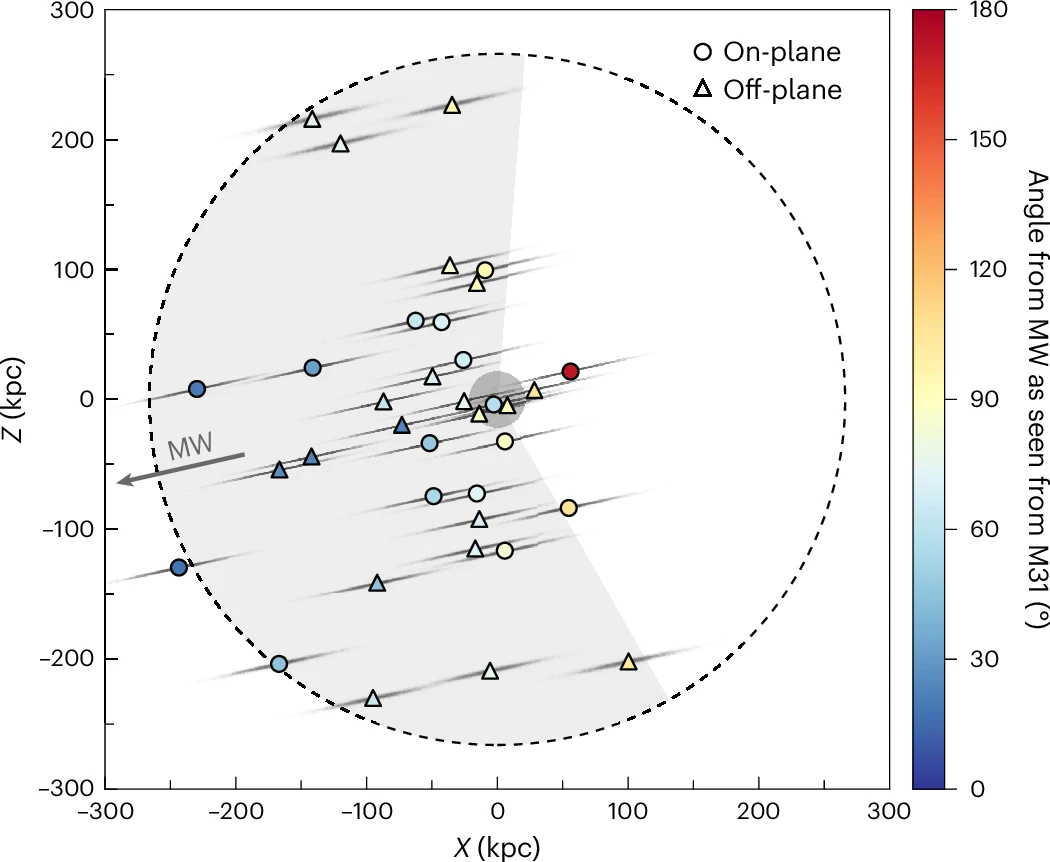
To evaluate whether the asymmetry in the Andromeda system is truly unusual, Jamie Kanehisa, Marcel Pawlowski, and Noam Libeskind (all at Leibniz-Institute for Astrophysics Potsdam, Germany) took already collected data on the galaxies and developed a new way of quantifying its lopsidedness. Then they compared what they found with two cosmological simulations: Illustris TNG and the Evolution and Assembly of Galaxies and their Environments (EAGLE). The results are published in Nature Astronomy.
What they found is that, while Illustris and EAGLE simulations both turned up some systems as lopsided as Andromeda’s, those systems were few and far between.
Nature Astronomy / CC BY
Importantly, the trio of researchers were able to account for systems that appeared lopsided but only because a few dwarf galaxies clustered together as they fell in toward the larger galaxy —something that’s not the case around Andromeda. Discarding those systems, the team found that only 0.1% of galaxies in the two simulations are as lopsided as Andromeda.
The rarity of the arrangement among simulated galaxies “requires either a very unique evolutionary history, or otherwise may hint at an insufficiency in our current cosmological model,” Kanehisa says.
There has been some discussion about a possible unique history for Andromeda, notes Amandine Doliva-Dolinsky (Dartmouth College and University of Surrey, UK), who wasn’t involved with the study. “This is an exciting result that raises many questions about M31’s evolution and the origin of this anisotropy,” she says. “Could it be linked to M31’s recent merger history?” She adds that the nearby Triangulum Galaxy (M33) might be interacting with Andromeda in a way that helps rearrange the smaller galaxies.
Doliva-Dolinsky tempers her excitement with caution, noting that the lopsided arrangement might be short-lived on a cosmic timescale, which might be difficult to capture in simulations. “Nevertheless,” she says, “these findings show the importance of studying systems like M31 to better understand galaxy formation and evolution.”
About Monica Young
Monica Young, a professional astronomer by training, is News Editor of Sky & Telescope.








Comments
You must be logged in to post a comment.