 SUNSET:

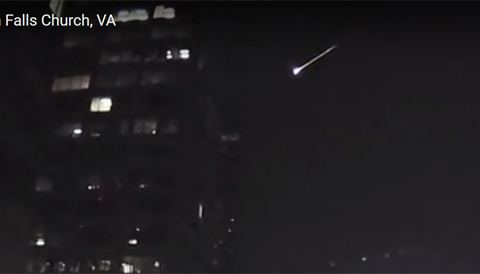
East Coast Bolide Triggers Hunt for Meteorites
A blazing-bright fireball that lit up the early evening sky on January 30th appears to have scattered meteorites near the Pennsylvania- Maryland border. Now the search is on to find them.

Tour February's Sky: Five Planets at Dawn!
This month's audio sky tour starts before dawn, when you can spot all five bright planets by eye, and moves to the sparkling stars seen on winter evenings.
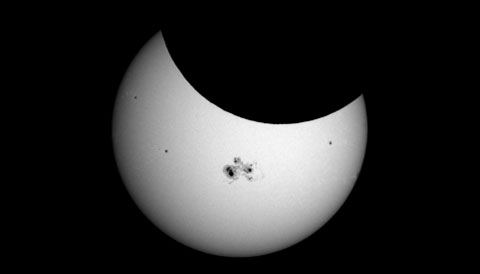
Solar and Lunar Eclipses in 2016
There will be four eclipses in 2016. Highlights are a total solar eclipse on March 9th (visible from Indonesia) and an annular solar eclipse on September 1st (central Africa). But we'll see just two barely-there penumbral eclipses, on March 23rd and September 16th.

Making the Case for "Planet Nine"
Does a massive, extremely distant planet orbit the Sun? A new analysis of distant solar-system orbits argues that it should exist.
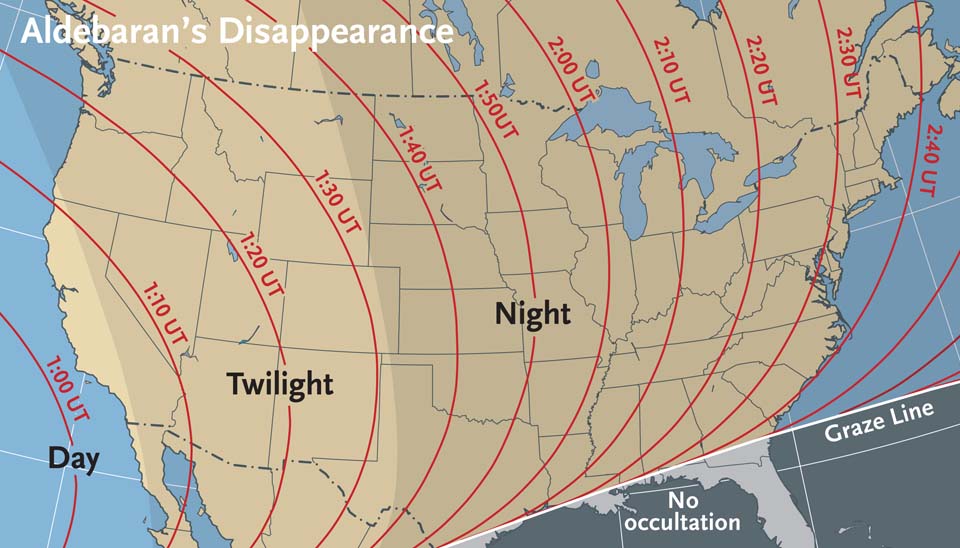
Tonight's Easy Aldebaran Occultation
North Americans have front-row seats when the Moon covers up the brightest star in Taurus.

Get Up Early, See Five Visible Planets at Once!
Over the next two weeks, for the first time in more than a decade, you can see all of the naked-eye planets — from Mercury to Saturn — together in the predawn sky.

Solar System Featured on New U.S. Stamps
The U.S. Postal Service has unveiled new stamps, to be issued later this year, that feature 10 solar-system objects — including Pluto.
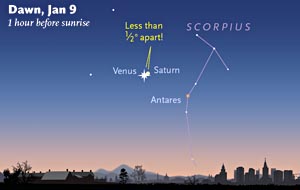
Tour January's Sky: Venus & Saturn Pair Up
The first month of 2016 offers a close pairing of Venus and Saturn before dawn, a strong meteor shower, and a parade of bright stars after sunset.

Martian Gullies: Triggered by Dry Ice?
Are enigmatic gullies seen on many steep Martian slopes caused by liquid water or instead by episodic coatings of frozen carbon dioxide?

New Star and Exoplanet Names OK'd by IAU
Following a wildly popular contest, the International Astronomical Union has named 14 stars and 31 planets that orbit them.
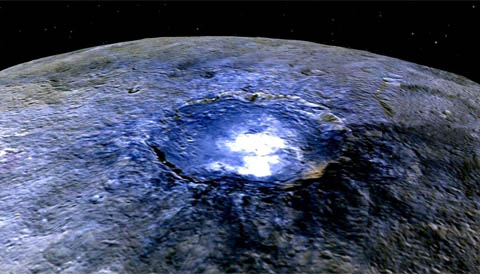
Bright Spots on Ceres: Mystery Solved?
Results from NASA's Dawn spacecraft hint that the stark brightenings in and near scores of craters on Ceres might result from salty brines seeping onto the surface.
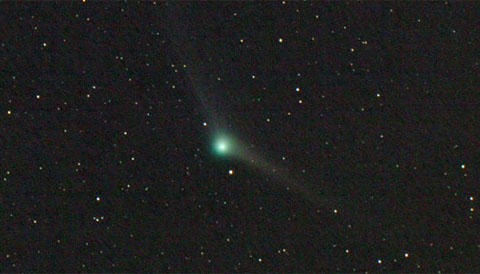
Get a Predawn Peek of Comet Catalina
Our current visitor from the Oort Cloud, rising into northern skies at last, can be glimpsed with binoculars low in the east before dawn. Spotting it will be especially easy on December 7th.
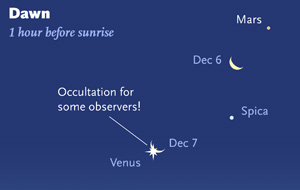
Tour December's Sky: Planets and Meteors
This month offers great variety in the night sky: planets (and a comet!) before dawn, a strong meteor shower, and a parade of bright stars after sunset.

Will Phobos Create a Ring Around Mars?
Dynamicists predict that the larger of Mars's two moons will shatter to create a ring, slam into the planet — or both — in 20 to 40 million years.

V774104: Solar System's Most Distant Object
An ultra-deep survey has turned up a sizable object situated nearly 10 billion miles from the Sun — more distant than any known solar-system object.

Leonid Meteors in 2015: Modest but Moonless
This year's Leonid meteor shower, which peaks tonight, will offer modest numbers of "shooting stars" — but might reward you with some dazzling fireballs.

Pluto's Cold Atmosphere and "Volcanoes"
Four months after New Horizons' historic flyby, mission scientists have been amazed by unexpected discoveries — and by how some preconceptions about Pluto were flat-out wrong.
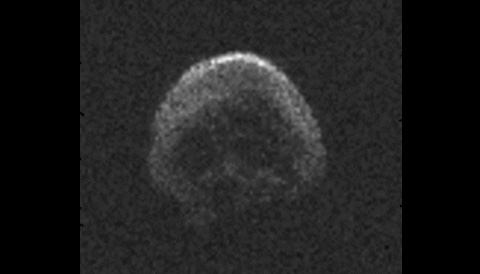
2015 TB145 — Rogue Asteroid or Dead Comet?
Astronomers can't decide whether the sizable object known as 2015 TB145, which is cruising past Earth today, is a renegade asteroid or a dead comet.
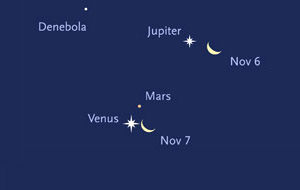
Tour November's Sky: Treats at Dawn & Dusk
Bright planets are putting on a show in the predawn sky, and evenings feature a mythical horse flying upside-down across the sky.

The Curious Case of KIC 8462852
The Kepler spacecraft recorded a bunch of irregular dimmings around one of its target stars, designated KIC 8462852. No natural phenomenon explains the dips well.
