 SUNSET:


Did We Find a Planet in Another Galaxy?
Astronomers using an innovative method have detected the signal of what could be an extragalactic exoplanet. But confirming its existence will be difficult.

The Roots of Jupiter’s Great Red Spot Run Deep
NASA’s Juno mission has obtained measurements that finally say just how deep the Great Red Spot goes.

Astronomy in Pictures: Black Holes, Baby Stars, and Magnetic "Tunnels"
Astronomers witness the unfurling of a black hole-powered mushroom cloud, a baby super-Jupiter, and a magnetic "tunnel" around the solar system.

Streetlights to Satellites: Taking Light Pollution to the United Nations
The United Nations' Office of Outer Space Affairs is considering issues of light pollution spanning from streetlights to satellites.

Did Astronomers See a Distant, Dying Star? Or an Earth-bound Satellite?
What seemed a lucky break — the discovery of a gamma-ray burst in the most distant known galaxy — might instead be the flash of passing space debris. As satellites fill low-Earth orbit, such events might become common.

What Is a Quasar?
A quasar is a supermassive black hole gorging on gas in the heart of a distant galaxy.

60-second Astro News: Magnified Galaxies Provide Window to Early Universe
Astronomers use cosmic magnifying lenses to peer into the universe's distant past.

Supernova Blasts Hollowed Out "Giant Cavity" in Space
Some 10 million years ago, dying stars cleared a giant cavity in space and ultimately inspired a new generation of star formation.

60-second Astro News: Solving Supernova Mysteries
This week, astronomers have solved one supernova mystery and predicted a new one — to be solved in 2037.

Take a Deep Look into the Milky Way Halo
New analysis shows the best view of the Milky Way halo to date, providing a window into our galaxy's future star formation.

60-second Astro News: White Dwarfs Still Burn, Black Holes Merge
This week in astronomy news, we learn that some white dwarfs still burn and image X-rays from black holes almost 12 billion light-years away.

Astro News: Planet-eating Stars and an Accidental Brown Dwarf
This week in astronomy news: A citizen scientist happens upon a weird, ancient brown dwarf and astronomers discover that Sun-like stars eat their own planets.

Watch Black Holes Grow, Galaxies Fall
Watch black holes grow and galaxies fall — astro photos and visualizations to get you through the week.

Saturn Has a Fuzzy Core, Too
New research reveals that Saturn, like Jupiter, has a “fuzzy” core that extends 60% of the way to its surface, a finding that is changing how astronomers think about giant planets.

How Black Holes Eat Reveals Their Mass
No one knows why quasars flicker — but astronomers are using these wavering beacons to "weigh" the black holes that power them.
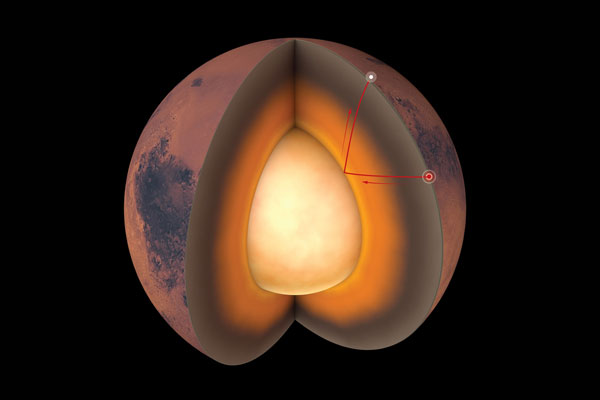
NASA's Insight Reveals First Look Inside Mars
The Insight mission science team has used about 10 deep marsquakes to take stock of the planet's anatomy.

Lost & Found: Milky Way-size "Orphan Cloud"
Astronomers have found a giant gas cloud, likely stripped from its parent galaxy long ago, in a cluster 330 million light-years away.

Moon-size White Dwarf Is the Smallest Ever Found
Astronomers have discovered a white dwarf only slightly bigger than the Moon, making it the smallest ever found. It might even be on the edge of collapse.
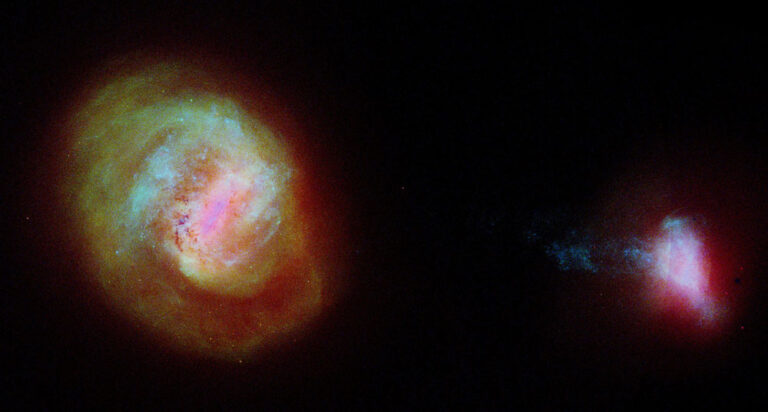
Galaxies That Evolve Together But Don’t Stay Together
A study of 36 dwarf galaxies within a volume of space spanning 13 million light-years show they all have remarkably similar histories despite the vast distances between them.

The Giant Star That "Blinked"
Astronomers are trying to understand why a giant star "blinked," fading almost completely before brightening again over the course of about 200 days.
