 SUNSET:

Black Holes First, Galaxies Second
Back when the universe was young, a new study finds, galaxies grew their central black holes faster than the holes' starry surroundings. But how?
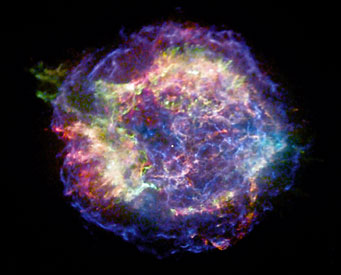
Fly Through a Supernova Remnant in 3-D
Astronomers have figured out the three-dimensional structure of Cassiopeia A, an expanding supernova remnant. From this, it looks like the star blew up in two parts.
Milky Way Doubles Its Mass
Our Milky Way Galaxy rotates 15 percent faster and is twice as massive as formerly believed — making it an equal match for the Great Andromeda Galaxy rather than its little brother.
The Mystery of the Missing Brown Dwarfs
Fewer of these dim, glowing coals exist than astronomers once expected. And in particular, they shy away from associating with normal stars.
First True Exoplanet Images…Probably
Although questions remain, it appears that astronomers have at last taken images of actual planets orbiting other stars.
NASA Satellite Spots New Type of Pulsar
The Fermi Gamma-ray Space Telescope has made its first major discovery.
Double-Barrel Blast
A gamma-ray burst detected on March 19th was so bright it could be seen with the naked eye. And now astronomers think they know why.
Milky Way's Central Monster Measured
Astronomers have refined the mass of the Milky Way's central black hole by tracking the orbits of several stars whizzing around it. The job hasn't been easy.
NASA Space Observatory Gets New Name
The best-ever gamma-ray satellite is living up to expectations and NASA has just given it a new name.
Monster Black Holes Soon to Collide?
The members of a binary black hole in Cancer, one of which is unbelievably massive, look to be on a collision course.
Amateurs Spot Transiting Exoplanet
Using modest gear and a lot of skill, amateur astronomers catch a record-breaking planet crossing the face of its star 250 light-years away.
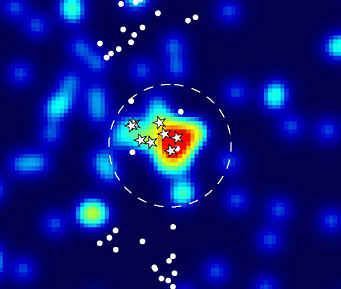
A Pristine Galaxy Heading Our Way
A dwarf galaxy apparently untouched since the beginning of the universe is offering a view into the past.
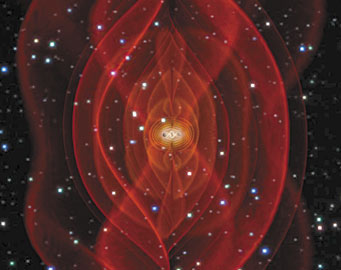
Why Monster Black Holes Don't Run Away
It’s hard to kick a monster around, especially when the beast weighs millions or even billions of times the mass of our Sun. But in recent months, computer simulations by five independent groups have shown that something astonishing can happen when two supermassive black holes spiral together and combine in the aftermath of a galaxy merger.

A Hot Earth-Neptune Hybrid
With 236 exoplanets now known, most new discoveries meet with indifference. But when one of them introduces a new class of planets, a data point on a graph turns into a real world that stirs the imagination.

Black Hole Spins as Fast as It Can
A black hole has been measured spinning more than 950 times per second, about as fast as it can theoretically go under the laws of physics.
Bob's World of Astronomy with Robert Naeye
Farewell
I will be leaving S&T at the end of today, but it's been a great 3-year ride.
Bob's World of Astronomy with Robert Naeye
Intelligent Design and the Kanootin Valve
Belief in "intelligent design" stifles human initiative to understand the natural world.
The Milky Way's Hungry Monster
The Milky Way has a monster black hole lurking in its core, but it's on a starvation diet. The black hole, known as Sagittarius A*, weighs in at about 4 million solar masses. But despite the beast's overwhelming gravitational pull, recent studies show that it consumes only a pathetic fraction of Earth's mass in a typical year. For some unknown reason, very little food is falling into the black hole, so it remains calm and quiet — radiating very little energy. But fortunately for the monster, every now and then it enjoys a snack.
The First Triple Quasar
In an announcement made on Monday at the American Astronomical Society conference in Seattle, astronomers confirmed that quasars can come in threes.
