 SUNSET:

Supernova Mystery Remains Just That
Despite a recent claim, astronomers still don't understand an important class of exploding stars.

IAU's Discovery Clearinghouse Moves
The Central Bureau for Astronomical Telegrams, long the place from which astronomical discoveries have been announced to the world, has a new address.
New Plan for NASA
The Obama administration abandons NASA's Constellation Moon program, but sets its sights farther afield.

WISE Sees First Light
Scientists unveil the first image from the Wide-field Infrared Survey Explorer satellite, which will map the sky in depth and detail at new wavelengths.
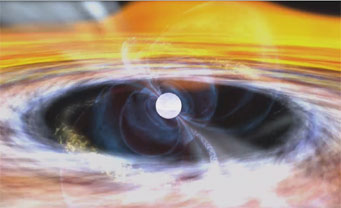
A "Treasure Map" of Millisecond Pulsars
The gamma-ray sky map assembled by the Fermi satellite points the way to finding natural, high-precision "clocks." These could be used in a cosmic GPS-like system to look for flexings of spacetime.

Black-Hole Bonanza
Astronomers announce supermassive double holes, an intermediate-mass hole that seems to have pulled apart a star, fast-spinning holes, and a screaming runaway.

A Super-Duper Supernova
A much anticipated new type of exploding star lights up a distant galaxy.
Clouds Part for Solar Eclipse
With the monsoon in full swing, observing conditions were iffy across the entire land path — from India through China — of the July 2009 total solar eclipse. Nonetheless, a surprising number of people managed to obtain great views of totality through holes in the clouds.
At Last, an Exoplanet by Astrometry
After decades of frustration and false alarms, astronomers may finally have a new method in their toolkit for finding planets around other stars: astrometry.
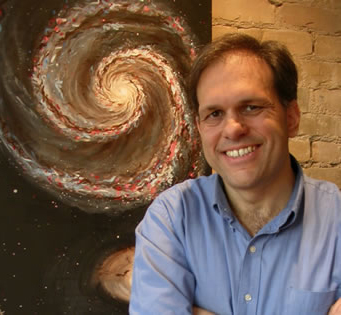
Our New Blogger: Ivan Semeniuk
Sky & Telescope is pleased to announce a new blogger for our website: Canadian science writer and broadcaster Ivan Semeniuk.
NEAF 2009 Videos Are Here!
Huge numbers of amateur astronomers flocked to the 18th annual Northeast Astronomy Forum to attend talks by world-renowned astronomers — and to sample (and often buy) the wares at one of the world's largest telescope shows. For the first time, Sky & Telescope was able to videotape the event, including interviews with many of the exhibitors . . .
S&T Now on Twitter
You can now follow Sky & Telescope on the social-networking service Twitter. Sign up to follow S&T, and you’ll be notified whenever we post new stories on our home page.
Global Astronomy Marathon Underway
The largest astronomy public outreach event in world history got off to a flying start today with the official opening ceremony at the Franklin Institute in Philadelphia.

First Earth-Size Exoplanet
S&T IllustrationIn early February, European astronomers broke new ground in the search for extrasolar planets. They announced the discovery of the first planet outside the solar system with a well-measured diameter that can be described as “terrestrial” in size. The planet is less than twice Earth’s diameter, and it orbits…
New Light on Dark Matter
Soon after it was installed on Hubble, the ACS captured this image of the Cone Nebula, a stellar nursery shrouded in hydrogen gas.Courtesy Holland Ford (JHU), NASA, ACS Science Team.Like other large spiral galaxies, our Milky Way shines with the light of hundreds of billions of stars. It contains giant…
Gamma-Ray Burst Hints of Space-Time Foam
Observations from NASA’s orbiting Fermi observatory hint that extremely high-energy gamma rays don't travel at the speed of light. If more observations bear this out, it will rock the foundations of physics, hint at small-scale "space-time foam," and perhaps point the way to a "theory of everything."
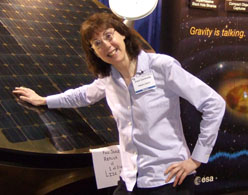
Cosmic Cataclysms
Joan Centrella poses with a scale model of one of the three LISA spacecraft, which are designed to detect gravitational waves from black-hole mergers.Bonny Schumaker (JPL) What are the most energetic events in the universe since the Big Bang? If you ask an astronomy aficionado, there’s a good chance the…
New Cosmic Background Radiation Found
Astronomers have found something in the very distant universe filling the sky with a radio roar at frequencies they did not expect. No one knows what it is.

Exoplanets Dance in the Same Plane
Three planets orbit the red dwarf star Gliese 876, and at least two of them do so in nearly the same plane, according to an ingenious new study of their interaction.
Surprising Trove of Gamma-Ray Pulsars
Pulsars flash in radio, but some of them flash a lot more powerfully in gamma rays, due to different processes happening in different places around them.
