 SUNSET:

 0
0The Vitals
| Official name | Algol |
| Other designations | Beta Persei, HIP 14576, HD 19356, HR 936 |
| Nickname | Demon Star |
| Apparent magnitude | 2.12 (variable; fades to 3.4) |
| Distance from Earth | 90 light-years |
| Type | B8, main sequence |
| Color | Blue-white |
| Mass | 3.5 solar masses |
| Radius | 2.9 solar radii |
| Constellation | Perseus |
| Right ascension | 03h 08m 10s |
| Declination | +40° 57’ 20” |
| Multiple system? | Yes |
| Variable star? | Yes: eclipsing binary star system with a third, farther-out companion |
| Exoplanets status | None known |
| Probable fate | White dwarf |
Physical Characteristics
If you need a touch of trick-or-treat in the sky this season — or anytime — seek out Algol, a bright star in the constellation Perseus.
The notoriety of Algol, also called the Demon Star, stretches back thousands of years because of a notable “trick”: The star dims over the course of a few hours before rebrightening, a feat it repeats precisely every 2.87 days. When Algol performs its trick, it fades from a vivid magnitude 2.1 (almost as bright as Polaris, the North Star) to a dim magnitude-3.4. At its faintest, it’s still visible without optical aid. The behavior may have startled ancient stargazers (see below for their stories). Happily, today we have the tools to pull the treat out of the trick.
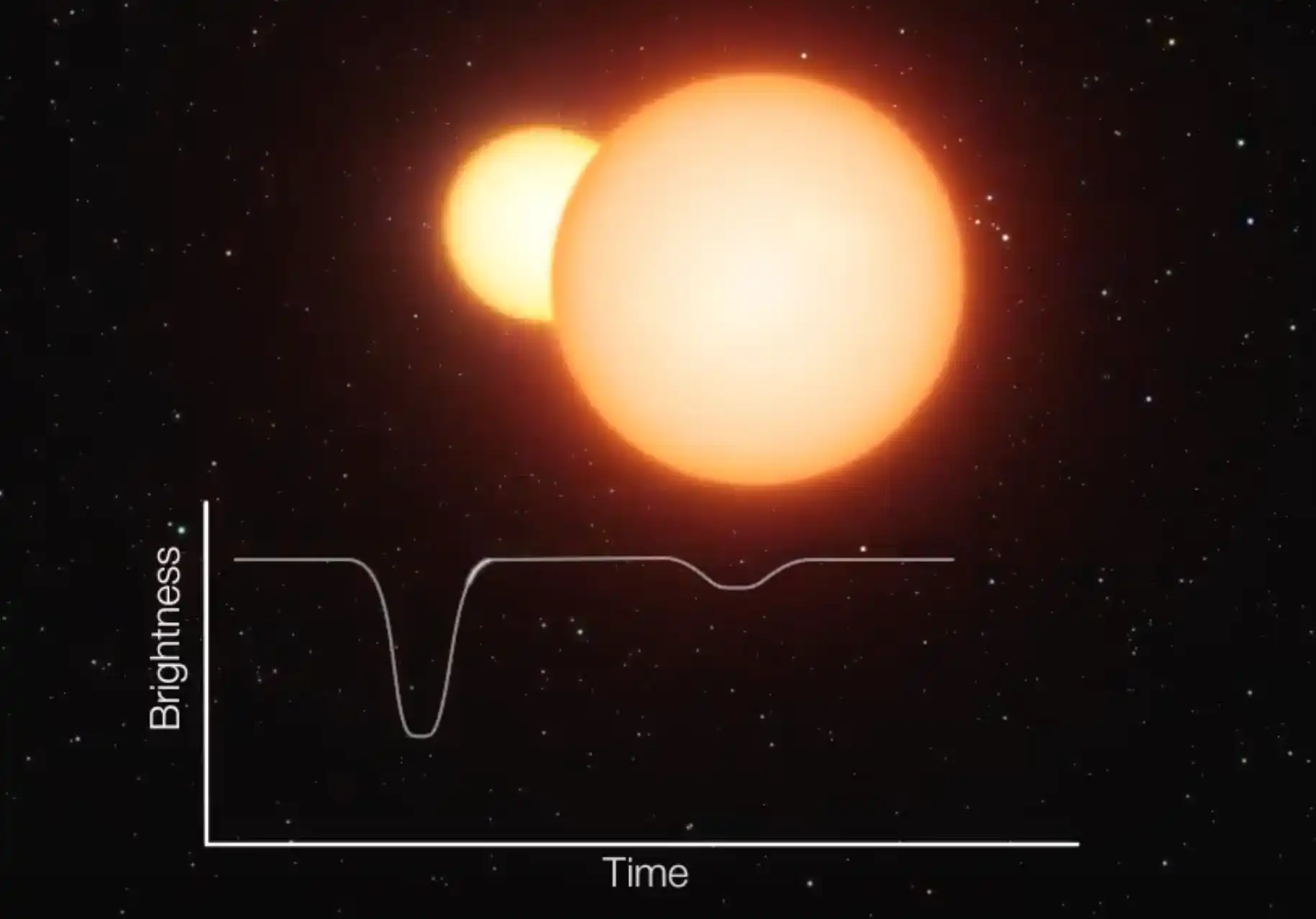
ESO / L. Calçada
Algol is a terrific example of an eclipsing binary variable star. Algol itself never changes in brightness at all, but is eclipsed by a larger and dimmer companion, whose orbital plane is aligned just so in Earth’s direction. When the fainter star passes in front of Algol, we see the system’s brightness drop until the companion moves back out of the way. (Ten hours is enough to view the whole event).
The primary, Algol A, is a hot, blue, main-sequence star, while Algol B is a cooler K2 giant with a yellowish cast. You can’t separate the two visually — they orbit each other far closer than Mercury orbits the Sun — but you can see the effect of their interactions without optical aid. Even though Algol B never completely obscures Algol A’s light, the darkening effect is dramatic.
Origin / Mythology

The darkening and brightening of Algol didn’t go unnoticed by ancient stargazers, who crafted various myths and stories inspired by the star's behavior. Often, Algol represents some kind of bad luck, ill omen, trickster, or monster. The Greeks connected Algol’s blinking brightness with the winking eye of the snake-shrouded Medusa, a being whose ugliness turned unfortunate viewers to stone. The Iliad refers to the monstrous head as “a ghastly sight, deformed and dreadful, and a sight of woe.”
Elsewhere in the ancient world, the story is much the same. Ancient Hebrew astronomers called Algol “Satan’s Head,” and ancient Chinese astronomers shared similar unfavorable opinions of the winking light.
As for the name of the star, this is a case where the name really says it all — the word Algol has Arabic roots: al ghul means “the ghoul.” Another possibility is the phrase “Al Ra’s al Ghul,” meaning, “head of the demon,” where the modern nickname is derived. Other interpretations of the name could be “the prankster,” or similarly, “mischief maker.” Peoples have certainly harbored ill feelings for this inconstant star!
How to See Algol

Daniel Johnson
Algol is bright, but not super bright: At 2nd magnitude, it’s only slightly fainter than Polaris and similar in brightness to Polaris’s neighbor Kochab. But even at Algol’s faintest, when it briefly fades to 3rd magnitude, it’s still visible even from most light-polluted skies.
It helps to have a couple of waypoints in the sky to bring you close to Algol. One of them is the Pleiades — the famous and easy-to-see star cluster in Taurus that sometimes looks like a dim fuzzy patch in the sky. The other is bright Capella, the Goat Star, known for its brilliant, 0th-magnitude twinkle. You’ll find both of them sitting low in northwest sky on these autumn evenings of the Northern Hemisphere. Later in the winter, they’ll be higher up. Draw a line between the Pleiades and Capella, then extend a second line upwards to form an almost-equilateral triangle. The bright star at the point of the triangle is Algol.
Take care not to confuse Algol with the bright, nearby star Mirfak — Mirfak is yellowish compared to Algol’s blue-white, and it lies in a busy field of stars. Find more observing tips for Algol here.
Algol is far enough north in the sky that it’s pretty easily visible throughout the year in the Northern Hemisphere, but Halloween does make an ideal time to go looking since the star is reasonably low in the evening sky around that time of year. And in fact, October 31, 2024 will see the Demon Star “winking.”
To appreciate Algol’s dimming, it helps to first familiarize yourself with how the star looks on a normal evening. Then you can look up the time when the star will be at its dimmest using this handy Sky & Telescope app, which lists when the next dimming will occur in Universal Time as well as your own local time.
You can also document the changing brightness with a camera, but make sure you use a manual exposure mode to lock in your settings. That way, the photos will be identical, and you can make a true “apples to apples” comparison of Algol as it dims and brightens.
Daniel Johnson is a Wisconsin-based freelance writer and professional photographer and the coauthor of more than a dozen books. He’s a longtime amateur astronomer and fortunate enough to live in a rural region with excellent seeing conditions. You can view some of Dan’s photography (he does a lot of animals!) at www.foxhillphoto.com
About Daniel Johnson
Daniel Johnson is a Wisconsin-based freelance writer and professional photographer and the co-author of over a dozen books. He’s a longtime amateur astronomer and fortunate enough to live in a rural region with excellent seeing conditions. You can view some of Dan’s photography at www.foxhillphoto.com.





Comments
You must be logged in to post a comment.