 SUNSET:


Meet Fomalhaut, the Autumn Star
The bright star Fomalhaut, home to three suns plus a planet, peeks over the southern horizon in early autumn evenings in the Northern Hemisphere.

SpaceX Launches Orbiting "Sculpture in the Sky" / Comet Update
An art sculpture achieves orbit, 46P/Wirtanen becomes a naked-eye comet, and C/2018 V1 makes one last good pass.

Seeking Cas A, the Ghostly Remains of a Mysterious Supernova
We still don't know for sure if anyone saw the supernova explosion in Cassiopeia around 1680, but there's no question we can observe what remains of it today.

Comet 46P/Wirtanen Approaches Earth
On December 16th, the comet will pass within 12 million kilometers of Earth and should brighten to about 3rd magnitude, though the diffuse coma and a nearly full Moon will make observations difficult.

Ducks in Disguise or How Stars Hide Their True Colors
Do star clusters form all at once or over several generations? A team of astronomers finds an answer among the spinning stars of an amateur favorite, the Wild Duck Cluster.

Meet Rigel, Orion's Blue Suede Shoe
The seventh brightest star in the sky, blue-white Rigel shines brilliantly at the left foot of Orion and is actually a trio: a supergiant orbited by a pair of Sun-like stars.

Amateur Don Machholz Discovers His 12th Comet! (Updated)
Arizona comet hunter Don Machholz did it again! He discovered his 12th comet only two mornings ago. Set your alarm, grab your scope, and take a look.

Trick-or-Treat with the Seven White Dwarfs
In the Halloween spirit, we pay a visit to the cosmic dead, those tiny stars that should just fade away but always seem to be causing trouble instead.

Double Your Deep-Sky Pleasure with "Two-in-the-View"
Once you've seen two, a single won't do. Enjoy this selection of multiple deep-sky objects visible in the same field of view of your telescope.

Meet Deneb, the Bright but Distant Star
Deneb, in the constellation Cygnus, is a star that shines brilliantly despite being one of the farthest you can see with the unaided eye.
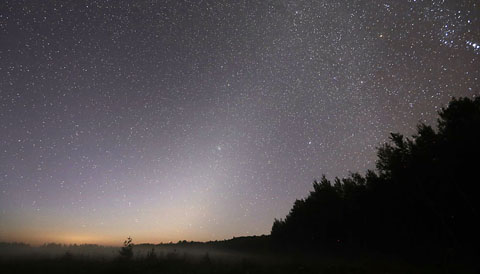
The Sacred Hour Before Dawn and an Evening Comet Surprise
Silence can sometimes be in short supply, but one sure place to find it is under a starry sky before the first blush of dawn. Comet 29P/Schwassmann-Wachmann erupts again!

Equuleus, the Constellation Nobody Knows
Often passed over, the constellation of the Little Horse has charms of its own, including double stars, galaxies, and asterisms. Let's saddle up and go for a ride.

Explore the Veil Nebula
The Veil Nebula, the tattered remains of an ancient supernova explosion, is one of the most spectacular objects in the night sky. Did you know it has two dozen parts visible in amateur telescopes?

Meet Pollux, the Red Giant with a Planet
Meet the stars: Pollux, one of the Twins in the sky, is a star that has swelled into its red giant phase while holding onto its Jupiter-like exoplanet, dubbed Thestias.

Comet 21P/Giacobini-Zinner Shines in September
Watch a binocular-bright comet leapfrog across Auriga in the next few weeks before a remarkable conjunction with the bright star cluster, M35.

See All Eight Planets in One Night
Four planets are great, but how about eight? You can see them all in a single night in the next couple weeks — if you play your cards right.

Shadow Play — Summertime Dark Nebulae for Binoculars
Using only binoculars, we explore a host of inky dust clouds, the dark nebulae that smudge the Milky Way on late summer nights.

R Coronae Borealis Awakes and Pluto Blocks a Star
Sometimes, it's just as exciting to watch a celestial object fade or disappear as it is to see it explode. We celebrate the "return" of a mysterious variable star and prepare for Pluto to occult a star.

Meet Regulus, Little King of the Ecliptic
Meet Regulus A, dubbed "Little King" and "Heart of the Lion," among the 25 brightest stars in the sky. The star belongs to a complex system, including a close white dwarf companion that makes its ultimate fate uncertain.

PanSTARRS Comet, Rocked by Outburst, Goes Green
Comet PanSTARRS (C/2017 S3) has erupted again! Now bright enough to see in binoculars, it might become a naked-eye object if it survives until perihelion.
