 SUNSET:


This Week's Sky at a Glance, August 7 – 15
It's Perseid meteor week! The shower peaks on the night of August 11th, but you may see the occasional Perseid any night and perhaps already have. Jupiter and Saturn shine in the southeast after dark. Bright Vega passes closest to overhead around 10 or 11 p.m.

August 2020: Planets & Perseids
The Perseids are upon us — and as you're looking out for shooting stars, look for Jupiter and Saturn low in the southeast as soon as night begins to fall.
This Week's Sky at a Glance, July 31 – August 8
Mars rises in the east around 11 p.m. daylight saving time this week, in Pisces. Watch for it to come up below the Great Square of Pegasus.

Cool Off with Pluto This Summer
Pluto might be a challenging target but it's well worth the effort. Grab your telescope and see if you can spot this distant, chilly world.
This Week's Sky at a Glance, July 24 – August 1
All this summer, there's no missing Jupiter and Saturn on any clear evening. Jupiter is the brightest point in the evening sky. Saturn is left of it.

500 Days Until the Total Solar Eclipse Over Antarctica
Travel to the ends of the Earth to experience a special — but risky — total solar eclipse in Antarctica.
This Week's Sky at a Glance, July 17 – 25
The waxing crescent Moon swells back into the evening sky this week, and Jupiter and Saturn are at opposition on the nights of July 13th and 20th, respectively.

Comet NEOWISE Dazzles at Dusk
Comet NEOWISE has captivated skywatchers with its stunning tail. Now that it's moved into the evening sky and climbing higher each night even more people will get a chance to see it.
This Week's Sky at a Glance, July 10 – 18
Jupiter and Saturn rise in twilight this week. Mars is a fire-beacon high in the southeast by the beginning of dawn. Venus, low as dawn begins to brighten, passes just 1° from Aldebaran on Saturday and Sunday mornings July 11th and 12th.

Comet NEOWISE Delights at Dawn
Skywatchers are treated to a naked-eye comet as NEOWISE emerges into the the dawn sky.

Two Bright Supernovae Light Up Nearby Galaxies
Two bright new supernovae — 2020nlb in M85 and 2020nvb in NGC 4457 — are now within the range of amateur telescopes in the western sky at nightfall.
This Week's Sky at a Glance, July 3 – 11
This is the time of year when the two brightest stars of summer, Arcturus and Vega, are equally high overhead at dusk. Arcturus is toward the southwest, Vega is toward the east.

Anticipation Grows for Comets NEOWISE and Lemmon
Two comets spark excitement for the coming week — NEOWISE might reach naked-eye visibility at dawn, while Lemmon will be visible in binoculars at dusk.

July 2020: Welcome Jupiter & Saturn
July's 11-minute Sky Tour astronomy podcast describes what to see in the summer sky in a casual, engaging way that your whole family can enjoy.
This Week's Sky at a Glance, June 26 – July 4
Every morning now, Venus is getting a little higher and easier to spot in the east-northeast as dawn brightens
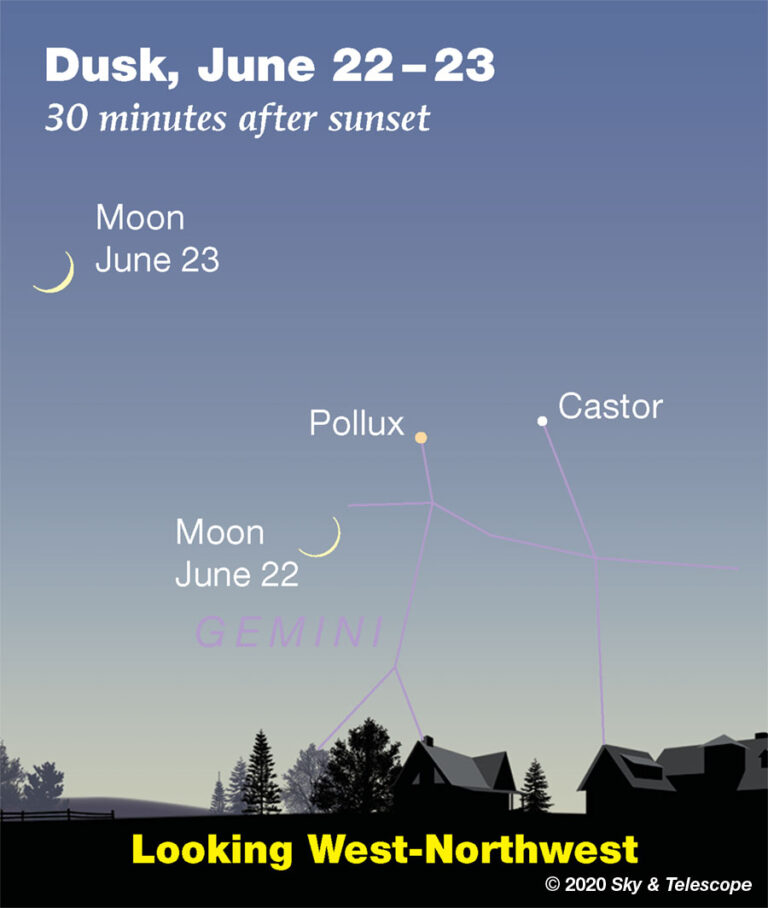
This Week's Sky at a Glance, June 19 – 27
Leo the Lion is mostly a constellation of late winter and spring. But he's not gone yet. As twilight ends look due west, somewhat low, for Regulus, his brightest and now lowest star: the forefoot of the Lion stick figure. The Sickle of Leo extends upper right from Regulus. The rest of the Lion's constellation figure extends for almost three fists to the upper left, to his tail star Denebola, the highest. He'll soon be treading away into the sunset.

Watch the Moon Pair Up with Venus on June 19th
Two crescents — the Moon and Venus — meet in the sky in the wee hours of June 19th.
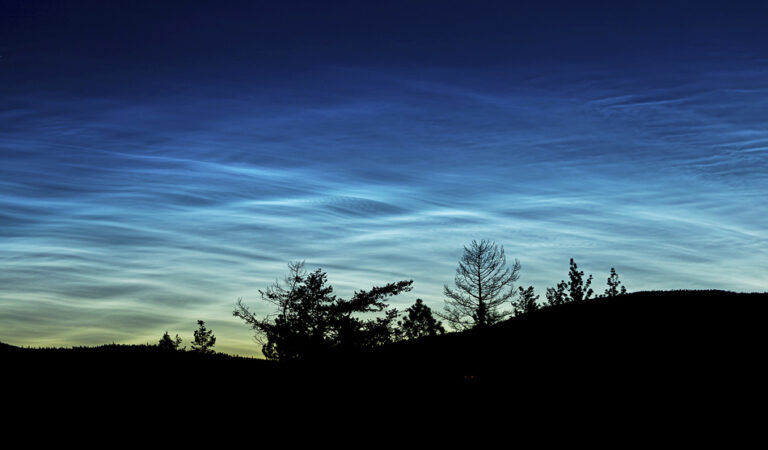
Nights of Noctilucent Clouds
Noctilucent clouds shimmer high in the sky during summer twilight at northerly latitudes.
This Week's Sky at a Glance, June 12 – 20
As we count down the days to official summer (the solstice is June 20th), the big Summer Triangle shines high and proud in the east after dark. Its top star is bright Vega. Deneb is the brightest star to Vega's lower left. Look for Altair farther to Vega's lower right.
This Week's Sky at a Glance, June 5 – 13
FRIDAY, JUNE 5 ■ Catch Mercury in twilight! It's under Pollux and Castor this week, as shown below. Mercury is ending its last good evening showing until winter 2021. Mercury is still visible in the western twilight, under the heads of Gemini, but it's fading. This scene is drawn for…
