 SUNSET:

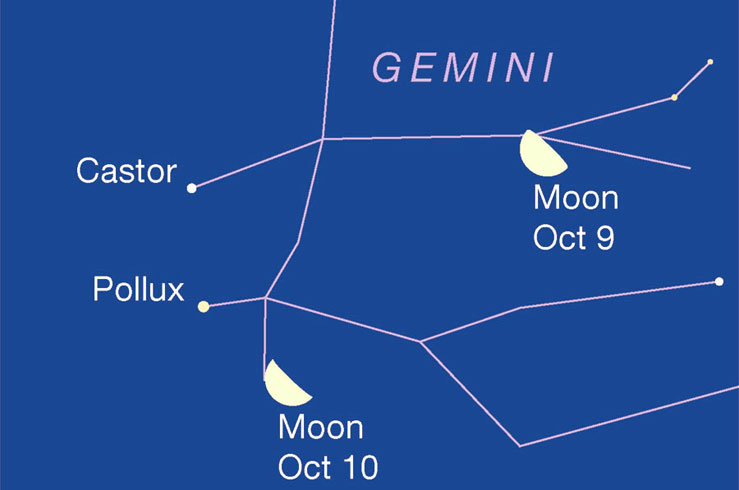
This Week's Sky at a Glance, October 9 – 17
Mars comes to opposition on October 13th. Although it was closest to Earth on the 6th, it is still at virtually the same distance all week, remaining 22.5 to 22.0 arcseconds in apparent diameter. This is bigger than we will see it again until September 2035.

Behold Mars! The Best View Until 2035
After a two-years hiatus Mars returns big and bright at opposition on October 13th, its best apparition until September 2035.
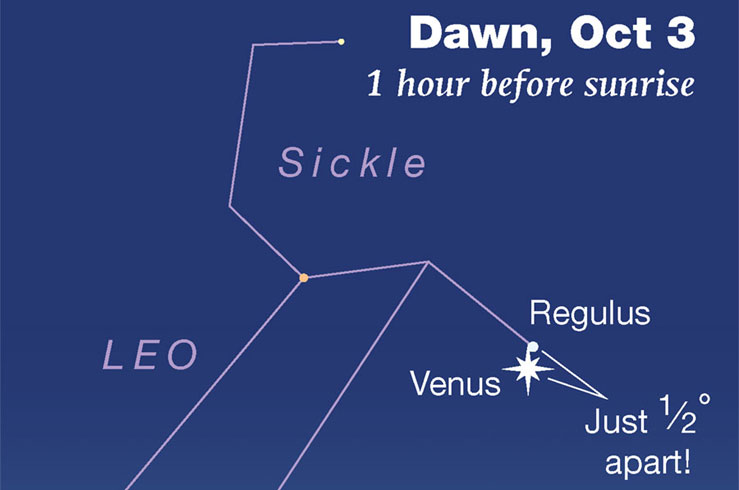
This Week's Sky at a Glance, October 2 – 10
Mars is closer this week than it will be until 2035! The Moon pairs up closely with Mars on Friday the 2nd — and occults Mars for parts of South America. Jupiter and Saturn, meanwhile, remain at their highest and best right around nightfall, lower in the south.

October 2020: Mars is the Star!
October evenings offer many wonderful night-sky sights — including a dramatic appearance by Mars — and you can find them by listening to our guided audio tour of the star-filled sky.

International Observe the Moon Night Is Here
International Observe the Moon Night is here. Step outside Saturday evening and admire our closest celestial neighbor with your family.
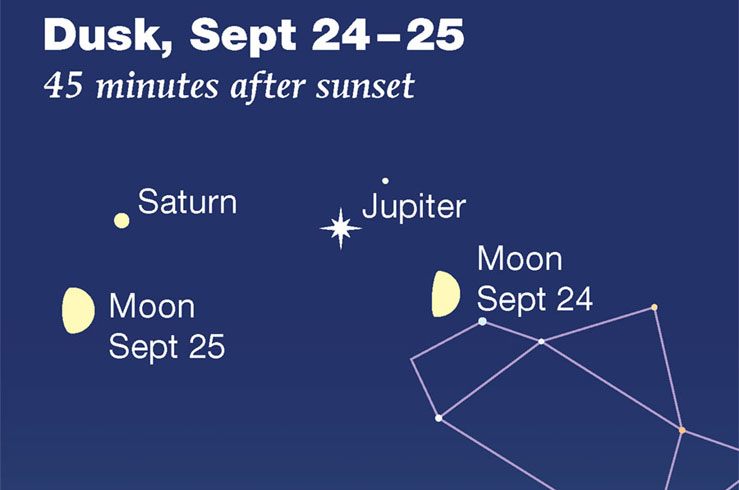
This Week's Sky at a Glance, September 25 – October 3
The Moon waxes through first quarter to gibbous this week, passing Jupiter and Saturn along the way. And by the end of twilight, Jupiter-bright Mars glares low in the east. It's big, bold, and almost at opposition!

See Beyond the Celestial Sphere: Follow These Lines into Space
For a little perspective, observe along a line that takes you to the Moon, past Jupiter and Saturn, the Kuiper Belt, and onward into our galaxy.

Explore Caroline Herschel's Celestial Showpieces
More than 200 years ago Caroline Herschel pointed her telescope at the heavens and discovered some of the finest deep-sky objects. Follow in her footsteps and see them for yourself.

This Week's Sky at a Glance, September 18 – 26
Jupiter and Saturn continue shining nearly level in the south at dusk. Meanwhile, the stars show the changing of the seasons: Just after nightfall, Cassiopeia has climbed higher in the northeast than the Big Dipper has sunk in the northwest.

Ice Giants: Neptune and Uranus
Spot Uranus and Neptune, and relive the original discoveries.

This Week's Sky at a Glance, September 11 – 19
Vega passes the zenith in late twilight. Vega is bigger, hotter, and 50 times brighter than our Sun. But at a distance of 25 light-years, it's 1.6 million times farther away. Jupiter and Saturn still dominate the south at dusk. And fiery Mars, close and almost Jupiter-bright, rises in the east around the end of twilight. It's at its highest and telescopic best in the south around 3 a.m. daylight-saving time.

Stormy Times on Jupiter, Comet Howell Steps Up, and More
Colder weather might be coming, but don't pack away that telescope! You'll miss a powerful storm that's remaking Jupiter's North Temperate Belt, a returning comet, Mira on the rise, and a bright supernova in the Great Bear.

This Week's Sky at a Glance, September 4 – 12
Mars is big, bright and close as it nears opposition! It nears the gibbous Moon this weekend.

Meet Antares: The Star That Is Not Mars
Antares is a red supergiant that — like Betelgeuse — will one day go supernova.

September 2020: Four Planets & More!
Take advantage of September's beautiful evenings to gaze upward as you listen to our guided tour of the star-filled sky.
This Week's Sky at a Glance, August 28 – September 5
Betelgeuse is dimming again. . . somewhat. After its historic fade last winter to magnitude +1.6, Orion's red supergiant Betelgeuse fully recovered, to +0.4, before it disappeared into the sunset for the season. But now as it emerges low in the east before dawn, it seems to have faded back…

Astronomy and Stargazing Projects
Take a Roller Coaster Ride with Algol, a Fast Eclipsing Binary
How would you like to see a star drop two magnitudes in the time it takes to eat dinner? Easy to do. Just check out one of these fast eclipsing binaries — they'll make your head spin.

This Week's Sky at a Glance, August 21 – 29
After dark, Jupiter and Saturn shine in the southeast to south, lined up almost level now. And Fomalhaut, the Autumn Star, is making its inevitable appearance above the southeast horizon.
This Week's Sky at a Glance, August 14 – 22
Jupiter and Saturn line up level in the south earlier in the evening now, as summer proceeds. How early in twilight can you see them both? High upper left of them shines Altair. As night comes on, look for the Sagittarius Teapot to Jupiter's lower right.

Perseids Peak August 11–12 — Get Ready for the Show
The Perseid meteor shower is like no other. Every August it delivers up to 100 meteors an hour in pleasant weather conducive to getting outside and staying up late. What's more, most kids still aren't in school, making it possible for the entire family to enjoy the event.
