 SUNSET:


Meet the Pleiades, the Seven Sisters
The Pleiades are actually a star cluster of thousands of stars enshrouded in dust and gas, and they're easy to find if you know where to look.

This Week’s Sky at a Glance, February 21 – 29
Venus is the big bright "Evening Star" shining in the west during and after dusk. To its right or lower right as the stars come out is the Great Square of Pegasus, sinking down on one corner.

Explore the Winter Hexagon
This expansive region is home to plenty of bright stars and deep-sky wonders.

Is Betelgeuse Approaching a Crossroads?
Astronomers all over are waiting with bated breath to see what Betelgeuse will do next. Is it going to start brightening again on February 21st? Or will it continue to surprise?
This Week’s Sky at a Glance, February 14 – 22
By 8 or 9 p.m. the Big Dipper stands on its handle in the northeast. In the northwest, Cassiopeia stands on end at about the same height.

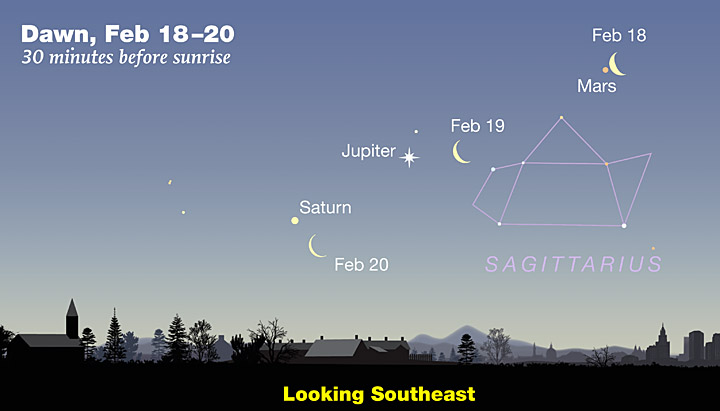
Watch the Moon Occult Mars Before Sunrise on February 18th
Occultations of stars by the Moon occur routinely, but planetary lunar occultations are much rarer birds. That's why I hope you'll make the effort Tuesday morning February 18th to watch the waning crescent Moon occult the planet Mars.
This Week’s Sky at a Glance, February 7 – 15
Venus is the bright "star" shining in the southwest during and after twilight. Fainter Mercury is far down to its lower left as twilight fades.

Catch the Full Moon High in the Sky for Telescope Treats
A nearly full Moon offers plenty to see and ponder.
February 2020: Five Planets & More!
If you drag yourself outside before dawn and then wait until after sunset, you can spot all five of the naked-eye planets. And the Winter Hexagon glides high in the evening sky.

The Latest on Betelgeuse, Plus a Bright Supernova and New Comet Iwamoto
The sky provides. This winter, the fading of Betelgeuse caught us all by surprise. Now, as January wraps up, we can add a new comet discovery and a supernova bright enough to see in a 6-inch telescope to an ever-growing list of seasonal sky wonders.
This Week’s Sky at a Glance, Jan. 24 – Feb. 1
Betelgeuse remains dim. The red supergiant Betelgeuse in Orion's shoulder has always been slightly variable, but for the last month or so it's been in an unusually low dip. As of January 22nd it was still about visual magnitude +1.5 instead of its more typical +0.5, It's clearly fainter than similarly-colored Aldebaran, magnitude +0.9, with which it's often compared and normally outshines quite obviously.

See Ancient “North Stars" Eclipse Each Other
The ancient pole star known as Thuban turns out to be an eclipsing binary. If you're up for a challenge, you can see the eclipses for yourself.

A Quick Tour of Orion, the Hunter
The evening sky this week presents a near perfect opportunity to explore winter's marquee constellation, Orion, with binoculars or a small telescope.
This Week’s Sky at a Glance, January 17 – 25
Is your sky dark enough for you to see the winter Milky Way? In mid-evening now it runs vertically up and across the zenith: from Canis Major low in the southeast, up between Orion and Gemini, through Auriga and Perseus almost straight overhead, and down through Cassiopeia, Cepheus, and Cygnus to the northwest horizon.

Comets to Catch in 2020
Here's the lowdown on which comets will brighten our skies in 2020.
This Week’s Sky at a Glance, January 10 – 18
Venus, shining at magnitude –4.0 in Capricornus, dominates the southwest during and after twilight, higher each week. It will shine as the grand "Evening Star" all winter and into the spring.

Solar and Lunar Eclipses in 2020
Six eclipses occur in 2020, with one total and one annular solar eclipse in the mix. But the four lunar eclipses will be disappointing brushes through the fringe of Earth's shadow.
This Week’s Sky at a Glance, January 3 – 11
Astronomy? Skywatching? Daily sky sights for the unaided eye, binoculars, and telescopes, from Sky & Telescope magazine.
This Week’s Sky at a Glance, Jan. 31 – Feb. 8
Betelgeuse remains dim. The red supergiant Betelgeuse in Orion's shoulder has always been slightly variable, but for the last month or so it's been in an unusually low dip. Now magnitude 1.6!

January 2020: Mid-winter Wonders
New Year's resolution: Do more stargazing! (Hint: Get an easy and entertaining head start by downloading this month's Sky Tour podcast for a guided tour of the night sky.)
