 SUNSET:

 2
2Want to build and expand your astronomy community? Go hyperlocal.
Our new neighbors went door-to-door to introduce themselves, and they brought us cookies. I have been to their house twice for casual crafting, and they hosted a s’mores party around a backyard fire pit. They’re focused on building real community, and our neighborhood is the better for it.
I wondered what I could do to follow their example.
Amateur astronomy is the perfect hobby for this particular introvert — it’s quiet and in the dark. Most of my cosmic explorations are solo endeavors. Even when I’m at a star party and sharing telescopes and anecdotes, our voices are hushed as we concentrate on a common interest in the stars. Daylight hours find me more shy.
But neighborly fellowship won’t always be ice cream socials and kids’ bike parades. When the world is on fire, strong communities assemble a bucket brigade. I wanted to be a part of that network of reliance, but other than knitting patterns and snacks, I wasn’t sure what I could contribute.
Until I realized I can host hyperlocal star parties. I can share wonder and joy in trying times.
There’s a public park about a half-block from my home in Portland, Oregon, but it’s no dark-sky site. The green space is bordered on three sides by homes, with woods and wildlife claiming the fourth. A sharp streetlight welcomes visitors at the main entrance, and unless you’re hiding in the trees, its bright range is inescapable. But the park offers not-terrible clearance in most directions, and I’ve braved the coyotes and low-flying bats a few times for the deep-sky objects that are blocked by buildings and trees at home.
Here’s the challenge: While summer boasts more reliably clear skies in the Pacific Northwest, our latitude means very late sunsets, and even later astronomical twilight and full night. Asking folks to come down to the park at midnight doesn’t make for a well-attended, community-building event.
So, the Moon.
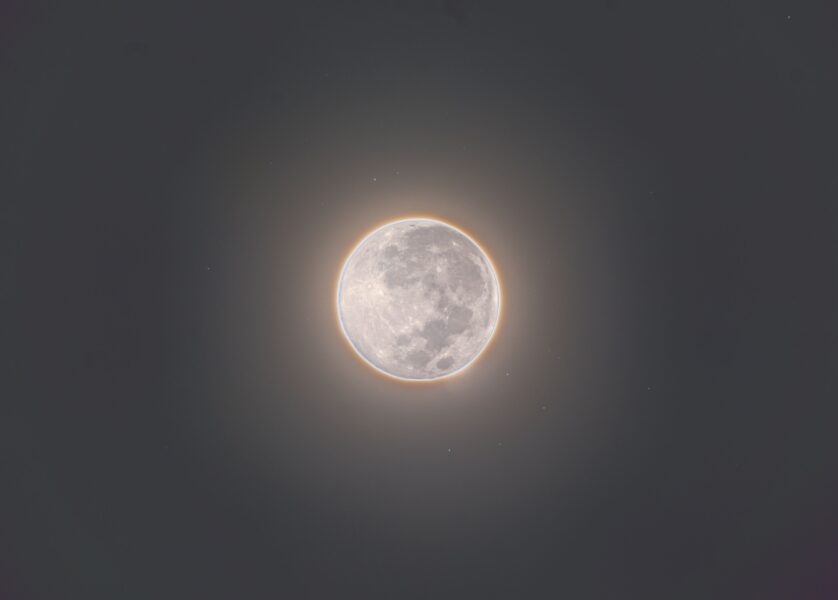
Who doesn’t like the Moon? It can be observed with or without instruments, no dark sky required. I picked the Friday during the waxing Strawberry Moon, then gave the official “go” on the neighborhood Facebook group a few hours ahead of time. Shortly before 9 p.m., I headed down to the park with my Dwarf 3 smart telescope and a few pairs of binoculars to share.
Within minutes, a woman and two young girls were headed my way.
While the mom zoomed in and out on the live view of the Moon on my tablet screen, the kids were excited about the binoculars. At first, they spent more time peering at dogs out for an evening stroll than they did the Moon. But then they looked up and got curious: What are those dark spots on the Moon? How deep are the craters?
“Some of them are so deep that if you were standing at the bottom of the crater, the ridges above would look like mountains,” I told them.
“Whoa!” one girl exclaimed.
The other lowered the borrowed binoculars to ask, "What's your job?"
"I'm a writer,” I said.
"Oh," she replied with obvious disappointment. "I thought you, like, worked for NASA." She lifted the binoculars and returned her attention to the Moon.
Several more neighbors filtered in over the next hour. My partner M wandered in with Jax, our giant Danelab, to supervise. Our friend and neighbor Nancy arrived just before I was about to pack up. She apologized for being late as I showed her the smart scope’s live lunar image. Then I handed her a pair of 12x54 binoculars.
“Oh! Oh, my gosh! There it is!” Nancy lowered herself to the ground — to steady her hand-held view and maybe also because she was overcome by awe. “That’s our Moon! Earth’s Moon. It’s ours, and no one else’s!”
This was the reaction I’d been hoping for all night. I delayed my departure until Nancy had seen enough.
But she wanted to know more. She peppered me with questions about planets as I stowed my telescope. We brainstormed more star parties while she walked us back to the house. Later that night, I sent her a link to a pair of inexpensive binoculars so she could purchase her own. I also attached a screen capture of the Moon from the smart telescope.
The reviews on Facebook the next day were positive. It’s possible that I’ve found my way to contribute, inspire, and forge bonds. Maybe stargazing in the park on the second Saturday, or whenever, will be a recurring event on the neighborhood calendar. Perhaps community members will become interested in dark sky initiatives. In the future, I hope my neighbors will bring their own instruments to share, and that we can gaze up together as we strengthen our community and deepen our understanding of who we can rely on, not only in the light but also in the dark.


Comments
Jeff
June 30, 2025 at 1:42 pm
I love hearing about astronomers who engage with their local community. This is a really great thing to do. Making connections with neighbours is so important, and to engage people with the night sky at the same time is something very special.
You must be logged in to post a comment.
Jen Willis
July 1, 2025 at 2:19 pm
Thanks, Jeff! Given that our days will be quite long for a while yet, I'm thinking our next adventure might be solar observation (via my smart scope with filters). As the year grows long and the nights come sooner, I hope to do more proper stargazing with my neighbors.
You must be logged in to post a comment.
You must be logged in to post a comment.