 SUNSET:

 0
0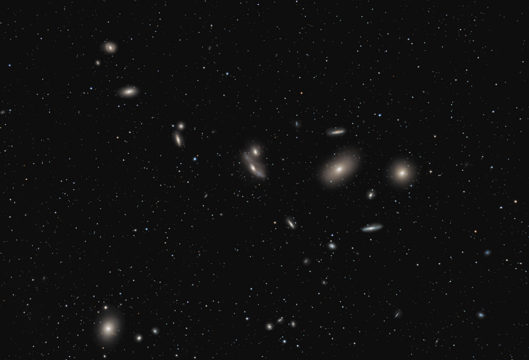
Joe Renzetti / S&T Online Photo Gallery
Since I first saw a galaxy for myself — as more than just a fuzzy blob — I have looked forward to galaxy season between March and May, when galaxies are most abundant in the sky. Adding a small smart telescope to my astronomical arsenal has further opened the sky and deepened my enthusiasm.
And every year, I run out of time.
Part of my problem is rooted in my own eagerness. Because I’m so keen to hunt for galaxies, I tend toward optimism. I believe I will have clear skies every night these three months, no equipment failures or personal conflicts, and no insomnia when I finally retire for the evening so I’m not a sleep-deprived slug the next day.
My excitement makes me greedy. I take a Pokémon approach to galaxies: I want to catch them all! When planning the night’s observations in the Stellarium app, I’ll tap on every tiny red oval. Another galaxy! Add it to the list!
I am overwhelmed by galactic riches. I might, finally, start a master record of astronomy observations, beyond my scribbled nightly logs. This would help avoid duplications when clear skies are few and far between. And when I’m tempted by another red oval or an image sent by a friend, I’ll have a reference to confirm, “Yep, already seen it.” But while checking off items on a list gives me a sense of accomplishment, ticking boxes isn’t the goal of my galaxy gazing. I am reaching for wonder.
As darkness falls, I am impatient. Most of these galaxies are beyond the capabilities of my optical equipment, and every galaxy takes time to image in my Dwarf 3 smart telescope — time measured in drained battery power, dwindling digital storage, and lost sleep.
But as the current target comes into focus on my tablet, I ponder what it must have been like when astronomers and laypeople alike realized that our Milky Way is but one of billions or trillions of galaxies in the expanding universe. Such a fundamental shift in understanding must have been unnerving and wondrous. I feel a tiny fraction of that every observation night during galaxy season.
When the first image was released from the James Webb Space Telescope, I lay on my office loveseat for hours, staring at that deep field. So many galaxies in a single image! I zoomed in and out, pinching and stretching the screen with my fingers. I felt like I was living inside of a power of ten video, all the while knowing this image shows only a minute section of our sky.
Galaxy hunting reinforces that limitless feeling. As the spiral arms build on my screen, I’m curious about who might be looking back at us. I feel confident hope that we aren’t alone in the universe. I imagine infinite worlds of music, science, nature, and philosophy. A few weeks ago, I showed an image of the Pinwheel Galaxy (M101) to my partner M and asked him to consider how many millions of civilizations — past, present, and future — might be contained in that picture. He came back at me with the Fermi Paradox, but I’m looking far beyond the Milky Way, even if we are highly unlikely to make meaningful contact with our galactic neighbors.
They’re small on my screen, yet I marvel at the immensity of galaxies, each containing hundreds of billions of stars. Stargazing reliably stirs true uplift, but when I am observing galaxies, that sense of wonder is exponentially greater. I’m bound to this rocky planet and yet part of an unfathomably vast universe. My mundane concerns are tinier than microbes on an anthill in comparison. [Bonus points if you caught the Contact reference.]
My initial impatience of watching the clock and monitoring battery levels fades as I linger over fresh images of my favorites — like the interacting Whirlpool Galaxy (M51), the Whale Galaxy (NGC 4631) with its “hockey stick” companion (NGC 4656) and that distorted companion’s “hook” (NGC 4657), as well as the show-stopping Markarian’s Chain in the Virgo Cluster. There’s a deep thrill that comes with each new-to-me target, too, including the Waterbug Galaxy (NGC 5033) and edge-on NGC 4302 with the nearby “spaghetti dish” (my designation) NGC 4298. I even caught asteroid 8 Flora hanging out near the Leo Triplet.
Even with a string of unseasonably cooperative spring nights holding the clouds at bay, I can’t get to every galaxy on my growing list. In daylight, I prioritize targets for the next clear night, but it’s not enough. I need more time. And then I feel genuine disappointment as the calendar turns to June and beyond, bringing the end of galaxy season. I will never catch them all.
And I love that.


Comments
You must be logged in to post a comment.