 SUNSET:

 1
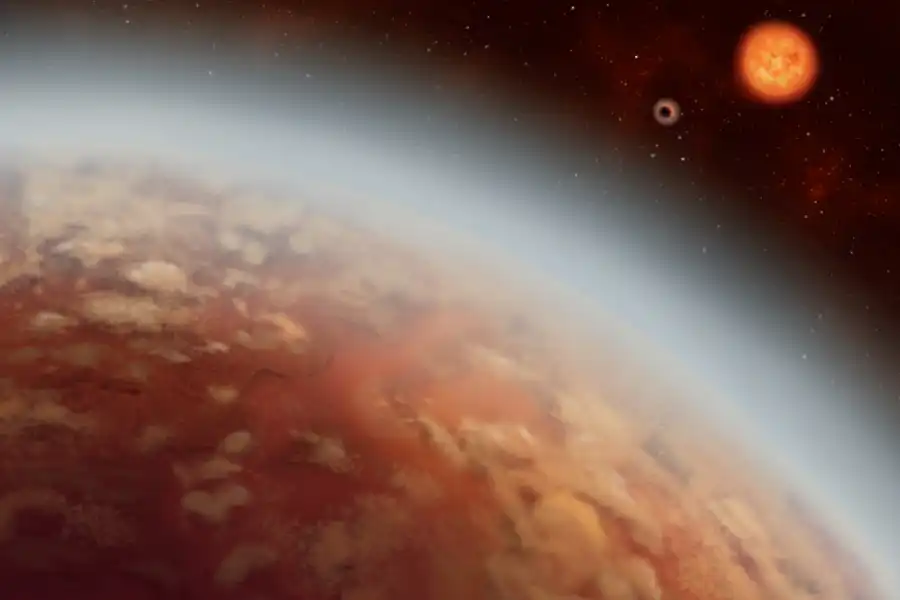
1Astronomers have discovered a ready-to-image super-Earth candidate less than 20 light-years away.
A. Boersma
Less than 20 light-years from Earth is a new candidate planet: a super-Earth that has at least four times the mass of our own. Thanks to the candidate’s proximity, it could be observed by next-generation telescopes — but confirmation of the planet’s existence must come first.
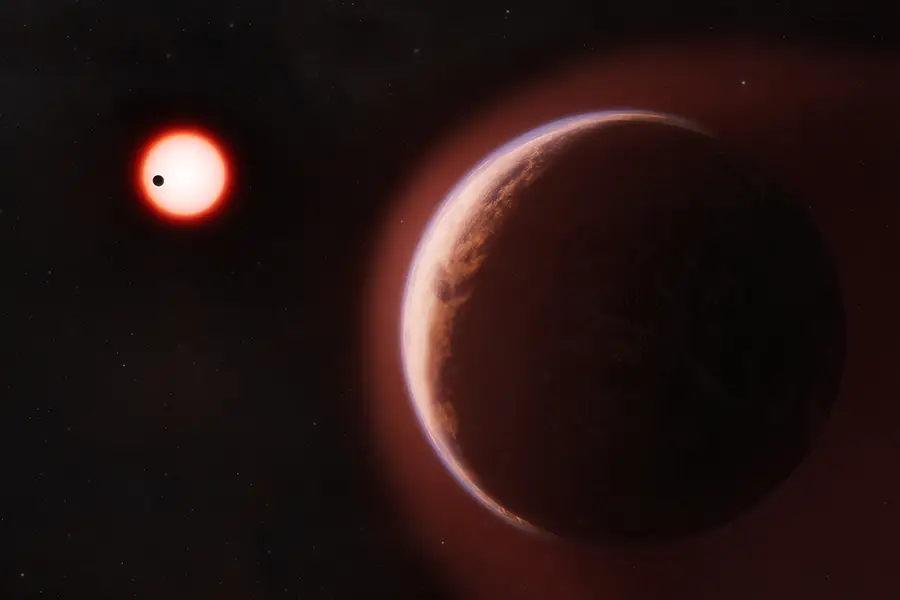
One planet was already known to closely orbit the M-class red dwarf star GJ 251. Also a super-Earth, it orbits edge-on from our perspective, briefly dimming its star’s light when passing in front of it. But more than 20 years of data have been collected on this nearby star, and now a new analysis has turned up a second signal, published in the Astronomical Journal. This signal could come from a planet that’s a little farther out — a super-Earth on a 54-day orbit around its diminutive star.
The star, which is 4.6 billion years old, is past the flaring phase of its youth. Still, stellar activity has the potential to masquerade as a planetary signal, acknowledges the team, led by Corey Beard (University of California, Irvine). The astronomers uncovered six repeating dips in luminosity, four of which come from stellar activity and rotation, and one of which comes from the known planet GJ 251b. The sixth they identify as the signal from the new candidate planet.
Goldilocks Candidate
“The exoplanet is in the habitable or the ‘Goldilocks Zone,’ the right distance from its star that liquid water could exist on its surface, if it has the right atmosphere,” says team member Suvrath Mahadevan (Penn State).
While the candidate planet is in the habitable zone, it’s probably not all that habitable for humans. No observations exist yet of its atmosphere, but given its size, mass, and orbit, Mahadevan’s team used a climate model to test potential compositions. To have liquid water on the planet’s rocky surface — perhaps even a whole ocean’s worth — the atmosphere would have to be thick and dominated by carbon dioxide. (An Earth-like atmosphere would instead result in a freezing surface temperature of -120°C.)
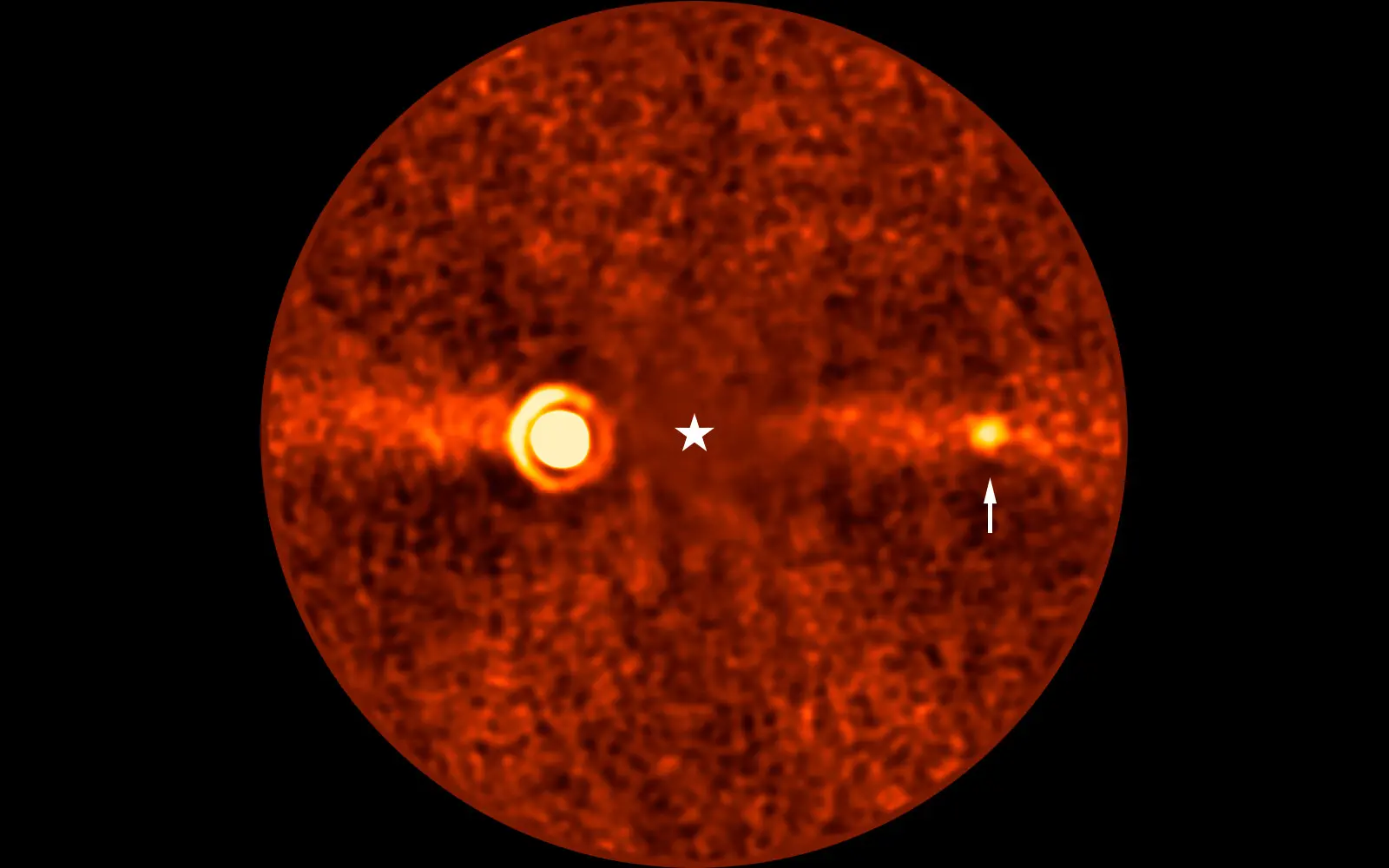
NASA’s Habitable Worlds Observatory mission concept, as it’s currently formulated, wouldn’t be able to capture a direct image of GJ 251c. In general, habitable-zone planets around red dwarfs are out of reach of the observatory because they lie too close to their host stars. A potential alternative is the Thirty Meter Telescope. The project has been plagued by local resistance and current budget uncertainties. But if the TMT were to move forward, the teams says we could see a direct image of this habitable-zone planet in the next 10 years.
Read more about the result in the Astronomical Journal and in Penn State’s press release.
About Monica Young
Monica Young, a professional astronomer by training, is News Editor of Sky & Telescope.




Comments
Anthony Barreiro
October 28, 2025 at 1:24 am
The wikipedia article on Gliese 251 says that the star is in Gemini, close to the border with Auriga, 49 arcminutes south-southeast of Theta Geminorum. At magnitude +9.89 GJ 251 would be visible with a 100 mm telescope.
https://en.wikipedia.org/wiki/Gliese_251
You must be logged in to post a comment.
You must be logged in to post a comment.