 SUNSET:

 2
2Gravitational lenses, Martian dust devils, and gaseous filaments in the galactic center provide a glimpse of cosmic perspective.
Cosmic Alignment

ESA / Webb / NASA / CSA / G. Mahler
A rare alignment has created a portal into the early universe. The gravity of a massive galaxy in a relatively nearby galaxy cluster (SMACS J0028.2-7537) has bent the light coming from a more distant background galaxy, twisting its image into an Einstein Ring. The mirage is not unlike the distorted images you can see when you look through the bottom of an empty wine glass.
The lensing galaxy is an elliptical galaxy, featureless but for a bright core. The background galaxy, distorted as it is in this image, is nevertheless clearly a star-forming spiral, studded with gaseous cloudsand bright clumps of newborn stars.
The Einstein Ring was found as part of the Strong Lensing and Cluster Evolution (SLICE) project, led by Guillaume Mahler (University of Liège, Belgium), which surveys 182 galaxy clusters spanning 8 billion years of cosmic time using James Webb Space Telescope's Near-infrared Spectrograph. The survey also incorporates Hubble data. This image was featured as Webb's Picture of the Month.
Starbirth Near the Magnetic Maw
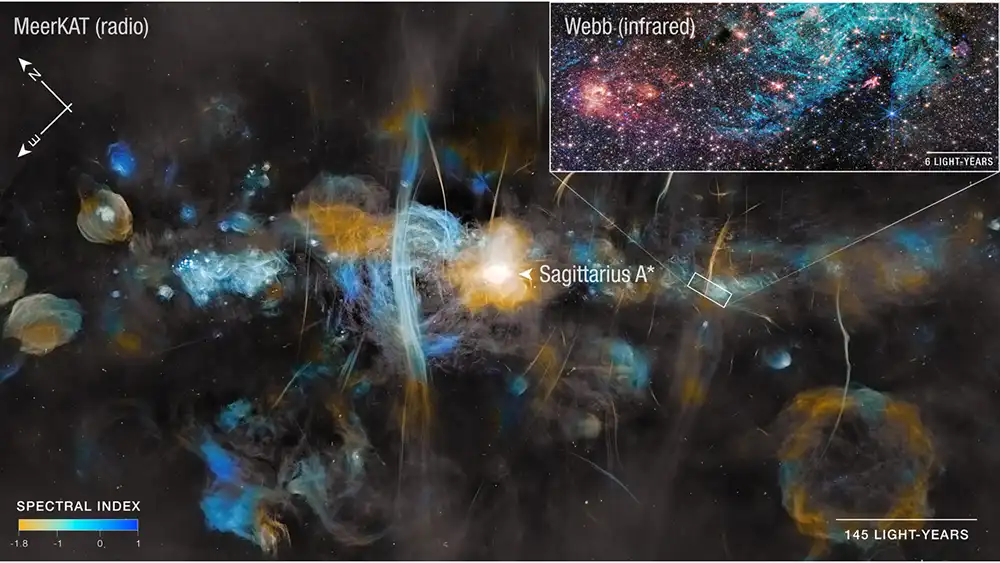
NASA / ESA / CSA / STScI / SARAO / Samuel Crowe (UVA) / John Bally (CU) / Ruben Fedriani (IAA-CSIC) / Ian Heywood (Oxford)
Many of our readers may be familiar with Sagitarrius A*, the name for the supermassive black hole that sits quietly at the center of our galaxy. Less familiar perhaps is Sagitarrius C, one of the star-forming regions around this black hole. Webb images show that strong magnetic fields are suppressing star formation in this region.
Sagittarius C is part of the Central Molecular Zone, the galactic center named for its plentiful interstellar gas. The CMZ has been the focus of intensive study. The MeerKAT survey, for example, resulted in the larger radio image above, highlighting the bubbles of starbirth and stardeath. The winds of newborn stars carve out cavities, as do the supernova explosions of dying massive stars. In between, towering filaments of dust and gas provide evidence of powerful magnetic fields associated indirectly with the black hole at image center. These filaments form as the extreme tidal forces from the black hole stretch out gas clouds and amplify their magnetic fields.
“A big question in the Central Molecular Zone of our galaxy has been, if there is so much dense gas and cosmic dust here, and we know that stars form in such clouds, why are so few stars born here?” says John Bally (University of Colorado, Boulder).
Bally helped lead a Webb investigation of Sagittarius C, finding long structures that echo the filaments scattered throughout the galactic center. The images hint that magnetic fields are likely suppressing the star formation in this region. Gas clouds collapse into stars when the gravity of the central mass overcomes outward pressures, such as the push produced by molecules' and atoms' thermal motions. The addition of powerful magnetic fields can likewise counteract gravity by preventing gas from falling toward the central mass.
Combining Webb data with data from other infrared observatories confirmed the presence of only two massive stars, each already more than 20 times the Sun's mass, as well as five lower-mass candidate stars that still need confirmation.
Additional details can be found in two papers published in the April 10th Astrophysical Journal (Bally et al. and Crowe et al.)
Aurorae on Neptune
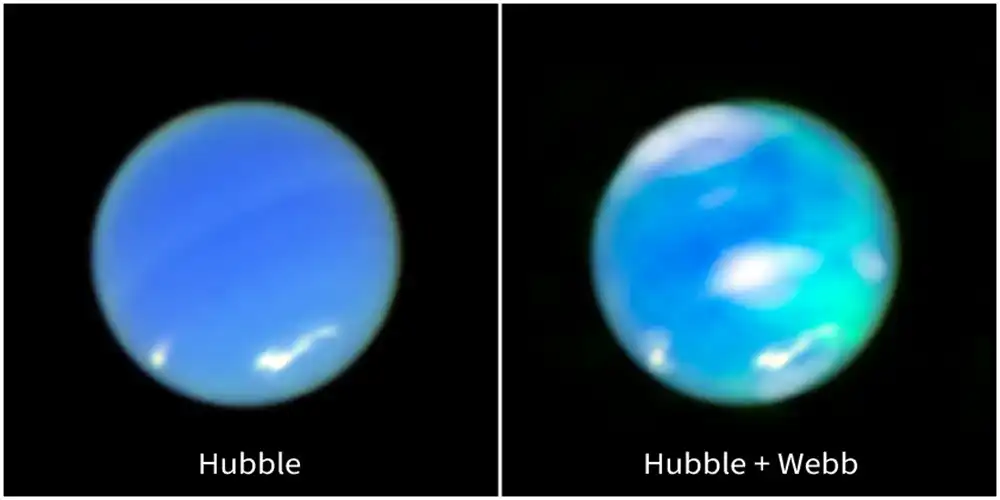
NASA / ESA / CSA / STScI / Heidi Hammel (AURA) / Henrik Melin (Northumbria University) / Leigh Fletcher (University of Leicester) / Stefanie Milam (NASA-GSFC)
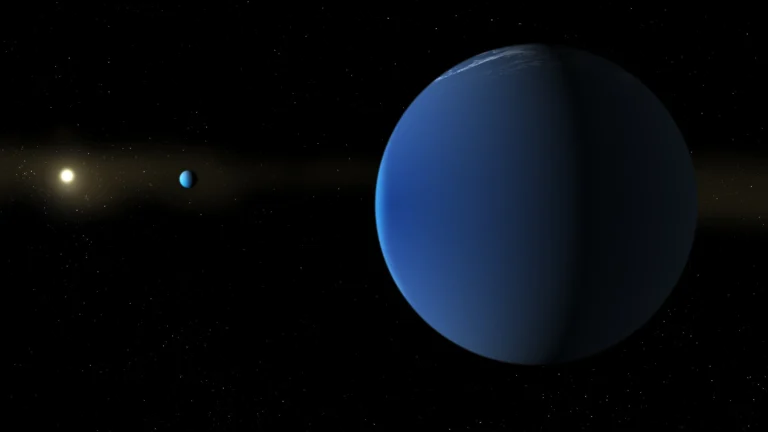
Before now, space telescopes have allowed us to image aurorae on Jupiter, Saturn, and Uranus, not to mention Earth, Mars, and even Venus. Now, Webb observations, led by Leigh Fletcher (University of Leicester, UK), has enabled astronomers to confidently capture aurora on Neptune for the first time.
The aurorae made themselves known by emission from the ionized hydrogen molecule, H3+, colored cyan in the image above. That light appears at mid-latitudes relative to the planet's rotation, which is a bit strange if you're used to the polar lights on Earth. But Neptune's magnetic field is tilted a full 47 degrees from its rotational axis, so the aurorae are in fact exactly where they're expected to be.
Neptunian aurorae have remained undetected for so long because it's so very cold out there, which inhibits ionization and makes the aurora weaker and more difficult to detect. In fact, the Webb observations show that the temperature in the upper atmosphere was twice as warm when Voyager 2 swung by in 1989 than it is now. It's unclear why the atmosphere is so much cooler now, but the timescale of the change (34 years) make it clear that neither Neptune's seasons (each 40 years long) nor the solar cycle.
Find additional details in Nature Astronomy.
Dust Devil Cannibal

NASA / JPL-Caltech / LANL / CNES /CNRS / INTA-CSIC / Space Science Institute / ISAE-Supaero / Univ. of Arizona
Towering columns of swirling dust are common on Mars, particularly in the crater in which NASA's Perseverance rover sits. The rover was about 1 kilometer (0.6 mile) away when it took the photos that became the video shown above.
Scientists have measured the larger dust devil to be about 65 meters (210 feet) wide — a little wider than the Leaning Tower of Pisa is tall — while the smaller, trailing dust devil was roughly 5 meters wide. Two other dust devils can also be seen in the background (left and center).
The dust devils are an important part of weather on Mars (especially for solar-powered robotic explorers), in part because they're responsible for about half the dust in the thin Martian air. The devils form as air near warmer ground heats up and rises. Cooler air rushes in, then heats and also rises. Incoming air brings with it both dust and rotation, and the spin only speeds up as the column of air continues to rise. As a larger, stronger dust devils encounters a smaller one, they quickly merge, with the larger subsuming the smaller.
We've seen dust devils on Mars since Viking 1 took images of one from orbit in 1978, but Perseverance has provided an unprecedented view of their activity, even recording their sound using its SuperCam microphone.
About Monica Young
Monica Young, a professional astronomer by training, is News Editor of Sky & Telescope.



Comments
Joe Slomka
April 7, 2025 at 11:27 am
The Astronomy and Observing News was disturbing.
The first group of observations described interesting scenes, but
the pictures would not appear. Only when we got to the Dust Devils
could I actually see an image.
Is there something wrong with my computer that the pictures do not appear, or is there problem on your end.
I am a reader for a long time an enjoy the science and the pictures.
You must be logged in to post a comment.
Monica YoungPost Author
April 7, 2025 at 12:50 pm
Hi Joe, Perhaps they're just taking some time to load? I'm only one data point, but the images are showing up on my end.
You must be logged in to post a comment.
You must be logged in to post a comment.