 SUNSET:

 0
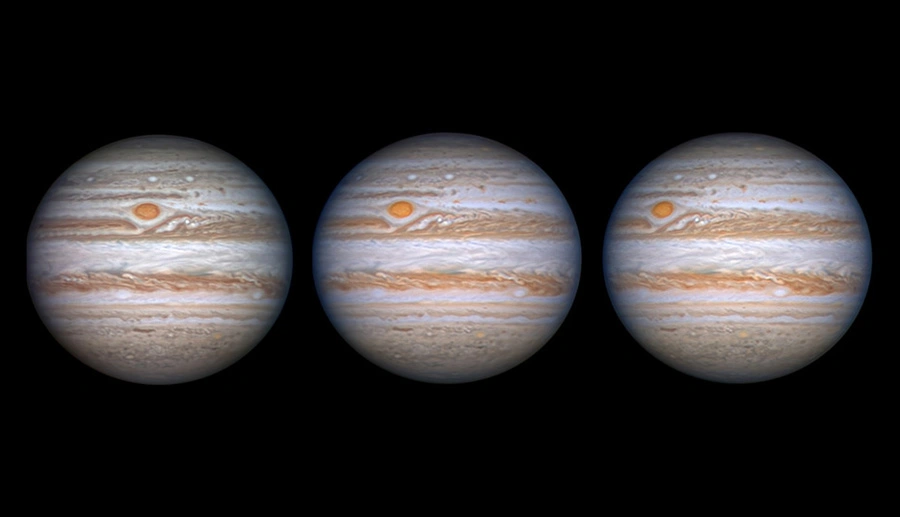
0Jupiter’s having a special moment! Don’t miss the giant planet at its best when it reaches opposition this week.
Christopher Go
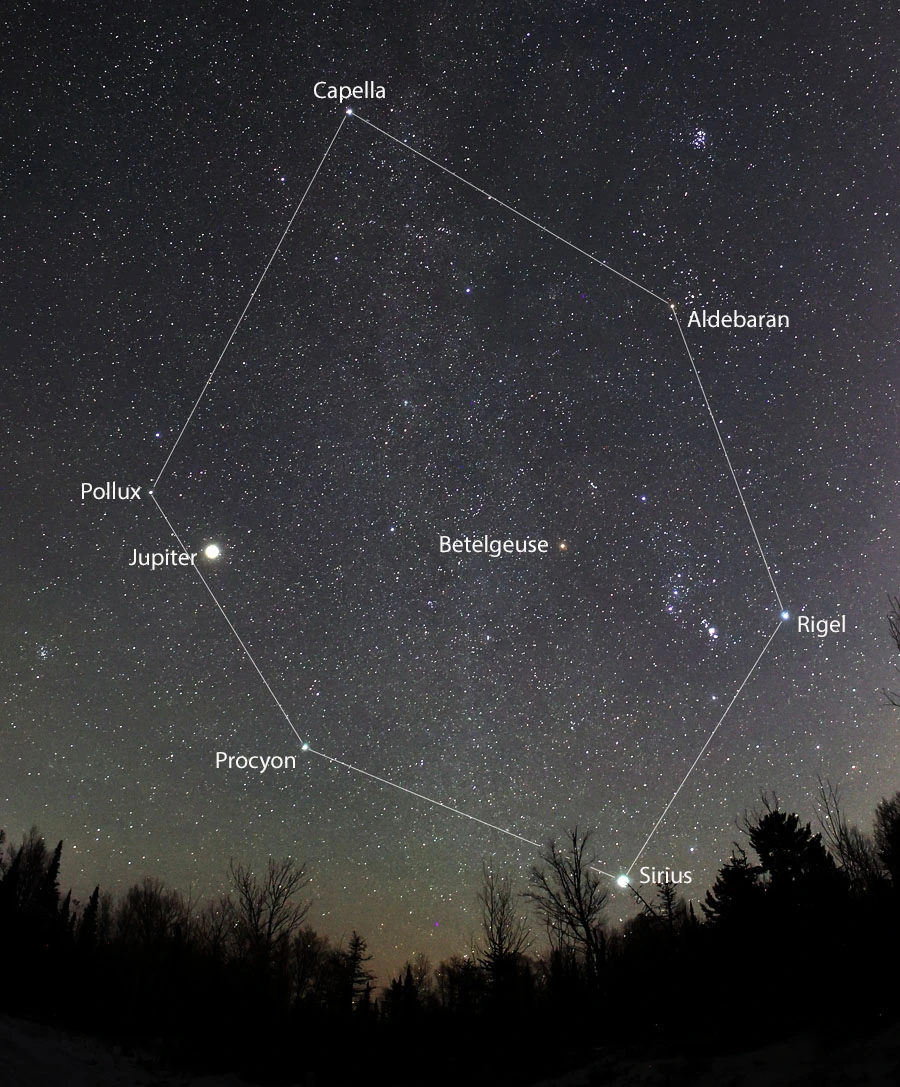
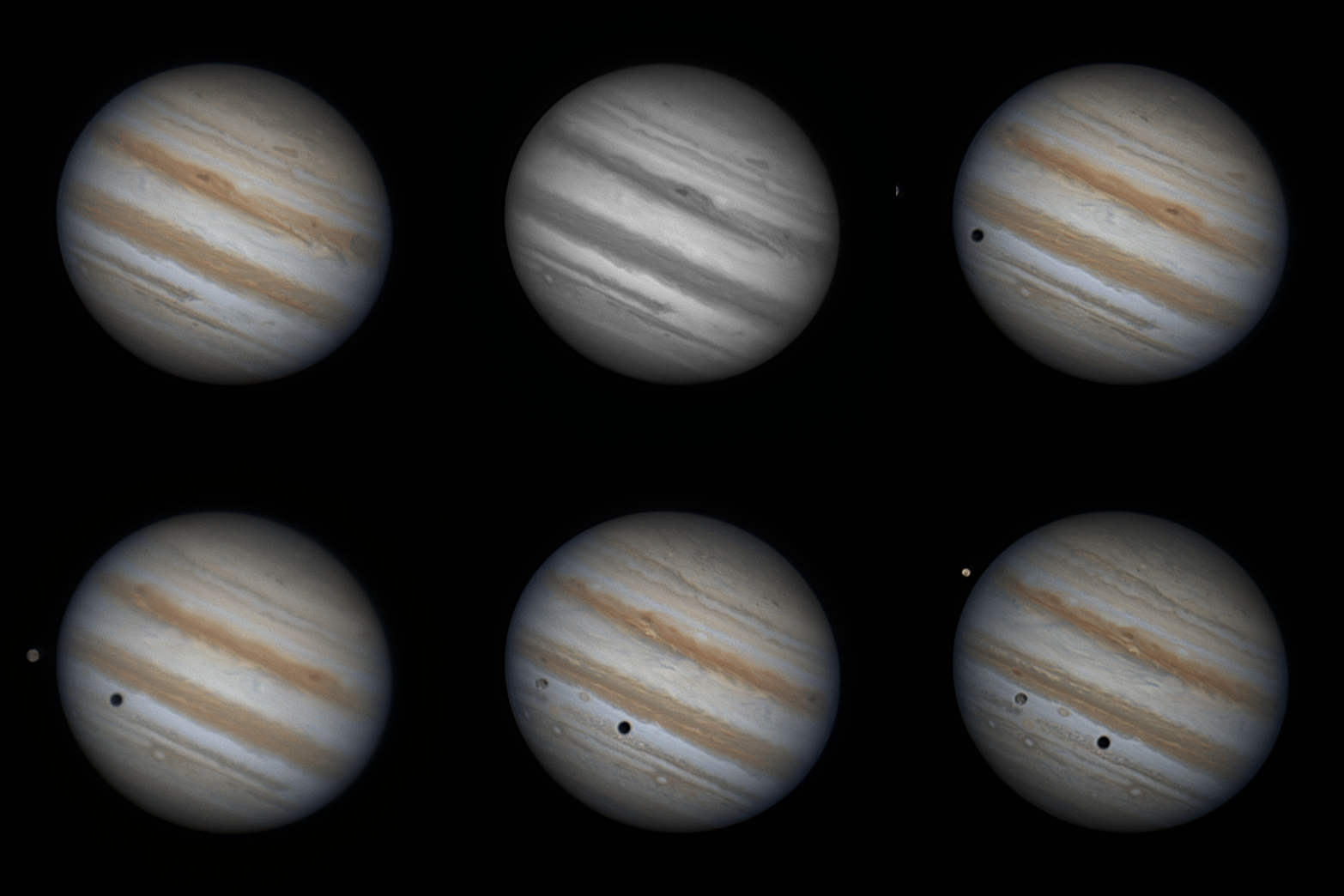
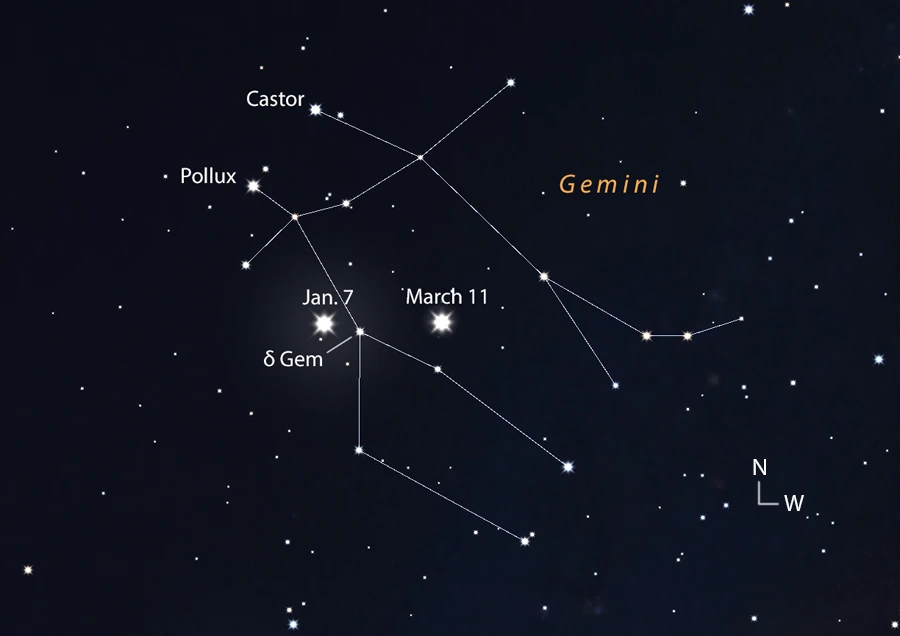
Jupiter has been teasing us for months. Thanks to its high-seated position in Gemini, it's been on the observing menu since last November. Shining brighter than any of the nighttime stars, the gas giant is irresistible. Given a clear night, I feel compelled to point my telescope at it. Like an old-fashioned department store, the biggest planet has it all — storms, spots, belts, colorful clouds, and the enchanting perambulations of its four brightest moons.
Stellarium with annotations by Bob King
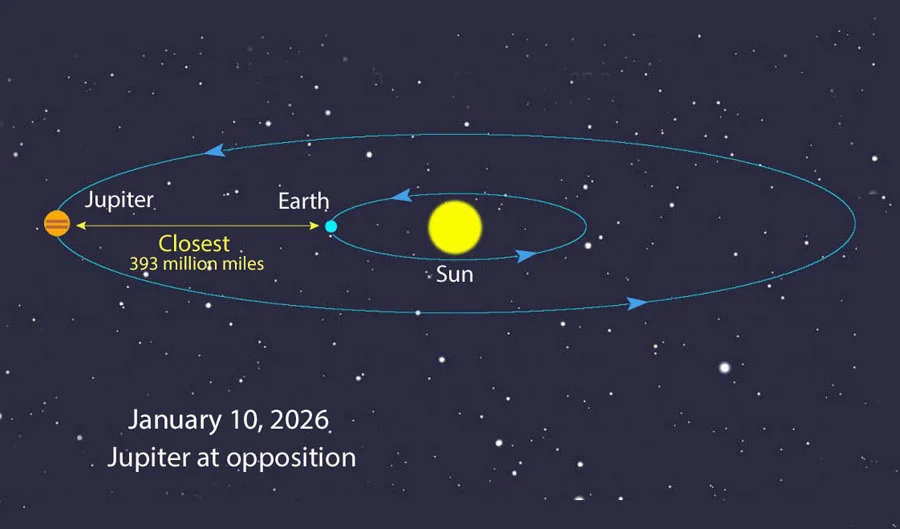
Although Jupiter reaches opposition on January 10th, closest approach to Earth occurs the night before due to the planets' elliptical orbits. The beaming behemoth will be just 633 million kilometers (393 million miles) away and gleaming at magnitude –2.7 with an apparent diameter of 46.6″ — big enough to see the planet's disk in tripod-mounted 10× binoculars. All four Galilean moons — Io, Europa, Ganymede, and Callisto — are visible in the same instrument provided you observe them at or near their greatest elongations from the planet. Good nights to spy the quartet fully spread out and thus easiest to resolve are January 12 (6 p.m. to 8 p.m. EST), January 15–16 (9 p.m. to 4 a.m.), January 22–23 (10 p.m. to 4 a.m.), and January 29–30 (11 p.m. to 4 a.m.).
Tom Williams (@tw.astrophotography / Instagram)
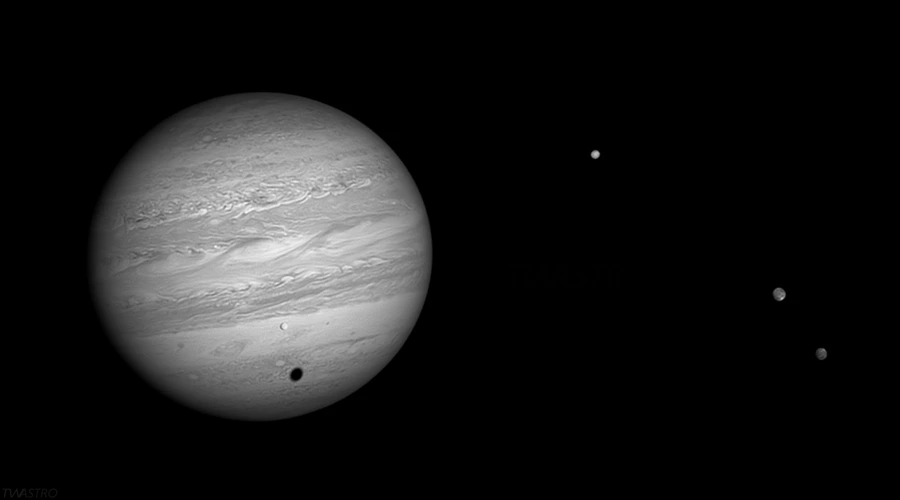
Very few observers have seen either Ganymede or Callisto, the outermost of the four, with the unaided eye. But that hasn't stopped us from trying. To attempt this visual feat, use a post, roof edge or tree trunk as an "occulting bar" to hide glary Jupiter and plan your observation when either moon is at greatest elongation. At best, Callisto shines 6′ east or west of Jupiter but only reaches magnitude 5.7 around opposition. Ganymede snugs closer, just 5′ from the mother ship, but it's considerably brighter at magnitude 4.6 and marginally easier to spot.
With an orbital period of 7.2 days, Ganymede swings from one elongation to the next about every 3 ½ days, so there are lots of opportunities to test your 1× observing skills. Consult a stargazing program such as Stellarium, Guide, or SkySafari and step through time to see when Ganymede shines farthest from its keeper. An alternative method is to consult Sky & Telescope's interactive observing tool, Jupiter's Moons, which also includes the times of when they (and their shadows) transit the Jovian disk as well as when the planet eclipses and occults them. On the appropriate night, hide Jupiter just out of sight behind the occulting bar and use averted vision to seek out this rare and delectable sight of Ganymede.
Bob King
About every 6 years, we enter mutual event season, when Earth and the Sun align with Jupiter's equatorial plane. During this time, the major moons regularly eclipse and occult each other. The season begins in May and continues into 2027, making the coming year of Jupiter-gazing even more engrossing than usual. Also, a good chunk of North America, the Caribbean, and West Africa will witness a spectacular occultation of the planet and its Galilean moons by the waning crescent Moon on the morning of October 6th. Like I said, it's hard to take your eyes off the king of the planets!

Sky & Telescope Illustration
A 3-inch telescope will reveal the gas giant's most prominent features, the NEB and SEB, EZ, and North and South Tropical Zones (NTrZ and STrZ). While an experienced amateur will also make out the Great Red Spot, Jupiter's most famous and persistent storm, most observers will need at least a 6-inch instrument and 150× or higher magnification to claim it. In average seeing the GRS is not immediately obvious even in my 10-inch, appearing at first like a lighter-colored gap along the southern edge of the SEB. Closer scrutiny at 245× brings the orange-red oval into clearer view.
Jean-Paul Oger
head in the clouds
Use Sky & Telescope's Great Red Spot Transit Times to find out when the GRS will be squarely in view on the planet's central meridian. With higher magnifications you might succeed in rooting out Red Spot Jr., a smaller GRS mimic within the South Temperate Zone (STZ) located near System II longitude 312° in early January. Additional small, white ovals dot the SSTB and northern edge of the NEB.
On nights of excellent atmospheric seeing, an 8-inch or larger instrument will reveal stunning details. I experienced one such precious evening in December, when the planet's image stood rock steady at 245×, with usable views up to 381×. The delicate hues, fine structure within scads of cloud belts (I counted eight in all), and the clarity of the GRS and its environs kept me locked in place at the eyepiece of my 15-inch scope for nearly an hour. An Io shadow transit was the cherry on top. I can't emphasize enough the value of regular observation — even as little as 5 minutes — so that you're present on that rare night when everything becomes crystal.
Top and bottom left: Stellarium. Bottom right: Robert Lunsford
Transfixing transits
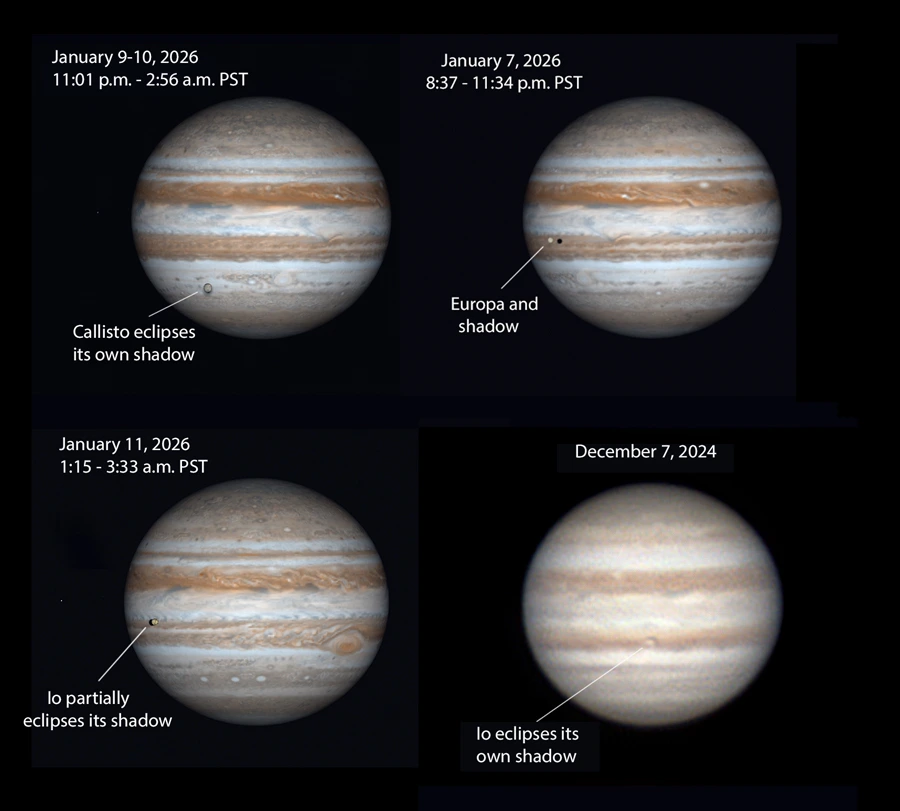
Several very special Jovian moon events are happening this week. The first is a shadow transit of Callisto. These are uncommon enough, but this one is unique because it occurs on January 9–10, when Jupiter and Earth are precisely lined up at opposition. As a consequence, the moon will overlap and cover its own shadow. Given Callisto's relatively large distance from the planet, its shadow appears fuzzier than those cast by the closer-in moons, with an umbral core set within a wider penumbra. Since Callisto has a low albedo — it's distinctly gray — we'll see a dark moon cloaked by a penumbral "hoodie" traversing Jupiter's face for nearly 4 hours. I can't wait.
A nearly identical moon-shadow overlap occurs on January 11th, when Io transits the planet while covering the western half of its shadow. The two enter the Jovian disk just 1 minute apart! Also, on January 7–8, observers have a chance to see the moon Europa and its shadow side-by-side. The shadow enters the disk first, followed 6 minutes later by the moon. After opposition, as Earth departs from the Sun-Earth-Jupiter line, the spacing between transiting moons and their shadows increases. So, seize the moment.
Stellarium
With Jupiter up so many hours this winter, I have a sneaking suspicion you'll quickly become an ace Jovian weather watcher. Studying Jupiter's dynamic atmospheric patterns not only engages our skill and imagination, but it also provides us with crucial insights into climate evolution on Earth.
About Bob King
I love the sky (day and night) and have been a skywatcher and amateur astronomer since childhood. I'm also a long-time member of the American Association of Variable Star Observers (AAVSO) and Astronomical League. I pen the Astro Bob blog and have written four books: Night Sky with the Naked Eye (2016); Wonders of the Night Sky You Must See Before You Die (2018) and Urban Legends from Space (2019) and Magnificent Aurora, published in 2024. The universe invites us on an adventure every single night. To accept the invitation, we only need look up.



Comments
You must be logged in to post a comment.