 SUNSET:

 0
0The proposed installation — less than 10 miles from Paranal Observatory — sparked international concern. Now it’s canceled.
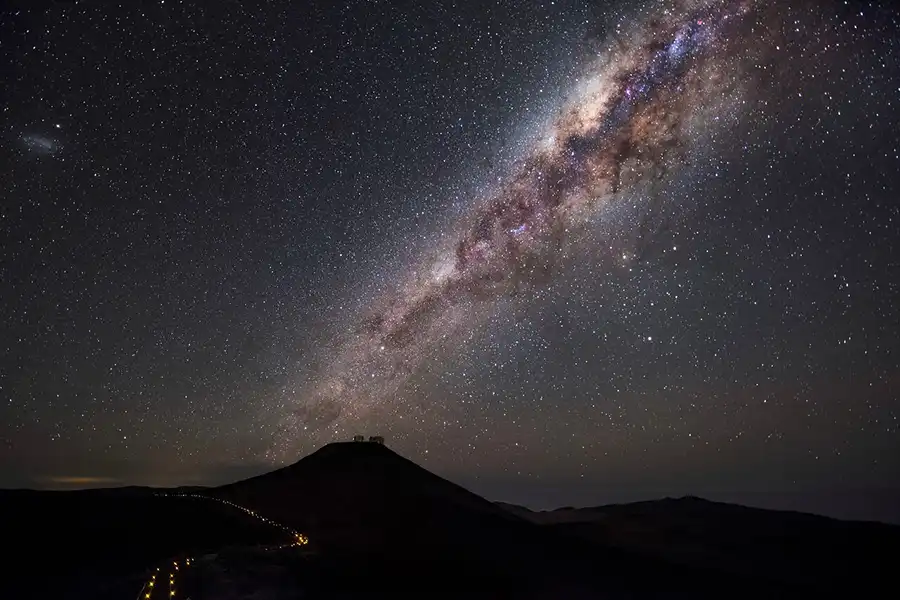
A. Ghizzi Panizza / ESO
Northern Chile’s dark skies are safe — for now. AES Andes, a subsidiary of the U.S. power company AES Corporation, will no longer pursue a large-scale industrial project in the country’s Atacama Desert, according to a January 23rd statement. This news comes as a relief to astronomers worldwide, who were concerned that the project would have degraded the darkest skies on Earth.
Scientists began criticizing the project as soon as plans first surfaced in late 2024: They feared that its installation would seriously affect the sky above some of the world’s most important astronomical facilities, including the largest visible-light telescope in the world, the 39-meter (130-foot) Extremely Large Telescope (ELT) that’s currently under construction.
According to the plans submitted to Chile’s Environmental Assessment Service (SEA), the $10 billion project, dubbed INNA (short for Infraestructura Energética para la Generación de Hidrógeno y Amoníaco Verde), would have spread over more than 11 square miles. It would have utilize solar and wind energy — abundant in Chile’s vast deserts — to produce hydrogen and ammonia gas for industrial use. However, some of the installation would have been located less than 10 miles from the European Southern Observatory (ESO) Paranal and Armazones observatories, including the Very Large Telescope, and even closer to the southern site of the planned Cherenkov Telescope Array Observatory (CTAO).
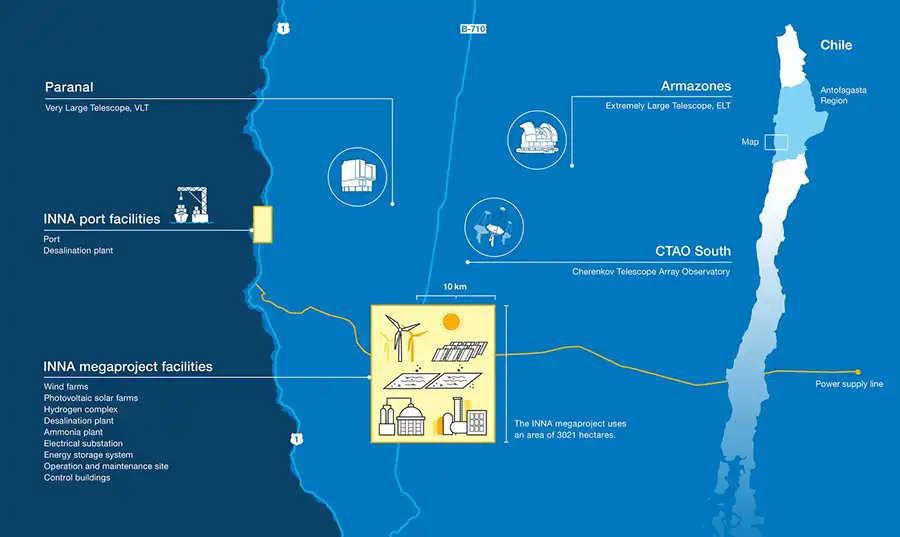
ESO
It wasn’t only that the project would have increased light pollution at Paranal by at least 35%, and by more than 50% above the CTAO. ESO also feared that dust and vibrations generated during the project’s construction would harm ELT operations. That’s why, in March 2025, Nobel Prize winner Reinhard Genzel visited the Paranal Observatory with the president of Germany. And in November 2025, 28 renowned astronomers appealed to the Chilean government to call for the project’s relocation. In December, Chile’s then opposition leader (now president elect), José Antonio Kast, spoke out against the energy project.
It’s unclear what convinced AES Andes to change their plans. Their statement does not mention environmental reasons and in fact states that INNA would have been “fully compatible with other activities in the region.” Instead, the company simply declares that it decided to discontinue the INNA project “following a detailed review of its project portfolio.” The company also does not mention whether it plans to move INNA to a different location within Chile in the future. Instead, AES announces that it wants focus on the production of renewable energy in the country.
The Chilean government has welcomed this turn of events: “This private decision is good for Chile, for science, and for all of humanity,” said Science Minister Aldo Valle Acevedo, as quoted on X, formerly known as Twitter. “Protecting our skies safeguards a unique scientific advantage and is a responsibility we owe to the international scientific community and future generations.”

ESO / P. Horálek
The astronomy community welcomes the decision, albeit with restraint. "We are reacting to the news with caution,” says ESO’s media manager Bárbara Ferreira. “While we expect INNA will be formally withdrawn from SEA soon, the project and its proposed location highlight the urgent need to establish clear protection measures in the areas around astronomical observatories."
Observatory sites in Chile do enjoy certain protection to ensure the quality and darkness of the sky above them. However, today’s levels of protection don’t protect against large-scale projects like INNA.
“When the cancellation is confirmed, we’ll be relieved that the industrial complex will not be built near Paranal,” adds ESO Director General Xavier Barcons. ESO’s opposition, he stresses, is not against such projects per se: “Green-energy projects [...] are fully compatible with astronomical observatories, if the different facilities are located at sufficient distances from one another.”
Update (February 10, 2026): The AES Andes INNA project has now formally been canceled. Late last week, AES Andes sent a letter to the Chile environmental assessment service to ask for the project's withdrawal.






Comments
You must be logged in to post a comment.