 SUNSET:

 9
9
Lionel Majzik
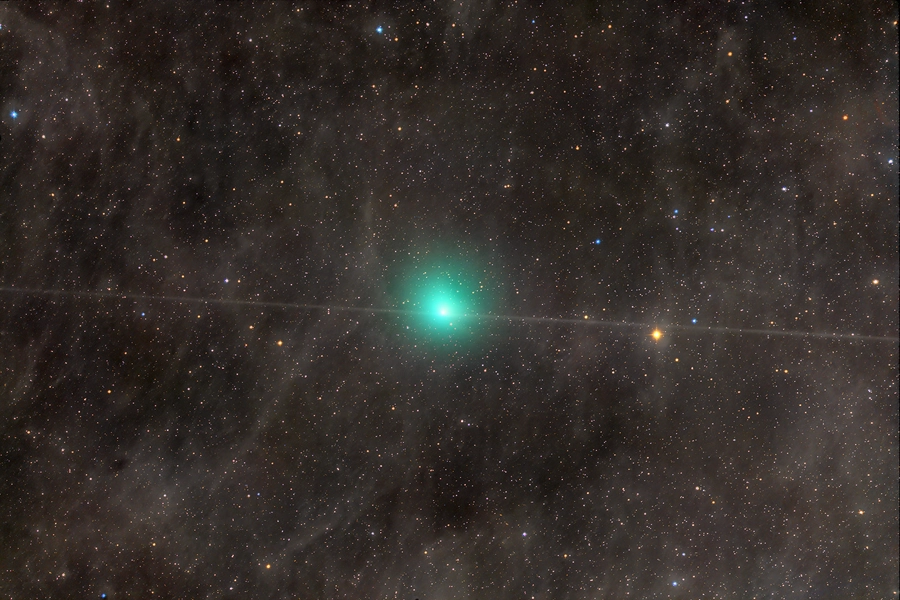
The nucleus of Comet ATLAS (C/2024 G3) held together during a brutal perihelion but not for long. Lionel Majzik of Hungary was the first to report and record dramatic changes in the comet between January 18th and 19th. The bright, strongly condensed head rapidly became more diffuse, a sure sign that its nucleus was disintegrating based on past observations of crumbling comets. His superb sequence, photographed remotely from Chile, clearly reveal the dramatic transformation, which was later confirmed by Australian observers.

Jakub Černý
You might think that after a breakup the comet would suddenly disappear. Thankfully it will still be around for days. The dust forming the tail was expelled prior to the breakup and will linger even as C/2024 G3 fades. Meanwhile, the comet's head will maintain its form but grow fainter and more diffuse. In other words, Southern Hemisphere observers and astrophotographers are still in for a show.

Kelly Shung
Amateurs have a special name for comets like these — headless wonders. I've seen a few over the years both with the naked-eye and telescopically. One night the comet looks completely normal with a bright, compact nuclear region and extended tail. The next night, the core is soft and diffuse, as if dissolving before your eyes. Days later the comet's tail maintains its shape in spite of the catastrophe. The best known of these is Comet Lovejoy (C/2011 W3). After an exceptionally close perihelion (140,000 kilometers) on December 16, 2011, the nucleus initially survived but then underwent a cataclysmic fragmentation just a few days later.
One the one hand it's disappointing to see a comet flame out as it were, but at the same time what's happening to Comet ATLAS is exactly why comet-lovers keep coming back for more. Surprises that can alter an object's appearance and future on such a short time scale are thrilling to see.

Michael Mattiazzo

Bob King
Although fading, the comet remains an easy naked-eye sight for Southern Hemisphere observers. Are there any tidbits left over for northern observers? Possibly. With a wide-angle lens and tracked time-exposure of several minutes or more, it may be possible to record multiple, faint syndynes and striae poking over the southwest horizon. Make the attempt starting in late evening twilight through early darkness. You'll need an open horizon to the west-southwest. Syndynes are streaky, dust features in the tail's extremities and represent similar-sized particles ejected by the nucleus at different times. Truly, the show isn't over yet!
About Bob King
I love the sky (day and night) and have been a skywatcher and amateur astronomer since childhood. I'm also a long-time member of the American Association of Variable Star Observers (AAVSO) and Astronomical League. I pen the Astro Bob blog and have written four books: Night Sky with the Naked Eye (2016); Wonders of the Night Sky You Must See Before You Die (2018) and Urban Legends from Space (2019) and Magnificent Aurora, published in 2024. The universe invites us on an adventure every single night. To accept the invitation, we only need look up.




Comments
accurateye
January 20, 2025 at 5:42 pm
Might produce a sharp peak in some future meteor shower.
You must be logged in to post a comment.
Bob KingPost Author
January 20, 2025 at 5:45 pm
accurateye,
Wouldn't that be nice! I have no idea whether Earth is ever likely to cross the comet's path however.
You must be logged in to post a comment.
davidcarper
January 22, 2025 at 11:33 pm
Two issues I see for a meteor shower.
First is the period; the next time the densest part of the debris cloud comes around, we will all be long gone.
But I also think that the orbit is inclined enough that the path never really comes close to Earth's actual orbit. Perhaps a small amount of debris could get ejected far enough to intercept, but I doubt that it would be noticeable above sporadic meteors.
Sadly, I was under cloud cover during the entire time that this comet was even marginally visible for my area, so didn't get to see it. Thanks for the pictures!
You must be logged in to post a comment.
kdconod
January 24, 2025 at 9:53 am
Ye I think you are right - the comet's path is inclined so steeply that the dust left behind would never intersect the Earth's orbit - so alas no meteor shower.
You must be logged in to post a comment.
Bob KingPost Author
January 24, 2025 at 11:14 pm
KD,
High inclination alone doesn't necessary preclude a meteor shower from a comet or asteroid. For instance, the Quadrantid shower's parent body's orbit is tipped 71 degrees.
You must be logged in to post a comment.
Chris-Schur
January 20, 2025 at 6:30 pm
Just when we think weve seen everything in comets, something new and exciting occurs. the odds are now that the next bright comet will come in from the south, and be big and beautiful for us north of the equator!
You must be logged in to post a comment.
Bob KingPost Author
January 21, 2025 at 11:23 am
Hi Chris,
That's why we love 'em!
You must be logged in to post a comment.
NovaB
January 21, 2025 at 11:32 pm
Yes! Thank you so much for covering this, as I had no idea what I was looking at... I woke up, facing the Eastern sky in Northern USA; this would've been after 4:30am. I knew I wasn't looking at a meteor shower, but was concerned about the way it looked like debris was falling... Anyway, I'm so glad that I got a chance to witness this phenomena in real time. Thank you so much for this article and the website, in general! <3
You must be logged in to post a comment.
Bob KingPost Author
January 22, 2025 at 4:48 pm
Hi Nova,
Thank you and you're most welcome. I'm not sure exactly what you saw since the comet is in the western sky at dusk and only visible right now from equatorial and southern latitudes. Maybe you witnessed a train of satellites? Either way, keep looking up 🙂
You must be logged in to post a comment.
You must be logged in to post a comment.