 SUNSET:

 0
0The young, nearby star may be experiencing an episode of repeated, violent collisions within its forming planetary system.
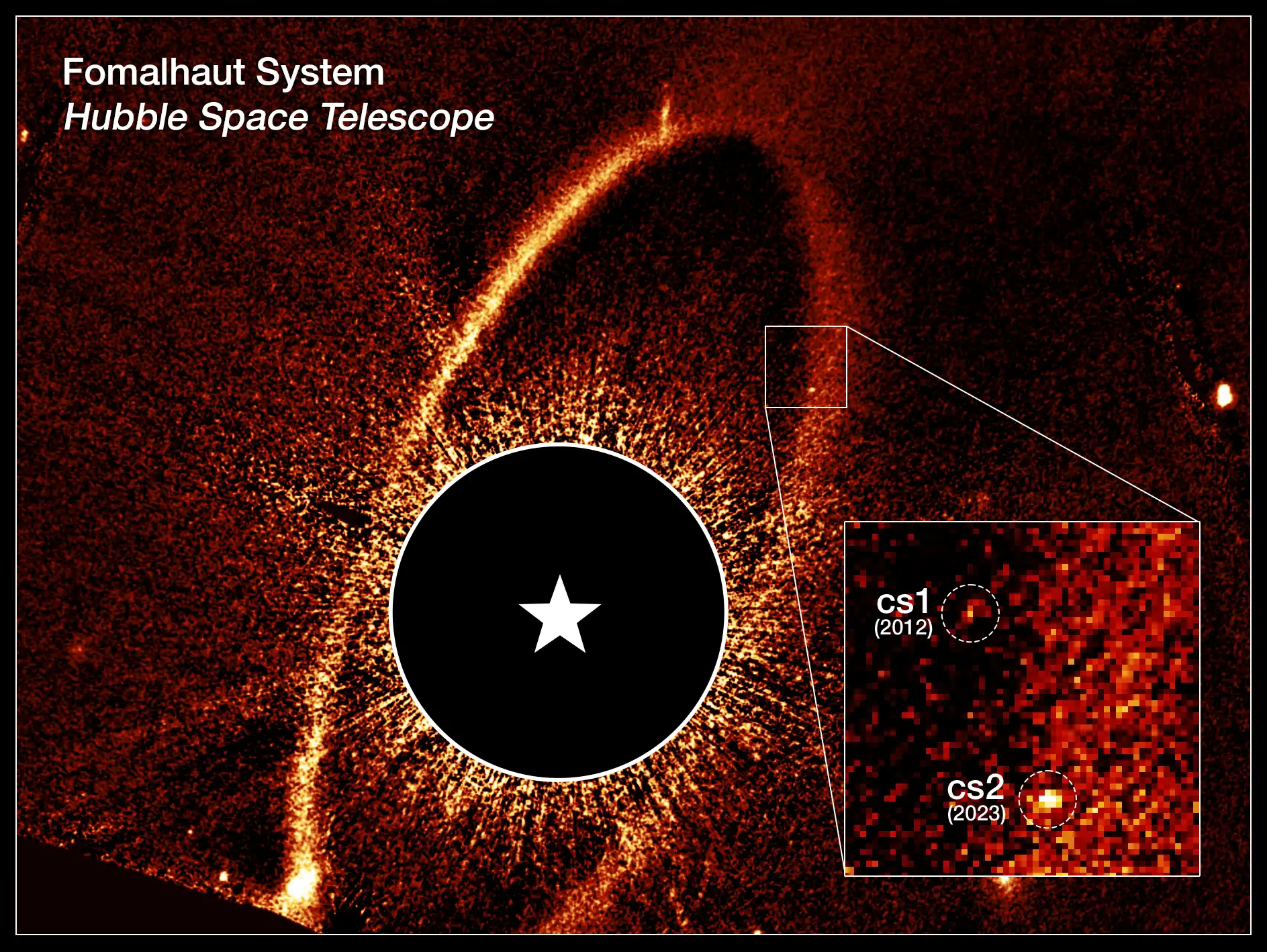
NASA / ESA / Paul Kalas (UC Berkeley); Image Processing: Joseph DePasquale (STScI)
Sometime between 2014 and 2023, near the bright star Fomalhaut, two space rocks appear to have crashed into each other: Images by the Hubble Space Telescope show a bright spot about 135 astronomical units (au) from the star that wasn’t there before. One year later, in September 2024, the spot had moved, ruling out a background source. “This is certainly the first time I’ve ever seen a point of light appear out of nowhere in an exoplanetary system,” says Paul Kalas (University of California, Berkeley). “It’s absent in all of our previous Hubble images, which means that we just witnessed a violent collision between two massive objects forming a huge debris cloud.”
The researchers say in the January 22nd Science that the objects that created this cloud measured less than 100 kilometers (60 miles), and that the cloud itself will disperse in just a few years. But Kalas and his team seem to have picked just the right time to watch this system. It wasn’t all lucky coincidence, though: The astronomers were looking for another cloud that they had found two decades ago — and mistaken for a planet at first.
Fomalhaut is the brightest star in the constellation Piscis Austrinus, the Southern Fish. At a distance of only 25 light-years, it’s close enough to be studied in detail. It’s also just 440 million years old, less than 9% of our Sun’s age. When the solar system was that young, collisions and impacts involving asteroids were much more common. The result of this early bombardment is visible on the crater-scarred surface of the Moon even today.
In 2004, Kalas, together with James Graham (also Berkeley) and Mark Clampin (Goddard Space Flight Center, Maryland) imaged its infant planetary system for the first time. They found that Fomalhaut is surrounded by a 25-au-wide belt of dust. Its slight offset and sharp inner edge led to the suggestion that at least one “shepherding” planet is shaping the disk, much like how some of Saturn’s moons keep the planet’s famous rings in place. Hubble images taken between 2004 and 2006 then revealed a point-like source orbiting the star within the belt. Dubbed Fomalhaut b, it was considered the first exoplanet detected by reflected starlight at the time.
But in a Hubble image taken in 2013, the dot had drifted slightly outward, away from the star. What’s more, it had expanding in size and at the same time its brightness had faded. A 2014 image failed to detect Fomalhaut b at all. Some astronomers thought that the object might have been a forming exoplanet enshrouded in a cloud of dust. Others advocated for an expanding cloud of debris created by the collision of two large planetesimals, large asteroids within the evolving planetary system.
The latter idea seemed unlikely at first: Collisions of such magnitude were thought to happen only every few hundred thousand years. But in 2020, András Gáspár and George Rieke (both at University of Arizona) argued that the collision scenario explained all observational evidence.
So when Kalas and his team turned Hubble to watch the star in 2023, nine years after the previous observations, they first looked for remnants of Fomalhaut b (or, as they now call it, “Fomalhaut circumstellar source 1”, Fom cs1 for short). They found no clear evidence, hardening the conclusion that the source of light had been a dust cloud. But much to their surprise, just 1.26 arcseconds away, equivalent to 23.4 au from where cs1 was found 20 years earlier, there was the new dot, dubbed cs2. It appeared to be more than twice as bright as cs1 was in 2004 and 2006.
“Fomalhaut cs2 looks exactly like an extrasolar planet reflecting starlight,” says Kalas. This time, knowing that there hadn’t been anything visible on earlier images, the astronomers didn’t let themselves be fooled again: “What we learned from studying cs1 is that a large dust cloud can masquerade as a planet for many years.”
“In 2020, [when] we showed that [cs1] is likely a result of a massive planetesimal collision in the system, this was viewed with skepticism by some people in the field,” comments Gáspár, who was not part of Kalas’ team. “I am glad to see our earlier conclusions on Fomalhaut b validated. [It] is an indication that such events may be more frequent around Fomalhaut than previously thought.”
Indeed, in 2022 Gáspár, Rieke, and their team found another dusty belt inside the existing dust ring using sharp James Webb Space Telescope images. They made the case that cs1 could have originated in this belt, suggesting increased collision rates there.
Gáspár’s team also detected yet another possible debris cloud that might be the result of an even larger collision. “Our JWST/MIRI imaging of the inner disk and now this latest observation reveal that the Fomalhaut system is in fact dynamically very active,” Gáspár adds.
If the medium timescale between two large collisions is decades rather than hundreds of thousands of years, then there could have been millions of such events during Fomalhaut’s lifetime so far.
It could be that Fomalhaut is experiencing something much more violent than what our solar system went through billions of years ago, says Eric Mamajek (JPL Caltech), who was not involved with Kalas’s study. “What people sometimes seem to ignore is that Fomalhaut is a triple system with two distant low-mass stellar companions.” Known as TW Piscis Austrini and LP 876-10 (or Fomalhaut B and C), both stars are much lighter than 1.9-solar-mass Fomalhaut. They circle in wide orbits and are only recognized as Fomalhaut’s companions by their common movement and similar ages. (LP 876-10 is so far away on the sky that it’s located in nearby Aquarius.)
Yet, despite their low masses and wide separations, they may come close to Fomalhaut at times, heavily disturbing the dust belts around it, Mamajek suggests. “There will probably be a lot of collateral damage to planetary bodies orbiting those stars as this system dynamically evolves,” he adds. “Fomalhaut could be living through its own heavy bombardment period.”
Kalas and his colleagues will keep monitoring cs2 to see how it changes over the coming years, and to shed light on our solar system’s past.
Editorial note (January 30, 2026): This article was corrected to note that the asteroids involved in collisions around Fomalhaut are no bigger than 100 kilometers (60 miles) in radius.



Comments
You must be logged in to post a comment.