 SUNSET:

 6
6A team of scientists thinks a clustering of ancient impact craters points to a temporary ring around Earth hundreds of millions of years ago.

Oliver Hull
Earth's gravity might have snared an asteroid making a very near miss of the planet 466 million years ago. As it shattered its debris went into orbit, giving our planet its own ring that may have lasted millions of years.
Astronomers have long thought that Earth was too small to have rings like the giant planets do. But for a period of 40 million years in Earth’s past, all known impacts happened to land near the equator, and to geologist Andrew Tomkins (Monash University, Australia), that unusual concentration suggests those asteroids fell from a ring that was orbiting Earth.
“What got me started on this was a popular news story that Mars might have had a ring in the past,” says Tomkins. “I didn’t realize such a small planet could ever have rings, and that made me think about what Earth would look like with rings.”
Having studied meteorites, Tomkins knew that impact craters were unusually abundant during a 40-million-year window in the Ordovician Period, starting about 466 million years ago. Curious if those impacts might have come from a ring orbiting the planet, he asked colleague Erin L. Martin to plot those craters on a paleogeographic map of the planet at the time. When she found all the craters were close to the equator, they decided to investigate further.
Earth took an unusual beating during the Ordovician Period, with 21 known impact craters created between 485 million to 444 million years ago. To investigate the exact location of the craters, given the constant shifting of Earth’s crust, the researchers studied six models of plate tectonics for the Ordovician. In all six models, at least part of all 21 craters fall within 30 degrees of the ancient equator. The odds of such a distribution if the objects came from random orbits in the asteroid belt are astronomical, so to speak. But the odds would be more reasonable if the asteroids originated from Earth orbit, the team concludes in a study published in Earth and Planetary Science Letters.

Earth and Planetary Science Letters 2024
There’s little precedence for rings around bodies smaller than the giant planets, but it’s not zero. We aren’t certain whether Mars ever had rings in the past, but we do know of two much smaller bodies that currently have rings: the minor planets 10199 Chariklo and 2060 Chiron. Both are Centaurs with orbits between those of Saturn and Uranus, and both have multiple rings; the origin of those rings, however, remains uncertain.
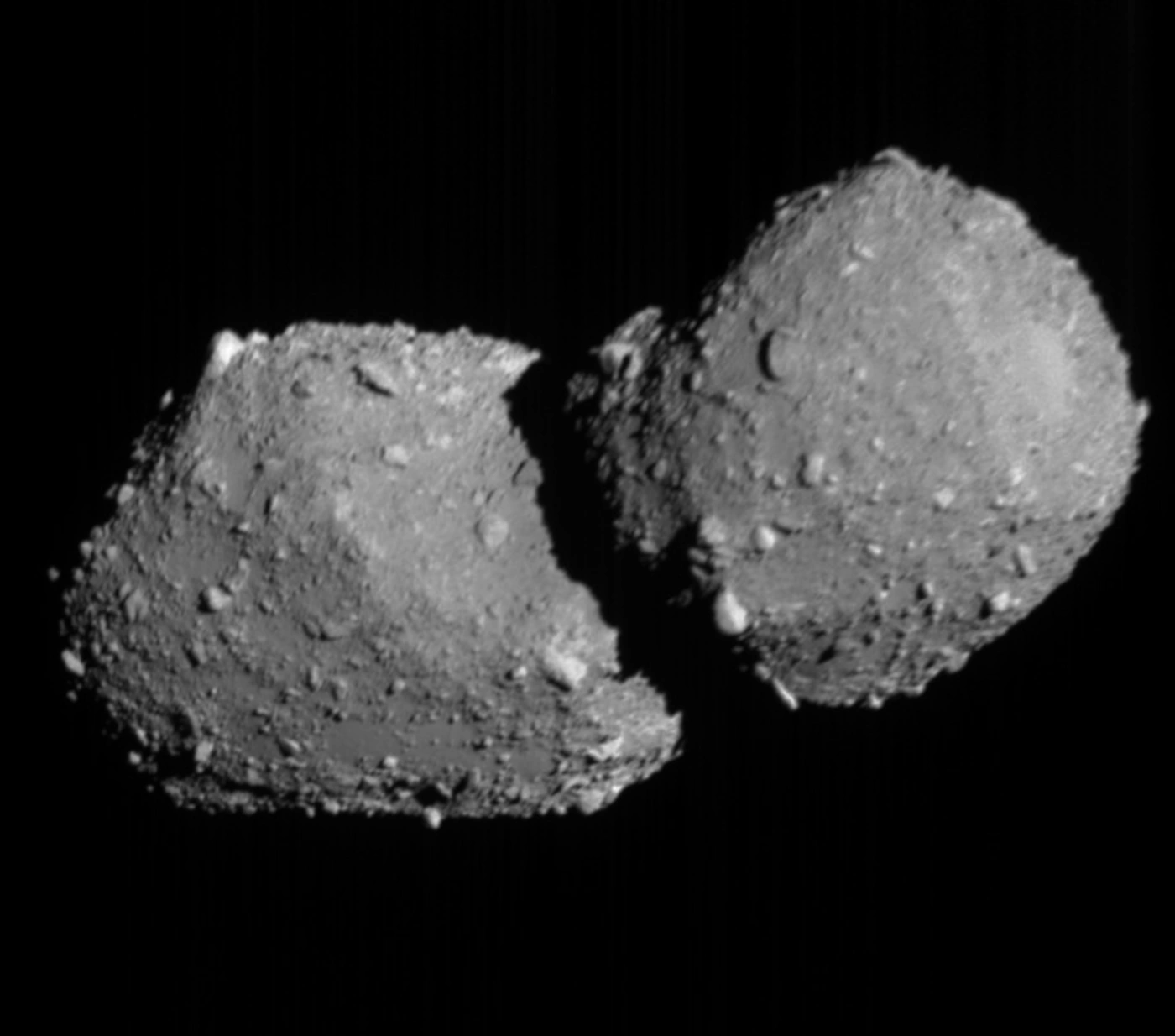
Tomkins thinks Earth’s ancient ring could have formed after an asteroid passed too close to Earth and was pulled apart by its gravity. From the size of the known craters, he estimates that the incoming object was some kilometers (6 miles) wide.
Big chunks would have fallen from orbit to form craters, while smaller debris could have stayed longer in orbit as a ring, potentially lasting millions of years. The long-lived ring might even have shadowed the planet, triggering global cooling and contributing to an ice age and mass extinction that occurred during the Ordovician Period, the team speculates.
The cluster of Ordovician asteroid impacts on Earth coincided with a more dramatic event — the breakup of a 150-kilometer body between the orbits of Mars and Jupiter, which became the parent of a type of meteorite called L type chondrites. All of the Ordovician craters were formed by L chondrite asteroids, which are the most common type of meteorite falling down to Earth today.
“This breakup is the largest documented breakup of an asteroid,” says geologist Birger Schmitz (Lund University). He spoke with Sky & Telescope from Lake Hummeln in southern Sweden — a lake, he notes, that formed in an Ordovician crater.

Birger Schmitz
Schmitz, who was not involved in Tomkins’s research, studies micrometeorites, specifically submillimeter-size L chondrites. In his own work, he has found that the influx of these tiny meteorites to Earth increased by a factor of 100 to 500 after the ancient breakup. He agrees that they contributed to the Ordovician ice age.
Tomkins’s work lights a path forward. “His idea is testable,” Schmitz adds. While the recent study approached the Ordovician from the perspective of large impactors, Schmitz sees potential tests of the idea from looking at much smaller intruders. “We can take samples from different latitudes to see if there are smaller numbers [of micrometeorites] the further we go away from the [ancient] equator,” he says. If scientists find such a trend, it will help validate Tomkins’s hypothesis.

Oliver Hull
About Jeff Hecht
Jeff Hecht writes about science and technology, with a particular interest in all things optical. He first discovered Sky & Telescope when he was 10, and he still has the one-inch Wollensak refractor his father gave him then.



Comments
Rod
September 25, 2024 at 10:02 am
My note. As more and more astronomical studies take place involving impacts in the solar system, Charles Darwin warm little pond in 1871 needs much modification now for violent catastrophism, including the long ages for evolution to take place, more violence, more mass extinction, and death. Abiogenesis models must adapt and change 🙂
You must be logged in to post a comment.
Michael
September 25, 2024 at 8:52 pm
This is a very imaginative and thought-provoking theory. Have they published it in any journals, or submitted it? I didn't see any references in the article.
You must be logged in to post a comment.
William-Becker
September 27, 2024 at 10:19 pm
Here's a link to the paper:
https://www.sciencedirect.com/science/article/pii/S0012821X24004230?via%3Dihub
There's a nice discussion of each continental area.
You must be logged in to post a comment.
Monica Young
October 1, 2024 at 3:45 pm
Dear Mike and William - thank you for both the question and answer! I've added a link to the paper to the story itself as well.
You must be logged in to post a comment.
Michael
October 1, 2024 at 8:45 pm
Thank you, William and Monica!
You must be logged in to post a comment.
Warren-Odom
September 28, 2024 at 4:34 pm
Indeed, quite a piece of research.
BTW, "There’s little precedence" should be "There’s little precedent."
You must be logged in to post a comment.
You must be logged in to post a comment.