 SUNSET:

 0
0Circumstances are ideal for watching debris from Halley’s Comet set the morning sky ablaze.

Petr Horálek
It always feels like the start of the holiday season when the Orionids arrive. The annual meteor shower precedes three minor meteoric drizzles, the North and South Taurid streams and Leonids, followed by mid-December's Geminids, the year's strongest cosmic powder blast.
Temperatures are still on the pleasant side for watching meteors in late October, when the Orionids are most active. They peak mid-week on the night of October 20–21, when the Moon will be just past new and only 0.1% illuminated. The shower streams from Orion's upraised hand about 10° northeast of Betelgeuse and climbs high enough in the southeastern sky to put on a reasonably good show as early as midnight. Better yet, watch between about 2 a.m. and the start of dawn, when the radiant stands high in the southern sky. Fewer meteors will be cut off by the horizon during this time, so you'll see the shower at its best. Outside of the occasional outburst, the Orionids typically produce around 20 meteors per hour when viewed from a dark sky.
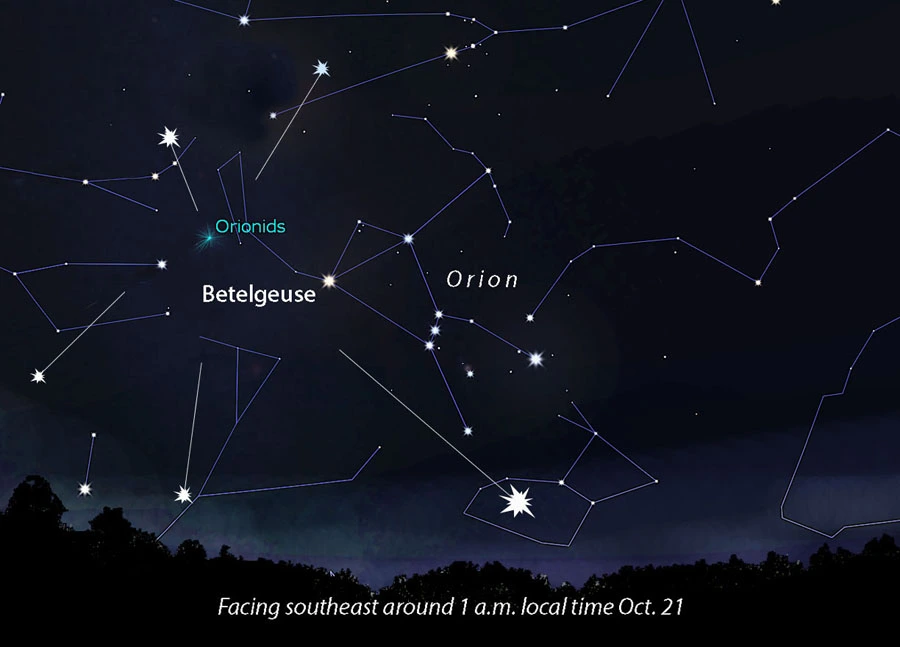
Stellarium, with annotations by Bob King
Assuming good weather, I'll set my alarm for 3 a.m. and observe till 5 from a lounge chair in my front yard. One hour is about the minimum for watching a meteor shower. But if you make it two, you'll see the full gamut of what the shower has to offer, from pip-squeak flashes at the limit of vision to potential fireballs. While meteor-gazing is essentially effortless, it does require patience and low expectations. Every time I slip down into the chair and pull the wool blanket up to my chin, I'm amazed that the shower happens at all. The fact that it does feels strangely miraculous, the way the first snowfall of the season begins with a single flake. Then it's game on. The shower doesn't take long to sink its hooks in you as anticipation builds for the next fragment of Halley's Comet to silently enter Earth's atmosphere at high speed and become incandescent.
Both the Orionids and its sister shower, the Eta Aquariids, are debris shed by the comet in dribs and drabs when it swings around the inner solar system about every 76 years. Solar heating vaporizes dust-rich ices in Halley's nucleus, creating a fuzzy coma and a long tail of fine detritus. Over the eons, the material spreads out along the comet's orbital path. Earth intersects the outbound stream of sloughed grit and dusty fluff in May, resulting in the Eta Aquariid shower. In October, we cross the comet's inbound orbital stream, and we see meteors flying off from the direction of Orion. To get a feel for the motion and orbit of the flow, use your mouse's scroll and zoom functions to explore the interactive diagram created by Ian Webster and Peter Jenniskens.

Phil Hart
Like most cometary meteors, Orionid meteoroids are the size of sand grains, typically under a millimeter. They fully vaporize in a flash of light when they strike the atmosphere at around 61 kilometers per second (136,000 mph). Smaller meteoroids produce dimmer meteors, while larger pieces — pea-sized and up — flame out as bright fireballs. All point back to the radiant above the main figure of Orion, a sure way to distinguish an Orionid from sporadic (random) meteors and other minor showers afoot at this time.
Although the South Taurids reach maximum in early November, the stream has been active since late September. Counts are only in the single digits per hour, but the shower is known for its slow, bright fireballs. On October 21st its radiant lies in northern Cetus, about 20° southeast of the Pleiades.
While the Orionid stream is thought to have originated some 23,000 years ago, as outlined in the 1989 paper The Age of the Orionid Meteor Stream by J. Jones et al., the earliest confirmed observations of the shower come from Chinese and Japanese records around 585 A.D. That year, activity was particularly strong with “hundreds of meteors scattered in all directions." Outbursts have occurred at various times throughout the shower's history, most recently from 2006 to 2009 when rates reached 40–70 per hour.
Photo tips
Every year, I hope to snag a glaring fireball slicing across Orion. While that has yet to happen, I'm not deterred. I use a mirrorless digital camera equipped with a 16-mm wide-angle lens. The camera's electronic viewfinder provides a brighter view of the scene compared to the optical viewfinder of a digital single-lens reflex (DSLR) camera, which makes it easier to focus and compose an image.
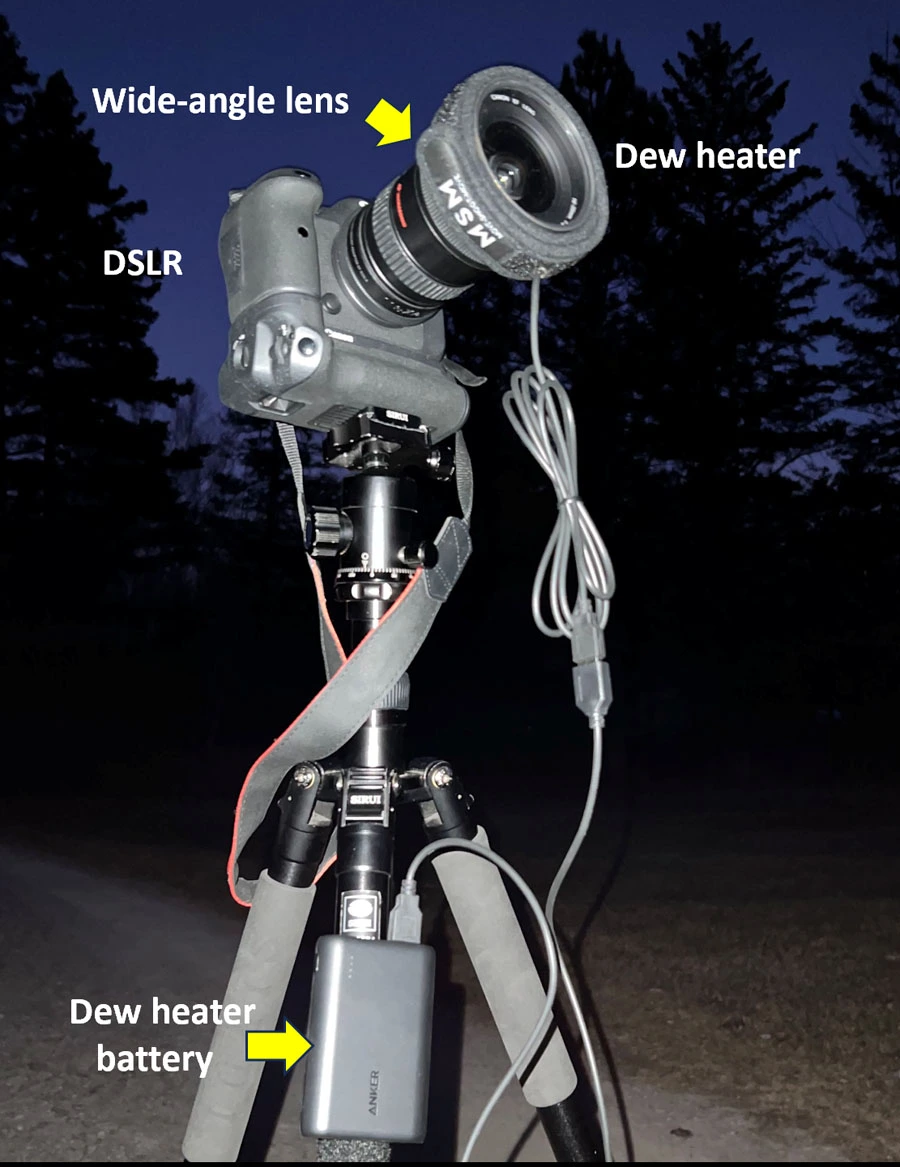
Bob King
When photographing meteors, open the lens to its widest aperture, typically f/2 or f/2.8, and set the ISO to 1600 or 3200. Then use the camera's live-view feature to precisely focus on a bright star. Aim the camera where light pollution is least and set the radiant off to one side of the frame to ensure a mix of both long-trailed and short-trailed meteors. Once your scene is composed, expose anywhere from 15 to 30 seconds depending on the degree of local light pollution.
If you don't already own them, consider purchasing two useful accessories — a programable, remote shutter release called an intervalometer that automatically activates the shutter button — and a wraparound Velcro lens heater to eliminate dew or frost on your lens. Then as the camera does its thing, you can relax and watch fragments of Halley's Comet meet their end in hurried blazes of glory.
About Bob King
I love the sky (day and night) and have been a skywatcher and amateur astronomer since childhood. I'm also a long-time member of the American Association of Variable Star Observers (AAVSO) and Astronomical League. I pen the Astro Bob blog and have written four books: Night Sky with the Naked Eye (2016); Wonders of the Night Sky You Must See Before You Die (2018) and Urban Legends from Space (2019) and Magnificent Aurora, published in 2024. The universe invites us on an adventure every single night. To accept the invitation, we only need look up.



Comments
You must be logged in to post a comment.