 SUNSET:

 6
6The renowned eclipse chaser and popularizer passed away in Arizona after a life of adventure.

Patricia Totten Espenak
Fred Espenak, who laid the foundation for modern-day eclipse chasing, died of idiopathic pulmonary fibrosis on June 1st. He announced his diagnosis and his impending passing on April 15th on social media and on the Solar Eclipse Message List (SEML) forum as he prepared to enter hospice care, sparking an outpouring of sorrow, sympathy, good wishes, and thank-you’s for his life’s work.
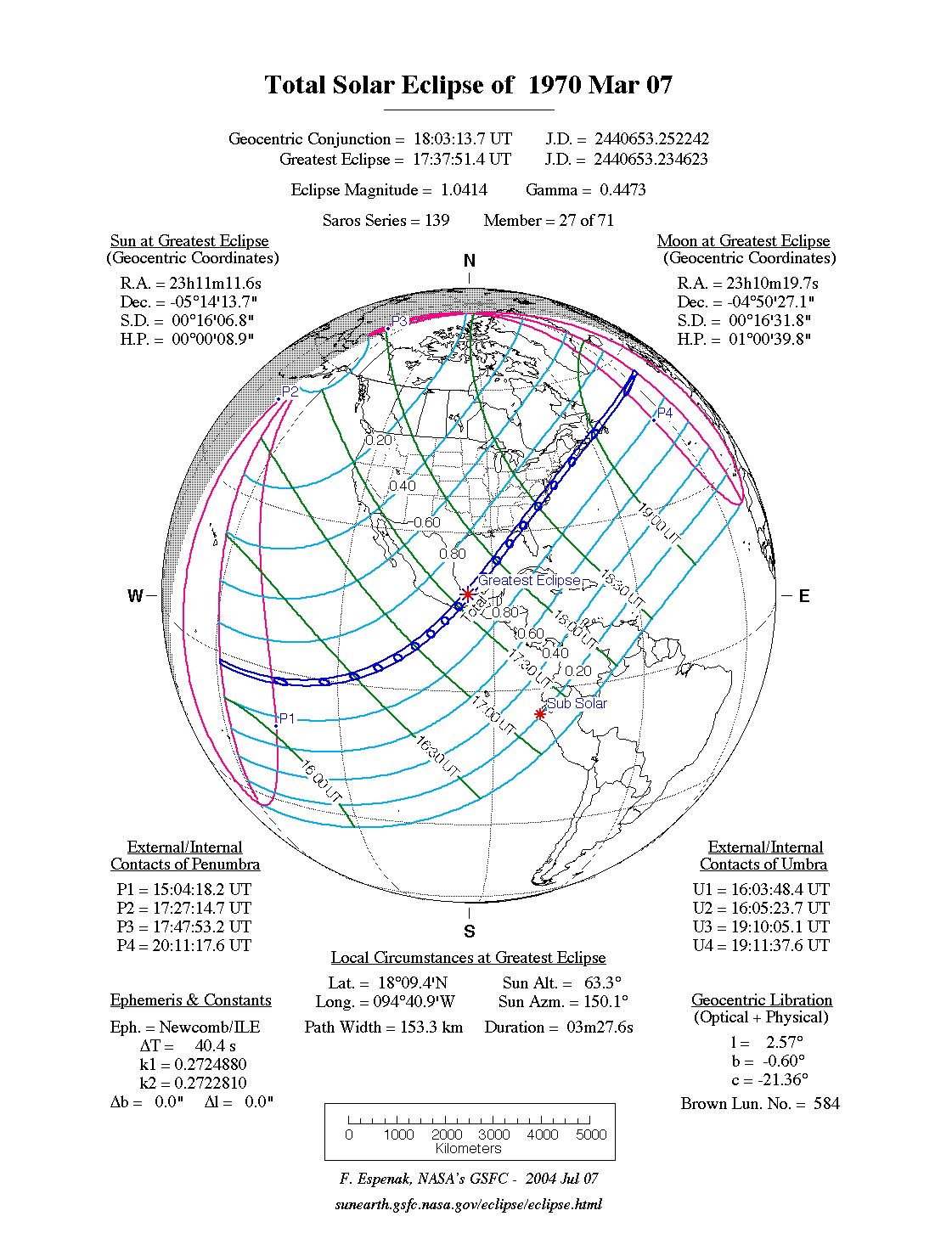
Fred’s fascination with the lunar shadow began with an off-the-track partial eclipse in 1963 and was cemented several years later by the total solar eclipse that traveled along the U.S. Eastern Seaboard in 1970. Upon his death 55 years later, he had witnessed 52 solar eclipses of various types, of which 31 were total. He had also helped countless others prepare for and experience the wonder of totality, thanks to his dedication to outreach.
There were many stories along the way, but he was fond of telling of his most rewarding eclipse-chasing experience — a trip to India in 1995 to catch 41 seconds of totality, during which he noticed a high-school chemistry teacher watching her first eclipse. “Nice hair,” he thought. Several eclipses and a decade later, he and Patricia Totten, the lady with the hair, were married. It was a particularly fond pairing, as visitors to his Arizona home could attest.
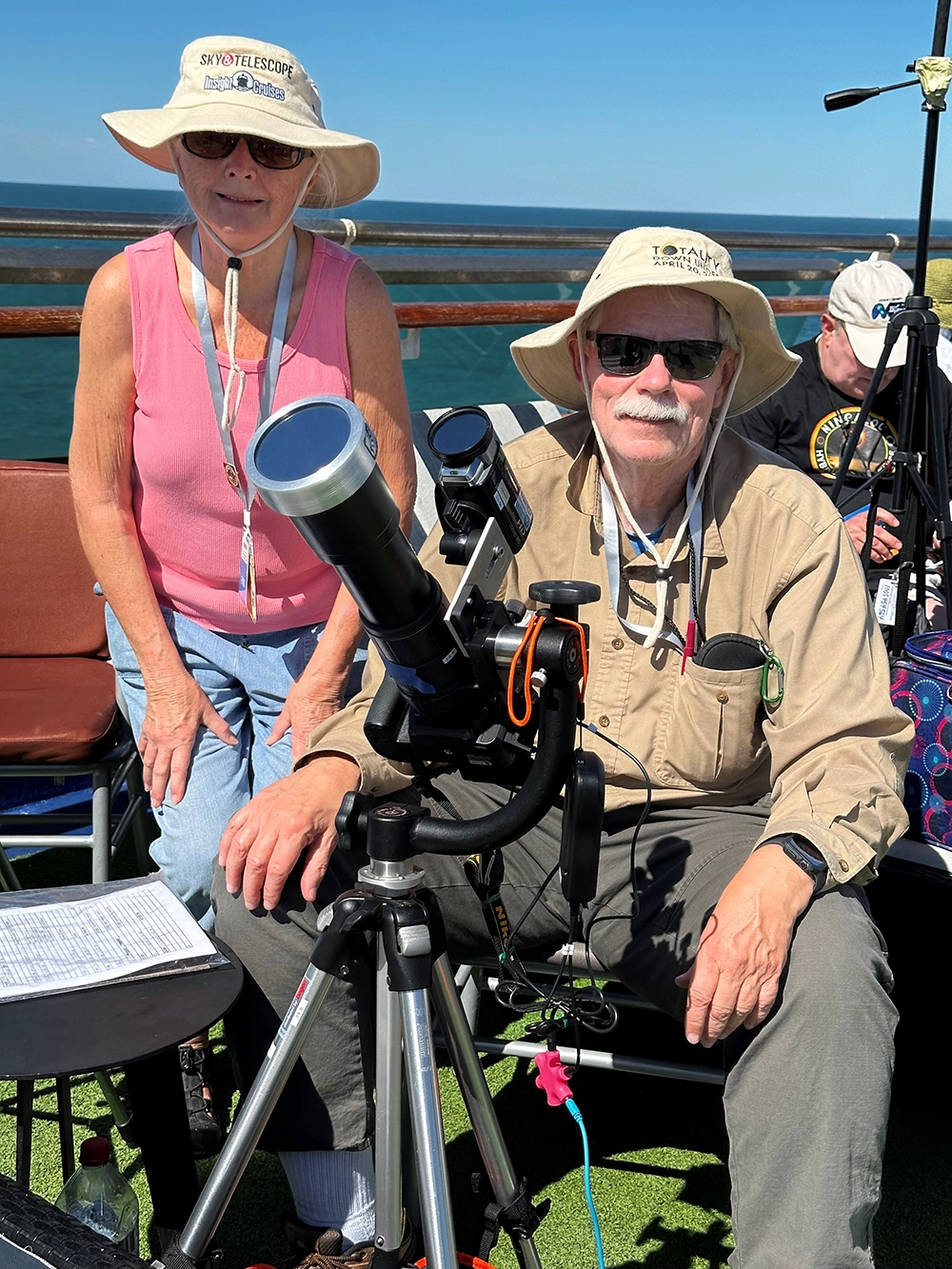
Michael Zeiler
As a NASA scientist at the Goddard Space Flight Center, Fred’s research focused largely on planetary atmospheres using an infrared spectrometer that he and his colleagues took first to Kitt Peak and then to NASA’s Infrared Telescope Facility on Mauna Kea, Hawai‘i. He coauthored papers on winds on Titan, ethane in Jupiter’s atmosphere, ozone on Mars, and hydrocarbons in the outer planets.
But to most of us, he is best known for his calculations of the circumstances of solar and lunar eclipses and the many publications and platforms he used to spread that information globally to scientists, eclipse chasers, and the public. Prior to 1994, the U.S. Naval Observatory issued eclipse circulars; when their funding ended, Fred wrote to me and proposed that we take on the job, under NASA’s auspices. The result was 13 circulars from 1994 to 2010 and a popular NASA website that he developed and maintained. When NASA funding ended with his retirement in 2009, he took to the web and to private publishing to continue the work. In recognition of his efforts, asteroid 14120 was named Espenak in 2003. To the public, he became “Mr. Eclipse.”
With Jean Meeus, he published two major reference works: in 2006, the Five Millennium Canon of Solar Eclipses, which covers all types of solar eclipses from 2000 BC to AD 3000, and the similar Five Millennium Canon of Lunar Eclipses in 2009. Other Canons and eclipse guides followed, totaling 30 publications in all, many of which he printed and distributed through his own publishing company, AstroPixels. He was coauthor of Totality: Eclipses of the Sun with Mark Littmann and Ken Willcox, which went into three editions to cover the eclipses of 2017 and 2024. In a lighter vein, he partnered with Patricia to write TOTAL Eclipse or Bust! A Family Road Trip. He was also a regular contributor (with me) to Sky & Telescope, providing predictions for timing, weather, and other circumstances to help readers make the most of their eclipse experiences.

Michael Zeiler
Eclipse photography was one of Fred’s other passions, and he was famous for the number of cameras he carried on each expedition and for his intense focus on the task at hand — although sometimes the pressure of so many cameras overwhelmed those few precious minutes of totality. Nevertheless, his eclipse photographs were popular with the media and widely distributed through his website MrEclipse.com. One photo was selected for the 2017 eclipse souvenir stamp issued by the U.S. Postal Service. It wasn’t his only stamp — Mongolia used an image of his eclipse track from a NASA Circular in a commemorative of the 1997 eclipse, much to his surprise.
After his retirement, he moved with Patricia to a home they’d constructed in Arizona Sky Village, near Portal, AZ, to take on a hobby that work in Washington, D.C., had not permitted: astrophotography. He built Bifrost Observatory there and, later, collaborated on establishing a remote observatory in Chile; soon, he was showing his deep-sky images on the AstroPixels website. His photographic skills served him well, and in 2018, the Royal Photographic Society honored Fred with their Award for Scientific Imaging.
Although the passing of Mr. Eclipse brings an end to an important era in eclipse planning, Fred has left us with a trove of offerings for the future. Among them, The Guide for the Total Solar Eclipse of 2045 highlights the next shadow path that crosses the United States. Although he won’t be there physically with his flock of cameras, Fred Espenak — Mr. Eclipse — will be with us in spirit, guiding us with his careful calculations for many Saros cycles to come.
About Jay Anderson
Jay Anderson has been looking at eclipses and eclipse climatology for nearly 30 years, helping to make the shadow experience more rewarding (and more certain) for those inclined to stand within the umbra. See more of his climatology and weather for celestial events at eclipsophile.com.


Comments
William
June 2, 2025 at 6:14 pm
I remember being set up for the 1998 total solar eclipse, near where Fred was also set up .. on Aruba. It was on an outdoor plaza location, that the tour had provided.. with restrooms and refreshments. I only spoke with him briefly, introducing myself... but noticed how soft spoken and easy to talk to he was. I also remember his elaborate setup, and preparations. It was my 2nd totality, and my first attempt to photograph. We were almost clouded out.. despite a very promising weather forecast. We had a land or sea option , being part the of Astronomical League's eclipse cruise. We did witness a spectacular totality there. RIP Fred... and Thanks for all the information you have provided, on this most interesting and rewarding topic.
You must be logged in to post a comment.
Ken
June 3, 2025 at 8:06 am
Fred was so intimidating the first day we met him on eclipse day in Kenya in 2013. Little did we know that eclipse day is not the time to bother Fred! Over the years since we learned that Fred was more than wiling to be a mentor and we cherish the time we spent with him and Pat in so many fabulous places on the planet.
Wishing you clear skies Fred, and peace and comfort to Pat and all Fred's family and friends.
You must be logged in to post a comment.
Anthony-Mallama
June 3, 2025 at 10:45 am
I attended graduate school with Fred and then worked with him at NASA. There are few who matched his passion for astronomy. He was truly ‘Mr. Eclipse’.
You must be logged in to post a comment.
Bruce Kamiat
June 3, 2025 at 2:40 pm
He will be remembered with love and gratitude.
You must be logged in to post a comment.
Andrew James
June 8, 2025 at 4:09 am
So greatly saddened on hearing about his passing. His contributions abut where to observe the solar eclipses was useful and important. In the 1980s and 1990s, I used his advice, maps and data to determine where to observe near the boundaries of the north and south limit of eclipses, that we used to determine the solar diameter. Also his information on past and future total solar eclipses proved invaluable in time down dates of historical importance especially in the Ancient World. His popularisation of the eclipse phenomena was invaluable. May he rest in peace.
You must be logged in to post a comment.
Enrico the Great
June 16, 2025 at 2:49 pm
I liked his writing style. Conveyed lots of information.
You must be logged in to post a comment.
You must be logged in to post a comment.