 SUNSET:

 2
2Astronomers might have detected hints of life on a faraway planet — but they need more observations before they can say for sure.
On a faraway planet, tiny microbes might swim in a warm, planet-wide sea, releasing chemicals that astronomers trillions of miles away can detect with their telescopes.
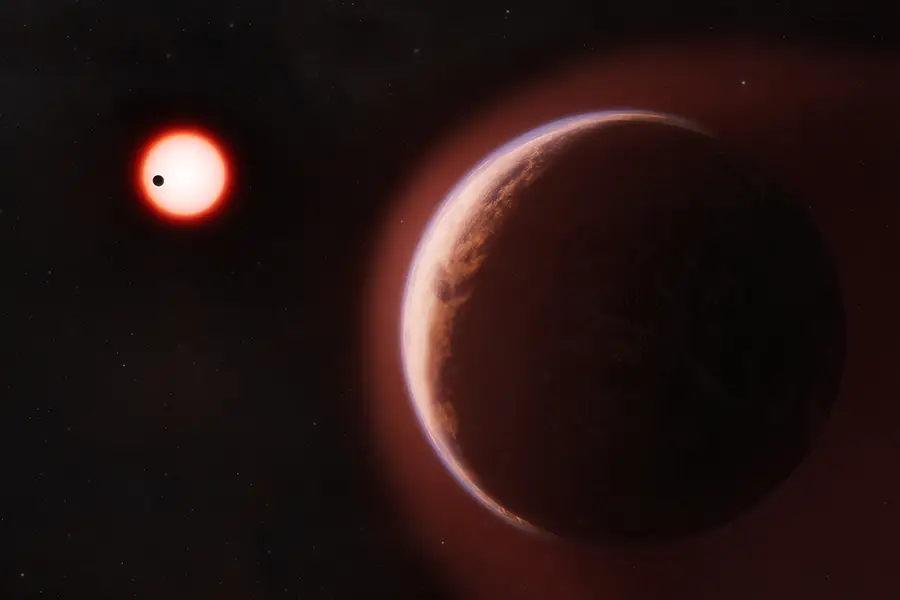
The world in question is the exoplanet K2-18b. Using the James Webb Space Telescope (JWST), a team of researchers led by Nikku Madhusudhan (University of Cambridge, UK) thinks they might have detected the molecules dimethyl sulfide and dimethyl disulfide in K2-18b’s atmosphere, both of which they suspect could be produced by marine algae.

A. Smith, N. Madhusudhan (University of Cambridge)
It’s an enticing picture, but an uncertain one. The detection only hints that life might be present. More observations are needed before astronomers can determine what K2-18b is like, and if it really could be inhabited.
Discovered in 2015 by the Kepler space telescope, K2-18b traverses its 33-day orbit around a red dwarf star that lies 124 light-years away from our solar system. Considered a “mini-Neptune” at around 2½ times Earth’s girth and more than 8 times its mass, K2-18b could potentially sustain a liquid ocean on its surface beneath a thin hydrogen atmosphere.
Madhusudhan and others previously proposed the existence of this new class of hycean worlds — a portmanteau of “hydrogen” and “ocean.” If they exist, hycean worlds could potentially host life within their hydrogen atmospheres and surface-wide oceans, expanding the diversity of habitable worlds.
But other scientists remain skeptical, suggesting that K2-18b could instead be a lifeless, gas-rich planet with a rocky interior and a suffocating hydrogen atmosphere.
Moreover, some astronomers have found evidence that dimethyl sulfide could be produced by abiotic mechanisms, such as on comets or within the clouds of gas and dust that form stars.
“In general, we have to be extremely cautious when claiming possible hints of life,” says Víctor Rivilla (Center of Astrobiology, Spain), who coauthored a paper on dimethyl sulfide’s abiotic sources. “Such a huge and exciting result will surely need much more robust evidence.”
Signs of Life
Astronomers can detect and decipher the molecules in an exoplanet’s atmosphere by looking at the light from the parent star as the planet passes in front of it. As the star’s light filters through the planet’s upper atmosphere, elements and molecules will absorb that light at different wavelengths, leaving their fingerprints in the stellar spectrum.
In 2023, Madhusudhan led a team that detected carbon-bearing molecules, such as carbon dioxide and methane, in K2-18b’s atmosphere, as well as a potential whisper of dimethyl sulfide. On Earth, trace amounts of the latter molecule — about one part per billion air molecules — are produced by marine organisms such as phytoplankton and bacteria. Because the molecule (and its cousin, dimethyl disulfide) is highly reactive, it disappears quickly from our air and must be constantly resupplied by marine life. For this reason, astrobiologists have suggested it as a compelling biosignature, a molecular marker of life’s presence.
However, this earlier detection was of low confidence: There was a 32% chance the signal was a statistical fluke. After following up with JWST’s Mid-Infrared Instrument (MIRI), the team has now increased the confidence in the dimethyl sulfide detection, with a 99.7% chance that it’s really there and not just the result of a noisy spectrum. They also found a similarly significant detection of dimethyl disulfide, announced in their paper published in The Astrophysical Journal Letters.
If the detections are real, then either one or both molecules could be present in abundance, suggesting that the planet could be brimming with algal life.
However, astronomers generally aim for stronger statistical confidence in their work, preferring to exceed a “this is real” likelihood of 99.99994%. “The authors claim some hints of [dimethyl sulfide and dimethyl disulfide], but they are still not enough to be sure that the signatures observed in the JWST spectra are really due to these two molecules, and not by others,” Rivilla says. So further observations are needed to confirm the signal or rule it out for good.
Water World or Lifeless Rock?

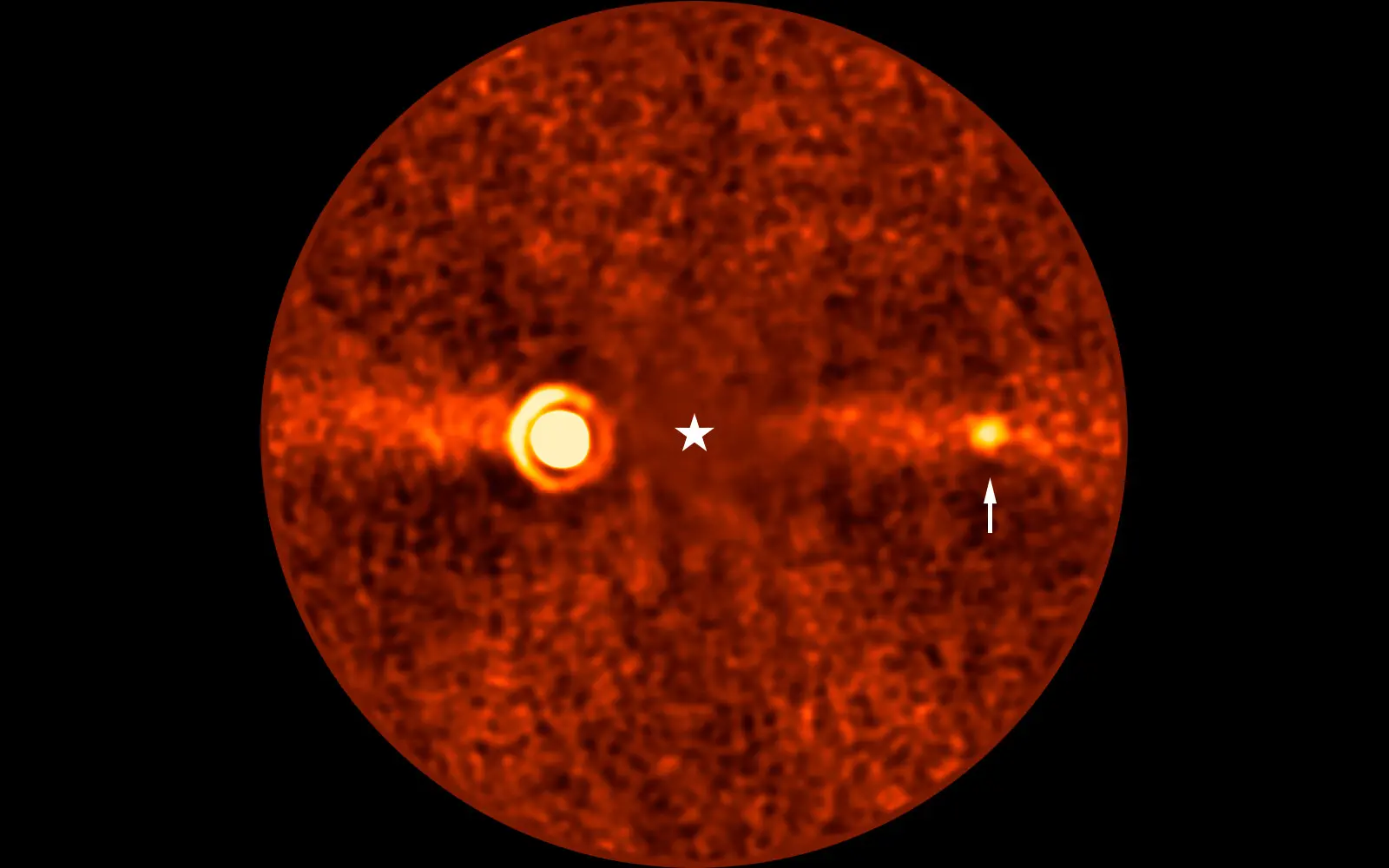
A. Smith, N. Madhusudhan (University of Cambridge)
Other astronomers have previously suggested that K2-18b could just as easily be a lifeless world with no water present on its surface. K2-18b falls in the class of mini-Neptunes, a diverse set of worlds bigger than rocky Earth but smaller than the gas or ice giants. Various compositions are possible, ranging from temperate water worlds to gassy planets with thick atmospheres and molten interiors.
“As far as I am aware, the only scenario that explains all the constraints on the atmospheric composition to date is one where the interior has a substantial water content and the atmosphere is hydrogen-rich and relatively thin,” says Madhusudhan, whose team argues that the hycean scenario best fits this description. “If the dimethyl sulfide/dimethyl disulfide inference turns out to be true, then it takes us more in the direction of the hycean scenario.”
Notably, the team did not detect water, ammonia, carbon monoxide, or hydrogen cyanide in the atmosphere, consistent with the hycean scenario in which a vast liquid ocean sequesters such molecules. However, a magma ocean of molten rock could also explain these non-detections. Such a world would likely be inhospitable to life.
Nicholas Wogan (NASA Ames Research Center) led a study in 2024 investigating possible compositions for K2-18b. His team showed that the methane detections would be impossible to explain on an uninhabited hycean planet, while methane could accumulate on a hycean world with life, in an environment similar to ancient Archean Earth.
However, dimethyl sulfide wasn’t produced on Earth until 250 million years ago, under more similar conditions to those on Earth today. “Dimethyl sulfide production is a very specific and a late invention in Earth’s biosphere, post-dating the rise of oxygen gas in the atmosphere and all water reservoirs,” says Dimitar Sasselov (Harvard University), who was not involved in the 2024 study or the new one. “So, how that would be a biomarker of a hycean environment is not only unclear, but biochemically contradictory.”
Wogan’s results actually favor a lifeless scenario for K2-18b, with a thick hydrogen atmosphere, a rocky interior, and no habitable surface. “Neither scenario is fully reliable, but the one that is most likely and internally self-consistent is provided by [Wogan’s paper],” according to Sasselov. Constraining the composition of K2-18b and the environmental context that the molecules are produced in is necessary to confirm whether the detections are truly indicative of life.
The dimethyl signals themselves also require more follow-up observations to be robustly confirmed. Astronomers find molecules in exoplanet atmospheres by comparing the spectra to predictions based on lab work and computer simulations, which involves extrapolation and simplification.
Even if the two molecules are present, some astronomers have suggested that they could be produced in abiotic processes. Dimethyl sulfide, for example, has been discovered both on Comet 67P/Churyumov–Gerasimenko and in the interstellar medium in similar abundances, indicating that the molecule can be produced in the absence of life.
“An efficient and, more importantly, abiotic formation pathway for dimethyl sulfide —produced by cosmic chemistry rather than biological activity — does occur in space,” says Miguel Sanz-Novo (Center for Astrobiology, Spain), who led the study demonstrating dimethyl sulfide’s abiotic origins. “By definition, this implies that dimethyl sulfide cannot be considered a robust or unique biomarker.”
Laboratory experiments and future observations targeting star-forming regions and protoplanetary disks could confirm whether dimethyl sulfide can be produced by other chemical processes. “Our current knowledge about the chemistry of the planetary atmospheres is still very limited, and we cannot rule out abiotic mechanisms producing these molecules — if they are really present,” Rivilla says.
These limits apply even in our own solar system, where controversial detections of phosphine in Venus’s clouds led some astronomers to suggest that we were seeing hints of life.
To find another world with life would be a profound reckoning for humanity.
“It will transform our view of the universe and our place in it,” says Madhusudhan, “and could potentially inform how life originated here on Earth, which is still an open question.”
That transformation will have to wait, however, until rigorous vetting and follow-up confirm whether we have company in the cosmos.
About Arielle Frommer
Arielle Frommer is a science writer for Sky & Telescope and astronomy PhD student at Yale, where she studies exoplanets. In her free time, she enjoys hiking, crocheting, drinking coffee, and reading and writing fiction.



Comments
Revv
April 24, 2025 at 12:05 pm
It's never aliens, ever. Can't wait for this to turn out to be just gases from the rocks or something.
You must be logged in to post a comment.
Ludovicus
April 26, 2025 at 1:29 am
The SINGLE biggest issue I have with these exoplanetary models is almost NO ONE in the list of scientists is a CHEMIST! Drives me crazy - we see papers with all sorts of goofy modelling, assumptive potential explanations with almost zero chemical logic to it!
Time for the Astrophysicists to park their modelling and work with chemists that can help unravel potential mechanisms in production of these types of trace gases and compounds detected.
In the paper listed in the text, lots of spectroscopy and such, but absolutely nearly NO viable mechaisms for DMS production in situ for the atmosphere. None were seen in the text of that paper at all. I recall a Hycean world paper a year or so back that covered all sorts of thermodynamical calculations and NO coverage of the potential photochemical treatment of that atmosphere at all. Only thermodynamics and phase modelling. Totally silly, IMO.
So smarten up you Astro-scientists, time to employ and utilize more chemists in your teams!
You must be logged in to post a comment.
You must be logged in to post a comment.