 SUNSET:

 7
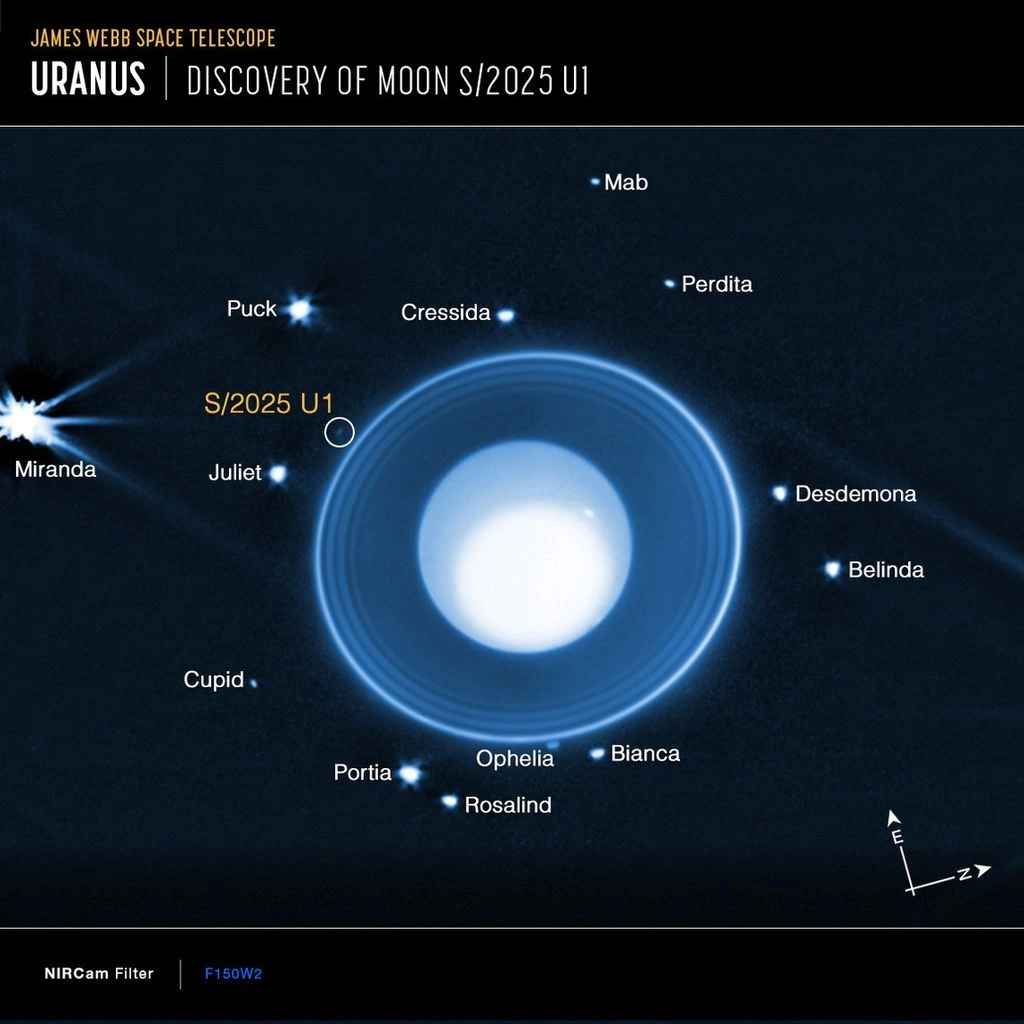
7Astronomers have spotted a new small moon for Uranus in images from earlier this year.
NASA / STScI / ESA / M. El Moutamid (SWRI) / M. Hedman (University of Idaho)
Chalk up one more tiny moon for the ice giant Uranus. On August 19th, researchers announced the discovery of the small new moon, provisionally dubbed S/2025 U1. The Central Bureau for Astronomical Telegrams also announced the discovery on the same day. The discovery brings the number of confirmed moons for Uranus to 29.
The researchers used images captured by the James Webb Space Telescope on February 2nd of this year for the discovery, combining ten 40-minute exposures from the Near-Infrared Camera (NIRCAM). The moon can be seen in the sequence of discovery exposures as a +25th-magnitude object. Assuming the moon’s albedo (surface reflectivity) is similar to that of other known Uranian satellites, S/2025 U1 has a mean diameter of 10 kilometers (6 miles), about the size of Mars’s misshapen moon Deimos. That would make it one of the smallest known moons of Uranus.
“It’s a small moon but a significant discovery, which is something that even NASA’s Voyager spacecraft didn’t see during its flyby nearly 40 years ago,” says team leader Maryame El Moutamid (Southwest Research Institute) in a recent press release.
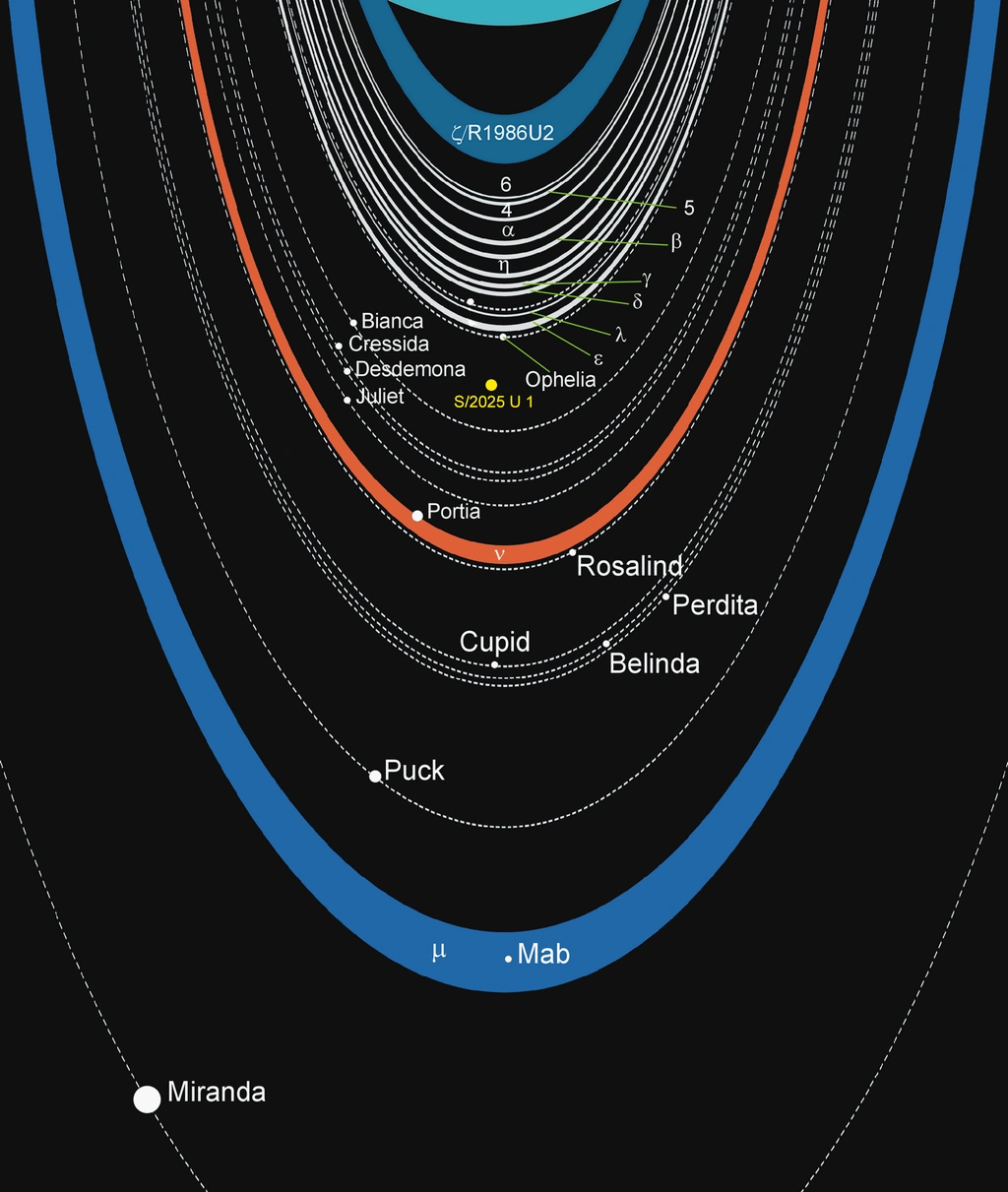
S/2025 U1 orbits Uranus once every 9.6 hours, some 56,250 kilometers (34,950 miles) from the planet’s center. This puts the tiny moon between the inner moons Bianca and Ophelia.
SWRI
The view captured by NIRCAM’s F150W2 filter at 1.0 to 2.4 microns shows the dramatic scene, complete with the planet’s rings, plus 13 other known moons. This is JWST’s first discovery of a moon orbiting a planet in our solar system.
“These observations were designed to have long exposures to search for faint signals around Uranus,” says Matthew Hedman (University of Idaho). This was done, “in part, to search for previously unknown moons like this one.”
William Herschel discovered the first two moons for Uranus (Oberon and Titania) in 1787, six years after he discovered the planet itself. William Lassell added Ariel and Umbriel to the assemblage in 1851, and Gerard Kuiper’s discovery of Miranda in 1948 brought the count to five, the number I learned in elementary school as a child of the 1970s.
The rings of Uranus were discovered by using the Kuiper Airborne Observatory during a stellar occultation on March 10, 1977. Kuiper used an infrared telescope mounted in a converted U.S. Air Force C-141 Starlifter aircraft and was the predecessor to the airborne SOFIA observatory.
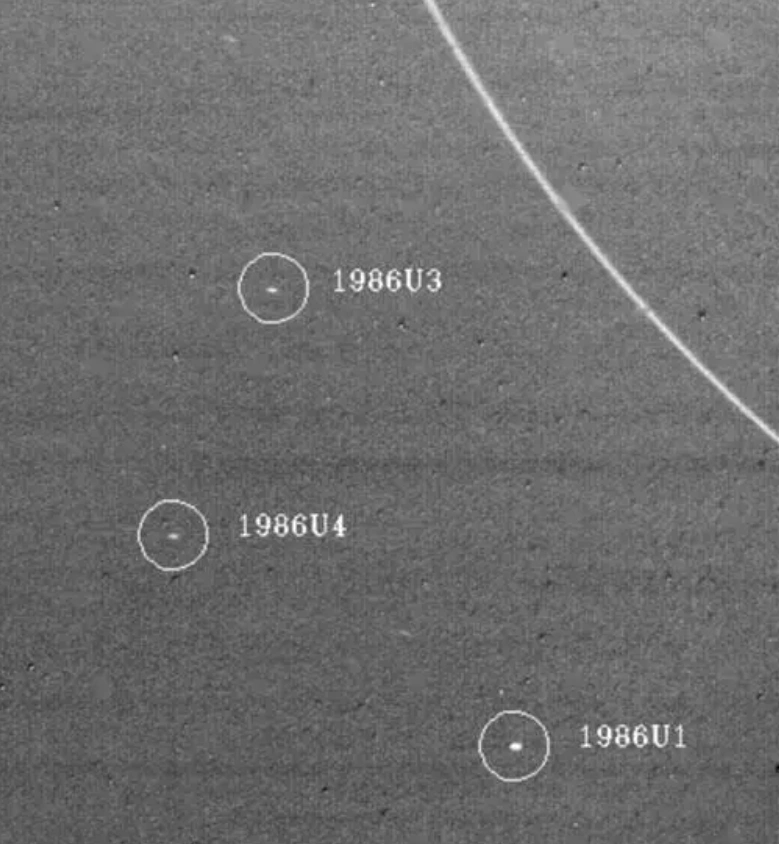
But it took Voyager 2’s historic flyby in January 1986 to expand the count by another 10 moons, and Hubble and later ground surveys to add more. S/2025 U1 was just faint enough to elude these surveys.
NASA / JPL
William Herschel’s son, astronomer John Herschel, started the poetic tradition of naming the Uranian moons after characters from the works of Shakespeare and Alexander Pope. Certainly, the International Astronomical Union has a rich remaining cast of characters to choose from when a formal name is proposed.
This discovery was the result of JWST’s General Observer program and is a vindication of the space telescope’s use in probing the solar system. NIRCAM’s sensitivity and resolution in the infrared make it especially adept at catching faint objects in the outer solar system. This legacy will continue with the Nancy Grace Roman Space Telescope, set to launch in 2027.
NASA / JWST
“This proves the remarkable capabilities of JWST’s NIRCAM camera for studying these regions, where the challenge is that it’s like you are staring into a headlamp and looking for a nearby gnat,” says Mark Showalter (SETI Institute). "We had to develop a number of new techniques for processing the images such that the rings and tiny moons could be clearly detected. We definitely hope to use the same methods elsewhere in the solar system now.”
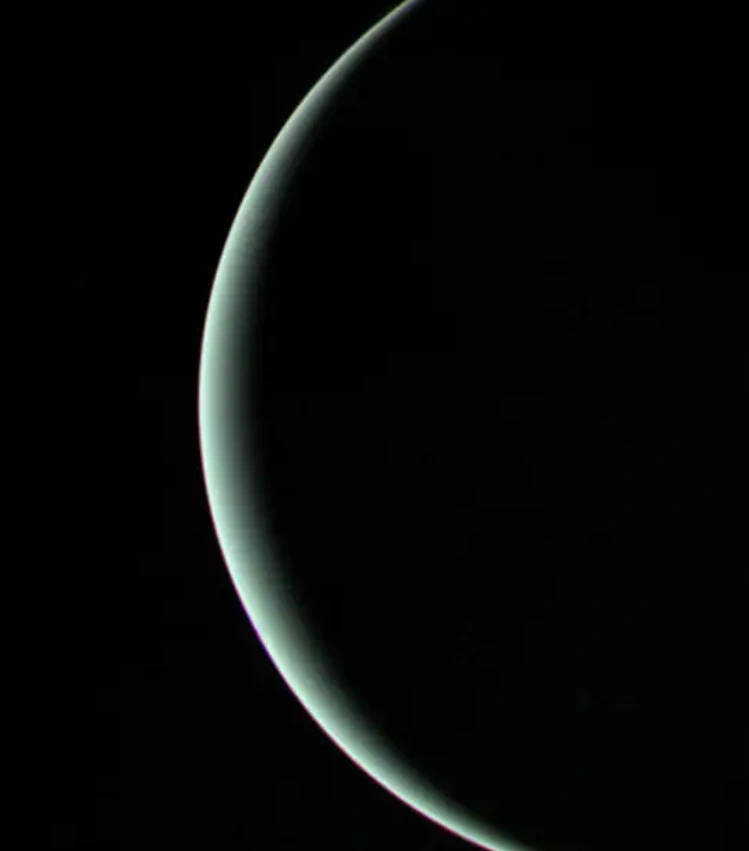
NASA / JPL
It’s remarkable that JWST can now see moons that Voyager 2 missed in the '80s. We can only hope to see the moons of Uranus up close again if the proposed Uranus Orbiter — recommended in the 2023-2032 Planetary Science Decadal Survey — makes its way to space in the coming decade. For now, we’ll have to marvel at JWST’s amazing views and the addition of one more tiny world to the drama of our solar system.
About David Dickinson
David Dickinson is a freelance science writer, high school science teacher, retired enlisted U.S. Air Force veteran and avid stargazer. He currently resides with his wife Myscha in Bristol, Tennessee. David also writes science fiction in his spare time. He posts as @AstroDave on BlueSky about space news and sky-watching worldwide.



Comments
Michal
August 21, 2025 at 4:03 pm
" S/2025 U1 has a mean diameter of 8 to 10 kilometers (13-16 miles)"
Might want to get out the slide rule and check this
You must be logged in to post a comment.
David DickinsonPost Author
August 22, 2025 at 11:21 am
Thanks... fix'd.
You must be logged in to post a comment.
t3kboi
August 29, 2025 at 10:22 am
Perhaps we could welcome sky and telescope to 2025 - please replace those static tables with ones that allow sorting and filtering.
You must be logged in to post a comment.
Monica Young
August 29, 2025 at 11:38 am
Could you clarify which tables you're referring to?
You must be logged in to post a comment.
RC Silk
August 22, 2025 at 4:41 pm
It would help, as a general rule, whenever a "new" moon is discovered, to list the updated satellites in an orbital sequence, such as:
(Closest Moon) [A] [Name] [stats]
(Middle Moon) [M] [Name] [stats]
(Farthest Moon) [Z] [Name] [stats]
You must be logged in to post a comment.
Monica Young
August 26, 2025 at 11:50 am
We actually have exactly what you're looking for!
https://skyandtelescope.org/astronomy-news/solar-system/a-guide-to-planetary-satellites/
You must be logged in to post a comment.
Chris Miller
August 22, 2025 at 5:05 pm
The IAU really needs to come up with a definition of dwarf moon, analogous to that for dwarf planet.
You must be logged in to post a comment.
You must be logged in to post a comment.