 SUNSET:

 12
12Walking through neighborhoods, volunteers identified sources of light pollution —surprisingly, streetlights weren’t the main culprit.
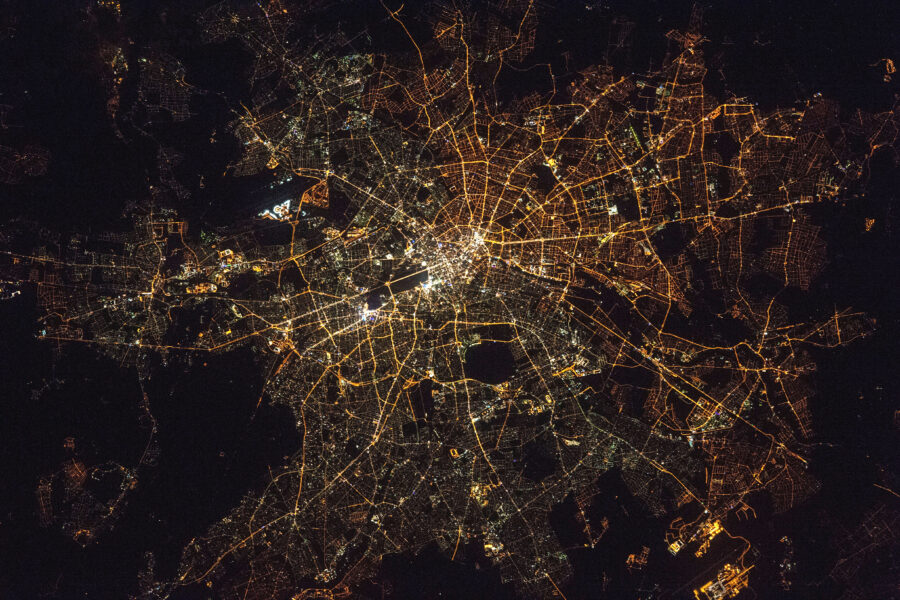
Image Science & Analysis Laboratory / NASA Johnson Space Center
If you’ve noticed your night sky becoming brighter over recent years, you’re not imagining things: Studies from the ground suggest that the amount that artificial light spills into the atmosphere is increasing by 10% year over year. We were supposed to see the opposite effect. Yet conversion of streetlights to energy-efficient LEDs, often fully shielded to direct light toward the ground, somehow weren’t doing the trick.
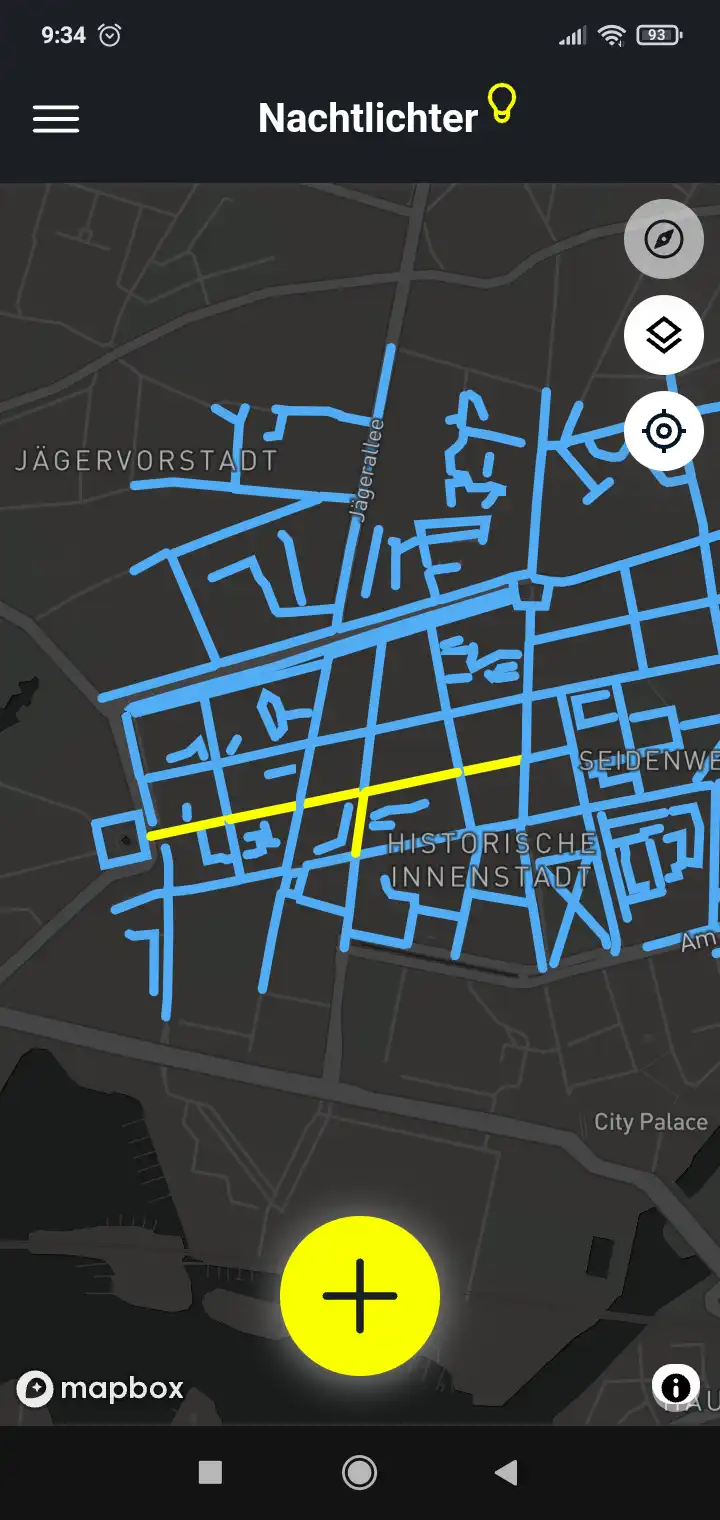
Using a simple app — and the help of hundreds of citizen scientists — a research group led by Christopher Kyba (Ruhr University Bochum, Germany) has found out the cause of this discrepancy. Publicly controlled streetlights only make up only a small percentage of contaminating light sources. The vast majority of light-pollution sources are private and commercial windows and signs, which so far have hardly been studied, let alone regulated.
Nachtlichter
“Policies on energy and lighting as well as research on the effect of artificial light on the environment have generally focused on street lighting,” Kyba writes in Nature Cities, published on June 16th. “Our results indicate that a broader approach that takes all lighting into account will be needed to understand and to mitigate the environmental effects of light from cities.”
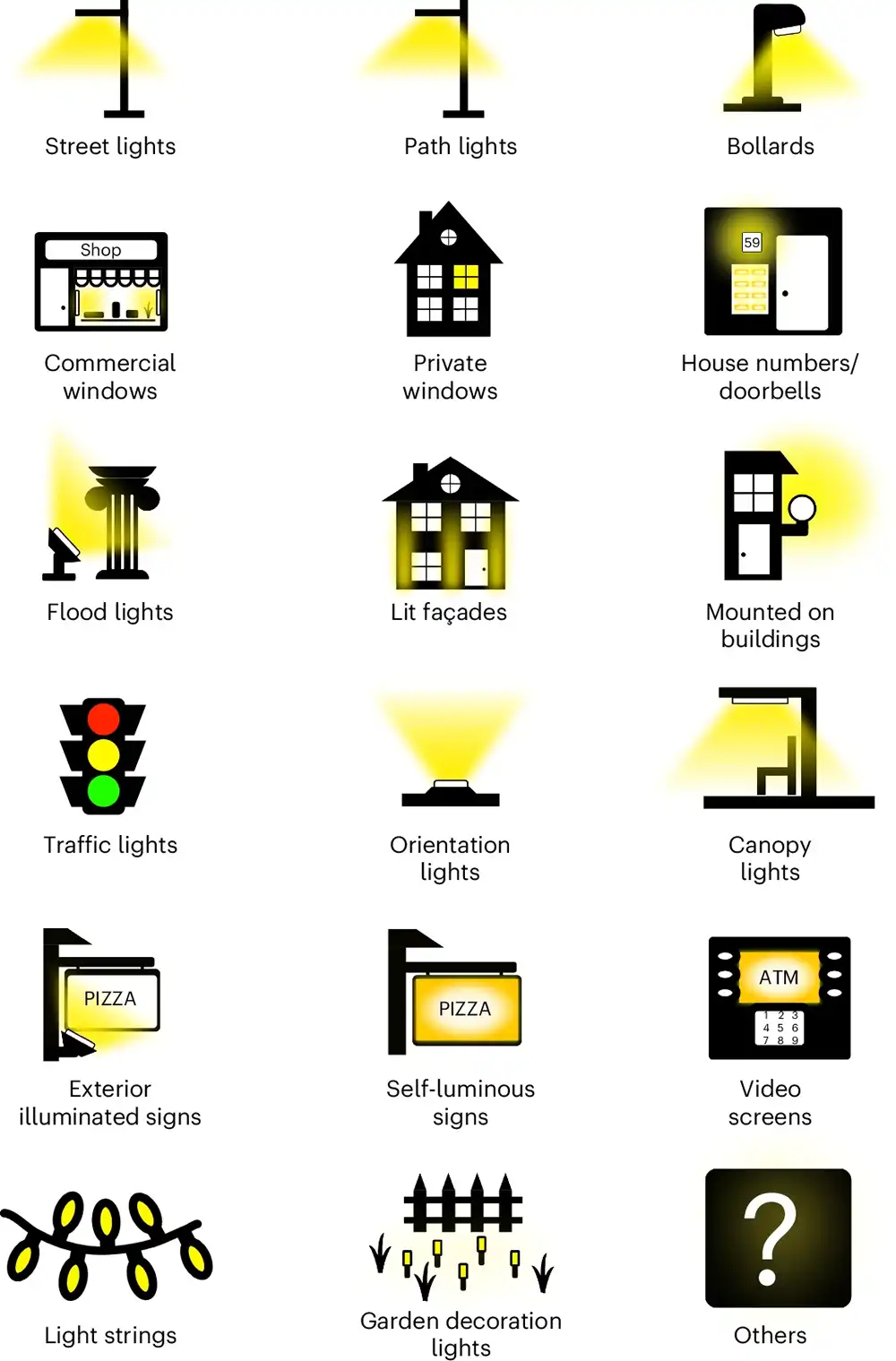
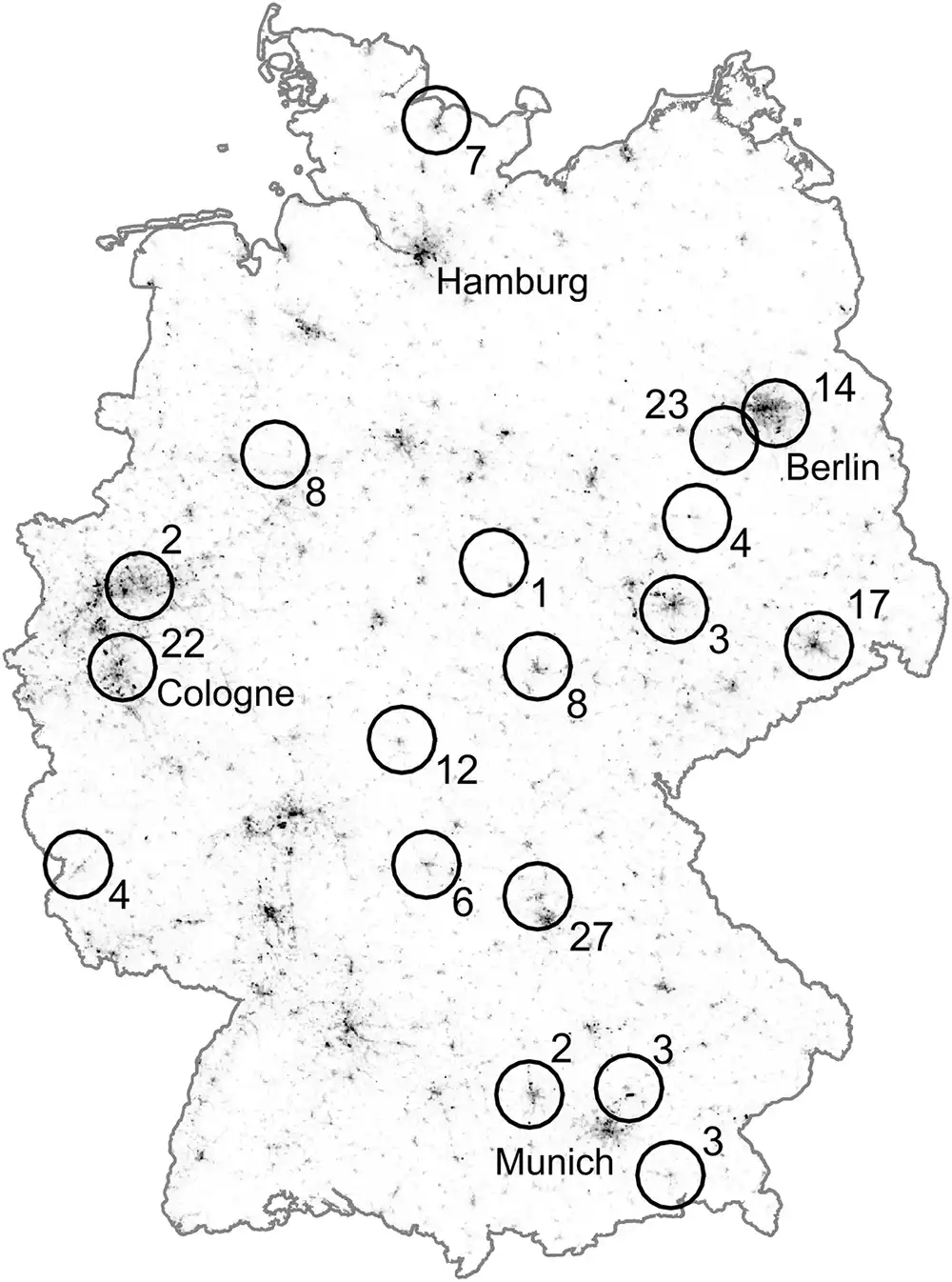
To match satellite images of cities at night with actual light sources on the ground, the team designed an app called Nachtlichter (“night lights” in German). About 250 citizen scientists used it to count and classify all light sources they could find as they walked along streets, paths, and alleys in predetermined areas in Germany. The surveyed areas included city centers, residential neighborhoods, dense commercial and industrial zones, and villages.
Team Nachtlichter / Nature Cities 2025 / CC BY 4.0
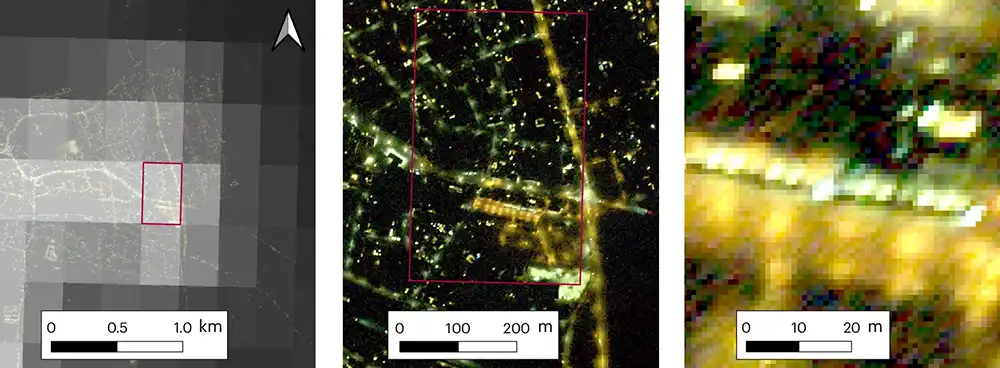
During the autumn of 2021, the users registered a total of 234,044 individual lights over the course of more than 4,400 surveys. The team then compared these counts with nighttime satellite imagery — specifically, visible- and near-infrared-light images taken by the National Oceanic and Atmospheric Administration’s Day-Night Band instrument aboard the Suomi National Polar-orbiting Partnership satellite. The scientists used that comparison to translate the radiance as seen from above into the number of lights on the ground.
They use this conversion to interpret satellite observations of other areas. For example, Kyba’s team estimates there are 2.5 million light sources that are on in the city of Berlin, and close to 80 million light sources for all of mainland Germany. That’s about one light source per inhabitant.
Team Nachtlichter / Nature Cities 2025 / CC BY 4.0
The team also discussed the types of lighting present in the surveyed areas. Surprisingly, streetlights only made up 10.3% of all the light sources. Many (48.2%) were illuminated private windows, and commercial windows added another 7.4%. Other source types made up the remaining 18%, including illuminated signs, floodlights, facade illuminations, video screens, decorative lights, and illuminated house numbers and door bells.
This result explains the discrepancy between satellite images and perceived skyglow: By focusing on public streetlights, almost half of which are full shielded in Germany, researchers ignore that most light pollution comes from other sources. In addition, satellite images, often taken around local midnight, miss a lot of private and commercial lighting that’s present during the evening hours. (This reasoning may also explain why images taken by Earth-observing satellites see a more moderate increase in light pollution than measured from the ground: just 2% yearly.)
The result may help explain why the conversion of public lighting to LED failed to decrease skyglow, as had been expected due to previous studies. Any improvement in public lighting may have been overwhelmed by a simultaneous increase in other light sources’ number and intensity.
Kyba’s team concludes that lighting policies should therefore target commercial lighting. Over a quarter of illuminated signs in commercial areas were reported as exceptionally bright by the volunteers, suggesting that regulations, mostly enacted decades before LED took over, may need to be updated. The team names France as a positive example, where new regulation requires advertising and interior lights to be turned off when there’s low pedestrian traffic and low building occupation, respectively.
Team Nachtlichter / Nature Cities 2025 / CC BY 4.0
There’s still more work to be done: Because the team focused on Germany, the results cannot be easily extrapolated to other places. That’s because even countries of similar wealth and development can have dramatically different light emissions per capita when observed from space. A 2019 study, for example, found that the U.S. emits three times more light into space than Europe, and even in Europe there is large variation between different nations.
Secondly, the study only registered the number of sources and not their individual contribution to skyglow. The scattering of light overhead will differ for an illuminated sign compared to a fully shielded lamp, for example. Therefore, it doesn’t really tell us how much skyglow each source type generates, Kyba says: “What I think we can say is that streetlights become less important, the more dense and brighter a region is. In rural areas and suburbs, the relative contribution of streetlights to skyglow (especially late at night) is larger than it is for city centers.”
Future surveys in and outside of Germany may fill some of these gaps. The Nachtlichter team already undertook a second campaign in 2023 on the same roads and neighborhoods but at different hours during the night. Another campaign is also planned in Ireland.
The light pollution problem is set to spiral out of control, unless sharper and more effective tools are found to mitigate its effects. Finding out who and what actually pollutes most is a crucial step toward that goal.





Comments
Anthony-Mallama
June 27, 2025 at 5:25 pm
A very interesting study. Thanks.
You must be logged in to post a comment.
thegoat914
June 27, 2025 at 6:03 pm
Good info.
We have a church nearby that installed a new 6ft by 8ft LED sign. So bright, it blinds me at night while driving when it switches to a white background. And I see more of these signs in the city each month. Why must they have it so bright?
You must be logged in to post a comment.
Warren-Odom
June 27, 2025 at 7:45 pm
Why so bright? I suspect so people can see it in the daytime. Maybe sign manufacturers could be persuaded to automatically turn down the intensity at night (to save money of course) -- if that capability doesn't already exist.
You must be logged in to post a comment.
Ludovicus
June 27, 2025 at 9:47 pm
It is nothing short of pure advertising mentality - bright = attention-getting.
Car and truck lots and agro equipment sales lots do same thing - they light up the show spaces and lots - partly (they say) for security, and partly to catch the attention of traffic passing by.
Until we reign in the advertising nutzos, there is only so much to be done. It requires ordinances for cites and townships to be harmonized as well. If mandated in urban areas, but not rural ones, guess where one will set up a sign? 🙁
Ludo
You must be logged in to post a comment.
Anthony Barreiro
June 28, 2025 at 12:56 am
Outdoor "security" lights on private residences are a huge source of light pollution in my neighborhood in San Francisco. Blindingly bright and completely unshielded.
You must be logged in to post a comment.
mxyzptlk
June 29, 2025 at 2:55 am
Private homes lit up like the Taj Mahal drive me insane. Electricity isn't free. How can people justify wasting energy 24h/365d? It also demonstrates the utter indifference these lighting polluters have for their fellow residents.
You must be logged in to post a comment.
AB
July 4, 2025 at 1:51 pm
^ This.... people just don't care. Among their other disruptions, my recently-installed neighbours from hell have exterior lights on all 3 buildings around the clock, and leave all the lights in their unoccupied ginormous garage on all night, spewing out the windows, as well as a light post beside it. People in my town would have total meltdowns if asked to reduce their lighting. My property, do what I want on it, doesn't matter who I bother.
I used to be able to stargaze right on my back porch. ...Yes, I need a new home 🙁
You must be logged in to post a comment.
Anthony Barreiro
July 4, 2025 at 8:32 pm
AB -- That is so sad. Could you move to a dark sky community with good outdoor lighting rules?
You must be logged in to post a comment.
mxyzptlk
June 29, 2025 at 2:58 am
Pardon me. I meant to type "lighting TRESPASSERS", not "polluters".
You must be logged in to post a comment.
Enrico the Great
June 30, 2025 at 12:11 pm
BLUE LEds are EVIL.
I hate them. New York City has almost totally gone over to this type of lighting.
I have not attempted to even semi-seriously observe ANYTHING. When the sky is slightly hazy--it GLOWS at night like early twilight. At best M-42 MIGHT be visible. (Haven't had the heart to try it even with binoculars since) Gotta get a long focus Maksutov for moon and planets.
You must be logged in to post a comment.
Enrico the Great
June 30, 2025 at 5:49 pm
That sentence should read:I have not attempted to even semi-seriously observe ANYTHING SINCE the changeover.
You must be logged in to post a comment.
Jim-Gasser
July 4, 2025 at 5:08 pm
Interesting article but the photo clearly outlines roads, so those are definitely street lights. Apparently all lighting contributes to the problem.
You must be logged in to post a comment.
You must be logged in to post a comment.