 SUNSET:

 4
4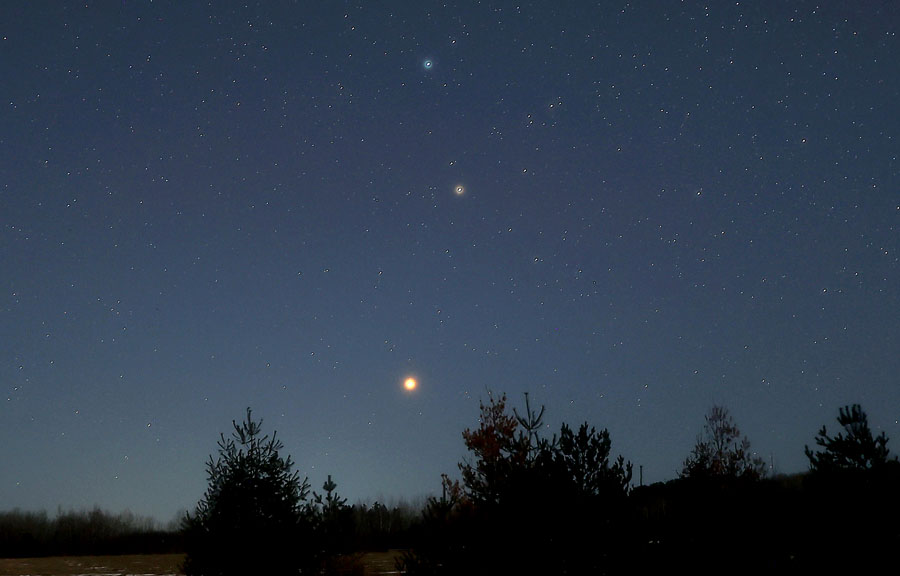
Bob King
Mars is bright again and a tempting target on winter nights. At opposition on Jan. 16th, the Red Planet shines at magnitude —1.38, just a fraction fainter than Sirius at —1.46. Sirius looks pure white to my eyes, but the naked-eye color of Mars has always been more elusive. Many people offhandedly say red, but is it? A closer look reveals a richer palette that includes gold, salmon and peach. I recently asked my Facebook friends what color they thought it was and received some perceptive descriptions:

NASA / JPL-Caltech / MSSS
"More like golden with a hint of rose," wrote Alexander Vasenin. Jill Meadows thought "glowing firelight" fit the bill, while Alan Dyer definitively answered "Salmon pink!" Others called it orange-red, terra cotta, rusty mandarin, amber, warm citrine, orangey-gold and "like an ember." Only a few described Mars as red. Images taken by NASA's rovers reveal a more terra cotta-hued landscape. All these colors tilt toward the warmer end of the color spectrum and result from the prevalence of iron oxide in the dust the covers vast areas of the planet's surface. If you could vacuum it all up we'd see a far blander Mars, since its crust is composed primarily of dark gray, basaltic rock.
NASA with additions by Bob King
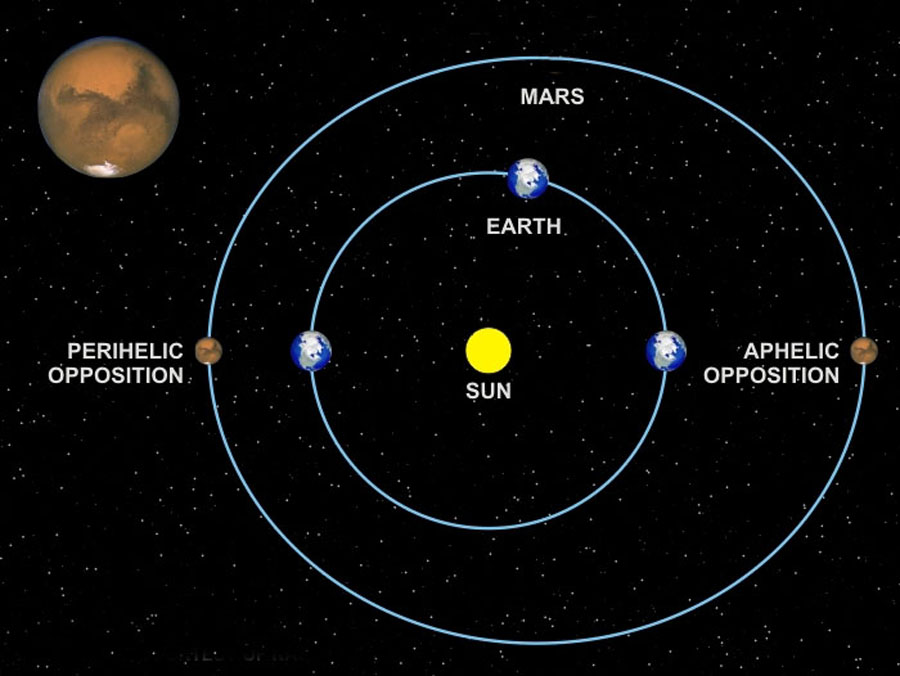
Oppositions of Mars occur on average every 2 years and 2 months, when Earth and the planet line up on the same side of the Sun and closely approach one another. Proximity makes Mars look much brighter than normal and also increases its apparent size as seen through a telescope.
If Mars' orbit more closely resembled a circle like Earth's, its brightness would vary little from one opposition to the next. But its orbit is one of the most eccentric (strongly elliptical) of the 8 planets. When Mars is closest to the Sun at perihelion, and the two planets align, it's big and brilliant. Exactly the opposite happens when it stands farthest from the Sun at aphelion, the current situation. The Red Planet's disk will swell to a modest 14.6″ when closest to the Earth on Jan. 12th compared to 24.3″ during the July 2018 perihelic opposition. Close (and distant) oppositions recur on average every 15.8 years.

Bob King
Mars may be a little puny this go-round but it still shows lots of telescopic detail — at least for mid-northern latitude observers — thanks in part to its high declination. On Jan. 16th, Big Red beams down from Gemini at +25°. From the southern U.S. the planet passes just a stone's throw from the zenith at culmination. Its lofty altitude helps ameliorate the effects of poor seeing. I've routinely observed Mars the past month using magnifications between 250x and 350x — no small feat from fickle Midwestern skies.
Damian Peach / Gregg Dinderman / S&T
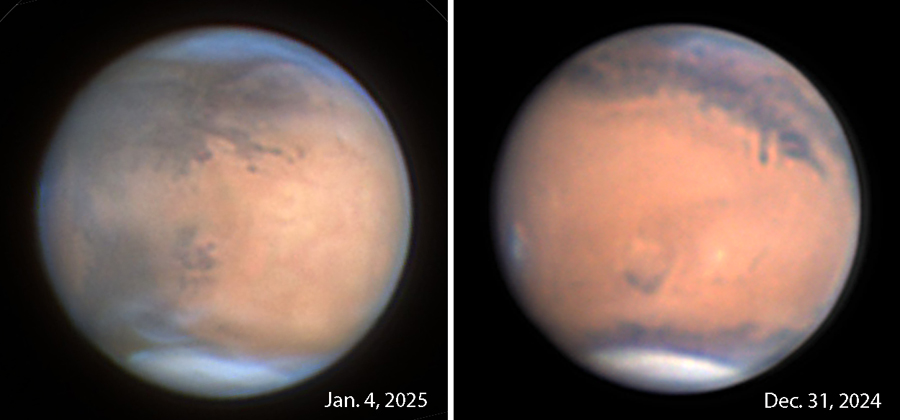
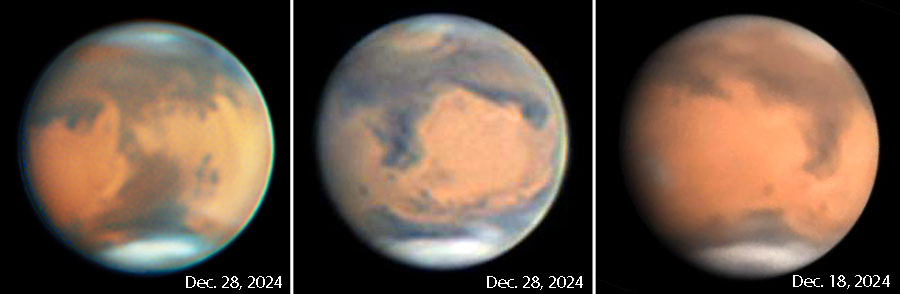
The most prominent and enticing feature visible right now is the North Polar Cap. During our early fall season it was hidden beneath the clouds of the North Polar Hood, but when northern Martian spring began in earnest in late November they parted to reveal a gleaming lentil-like cap of carbon dioxide ice visible even at 50x. As spring deepens into summer, the Sun will gradually warm and vaporize the ice, eventually exposing the much smaller, residual water-ice cap. Regular observers of the planet can watch it shrink right before their eyes. Mars contracts and fades faster than you think. One month past opposition on Feb. 16th, it dips to magnitude –0.6 and contracts to 12.1″. Observe it as often as you can.
Pierre Gilet (left) and Wayne Jaeschke (right)
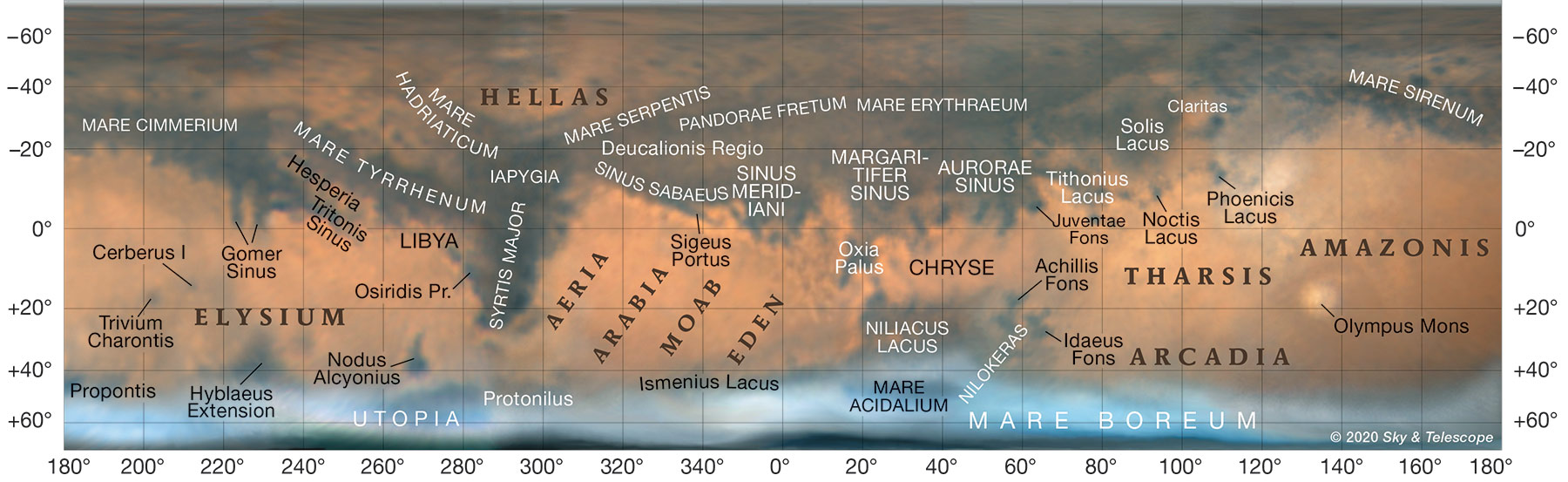
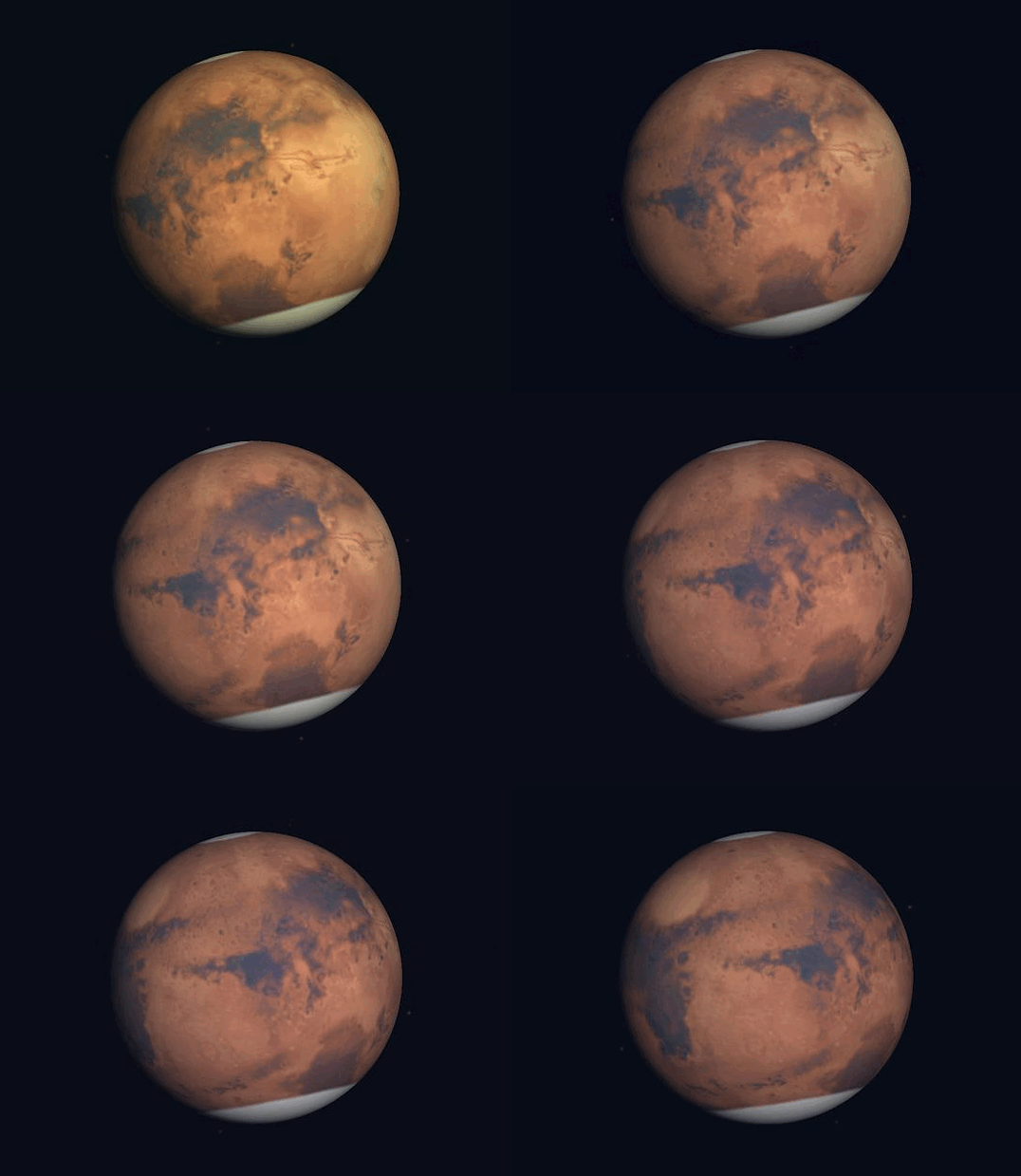
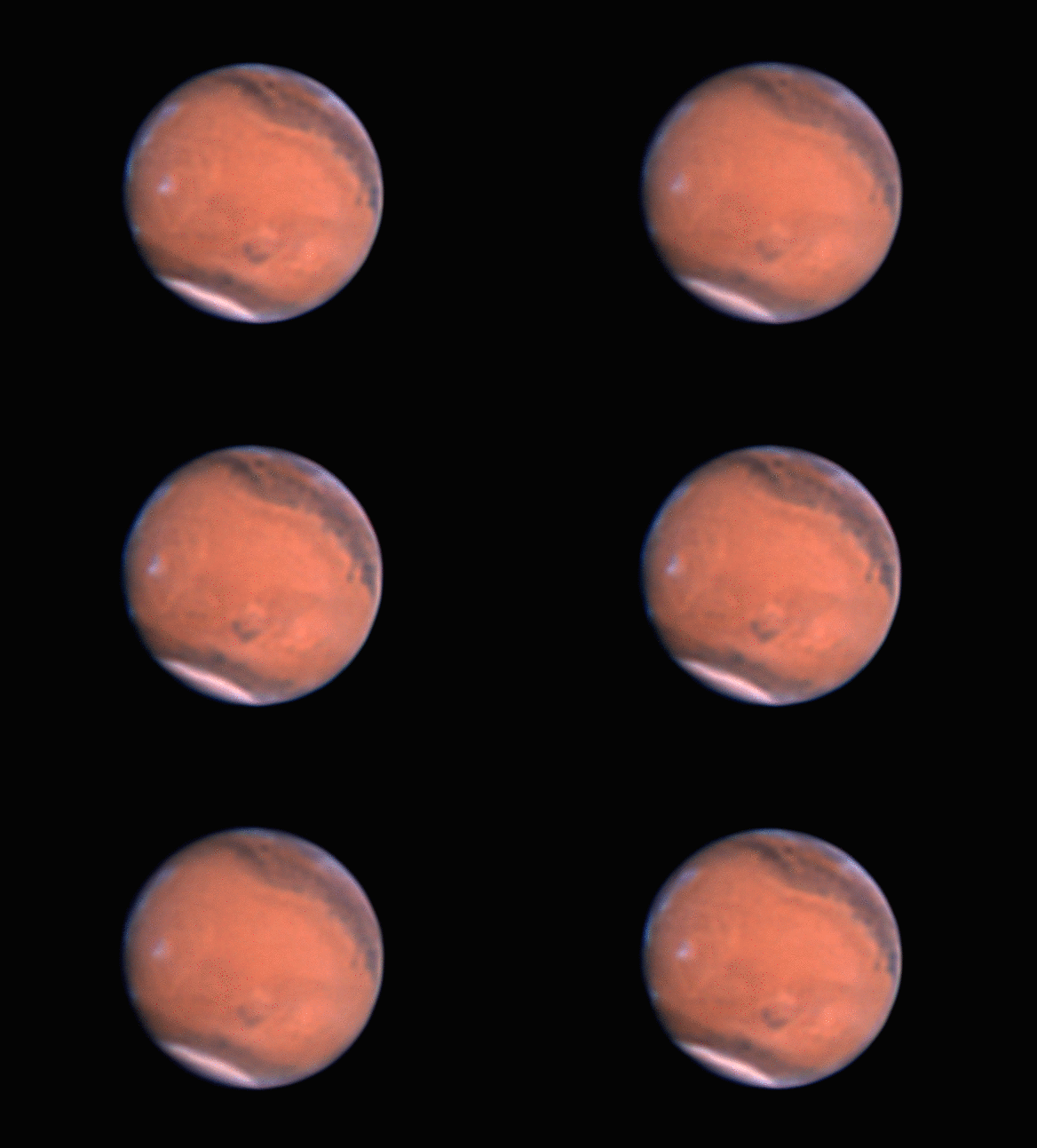
Dark albedo markings are not equally distributed across the planet. The eastern "Mare Sirenum" hemisphere can look pretty lackluster. But there's a tempting challenge here. Bright orographic clouds often hug the slopes of the solar system's largest volcano, Olympus Mons. Under high magnification in excellent conditions it reveals itself as a fuzzy, white spot.
Stellarium
Michael Teoh (left), Eric Harris (center), and Makrem Larnaout
Below is a list of dates when the planet's most prominent dark albedo features are well-placed for observation around 11 p.m. EST / 8 p.m. PST (4:00 UT). For a finer-grained, 24/7 perspective consult Sky & Telescope's Mars Profiler.
Jan. 12 — Aurorae Sinus and Mare Erythraeum (southern hemisphere); Niliacus Lacus and Mare Acidalium (northern hemisphere)
Jan. 17 — Sinus Sabeus and Sinus Meridiani (equatorial region)
Jan. 25 — Syrtis Major, Hellas and Mare Tyrrhenum (equatorial and south); Utopia (north)
Feb. 2 — Mare Cimmerium (south); Trivium Charontis (north)
Feb. 11 — Mare Sirenum (south); Olympus Mons (north)
Feb. 21 — Aurorae Sinus and Mare Erythraeum (south); Niliacus Lacus and Mare Acidalium (north)
Michael Phillips
Martin Bree
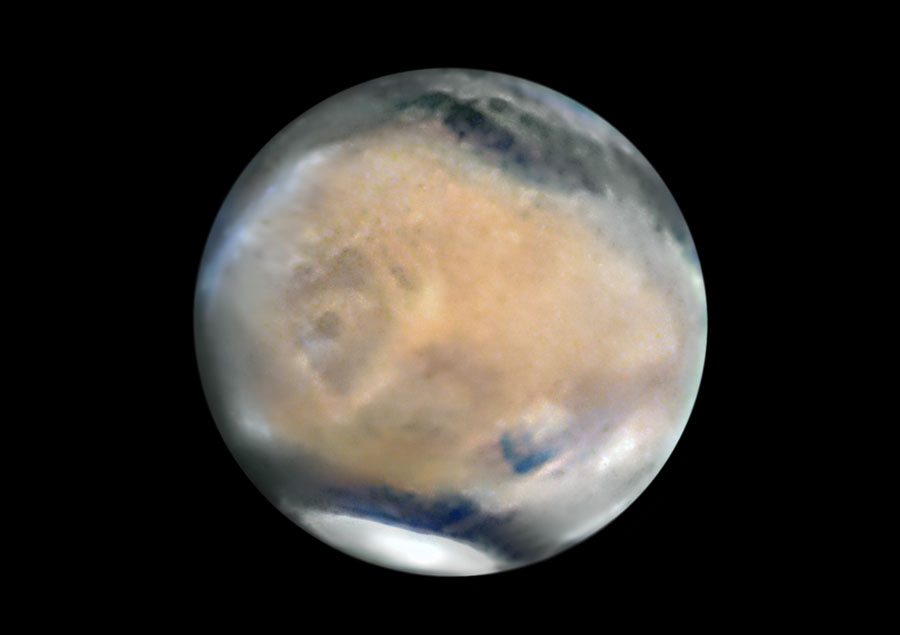
While identifying Martian features be sure to keep an eye out for bright hazes and occasional clouds along the planet's limb or terminator. They can be surprisingly easy to pick out especially if you use a blue filter such a Wratten #80A. Wratten #21 (orange) and #25 (red) filters boost the contrast of the dark albedo markings. For more about the Red Planet, check out the American Lunar and Planetary Observers (ALPO)'s guide to the 2024-2025 aphelic apparition of Mars. Another excellent resource is the Google Interactive Map of Mars, where you can really dig into the geology and land forms hinted at in the telescope. Although dust storms can occur at any time, major ones typically happen during southern hemisphere summer. Right now it's the middle of fall there.
Moon occults Mars Jan. 13-14
As if opposition isn't enough, there's a spectacular occultation in the mix. On Monday night January 13-14, the full Wolf Moon covers up the planet for the entire country (except Key West and nearby keys), much of Canada, western Africa and the extreme southwestern fringe of Portugal. You might recall that the very same thing happened during the previous opposition in December 2022.
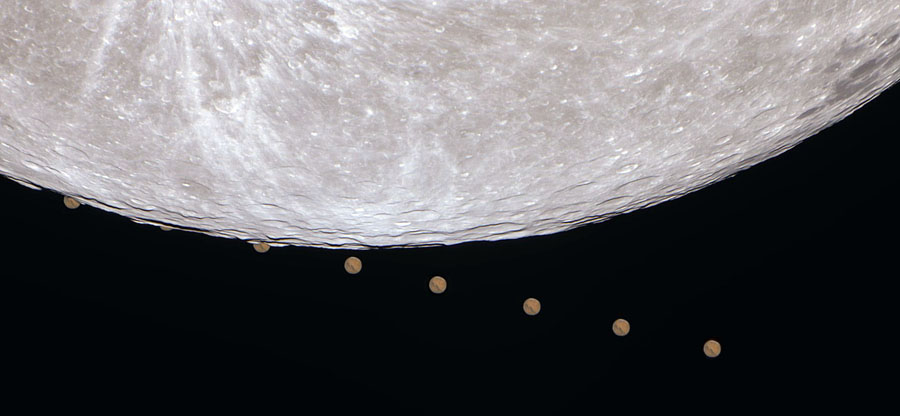
Sean Walker
For North American observers the occultation occurs during convenient evening hours with Mars sliding behind the Moon's bright limb around 9 p.m. EST (6 p.m. PST) and returning to view minutes to more than an hour later depending upon your location. From Denver the Moon will take 28 seconds to completely cover the planet. When Mars exits, there will be just enough shadowing in fringe craters at the dark limb to create a dramatic "Mars-rise."
For a map and list of cities and times of Mars' disappearance and reappearance, visit the International Occultation Timing Association's Mars occultation page. Times there are in Universal Time (UT) so remember to subtract 5 hours for EST; 6 hours for CST; 7 hours for MST and 8 hours for PST. To keep up with what's current events on Mars this apparition I encourage you to join the marsobservers group. Wishing you happy nights exploring the red-orange-mandarin-butterscotch planet!
About Bob King
I love the sky (day and night) and have been a skywatcher and amateur astronomer since childhood. I'm also a long-time member of the American Association of Variable Star Observers (AAVSO) and Astronomical League. I pen the Astro Bob blog and have written four books: Night Sky with the Naked Eye (2016); Wonders of the Night Sky You Must See Before You Die (2018) and Urban Legends from Space (2019) and Magnificent Aurora, published in 2024. The universe invites us on an adventure every single night. To accept the invitation, we only need look up.



Comments
Rod
January 13, 2025 at 11:42 pm
I did enjoy the Moon occulting Mars tonight in Gemini. I used my 90-mm refractor with TeleVue 14-mm Delos and 10x50 binoculars. Observed 2015-2240 EST. Observations notes posted here for 13-Jan-2025. Great fun tonight! Mars disappeared about 2116 EST, reappeared about 2231 EST using my flip cell phone 🙂
https://skyandtelescope.org/astronomy-news/observing-news/this-weeks-sky-at-a-glance-january-10-19/
You must be logged in to post a comment.
Dave Mitsky
January 27, 2025 at 4:27 am
I observed the occultation of Mars using the Naylor Observatory's 17" f/15 classical Cassegrain at 216x. I also took a number of afocal iPhone photographs prior to the occultation and imaged the Moon and Mars with a Seestar S50 after Mars reappeared.
You must be logged in to post a comment.
Dave Mitsky
January 27, 2025 at 4:51 am
One of the hand-held afocal iPhone photos that I took can be seen at https://www.cloudynights.com/topic/948053-lunar-occultation-of-mars-13-january-2025/?p=13915998
One of the Seestar S50 images that I captured after the occultation is posted at https://www.cloudynights.com/topic/948053-lunar-occultation-of-mars-13-january-2025/?p=13914857
You must be logged in to post a comment.
Bob KingPost Author
January 27, 2025 at 10:53 am
Hi Dave,
Thanks for sharing your images! Smartphones do a great job for quick astro shots.
You must be logged in to post a comment.
You must be logged in to post a comment.