 SUNSET:

 4
4New James Webb Space Telescope data shows us what the earliest known galaxy in the universe looks like.
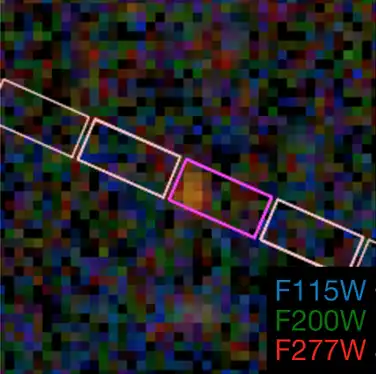
R. Naidu et al. / Open Journal of Astrophysics 2025
The most distant bright galaxy confirmed to date – MoM-z14 – has had its characteristics unveiled thanks to new images taken by the James Webb Space Telescope (JWST). The galaxy resides in a universe a mere 280 million years old.
The bright, early galaxy doesn’t fit traditional theories of galaxy formation. The Hubble Space Telescope, however, provided hints that such luminous galaxies might be commonplace with the discovery of GN-z11, announced in 2016. Since JWST started observing almost three years ago, the number of sightings has turned from a trickle to a torrent.
Numerous candidates whose extreme distance redshifts their light toward longer wavelengths have been identified, but the physics supporting them remains mysterious. Some have even suggested that nearer galaxies, with an abundance of dust that reddens their light, might impersonate distant galaxies.
Enter the “Mirage or Miracle” (MoM) survey, which helps determine whether suspected bright, early galaxies really lie so far away. The MoM survey is using the Near-Infrared Spectrograph (NIRSpec) on JWST to take new images of previously identified targets in patches of sky that astronomers have imaged again and again over the years. The new find, presented by a multinational team of astronomers led by Rohan Naidu (MIT), will appear in the Open Journal of Astrophysics.
Vivienne Wild (University of St Andrews, UK), who wasn’t involved in the study, pays tribute to the “phenomenal amounts of work” that has already gone into observing these wide-area fields. That work now enables JWST, with its narrow field of view, to train its sights on select, high-priority targets such as MoM-z14. JWST imaged this object anew on April 16th.
Analyzing the galaxy’s light, the team confirmed that MoM-z14 is, in their terms, a miracle and not a mirage. It is not, in other words, a dusty interloper galaxy but truly distant and truly luminous.
The team cannot explain this unexpected brightness with a feeding central black hole, suggesting the luminosity instead comes from the stars. Indeed, the galaxy’s stars appear to be young — JWST seems to have caught MoM-z14 at a particularly productive time, in the middle of a period when it forms stars at a high rate. The galaxy is also surprisingly compact, the team found, and has a mass comparable to that of the Small Magellanic Cloud, a dwarf galaxy near the Milky Way.

R. Naidu et al. / Open Journal of Astrophysics
The MoM survey team set out various reasons why MoM-z14 and galaxies like it might shine so brightly. For example, it could be that early galaxies’ star formation spits and sputters, resulting in variable luminosity that we sometimes catch at its peak. Alternatively, early galaxies might convert gas into stars more efficiently than later on. It could even be that dark matter is playing some role, or that dust is distorting the spectra less than it does later on.
Wild agrees that star formation processes in the early universe might have diverged from those at later epochs owing to vastly different environmental conditions. It was “frankly pretty naïve of astronomers” to have assumed otherwise, she notes.
MoM-z14’s spectrum shows an elevated amount of nitrogen, similar to that found in the oldest stars in our own Milky Way as well as our galaxy’s ancient globular clusters. According to one scenario, the nitrogen emission could signal runaway collisions, whereby stars in dense clusters merge into superbright, supermassive stars. The researchers caution, however, that these similarities between the distant galaxy and ancient local stars are “promising, yet preliminary.”
Wild finds the connections made in the study “very persuasive, suggesting that the answer to understanding early galaxy formation has, to some extent, been in front of our noses!”
Wild is also hopeful that the study will spur more research into the local universe, pointing out, as the study’s authors do, that although there have already been several generations of stars in the Milky Way and nearby galaxies, there is still plenty of archaeological evidence from earlier epochs lying around. Comparing such observations with data from remote galaxies like MoM-z14, she says, will enable astrophysicists to adjust their parameters and craft a clearer picture of how galaxies evolve.
Even as JWST expands our cosmic horizons, the Nancy Grace Roman Space Telescope, has the potential to help astronomers understand galaxy evolution throughout the universe’s history when — and if — the mission takes flight in 2027. If the federal budget doesn’t slash NASA funding and cut the mission, Roman’s spectrographs would enable the study of many more luminous, distant galaxies like MoM-z14.



Comments
accurateye
May 30, 2025 at 3:17 pm
Kit,
If we drop the cultural conceit that our little electromagnetic cir 5% came first, the “MoM” problem goes away. By placing scotonic (‘dark’) matter/energy first (cir 95%), photonic matter/energy has both a source and a framework for SMBH, very “early” galaxies, and the sponge model of matter distribution. That is: our physics explains only 5% of the universe. The rest is behind the "gravity firewall."
You must be logged in to post a comment.
Rod
May 31, 2025 at 9:56 am
This is a good one here 🙂 This galaxy with z=14.44 using cosmology calculators could be some 34 Gly away from earth today and sitting in space expanding nearly 2.4 x c 🙂 Metals seen in the gas too. I placed a note here at YT channel, https://www.youtube.com/channel/UCN037NurHvHu7wpWp9XPtaA/community?lb=Ugkx3CwuakcHfyf-xSGTPhLLoRY0OlFBaV_d
You must be logged in to post a comment.
TorbjornLarsson
June 1, 2025 at 7:04 am
I assume the emoticons signals that you are not serious, but for staving off possible confusion in other readers: The cosmological expansion rate of distant enough systems is in relation to us as an observer. It is not an absolute rate which is about 0.1 nm per meter and year at the current time.
You must be logged in to post a comment.
Rod
June 3, 2025 at 6:55 am
The cosmology calculators show much about redshifts in the expanding universe model and distances. I learned that all redshifts 1.4 or larger, to explain those large redshifts, space is expanding faster than c velocity. MoM-z14 is not 13.5 Gly distance from Earth today using look back time distance. The comoving radial distance shows where the object is at today, about 34 Gly away.
You must be logged in to post a comment.
You must be logged in to post a comment.