 SUNSET:

 1
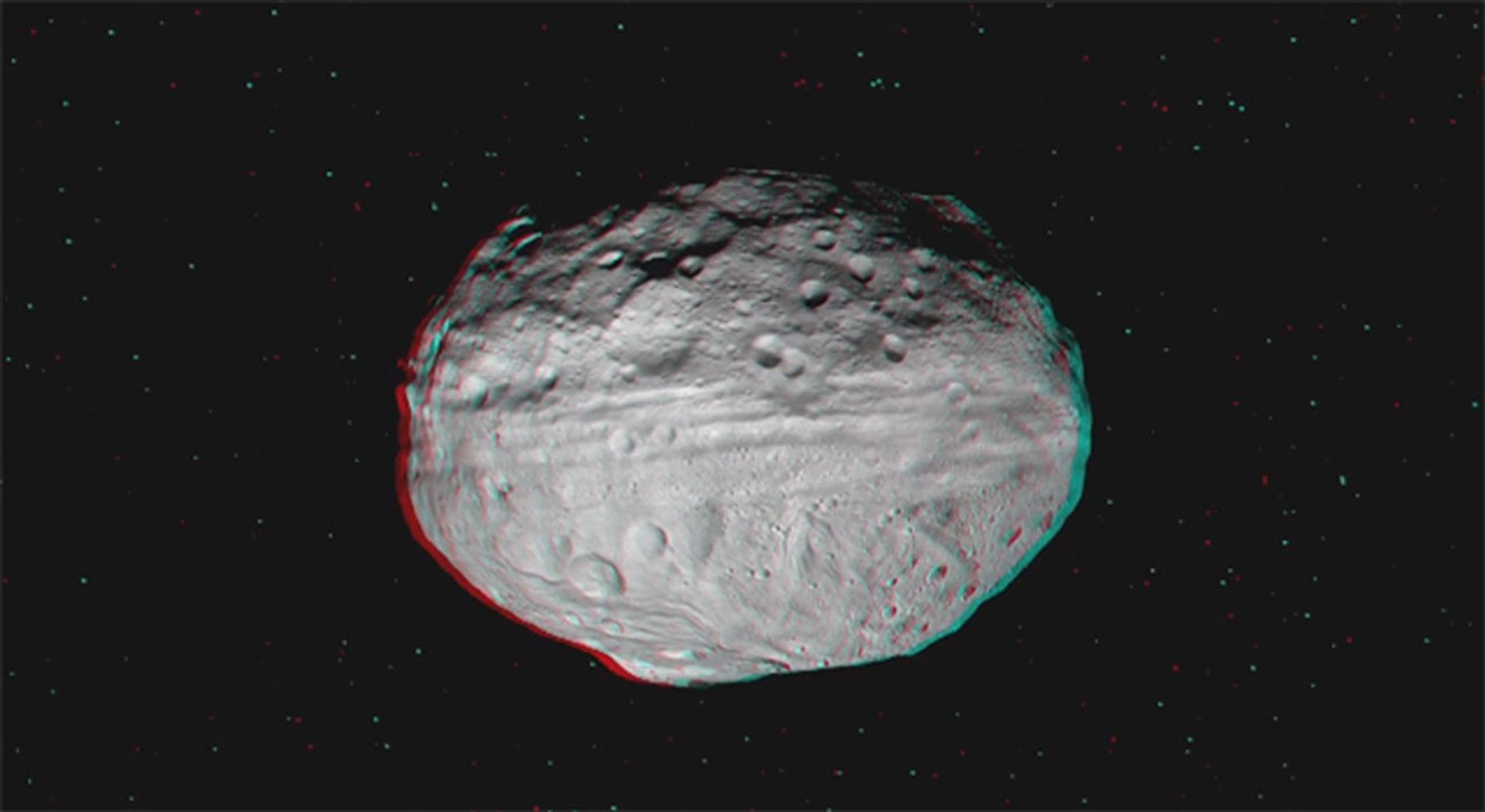
1Vesta, both protoplanet and asteroid, reaches opposition on May 2nd. From a dark sky it’s even visible with the naked eye.

ASA/JPL-Caltech/UCAL/MPS/DLR/IDA
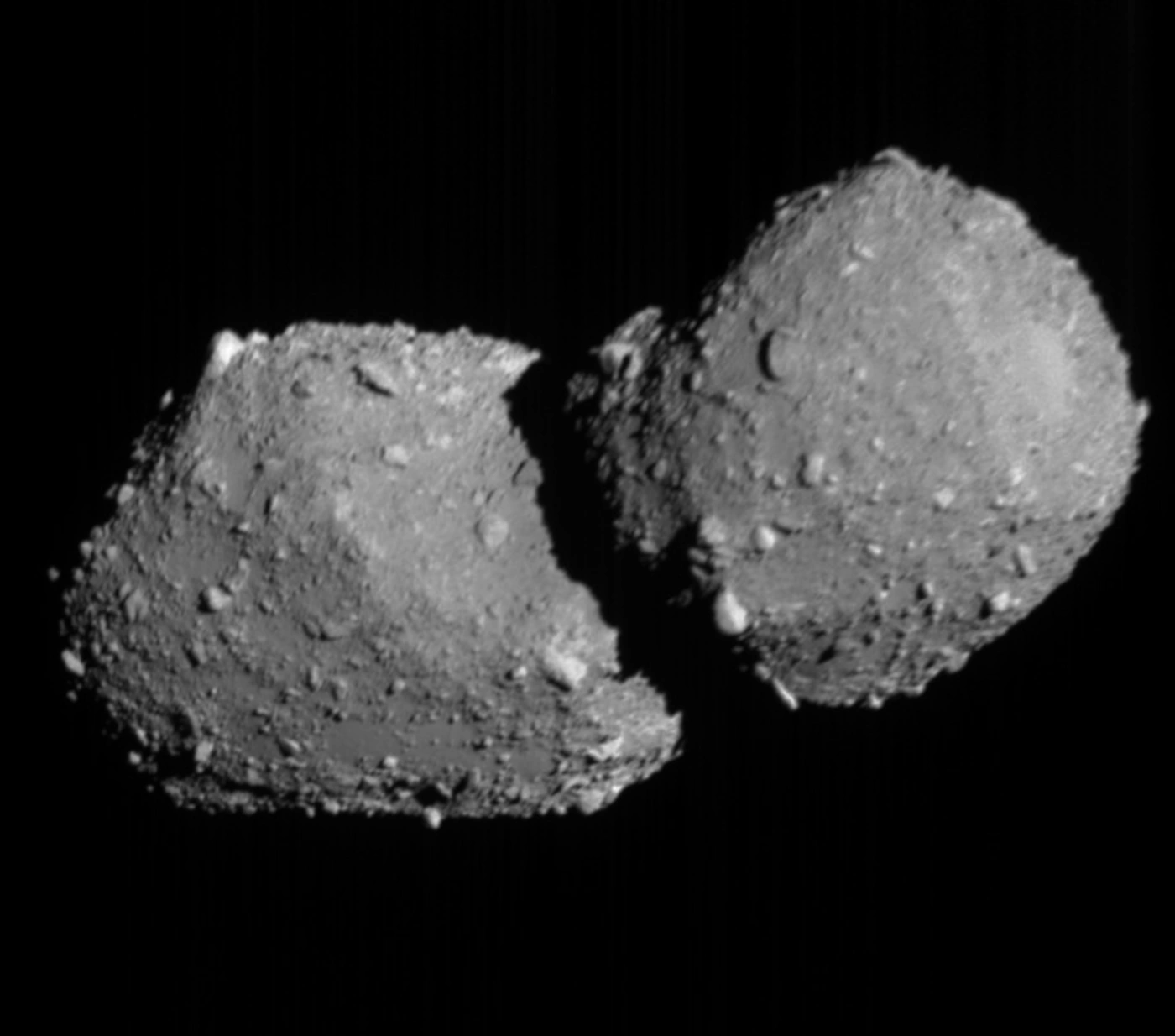
Vesta is not only the brightest asteroid but one of only a handful orbited by a space probe. NASA's Dawn mission spent 14 months in Vesta's gravitational embrace in 2011-12 before shoving off for Ceres. Ironically, the probe's instruments revealed that Vesta possesses both highly reflective, basaltic rock and significant amounts of dark, carbonaceous material delivered by meteorite impacts.
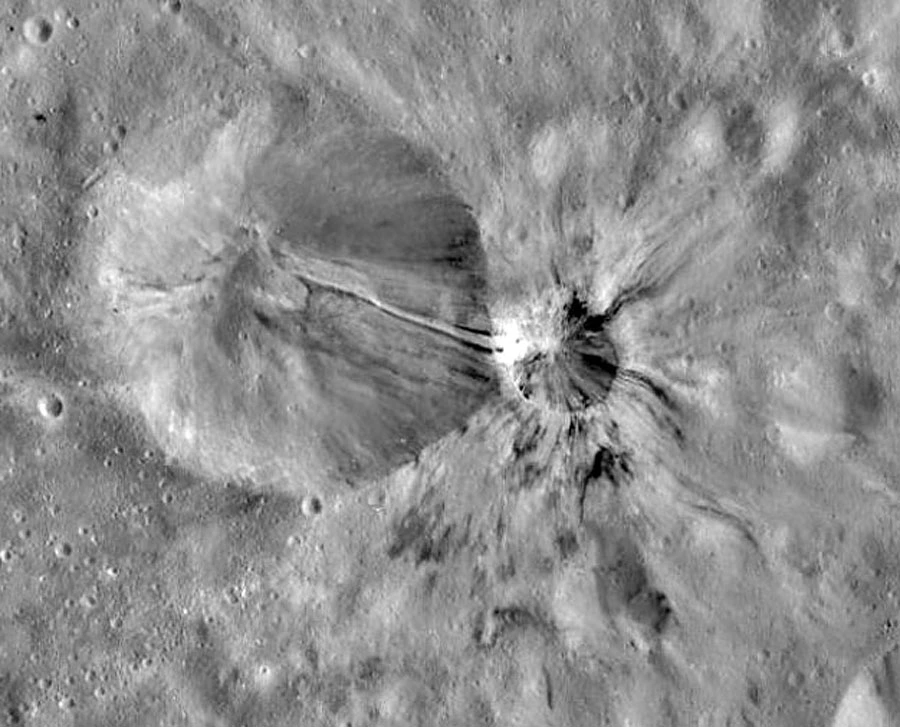
NASA/JPL-Caltech/UCLA/MPS/DLR/IDA
As for the origin of the asteroid's brilliance, a 2012 study discovered the signature of an ancient magnetic field frozen into the Vesta meteorite ALHA81001 3.7 billion years ago. Vesta is one of the few if only confirmed protoplanets in the solar system. During its planetary embryo phase more than 4 billion years ago, it was hot enough for its interior to have melted and differentiated into a metallic iron core, dense mantle and outer crust.
Thanks to the lucky find, we have evidence that electrically-conducting, molten metal within the core generated an asteroid-wide magnetic field eons ago. Magnetic fields shield otherwise exposed bodies from the solar wind and cosmic rays, which darken surface minerals over time in a process called space weathering. This may be how Vesta maintained the radiant countenance that makes it a tempting naked-eye target to this day.
Around the time of opposition, which happens on May 2nd, it's visible without optical aid under moonless, minimally light-polluted skies. Shining a robust magnitude 5.7, the wannabe planet tracks from northern Libra into Virgo this month and next. Even a pair of pocket binoculars will suffice to see it.
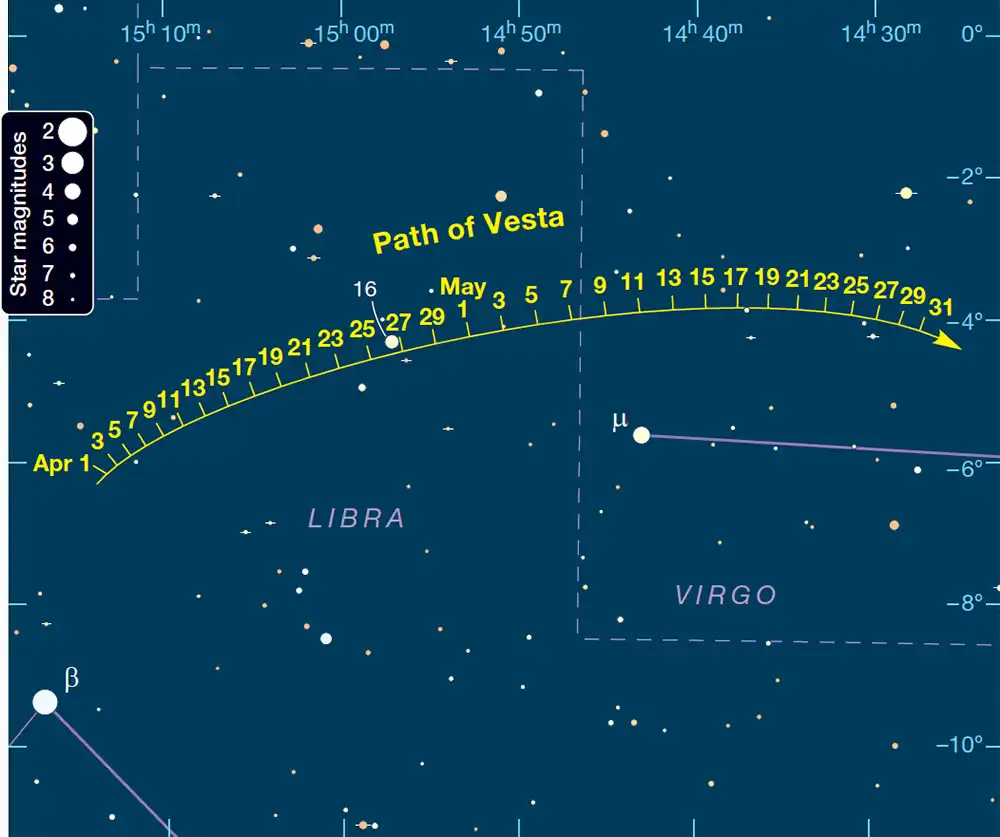
Sky & Telescope diagram
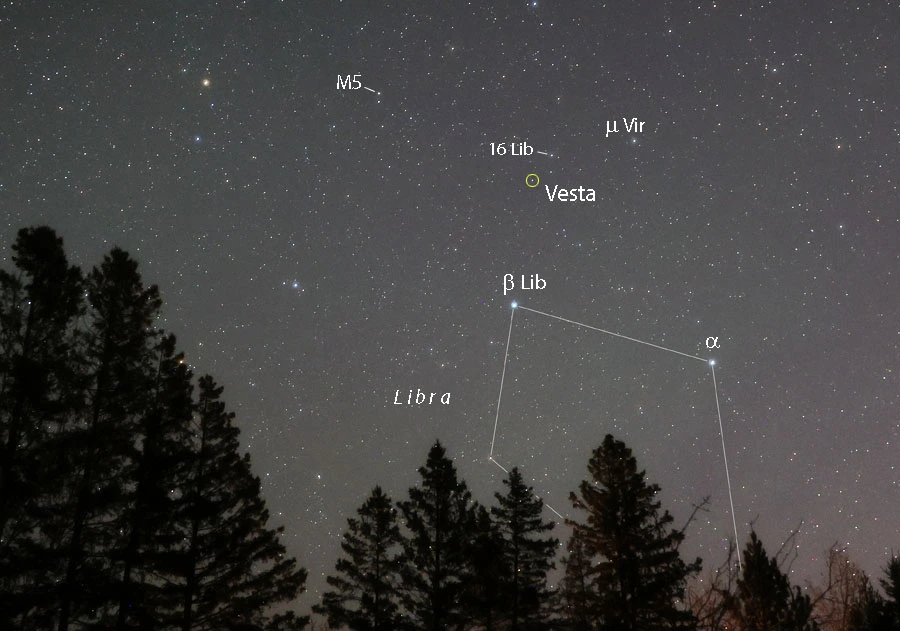
Bob King
To view Vesta with the naked eye, I first confirm its position with binoculars. Then I use two or more stars in its vicinity to create a distinctive pattern like a triangle, box or straight line, that includes the asteroid. That way I know exactly where to look to complete the pattern. Finally, I employ the almost magical power of averted vision — looking "around" the target instead of straight at it — to gradually coax it into view. In Vesta's case, 2.6-magnitude Beta (β) Librae, better known as Zubeneschamali, and 4th magnitude Mu (μ) Virginis will prove useful. Or you can select your own stars.
A special opportunity
From April 23-27, Vesta will lie within 35′ of 4.5-magnitude 16 Librae. As it slides northwest in retrograde motion it will form a temporary, ever-changing "double star" with its stellar companion. Not only will the fortuitous alignment make it easy to locate the asteroid, but its night-to-night movement will be very apparent. On April 25-26 the two will be only about 10′ apart. The night before, Vesta forms a compact, almost linear trio with 16 Librae and HD 132375 (magnitude 6.1), located 45′ to its southeast.
I hope these opportunities will encourage you to visit Vesta as well as share views of this unique object during public astronomy outings.
Swan song for comet Swan?
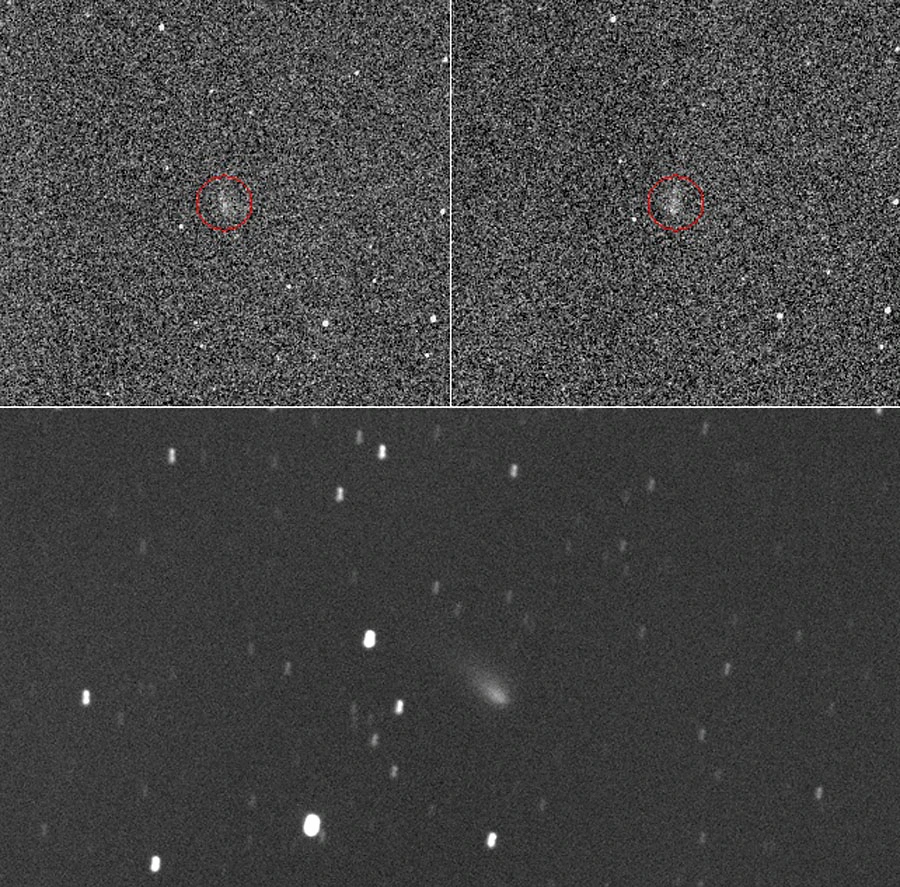
Mike Olason (top); Gianluca Masi (bottom)
Doggone it. A new comet that seemed fated to free us from the spring doldrums is now in tatters. Over the past two weeks, instead of brightening as expected, Comet SWAN (C/2025 F2) has been slowly disintegrating and fading. It's now around magnitude 9.5 with a weakly-condensed coma and just the hint of a tail. Even though it transitions to the evening sky this week, it will prove a difficult catch in twilight. Comets can be so unpredictable, it's hard to know what to expect. But if by chance SWAN suddenly re-brightens, I'll share the news along with a fresh map ASAP!
About Bob King
I love the sky (day and night) and have been a skywatcher and amateur astronomer since childhood. I'm also a long-time member of the American Association of Variable Star Observers (AAVSO) and Astronomical League. I pen the Astro Bob blog and have written four books: Night Sky with the Naked Eye (2016); Wonders of the Night Sky You Must See Before You Die (2018) and Urban Legends from Space (2019) and Magnificent Aurora, published in 2024. The universe invites us on an adventure every single night. To accept the invitation, we only need look up.



Comments
Anthony Barreiro
April 28, 2025 at 9:01 pm
Vesta is my favorite asteroid, mostly because she is the brightest. I've been following Vesta through binoculars during dawn and pre-dawn hours since November 26. After a stretch of cloudy weather and a few rain showers, I saw Vesta for the first time in the evening last night.
One benefit of following planets, asteroids, and the occasional comet throughout their apparitions is that I get to know the otherwise unremarkable background stars. Now I'll remember that Mu is Virgo's back foot.
You must be logged in to post a comment.
You must be logged in to post a comment.