 SUNSET:

 2
2Watch an Oort Cloud comet disintegrate before your eyes. Meanwhile, interstellar intruder 3I/ATLAS is brighter than expected.
P. Clay Sherrod
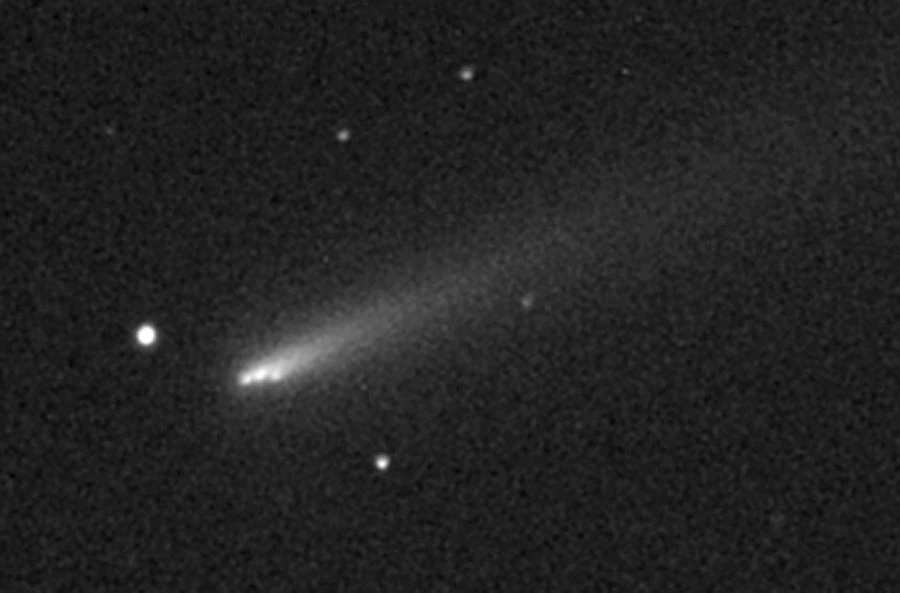
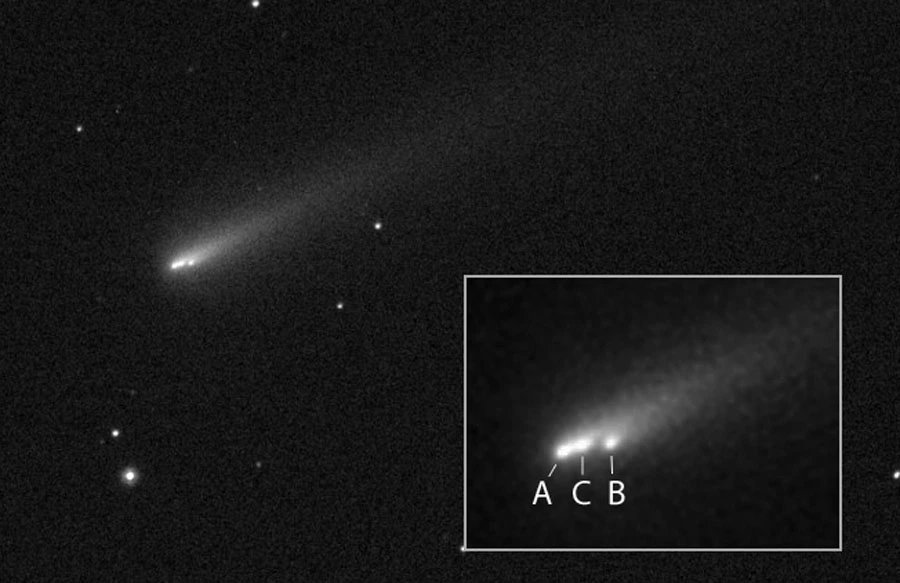
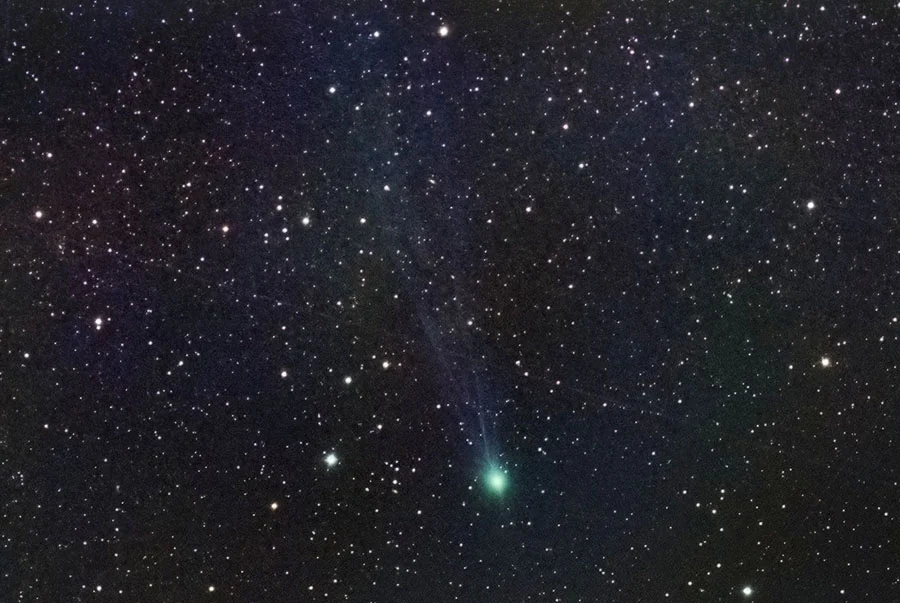
Look while you can — a comet is breaking to pieces right before our eyes. C/2025 K1 (ATLAS), not to be confused with the interstellar Comet 3I/ATLAS, was discovered in May this year. Originating in the relative solitude of the Oort Cloud, it's now fighting for its life in the inner solar system. At least three fragments have broken away from the comet, all of which are currently visible in 8-inch and larger telescopes. Whether or not it will carry on or fully disintegrate is uncertain, but observers can use this unique opportunity to watch the process unfold however it will.
Comets are made of ice and dust. They're generally small — about a few miles wide — and porous like sponge candy. Warmed by the Sun's rays and stressed by its overwhelming gravity, they can develop cracks and fissures. Streams of dust and gas from vaporizing ice called jets literally push a comet around, causing it to wobble or spin fast enough to shatter. Kneaded by these forces, parts of a comet can give way or the whole works may completely fall apart. The pieces are sometimes visible as individual "mini-comets" buried within the coma not far from the nucleus.
Gianluca Masi
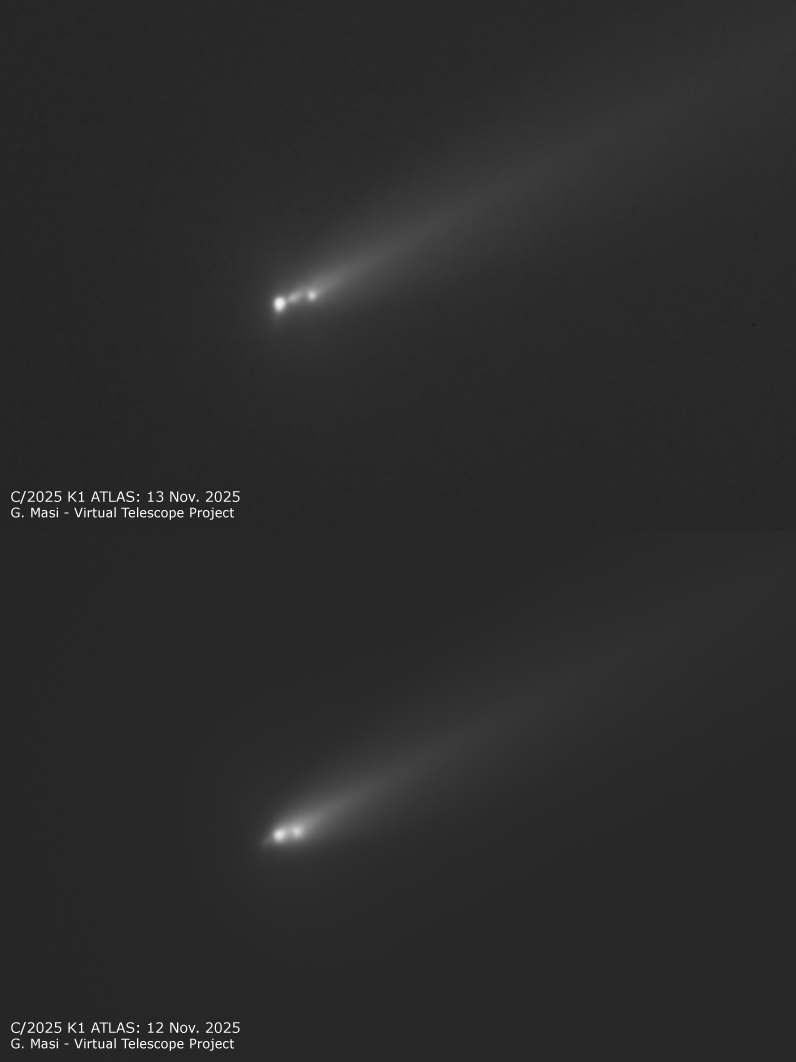
On November 10th, The Astronomers Telegram reported that K1/ATLAS had undergone two bright outbursts between October 31st and November 4th. A few days later, Hubble Space Telescope imagery revealed four glowing fragments within the coma — remnants of a rupture likely behind the brightness surges. On November 10th, photos made by multiple amateur astronomers revealed that the comet's pseudo-nucleus now appeared split or double. Amateurs and professionals alike continue to track the evolution of the comet and its fragments. You'll find the latest images on the Comet Watch and ICQ Comet Observations Facebook groups.
Bob King
Comet K1/ATLAS wasn't expected to survive its close perihelion passage of 49 million kilometers (31 million miles) on October 8th. For reference, that's about 5 million miles closer than Mercury's average distance from the Sun. While the comet at first appeared to have rallied, it's now obvious there was collateral damage. Should it continue to dissipate we may soon have another "headless wonder," a doomed comet that loses its nucleus through disintegration and becomes all tail. This happened most recently with C/2024 G3 (ATLAS).
P. Clay Sherrod
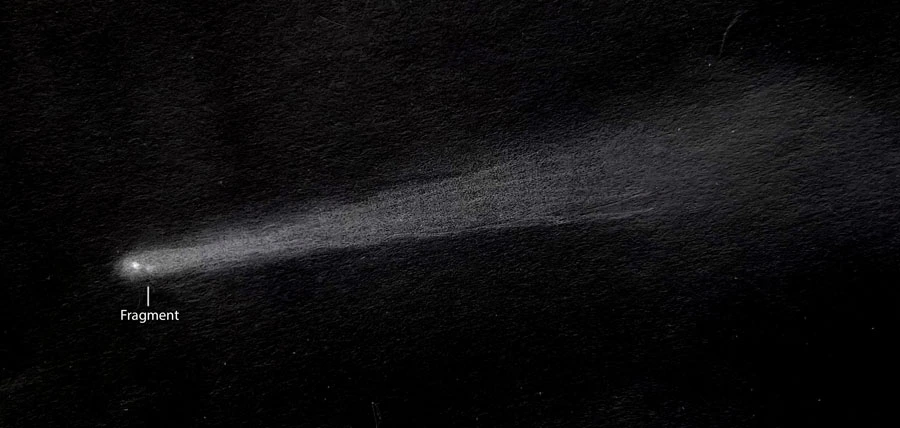
Comet K1/ATLAS is currently a 10th-magnitude object in the morning sky with a long, well-formed dust tail about 20′ in length angled northwest. Look for it in Ursa Major from 2 a.m. to dawn local time, when it stands highest in the northeastern sky. Around November 20th, the comet becomes circumpolar for mid-latitudes and therefore visible all night. You'll find an interactive locater map at in-the-sky.org or you can use a freeware program like Stellarium to create your own map.
The Moon will stay out of the comet's hair in the morning sky through about December 2nd. Fortuitously, the Moon then departs the evening sky around December 6-7. If you play your cards right — observing in the morning and then switching to evening — you'll see the comet in a moonless sky for several weeks with only a brief interlude of lunar glare.
Good news: comet 3I/ATLAS Brightens
Johnny Horne
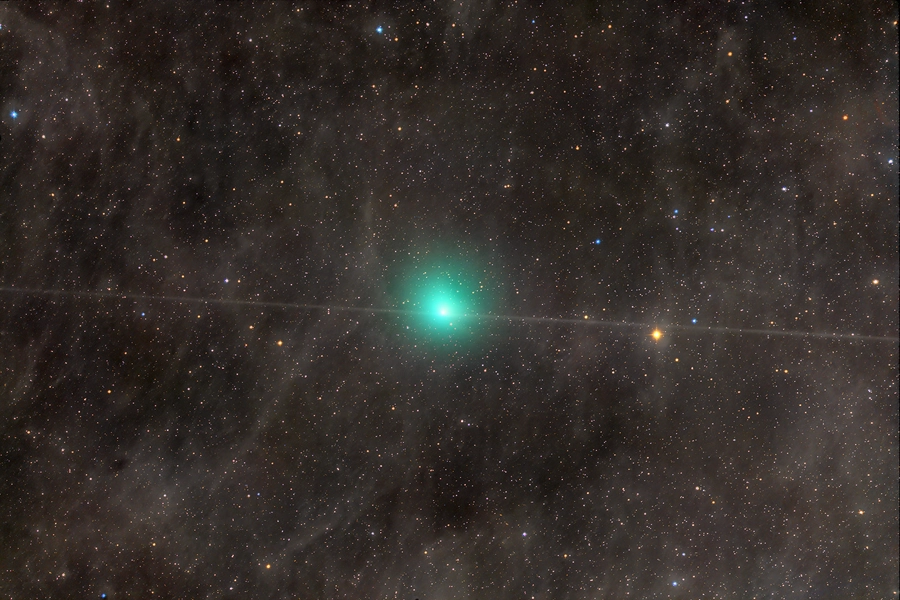
Meanwhile, many observers are rightly excited about observing interstellar comet 3I/ATLAS. Unlike K1, this rare visitor originated in a different part of the Milky Way Galaxy and is just now crossing through our solar system. Some early forecasts predicted it would only reach 11th magnitude after perihelion, when it returned to view in the morning sky. Happily, it did much better.
My first look was on November 10th, just before the start of morning twilight. I was shocked and elated to find it so obvious in my 15-inch Dob. The small, 2.5′-wide, strongly condensed comet glowed at magnitude 9.6, bright enough to spot in a 6-inch! I've observed 3I/ATLAS on four occasions now. Although it's begun to fade, this extraordinary object is still at 10th magnitude as of Nov. 18th and should be no problem in an 8-inch. Now that the Moon has departed the morning sky, it's possible to glimpse its dim gas tail, which points to the northwest.
See it best in the eastern sky in Virgo just before the start of morning twilight. Through November 21st it passes within a few of degrees of 3rd magnitude Gamma (γ) Virginis, making it easy to find. Buckle in and don't miss the ride of your life to parts unknown.
About Bob King
I love the sky (day and night) and have been a skywatcher and amateur astronomer since childhood. I'm also a long-time member of the American Association of Variable Star Observers (AAVSO) and Astronomical League. I pen the Astro Bob blog and have written four books: Night Sky with the Naked Eye (2016); Wonders of the Night Sky You Must See Before You Die (2018) and Urban Legends from Space (2019) and Magnificent Aurora, published in 2024. The universe invites us on an adventure every single night. To accept the invitation, we only need look up.



Comments
Joe Stieber
November 18, 2025 at 4:40 pm
I was able to see 3I/ATLAS this morning (18-Nov-2025) with my 35x115 spotting scope (4.5 inch aperture) from the darkish NJ Pines. At first, averted vision was needed to see the small fuzzy dot, but as it rose farther above the treetops and my eyes better dark-adapted, I was able to see it with direct vision.
Before that, I spotted C/2025 K1 (ATLAS) with the 35x115 scope. It was fairly easy to see, coming into view as I swept towards its position. It looked mostly like a tail, about half a degree long, without a dominant coma.
You must be logged in to post a comment.
Bob KingPost Author
November 19, 2025 at 2:01 pm
Hi Joe,
Thank you for sharing your observation. It's a testament to your visual skills and skies to spot both comets in a 4.5-inch instrument. When I suggest a certain aperture for viewing a comet or deep-sky object I always tend toward the higher (larger aperture) end because I assume most observers are dealing with light-pollution. I also factor in being able to see the object without too much difficulty rather than at the visual limit. Thanks again for showing us that a skilled observer can break many of these assumed limitations!
You must be logged in to post a comment.
You must be logged in to post a comment.