 SUNSET:

 6
6We check in with the brightest comet of the year and see what’s next, plus an update on Comet ATLAS (C/2024 S1), which still shows signs of life.

Gerald Rhemann
Comet Tsuchinshan-ATLAS has been wonderful. I've rarely seen so much interest in a comet, with first-time skywatchers getting such a kick out of photographing it with their smartphones. I'll admit I was skeptical when it first returned at dusk on October 11th. I couldn't even spot it with the naked eye. Did the astronomical community oversell the goods? The very next day my doubts melted away. C/2023 A3 gained sufficient altitude to punch through the twilight glow and display a small, bright coma and graceful, funnel-shaped dust tail — all visible without optical aid.

Dídac Mesa Romeu
Views only became better even as the Moon waxed bigger and brighter. The apparent tail length grew and grew while an anti-tail shot out from the coma like a laser beam on the night of October 14th. For a day or two around full Moon (October 17th), the comet briefly "disappeared" from sight for some observers, a victim of both moonlight and intrinsic fading as it continued to distance itself from both Earth and Sun. When beginning observers asked me how to find it in the bright sky, I told them to consult the map and then take a photo with their smartphone of the comet's general vicinity. A standard 3-second time-exposure was enough to clearly reveal it in relation to local landmarks, which could then be used to pinpoint its location.
Rafael Ferrando
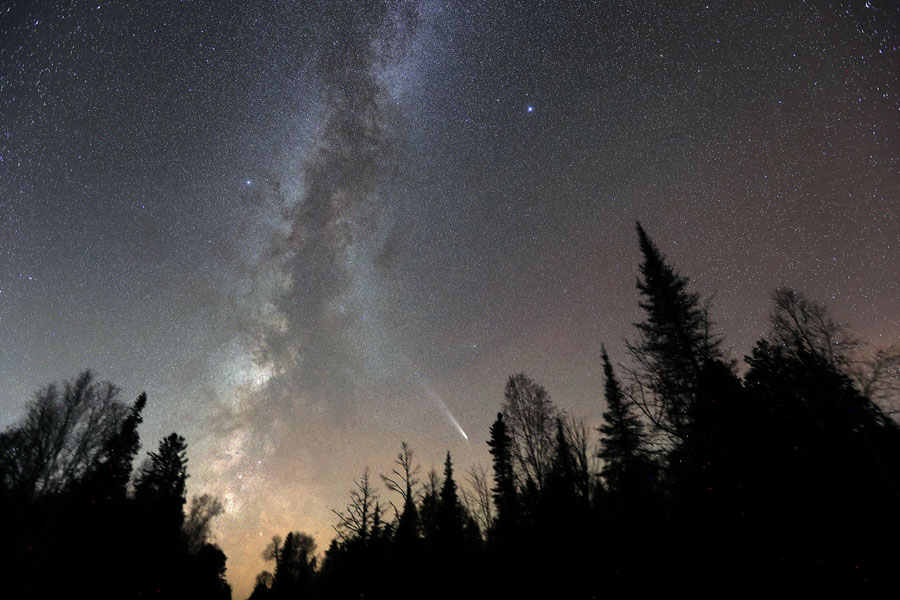
Once the Moon departed the scene starting on October 20th, the return of dark skies revivified the comet. Although it had faded to 4th magnitude by that time, I saw it with ease from a moderately dark sky and made out a 10° tail to the northeast with averted vision. Photographically, that length expanded to 17.5°!

Debra Ceravolo
Shortly before, during, and after Earth crossed the comet's orbital plane on October 15th, even short time-exposures captured the narrow anti-tail. Even though I made out the bright stub near the coma in 10×50 binoculars, I couldn't convince myself of seeing it with the naked eye even under optimal conditions. Although the anti-tail is broader now (on October 22nd), it continues to show up well even in relatively short time-exposures.

Deirdre Kelleghan

Chris Schur

Debra Ceravolo
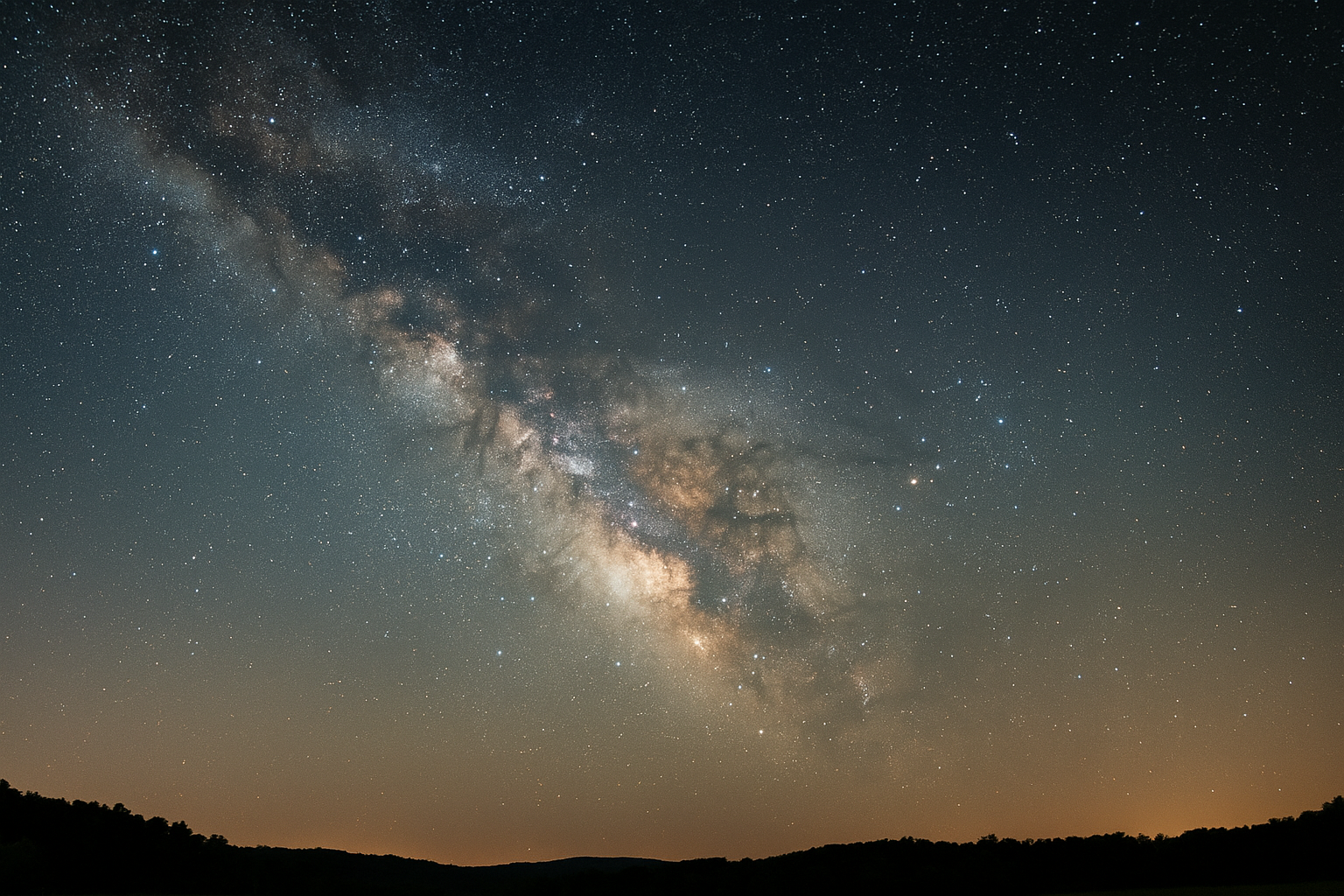
But facts are facts — the comet is slowly fading. While it's currently not impressive with the naked eye, it remains a beautiful target for photography, especially when paired with the Milky Way in wide-angle imagery. On October 23rd, C/2023 A3 flirts with 5th magnitude and continues to be visible without optical aid from a dark western sky. We should be able to hold onto it through month's end with averted vision, the technique of looking at an object peripherally instead of staring directly at it. On the evening of October 28th, C/2023 A3 will be framed by the loose, spangly open cluster IC 4665, located 2° to its northeast, as well as the 11th-magnitude globular cluster NGC 6426 25′ to its south.

Stellarium with additions by Bob King

Sky & Telescope
From about November 1st to the 9th, before the Moon interferes again, you'll have no trouble tracking it in a pair of ordinary binoculars. Observers with an 8-inch telescope can follow the fuzzy interloper into early January, by which time it's expected to be around magnitude 11.
Bob King
Markus Kohl
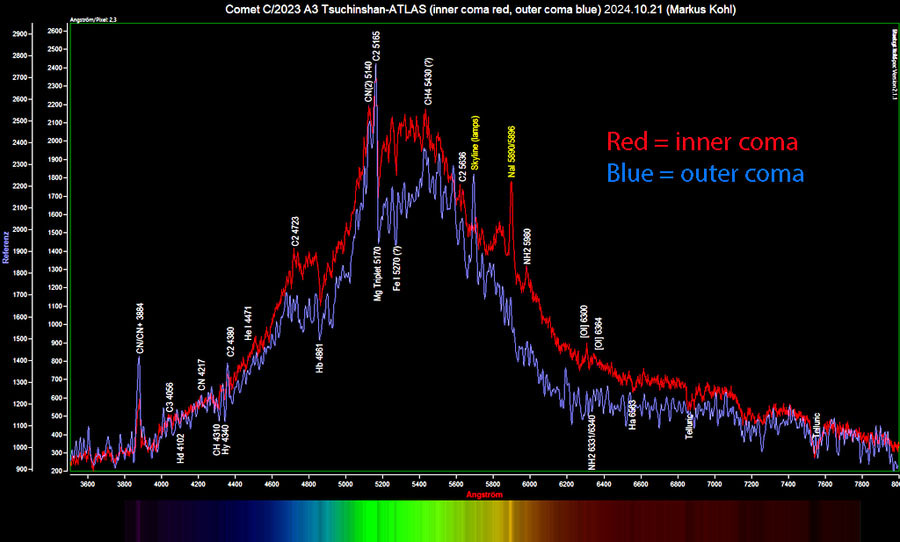
Currently, the blue ion tail overlaps the bright dust tail, making it visually impossible to separate the two. But the camera is certainly up to the job. I make Tsuchinshan-ATLAS my focus every clear night. First, I try to see how far I can trace the tail without optical aid, then I switch over to binoculars. They're ideal for adding additional degrees to the dusty appendage while also sharpening and enhancing the coma. In my 10-inch Dob at 60×, the coma and first half-degree of tail have a remarkably streamlined shape beautiful to behold and sculpted by little more than the pressure of sunlight, while the dense wad of dust surrounding the comet's nucleus glows a buttery yellow. The color is likely from sunlit dust, but sodium (Na) emission, which Markus Kohl recorded in his spectrum of the inner coma (above), may also be involved.
What about that other comet, Comet ATLAS (C/2021 S1)?

Michael Mattiazzo
Comet ATLAS (C/2024 S1) continues to be a wild card. The Kreutz sungrazer will pass just 1.2 million kilometers (746, 000 miles) from the Sun when it reaches perihelion on October 28th, but it may not survive the encounter. In the past couple weeks, the comet has experienced sudden and frequent swings in brightness that betray a nucleus on the brink of breaking apart. Fragmentation produces chunks of icy material that release large quantities of fresh dust as they sublimate in the Sun's heat. Sunlight illuminates the dust and temporarily enhances the comet's brightness.
As Comet ATLAS approaches the Sun, we'll soon lose sight of it from the ground. Fortunately, beginning October 26th, we can still watch the show in the LASCO C3 and C2 coronagraph images from the orbiting Solar and Heliospheric Observatory (SOHO).
At perihelion the comet passes just 11′ from the solar limb — a near-miss any relatively small, frozen object would find daunting. Should the friable traveler survive, Southern Hemisphere observers may spot it around 8th magnitude at dawn starting about November 4th. If the comet breaks up as expected, we may be left with a dusty wraith in the form of a tail without a head. Keep a close watch on the SOHO images to find out.
About Bob King
I love the sky (day and night) and have been a skywatcher and amateur astronomer since childhood. I'm also a long-time member of the American Association of Variable Star Observers (AAVSO) and Astronomical League. I pen the Astro Bob blog and have written four books: Night Sky with the Naked Eye (2016); Wonders of the Night Sky You Must See Before You Die (2018) and Urban Legends from Space (2019) and Magnificent Aurora, published in 2024. The universe invites us on an adventure every single night. To accept the invitation, we only need look up.



Comments
OwlEye
October 23, 2024 at 3:16 pm
Hi Bob,
This comet has not failed to deliver, and it continues to do so!
My first look on May 8th with the 12.5-inch revealed a small, yet fully developed comet with a tail. My next look was on the morning of Sep. 30th, when it was just barely naked-eye as it rose over our twilight prairie horizon. Two mornings later, on the 2nd of October, it was closer to the horizon but quite bright in a 7 X 50 binocular.
The evening of October 13th was the next reasonably clear one, and in spite of thick smoke from the western wildfires and bright moonlight, Comet T-A shone through undaunted, with 7 degrees of tail visible naked eye!
Dusk deepened on the evening of Oct. 15th, and the comet emerged from the gorgeous, darkening blue sky - the landscape at the Shawnee State Fishing Lake north of Topeka bathed in ethereal moonlight - as Barred and Screech Owls called to one another close by! Both real and surreal simultaneously!
I have seen it several times since the moon departed, and just last night from the driveway at home was rather amazed to see about 1 degree of the tail naked-eye, and this in my Bortle 6.5 skies!
I am greatly looking forward to the 28th (thanks for pointing this out!), when it will be in the same field of view as the globular cluster NGC 6426.
Regards,
Doug Z
You must be logged in to post a comment.
Bob KingPost Author
October 23, 2024 at 11:37 pm
Totally agree, Doug! Thanks for sharing your observations. I just got back from viewing it in a very dark sky and it was still very obvious with the unaided eye. I could even
make out a 10-degree tail without optical aid!
You must be logged in to post a comment.
Andrew James
October 23, 2024 at 6:45 pm
"We check in with the brightest comet of the year and see what’s next, plus an update on Comet ATLAS (C/2024 S1), which still shows signs of life."
Do you mean this was a panspermia event or where I got my head cold last week? 🙁
You must be logged in to post a comment.
Bob KingPost Author
October 23, 2024 at 11:36 pm
Andrew,
Sorry about your head cold. Yes, feel free to blame the comet 😉
You must be logged in to post a comment.
houstone
October 24, 2024 at 11:53 pm
It looks to me, tonight on the 24th, like the nucleus may have split, with parallel tails. Or is it a star pretending to be a new part?
Enquiring minds.... 🙂
You must be logged in to post a comment.
bob kelly
October 25, 2024 at 4:10 pm
I posted a photo on my facebook page. Comet was faint, just visible in 8X25 binoculars and my Canon XS with 28mm lens at f/3.5 for 8 seconds at ISO 1600.
bob kelly
ardsley, ny, USA
You must be logged in to post a comment.
You must be logged in to post a comment.