 SUNSET:

 7
7A new comet discovered in spacecraft images is bright enough to make you get out of bed before dawn.

Michael Jaeger
Amateur astronomers have done it again — discovered a comet. Not by looking through a telescope but through close study of publicly released, low-resolution images taken by the Solar Wind Anisotropies (SWAN) camera on the orbiting Solar and Heliospheric Observatory (SOHO).
On March 29th, Vladimir Bezugly of Ukraine was the first to report a moving object in SWAN photos taken the week prior. Michael Mattiazzo of Victoria, Australia, independently found "a pretty obvious comet" the same day using the same images, noting that the object was about 11th magnitude and appeared to be brightening. Rob Matson of California had also been examining the SWAN data and reported his independent discovery on March 31st. On April 1st, discovery details and early positional measurements were posted on the Comets Mailing List discussion group.
Comet Swan it is
Thanks to the discoverers' efforts to spread the word, the amateur community quickly geared up and observations of the comet began pouring in. Temporarily designated SWAN25F, the new visitor received its official name C/2025 F2 (SWAN) on April 8th. According to naming guidelines, comets discovered using public data or images are named for their program of origin, not the individuals who make the discovery.
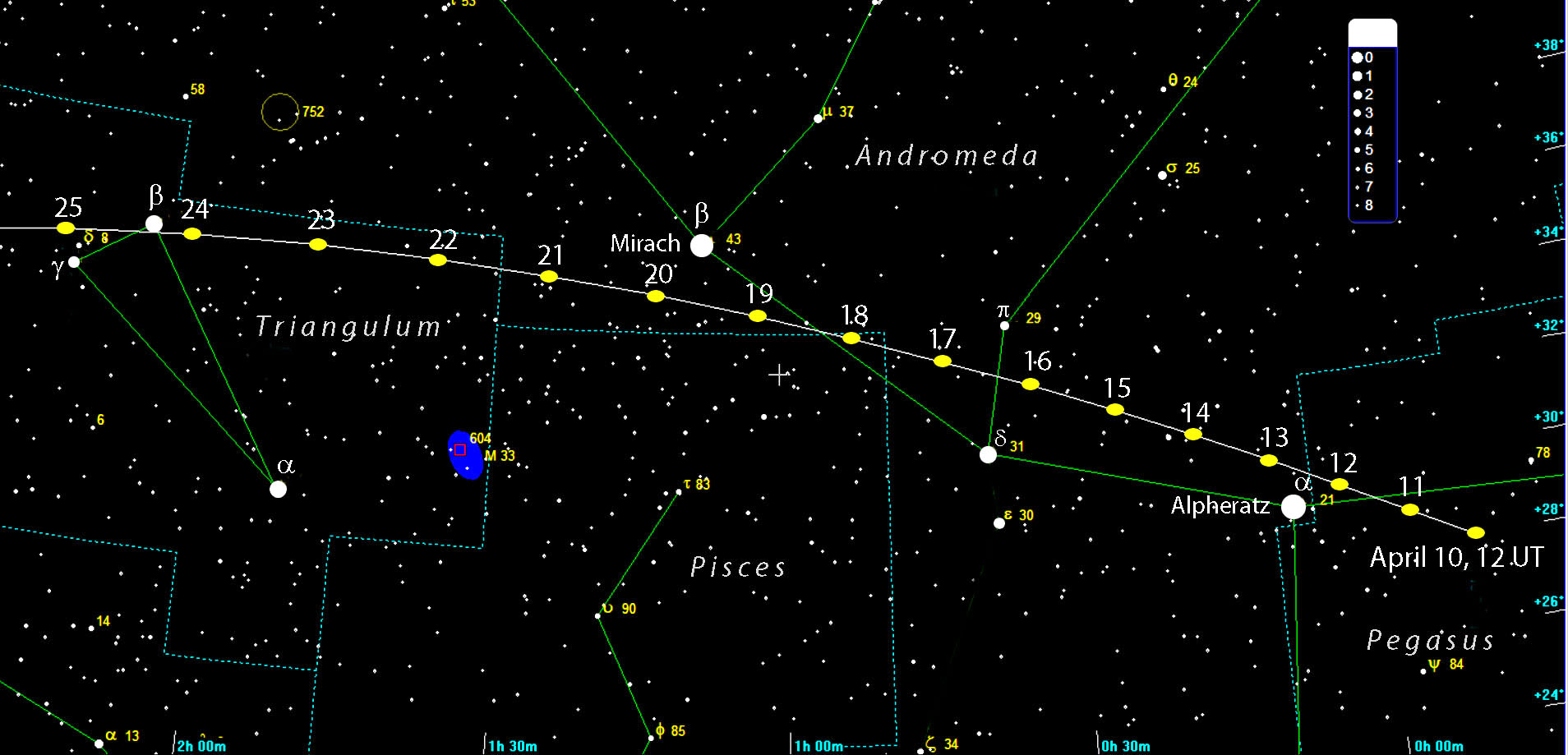
At the time C/2025 F2 was moving northeast across the Great Square of Pegasus and visible low in the eastern sky at the start of dawn. Despite the early hour, observers were pumped to see it. Pickings have been slim since the heady days of Tsuchinshan-ATLAS (C/2023 A3) and ATLAS (C/2024 G3). All new comets with bright prospects are welcome!
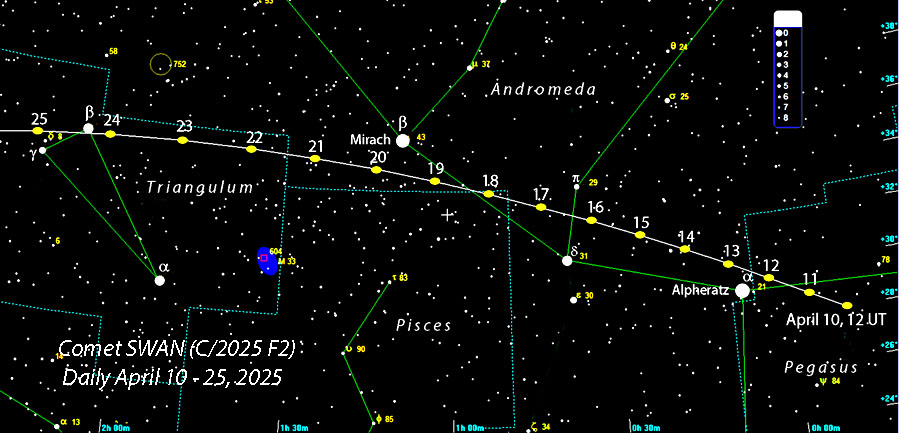
MegaStar, courtesy of Emil Bonanno, with additions by Bob King
The first ground observations of Comet SWAN pegged its magnitude at around 9.5 — bright enough to punch through atmospheric extinction and make it a fairly easy target in smaller telescopes despite its low altitude (~10° ) at the start of dawn. Over the next month, during the best part of its apparition, the comet will continue to hover low in the sky and tussle with twilight. Fortunately, it's also expected to brighten by at least several magnitudes.
Given Comet SWAN's high northerly declination, observers in mid-northern latitudes are favored. For now the comet's clicking northeast across the Great Square at some 1.75° per day. In the next two weeks, it will leave Pegasus for Andromeda, then sail through Triangulum. Perihelion occurs on May 1st, when the fearless flyer will coast 49 million kilometers (31 million miles) from the Sun while passing about 2° north of the Pleiades cluster.
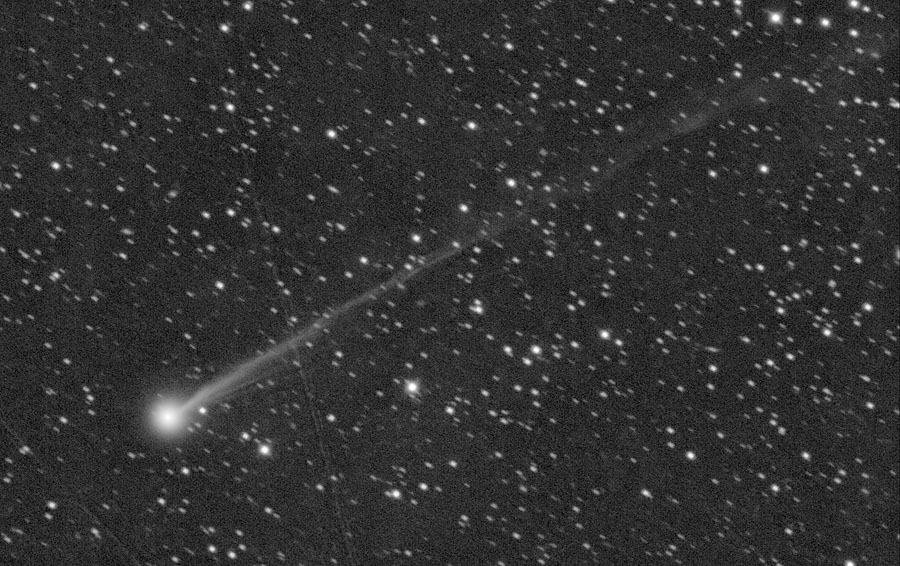
Gianluca Masi
I got my first look on April 4th just before 5 a.m. local time at the start of twilight. Through my 15-inch (38 cm) Dob at 64× it was immediately obvious, glowing at magnitude of 9.5 with a well-condensed 3′ coma. No tail was seen. Observers got a pleasant surprise on April 6th, when SWAN's magnitude shot up to 8.1. That morning I waited for narrow slivers of clear sky between clouds to see its transformation into a bright, strongly-condensed fuzzball. The 15-inch was overkill. A 6-inch would have nailed it. I even detected a hint of blue-green coloration from fluorescing diatomic carbon in the coma.
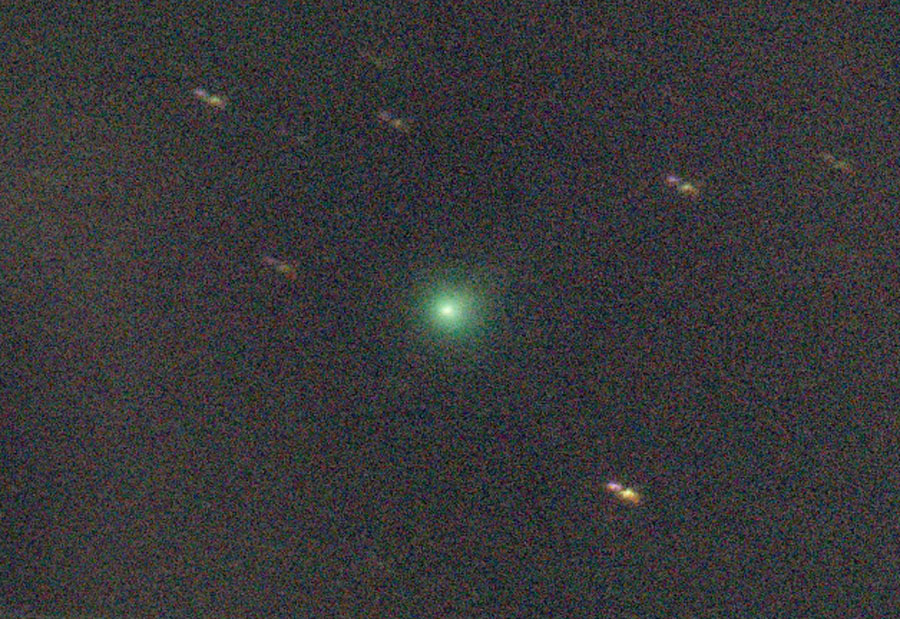
Juanjo Gonzalez
The comet either experienced a temporary outburst or it could have been an indication of a steep brightening trend. Seiichi Yoshida, who maintains Weekly Information About Bright Comets, predicted that SWAN would peak around 5th magnitude at perihelion. But the latest ephemeris published April 8th by the Central Bureau for Astronomical Telegrams (CBAT) forecasts a more optimistic magnitude 3.6 — with a caveat. Due to our incomplete understanding of the nature of the comet's outburst, Daniel Green, CBAT director, cautioned that "predicting the comet's brightness as it approaches perihelion is necessarily highly uncertain."
How and when to view the comet
If you plan to observe the comet you'll need a location with an unobstructed view to the northeast. It will be a morning sky object until about April 25th. Currently, it stands about 10° to 12° high at the start of dawn. But its altitude slowly declines in the next two weeks. The good news is that our visitor is bright enough to observe in early morning twilight, when it's up higher and less affected by the atmosphere. Dawn begins about 1 hour 50 minutes before sunrise in the northern U.S. and 1 hour 30 minutes for the southern half of the country at this time of year.
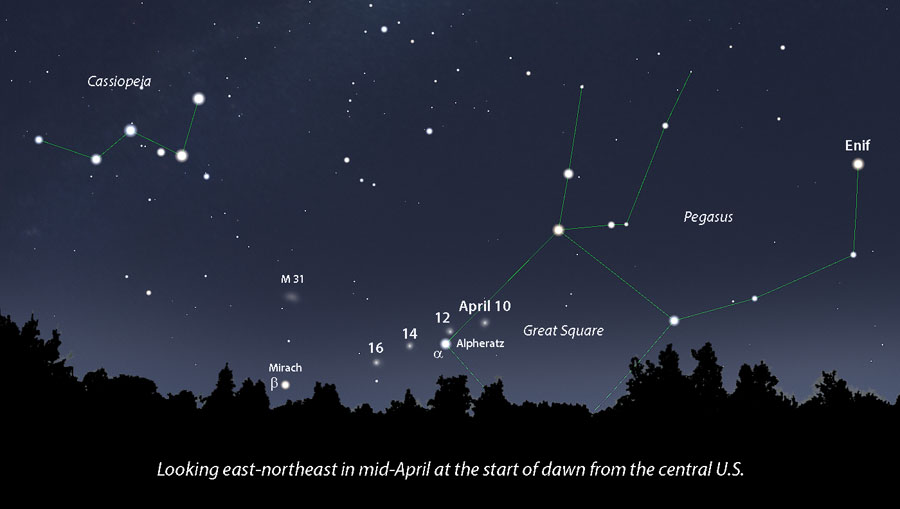
Stellarium with additions by Bob King
In late April, it moves into the evening sky and should be significantly brighter (if predictions hold), but it will also compete with lengthening twilight and low altitude. During the morning-evening transition, it may be visible at both dawn and dusk VERY low in the northeast and northwest, respectively, in mid-twilight.
From latitude 40° north, the comet stands about 5° high an hour after sunset on April 24th and 8° on May 1st, when it hangs just above the Pleiades cluster. Thereafter it drops deeper into twilight and will be lost to view after about May 8th. Southern Hemispheres skywatchers will get their chance join the party around May 4th. Their patience will be rewarded by extended views of the comet for the remainder of May and beyond.
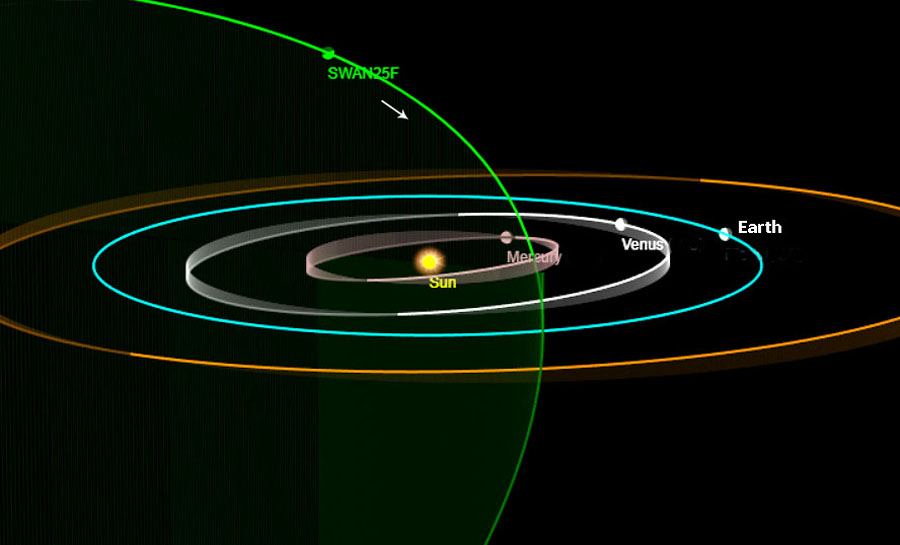
Courtesy of Tony Dunn
You can use the maps provided here to follow Comet SWAN or download orbital elements for a variety of software programs at the Minor Planet Center's Orbital Elements for Software Packages. Click on your software link, save the element file, and drop it into your program. I checked, and the latest update includes C/2025 F2. Some applications like Stellarium have to be updated by opening the program, clicking through options and then downloading the latest file into the program. If you prefer to hand-plot positions on a map, head over to Bill Gray's "Pseudo MPEC" for SWAN25F, where he posts daily hourly ephemerides.
I'll provide updates and new finder charts in the coming weeks. For now, let's get out there and greet this dusty traveler.
About Bob King
I love the sky (day and night) and have been a skywatcher and amateur astronomer since childhood. I'm also a long-time member of the American Association of Variable Star Observers (AAVSO) and Astronomical League. I pen the Astro Bob blog and have written four books: Night Sky with the Naked Eye (2016); Wonders of the Night Sky You Must See Before You Die (2018) and Urban Legends from Space (2019) and Magnificent Aurora, published in 2024. The universe invites us on an adventure every single night. To accept the invitation, we only need look up.



Comments
mbreeden
April 11, 2025 at 5:16 pm
When will this show up on the StarSense app?
You must be logged in to post a comment.
terryharan
April 12, 2025 at 3:42 pm
C/2025 F2 showed up on my Celestron Origin Brightest Comets menu item on April 8, the same day it was posted by the Minor Planet Center, which allowed me to image it the next morning at about 5am MDT local time. I'd post my image to S&T, but I don't know how.
You must be logged in to post a comment.
Bob KingPost Author
April 12, 2025 at 5:23 pm
Terry,
Would love to see your photo. Here are instructions for posting: https://skyandtelescope.org/photo-submission-faqs/
You must be logged in to post a comment.
Bob KingPost Author
April 12, 2025 at 5:22 pm
Hi Mbreeden,
That's a good question. I tried to look up whether the Comet SWAN had been added to StarSense yet but came to a dead-end. Have you checked again and downloaded the latest? Hopefully, it should only be a couple more days. Due to the bright moon, so you're not missing much at the moment.
You must be logged in to post a comment.
Rod
April 17, 2025 at 8:28 am
C/2025 F2 (SWAN), I was able to see using 10x50 binoculars (faint fuzzy) and 90-mm telescope this morning, 0430-0545 EDT (sunrise near 0628 EDT). The comet passing thru Andromeda some 2 degrees or Telrad circle view from delta And. Lovely clear sky this morning, temp 3C with NW winds 4 knots. Venus was brilliant, crescent shape in the telescope view. Waning gibbous Moon in Scorpius looked lovely as well, many craters along terminator line and Tycho region sharp. I viewed at 10 and 31x views today. So many satellites passed by during this time, perhaps 8 or more near 2nd mag moving NE one after the other in a line, others equatorial, and some polar orbits. I had my holsters on too (left and right sides). I may be a space cowboy holstered up and using a telescope 🙂 By 0530 EDT, C/2025 F2 SWAN was some 13.5 degrees above the NE horizon and sky getting brighter too. As sunrise approached, even M31 became difficult to see in my binoculars after 0540 EDT or so.
You must be logged in to post a comment.
mary beth
April 23, 2025 at 4:02 pm
Sounds like all the conditions were perfect for you to get to see this! Great, you had all the equipment and of course were holstered up! You may need to change your handle here on sky and telescope to Spacecowboy lol
Must’ve been beautiful to see it getting a little bit brighter.
You must be logged in to post a comment.
Bob KingPost Author
April 23, 2025 at 5:17 pm
Hi Mary Beth,
Holstered up — love that phase applied to astronomy. It was a wonderful surprise to see it suddenly brighten. Sadly, the comet now appears to be fizzling. I wrote an update on it in my latest post about seeing Vesta in binoculars (April 23).
You must be logged in to post a comment.
You must be logged in to post a comment.