 SUNSET:

 5
5Update (October 13, 2025): Read the observations Mars orbiters took of Comet 3I/ATLAS in our latest article.
Update (August 15, 2025): Read about follow-up observations of Comet 3I/ATLAS in our latest article.

Nick Haigh
Interstellar comet 3I/ATLAS is streaking across the solar system at more than 220,000 kilometers per hour as you read this. With a little luck, it might just turn up in your telescope this fall.
On July 1st, the 0.5-m f/2 Schmidt reflector at Rio Hurtado, Chile captured images of an apparent 18th magnitude asteroid during the course of the Asteroid-Terrestrial-Impact Last Alert System (ATLAS) near-Earth object search program. When bigger telescopes were brought to bear on the newcomer, they revealed a faint bit of fuzz around the “star” that extended into a teardrop shape — clear evidence that it was in fact a comet. It received the preliminary designation C/2025 N1 (ATLAS).
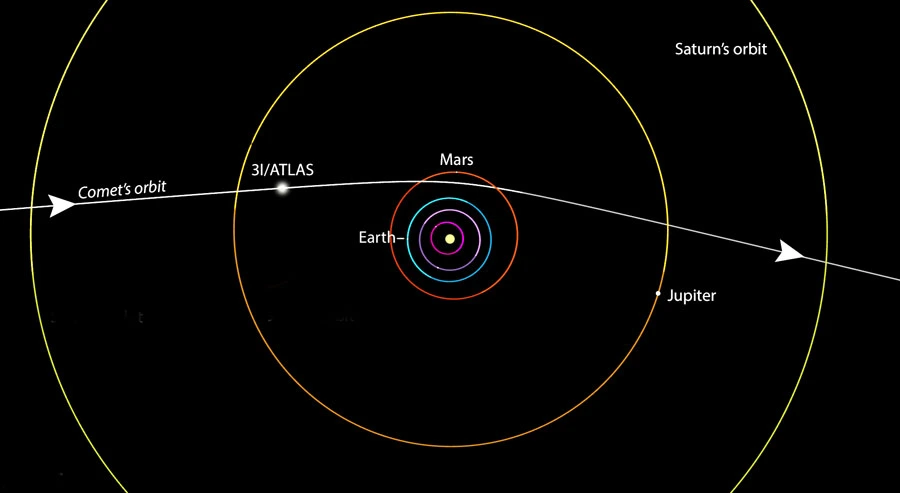
JPL HORIZONS with additions by Bob King
At the time of discovery, Comet 3I/ATLAS (the "I" stands for interstellar) was located 4.5 a.u. from the Sun just this side of Jupiter's orbit and traveling at 61 kilometers per second (137,000 miles / hour) — more than twice Earth's orbital speed. Most solar system comets travel on closed-path elliptical or near-parabolic orbits that are essentially bound to the Sun. The newcomer follows a high-speed hyperbolic orbit too fast for the Sun to rein it in. Perhaps Jupiter’s evil alien twin gave it the boot during a gravitational scuffle far away and long ago.
Although we may never know from which star system it originated, the icy itinerant arrived from the direction of the constellation Sagittarius and ultimately fade from view in the unseen depths of Gemini. Its stay in the neighborhood is temporary and one-time, like a first kiss.
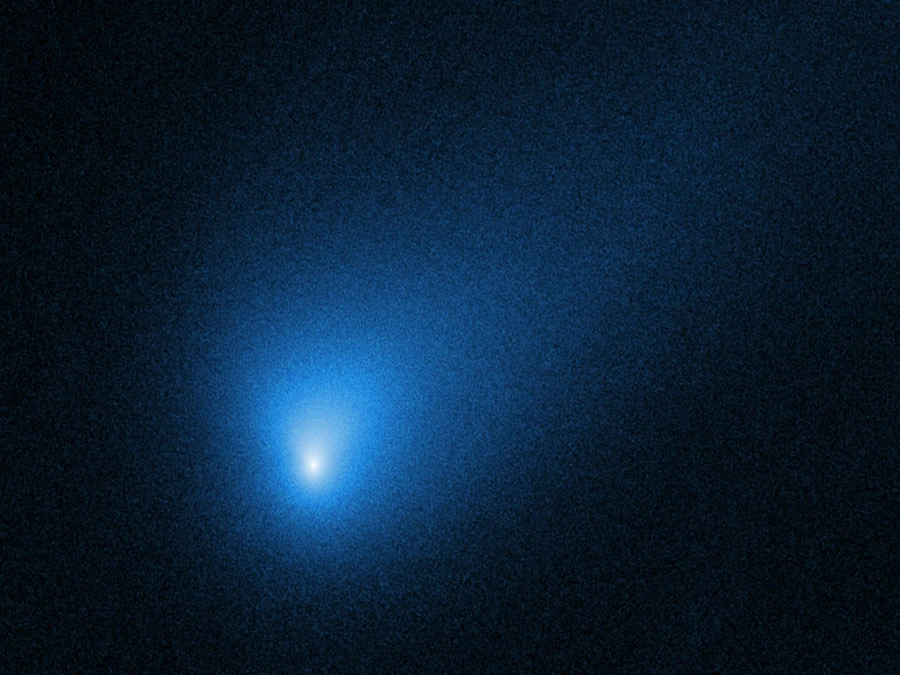
NASA, ESA, and D. Jewitt (UCLA)
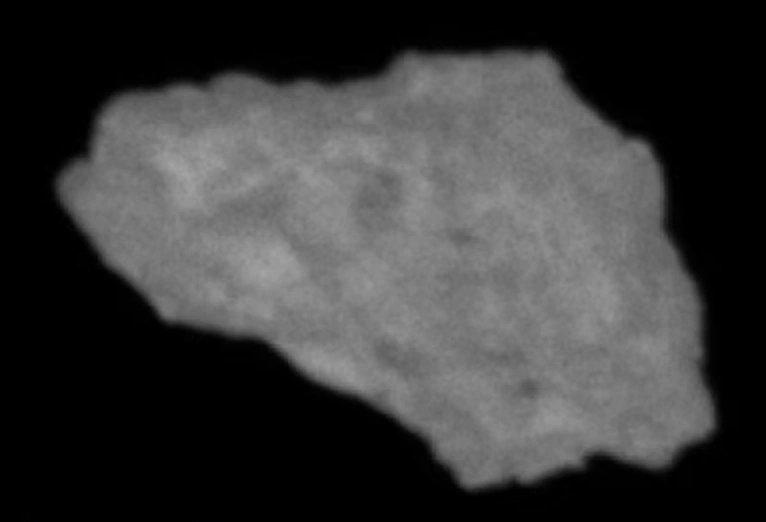
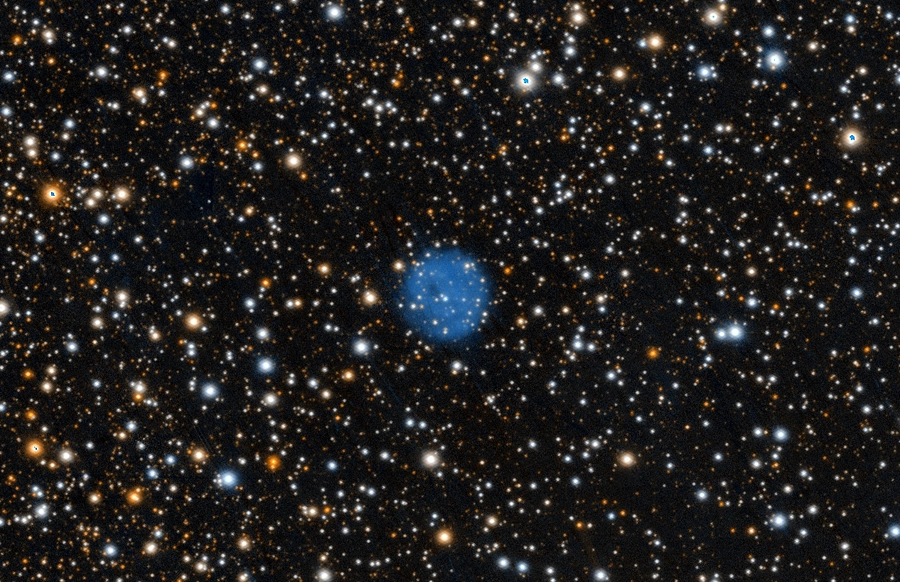
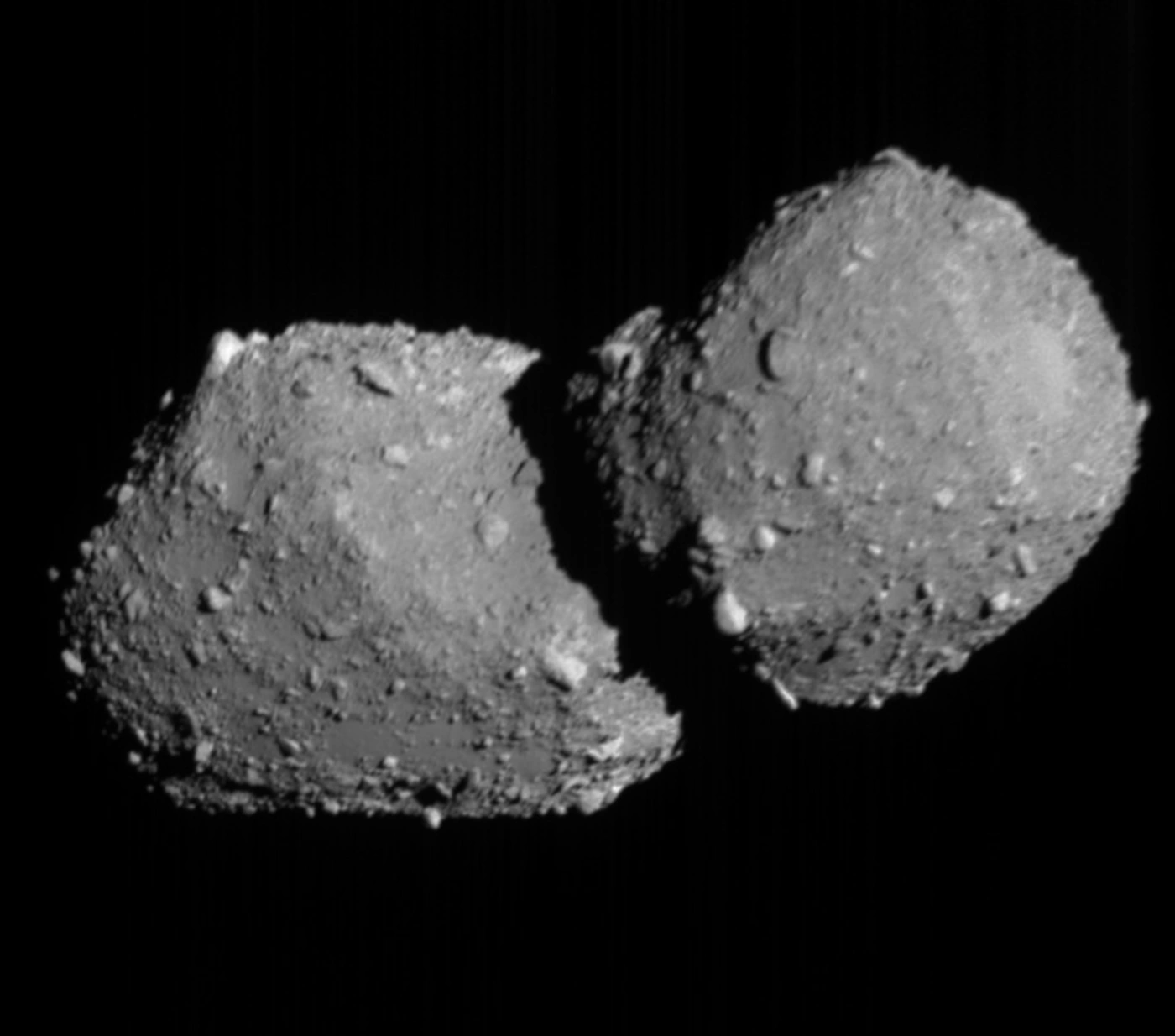
As its name implies, 3I/ATLAS is only the third known object to pay us a visit from outside our solar system. The first was 1I/ʻOumuamua (pronounced "oh-moo-ah-moo-ah"). We still don’t know exactly what it was, but one leading theory posits it could have been a splinter of nitrogen ice nearly half a kilometer across. The second was 2I/Borisov, the first interstellar comet, found by Crimean amateur astronomer Gennady Borisov in 2019. Although the comet strongly resembled our “local” comets, it was comparatively richer in carbon monoxide ice.
In the just-published paper, "Initial VLT/MUSE spectroscopy of the interstellar object 3I/ATLAS," by Cyrielle Opitom et al., spectroscopic observations carried out on the Very Large Telescope (VLT) show that 3I/ATLAS's coma is dominated by dust and redder than most solar system comets. The researchers describe the color as closer to that measured for the surfaces of some Trans-Neptunian objects — asteroids residing beyond the orbit of Neptune — and Centaurs, icy bodies orbiting between Jupiter and Neptune.
Just thinking about the new interloper is a mental field trip. Its long journey across space and time inspires awe at what nature makes possible. I like to think of it as warming its hands by the fire before returning to the frigid bleakness of interstellar space. During its solar system sojourn, professional and amateur astronomers worldwide will seize the opportunity to study and characterize the rare and unique object, while visual observers will likely experience the thrill of setting eyes on it.
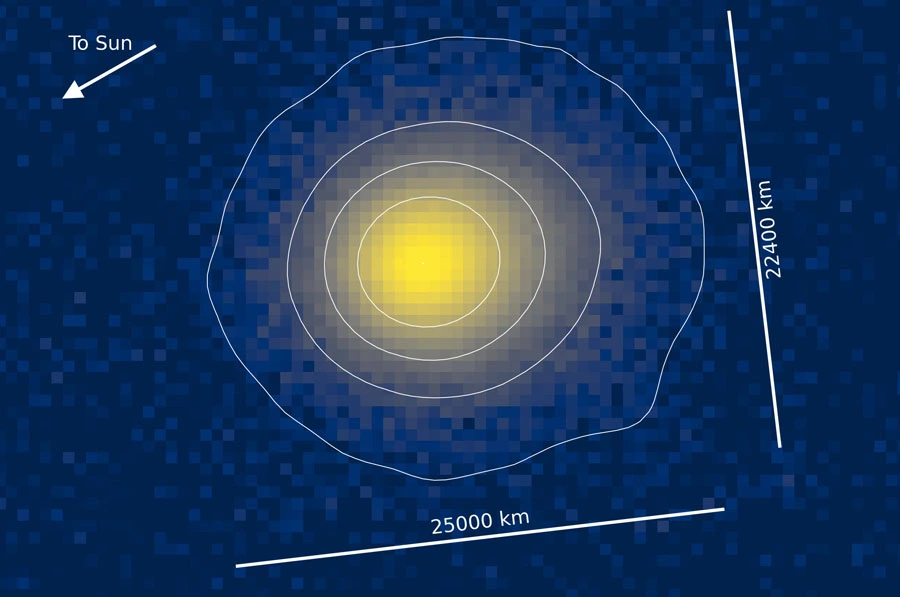
TTT Science Team and the Solar System and Low Surface Brightness groups of the Instituto de Astrofísica de Canarias
Currently, 3I/ATLAS is an 18th magnitude blip moving west across northern Sagittarius about 5° north of the ecliptic. It enters Ophiuchus on July 11th, and crosses into Scorpius on August 11th. As its solar elongation and distance from the Sun decrease, the comet brightens. By mid-September it will reach magnitude 14 in western Libra as it sinks into the while twilight glow for northern observers. Southern Hemisphere astrophotographers should be able to follow it through early October.
Perihelion occurs on October 29th, when the comet misses the Sun by a comfortable 1.4 astronomical units (au), equivalent to 206 million kilometers). Although unobservable at the time it’s expected to peak at magnitude 11. Earth gets a distant visit on December 19th when the object passes the planet at a distance of 1.8 au.
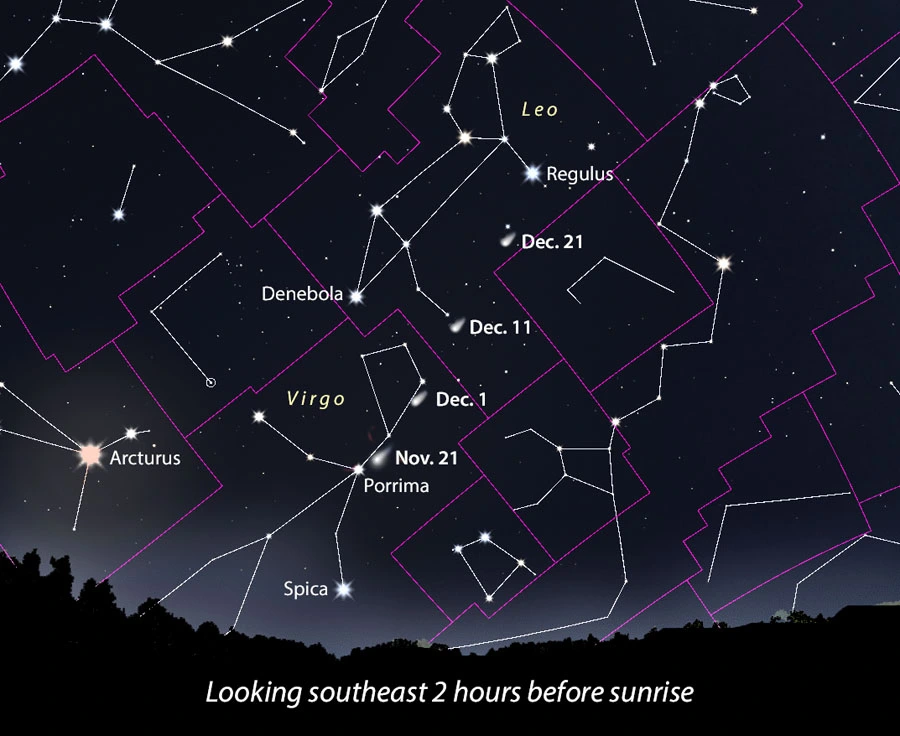
Stellarium with additions by Bob King
Starting about the second week of November, 3I/ATLAS returns to view for the brightest part of its apparition. Look for it moving west through Virgo low in the eastern sky shortly before the start of dawn.
Estimating the comet’s brightness is somewhat speculative especially given our limited experience with the interstellar variety, but the ephemeris published by Daniel Green, Director of the Central Bureau for Astronomical Telegrams, places it at magnitude 12.7-13.0 from late November through early December. While hardly "bright," a well-condensed comet in that brightness range is easily within reach of a 10-inch telescope from a dark sky.
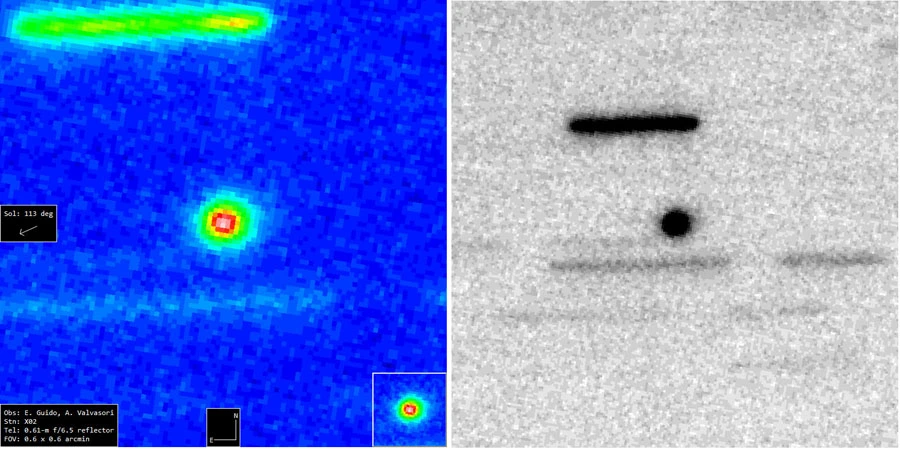
E. Guido and A. Valvasori
Thereafter, 3I/ATLAS slowly fades, reaching magnitude 13.5 in mid-December and then 14.0 at month's end. During its inner solar system sprint, the comet will have a close shave with Mars, passing about 0.2 a.u. (30 million km) from the Red Planet on October 3rd. Several amateurs in online discussion groups have mentioned the intriguing possibility of photographing it with one of the Mars orbiters. I sense exciting times ahead!
Learn More
3I/ATLAS page maintained by amateur astronomer Gideon van Buitenen
Discovery and Preliminary Characterization of a Third Interstellar Object: 3I/ATLAS
Weekly Information about Bright Comets by Seiichi Yoshida
About Bob King
I love the sky (day and night) and have been a skywatcher and amateur astronomer since childhood. I'm also a long-time member of the American Association of Variable Star Observers (AAVSO) and Astronomical League. I pen the Astro Bob blog and have written four books: Night Sky with the Naked Eye (2016); Wonders of the Night Sky You Must See Before You Die (2018) and Urban Legends from Space (2019) and Magnificent Aurora, published in 2024. The universe invites us on an adventure every single night. To accept the invitation, we only need look up.



Comments
Anthony Barreiro
July 9, 2025 at 12:41 am
Thank you very much Bob. I've read about this visitor in a few other places, but beyond "should be bright enough to see in an amateur telescope" nobody said anything about where it will be in the sky, etc. From the diagram of its orbit I thought it looked like it will be on the opposite side of the Sun from Earth at perihelion -- whoever plans these things has a sense of humor. Good to know we should get a look in the pre-dawn sky after perihelion.
It took me a minute to figure out that an inclination of 175 degrees is only five degrees from the ecliptic, moving in what would be a retrograde orbit, if it was an orbit.
After 'Oumuamua and Borisov there was talk of having a robotic spacecraft ready to launch when an interstellar visitor first appears. Is anybody working on this? Probably not NASA for at least the next few years, they're just going to have astronaut photo opportunities on the Moon and come up with unrealistic plans to put Americans on Mars. But hopefully the Europeans or Chinese will do some real up-close science the next time one of these things comes zipping through our solar system. The Vera Rubin telescope should find oodles of them.
You must be logged in to post a comment.
Bob KingPost Author
July 9, 2025 at 11:12 am
Hi Anthony,
Thank you for your comment. Yes, the 175-degree tilt — I also had to do a mental backflip to see that it equates to 5 degrees from the ecliptic plane. You asked about whether anyone is working on an interceptor. It does appear that the ESA is still on track with its Comet Interceptor mission to launch in 2029. The probe would park itself in space and wait for a suitable object. More info here: https://www.esa.int/Science_Exploration/Space_Science/Comet_Interceptor
You must be logged in to post a comment.
Anthony Barreiro
July 9, 2025 at 3:23 pm
Thank you. That's what I was remembering.
You must be logged in to post a comment.
Michael
July 10, 2025 at 7:35 pm
Thank you for this interesting and informative article. The title and text of the article call it "rare", but this is the third interstellar interloper discovered in less than 10 years. Now that we know they're out there, and we have newer and more sensitive sky surveys, we may find in a few more years that they're not so rare after all.
You must be logged in to post a comment.
Bob KingPost Author
July 11, 2025 at 4:09 pm
Hi Michael,
Thank you! I agree — we may discover they're much more common. I'm thinking the new Vera Rubin telescope will push things in that direction.
You must be logged in to post a comment.
You must be logged in to post a comment.