 SUNSET:

 3
3FRIDAY, AUGUST 16
■ The waxing gibbous Moon this evening shines just left of the handle of the Sagittarius Teapot. Cover the bright Moon with your fingertip to see the stars in its background better.
■ Mars is still close to Jupiter in the early morning sky, as shown below, but they're drawing apart day by day. They no longer both fit into a telescope's field of view at medium power; they're 1.4° apart tomorrow morning.

SATURDAY, AUGUST 17
■ As summer progresses and Arcturus moves down the western evening sky, the kite figure of Boötes that sprouts up from Arcturus tilts to the right (depending on your latitude). The kite is narrow, slightly bent, and 23° long: about two fists at arm's length. Arcturus is the kite's bottom point where the stubby tail is tied on.
■ The Big Dipper now slants at about the same height in the northwest, to the Kite's right. We've entered the time of year when the Big Dipper scoops down during evening, as if to pick up the water that it will dump from high overhead early next spring.
SUNDAY, AUGUST 18
■ Whenever bright Vega shines nearest your zenith, as it does right after dark now, you know that the Sagittarius Teapot is at its highest down in the south.
Two hours later, when Deneb passes the zenith, it's the turn of little Delphinus and boat-shaped Capricornus down below it to stand at their highest due south.
After those two, the third star of the Summer Triangle is Altair. It's the one three or four fists above the Moon early this evening.
MONDAY, AUGUST 19
■ Full Moon. The Moon is exactly full at 2:26 p.m. EDT, so for the Americas it rises during bright twilight after the Sun has set. As night comes on, watch for Saturn to become visible to its left or lower left, by about a fist and a half at arm's length.
This is a blue moon by the original definition: the third full Moon in a season that contains an unusual four (Maine Farmer's Almanac definition, 1937). It's not a blue moon by the simpler and more common definition nowadays: the second full Moon in a calendar month (James Hugh Pruett definition, Sky & Telescope, 1946). The whole story.
This is also a supermoon: a full Moon that happens when the Moon is near perigee, making it appear about 7% or 8% larger than average — barely enough to be discernable if you're a practiced Moon watcher. (The opposite, when the full Moon is near apogee, has been called a minimoon.)
TUESDAY, AUGUST 20
■ Saturn shines very close to the just-past-full Moon this evening. They're only about 1° apart or less as seen from North America. Their background is dim Aquarius.
WEDNESDAY, AUGUST 21
■ Arcturus is the brightest star high in the west on late-summer evenings. In astronomy lore nowadays, Arcturus may be best known for its cosmic history: It's an orange giant some 7 billion years old, older than the solar system, racing by our part of space on a trajectory that indicates it was born in another galaxy: a dwarf galaxy that fell into the Milky Way and merged with it.
But in the astronomy books of our grandparents, Arcturus had a different claim to fame: It turned on the lights of the 1933 World's Fair in Chicago, celebrating "a century of progress." Astronomers rigged the newly invented photocell to the eye end of big telescopes around the US and aimed them where Arcturus would pass at the correct moment on opening night. When the star's light crept onto the photocells, the weak signals were amplified and sent over telegraph wires to Chicago, and on blazed the massive lights to the cheers of tens of thousands.
Why Arcturus? Astronomers of the time thought it was 40 light-years away (modern value: 36.7 ±0.2 light-years). So the light would have been in flight since the previous such great event in Chicago, the World's Columbian Exhibition in 1893.
And earlier? Arcturus was famous as one of the first stars discovered to show proper motion, its own independent motion on the celestial sphere. In 1718 Edmond Halley realized that Arcturus, Sirius, and Aldebaran had moved more than half a degree from where the Greek astronomer Hipparchus had carefully measured them to be some 1,850 years earlier.
And before that? Arcturus was the first nighttime star to be seen in the daytime with a telescope: by Jean-Baptiste Morin in 1635.
THURSDAY, AUGUST 22
■ As summer progresses and Arcturus moves down the western sky, the kite figure of Boötes that sprouts up from it tilts to the right. The kite is narrow, slightly bent, and 23° long: about two fists at arm's length. Arcturus is its bottom point where the stubby tail is tied on.
The Big Dipper now slants at about the same height in the northwest, to the Kite's right.
FRIDAY, AUGUST 23
■ The brightest star high in the southeast these moonless evenings is Altair, with little orange Tarazed above it by a finger-width at arm's length.
A little more than a fist-width to Altair's left is delicate Delphinus, the Dolphin, leaping left.
Above Altair, slightly less far, is smaller, fainter Sagitta, the Arrow. It too is pointing leftward. You'll need a nice dark sky.
SATURDAY, AUGUST 24
■ August is prime Milky Way time when the Moon is out of the evening sky. After dark now the Milky Way runs from Sagittarius in the south, up and left across Aquila and through the big Summer Triangle very high, and on down through Cassiopeia to Perseus low in the north-northeast.
■ The Moon, nearly last quarter, rises around 10 or 11 p.m. Once it's well up an hour or two later, look for the Pleiades about a fist at arm's length to its lower left.
SUNDAY, AUGUST 25
■ Last-quarter Moon tonight; exactly so at 5:26 a.m. Monday morning. The Moon is now a few degrees lower left of the Pleiades, and in the more distant vicinity of much else, as shown below.

■ And, Algol in Perseus shines two fists upper left of the Moon (off the chart above). Here you can catch Algol doing its famous act: It should be in one of its self-eclipses, magnitude 3.4 instead of its usual 2.1, for a couple hours centered on 3:13 a.m. EDT Monday morning August 26th; 12:13 a.m. PDT. Algol takes several additional hours to fade and to rebrighten. Comparison-star chart, with north up. (Celestial north is always the direction in the sky toward Polaris. Outside at night, turn the chart around to match.)
This Week's Planet Roundup
Mercury is hidden in the glare of the Sun.
Venus, magnitude –3.8, is very low above the west horizon in bright twilight. It's getting very slightly more visible week by week. Look for it with binoculars a little to the right of due west starting 15 or 20 minutes after sunset. Much will depend on the clarity of your air; humid is hazy.
Mars and Jupiter (magnitudes +0.8 and –2.3, respectively, in Taurus) are pulling apart from each other in the early-morning sky. Watch for them to rise in the east-northeast around midnight or 1 a.m. daylight-saving time. Jupiter is up first. Mars, much fainter, follows closely at its lower left.
But less closely every night. On Saturday morning August 17th the two planets are still just 1.4° apart. A week later, on the 24th, they've widened to 5° apart.
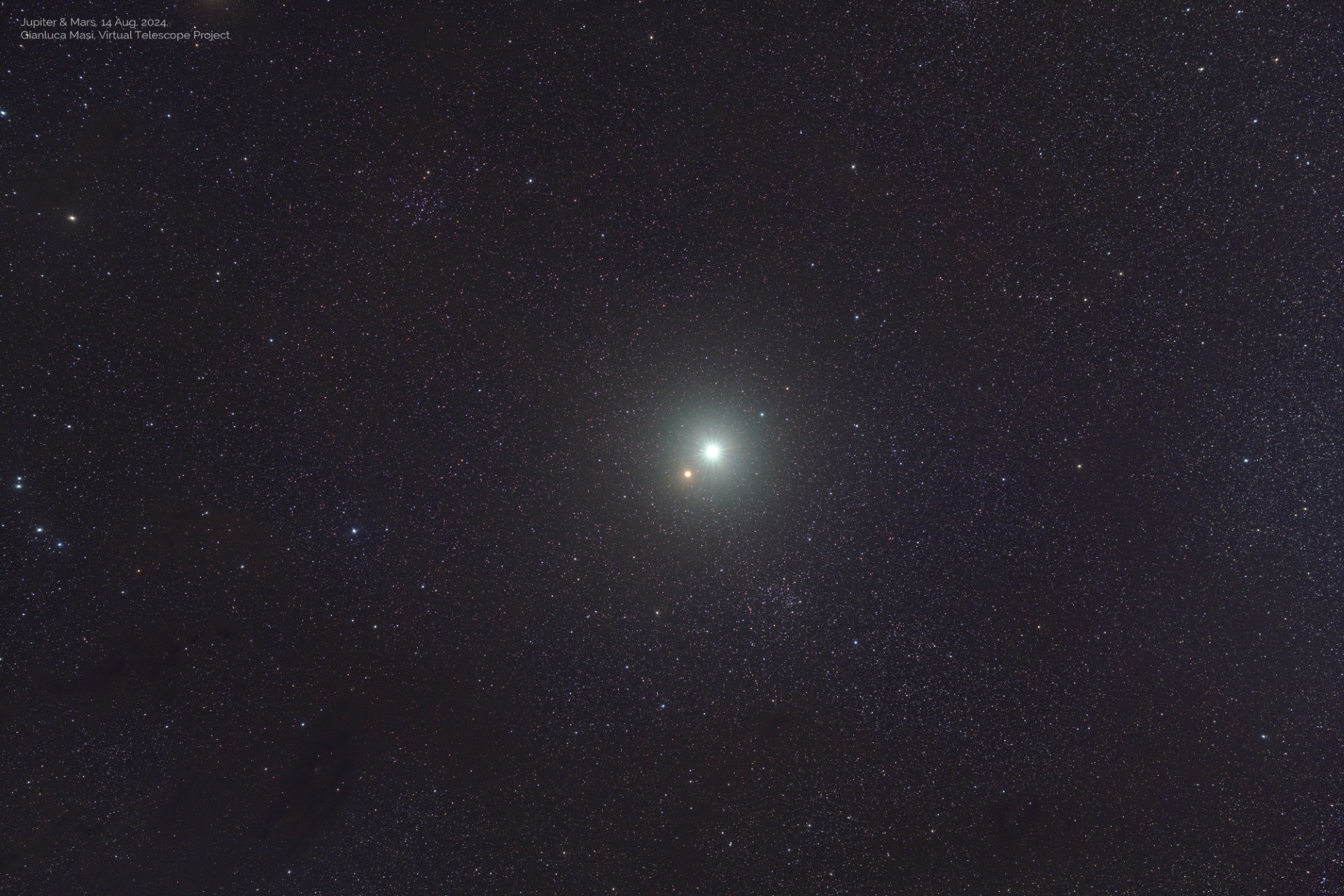
By the first sign of dawn, Jupiter and Mars are high up in the east. Aldebaran shines to their right, and the horn-tip stars of Taurus keep company to their left and lower left, as shown at the top of this page. Orion is down below.
Saturn (magnitude +0.7, south of the Circlet of Pisces) glows low in the east as evening twilight fades away. It's lower right of the Great Square of Pegasus, which is balancing on one corner. Saturn shines highest toward the south in the hours after midnight, through less of our blurry atmosphere for better telescopic viewing.
Saturn is heading toward opposition on the night of September 7th. It's already nearly opposite the Sun in our sky, close to where the Moon appears from our point of view when it's one day past full.

Uranus (magnitude 5.7, in western Taurus) is some 20° west of Jupiter in the early morning hours. You'll need a good finder chart to identify it among surrounding faint stars.
Neptune (a tougher magnitude 7.8, near the Circlet of Pisces) is 12° east of Saturn. Again you'll need a proper finder chart.
All descriptions that relate to your horizon — including the words up, down, right, and left — are written for the world's mid-northern latitudes. Descriptions and graphics that also depend on longitude (mainly Moon positions) are for North America.
Eastern Daylight Time (EDT) is Universal Time minus 4 hours. UT is also known as UTC, GMT, or Z time.
Want to become a better astronomer? Learn your way around the constellations. They're the key to locating everything fainter and deeper to hunt with binoculars or a telescope.
This is an outdoor nature hobby. For a more detailed constellation guide covering the whole evening sky, use the big monthly map in the center of each issue of Sky & Telescope, the essential magazine of astronomy.
Once you get a telescope, to put it to good use you'll need a much more detailed, large-scale sky atlas (set of charts). The basic standard is the Pocket Sky Atlas (in either the original or Jumbo Edition), which shows all stars to magnitude 7.6.
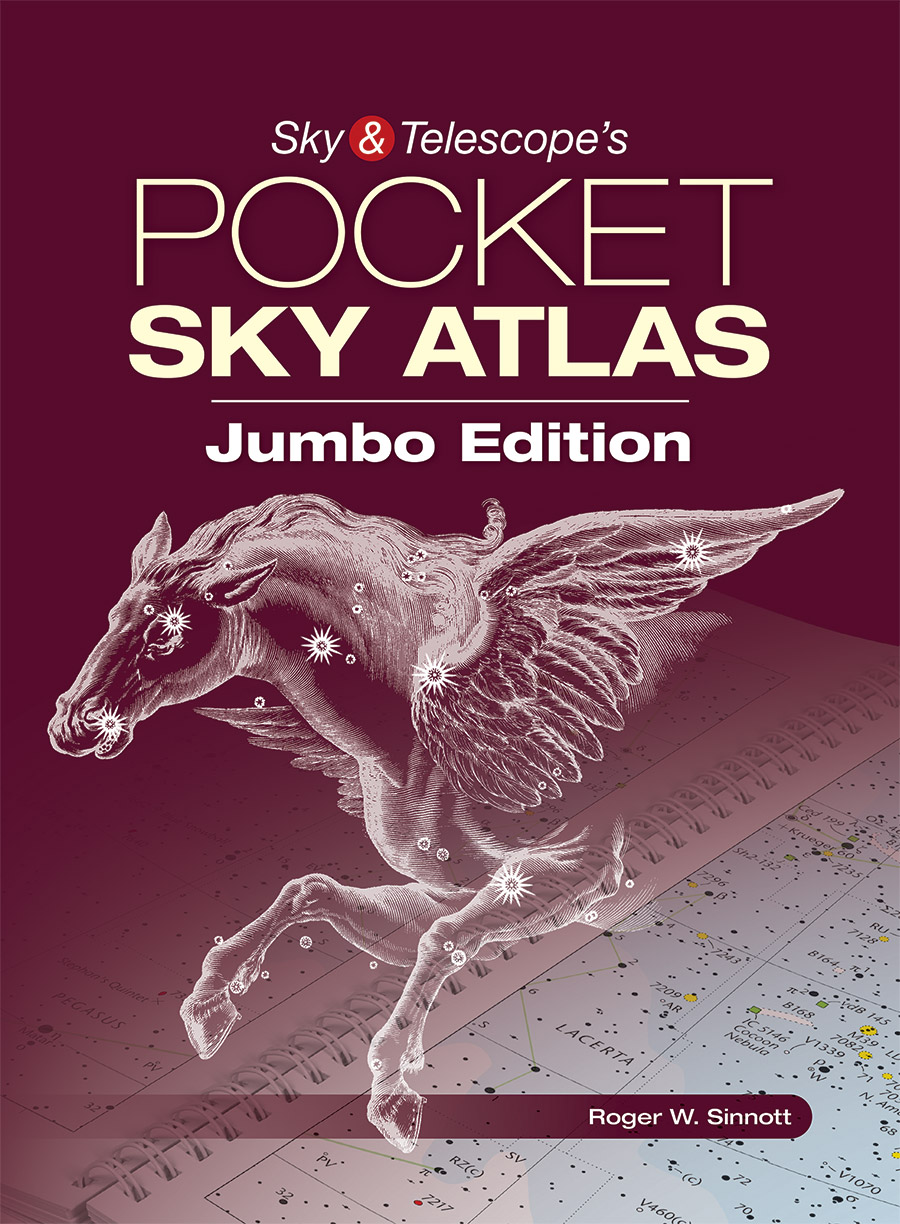
Next up is the larger and deeper Sky Atlas 2000.0, plotting stars to magnitude 8.5; nearly three times as many. (It's currently out of print.) The next up are the even larger Interstellarum atlas (stars to magnitude 9.5) or Uranometria 2000.0 (stars to mag 9.75). And read How to Use a Star Chart with a Telescope. It applies just as much to charts on your phone or tablet as to charts on paper.
You'll also want a good deep-sky guidebook. A beloved old classic is the three-volume Burnham's Celestial Handbook. An impressive more modern one is the big Night Sky Observer's Guide set (2+ volumes) by Kepple and Sanner. The top of the hill for total astro-geeks is the Annals of the Deep Sky series, currently at 10 volumes as it slowly works forward through the constellations alphabetically. So far it's only up to F.
Can computerized telescopes replace charts? Not for beginners I don't think, and not for scopes on mounts and tripods that are less than top-quality mechanically. Unless, that is, you prefer spending your time getting finicky technology to work rather than learning the sky. And as Terence Dickinson and Alan Dyer say in their Backyard Astronomer's Guide, "A full appreciation of the universe cannot come without developing the skills to find things in the sky and understanding how the sky works. This knowledge comes only by spending time under the stars with star maps in hand and a curious mind." Without these, "the sky never becomes a friendly place."
If you do get a computerized scope, make sure its drives can be disengaged so you can swing it around and point it readily by hand when you want to, rather than only slowly by the electric motors (which eat batteries).
However, finding faint telescopic objects the old-fashioned way with charts isn't simple either. Learn the essential tricks at How to Use a Star Chart with a Telescope.
 Audio sky tour. Out under the evening sky with your
earbuds in place, listen to Kelly Beatty's monthly
podcast tour of the naked-eye heavens above. It's free.
"The dangers of not thinking clearly are much greater now than ever before. It's not that there's something new in our way of thinking, it's that credulous and confused thinking can be much more lethal in ways it was never before."
— Carl Sagan, 1996
"Facts are stubborn things."
— John Adams, 1770
About Alan MacRobert
Alan M. MacRobert became an avid Sky & Telescope subscriber in 1966 at age 14, joined the editorial staff in 1982, and is now a senior contributing editor, semi-retired. He played a role in practically every part of the magazine and the company's other products for more than a generation, both on the amateur-observing side and the science-reporting side. In 1994 a book collection of his observing how-tos and telescopic sky tours was published as Star Hopping for Backyard Astronomers. He has produced This Week's Sky at a Glance online every week since 1989.


Comments
misha17
August 19, 2024 at 12:11 am
This week's Full Moon is also a seasonal "Blue Moon", the 3rd Full Moon in a season that contains 4 Full Moons. Usually a season (which lasts about 3 months) has only 3 Full Moons, but Summer 2024 manage to "sneak" in an extra Full Moon before the September Equinox. Since this month's Full Moon is 12 Full Moons after the 2023 Harvest Full Moon, the Blue Moon acts as a "Leap Moon" to keep the Harvest Full Moon near the September Equinox.
It's also the first of 4 consecutive "Super Moons", with September's and October's full moon occurring even closer to perigee.
You must be logged in to post a comment.
misha17
August 21, 2024 at 3:27 pm
"SATURDAY, AUGUST 24
■ The Moon, nearly last quarter, rises around 10 or 11 p.m. Once it's well up an hour or two later, look for the Pleiades about a fist at arm's length to its lower left."
The Moon-Pleiades conjunction this weekend will feature the 14th occultation in a series that began in early August a year ago.
It occurs almost exactly a year after the 1st occultation in the current Antares occultation series. The Antares series began with an occultation that was viewable from North America. The viewing areas for later occultations have moved southward; last week's Antares occultation was viewable from Antarctica.
On the other hand, the Pleiades series began in the far Southern Hemisphere and has reached much further north than the Tropic of Cancer; this weekend's occultation will best be viewed from Central Africa.
Things improve for the U.S. next month, when the Moon's passage thru the cluster will be visible from Hawaii and the western U S. before sunrise on September 22nd.
You must be logged in to post a comment.
misha17
August 21, 2024 at 3:30 pm
Correction: the 4th paragraph should read,
"... the Pleiades series began in the far Southern Hemisphere and has ~not~ reached much further north than the Tropic of Cancer; ..."
You must be logged in to post a comment.
You must be logged in to post a comment.