 SUNSET:

 0
0FRIDAY, JANUARY 2
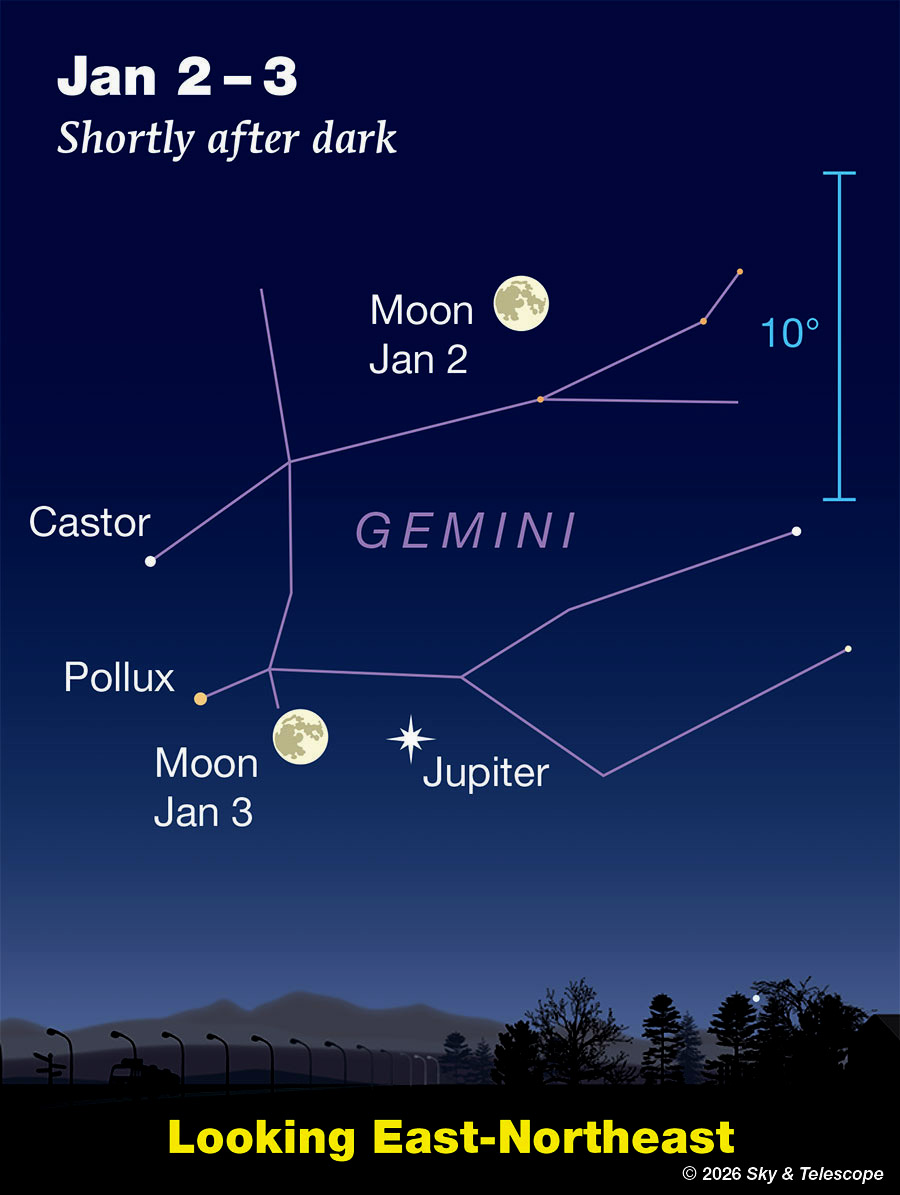
■ Full Moon tonight (exactly full at 5:03 a.m. Saturday morning EST). The Moon is above Jupiter, Castor, and Pollux this evening, as shown below.
■ Jupiter's Great Red Spot should cross the planet's central meridian (the line down its middle from pole to pole) around 8:39 p.m. EST. The spot is closer to Jupiter's central meridian than to the limb, and therefore appears its least foreshortened and easiest to detect in a telescope, for 50 minutes before and after its transit times.
SATURDAY, JANUARY 3
■ This evening the Moon is very nearly as full as it was yesterday evening (for the Americas). Tonight it shines right in the midst of Jupiter, Pollux, and Castor, as shown above.
■ The annual Quadrantid meteor shower will be about at its peak, but the light of the full Moon will flood the sky all night. Moreover, the shower's predicted peak (relatively brief, from about 18:00 to 24:00 UT January 3rd) is almost exactly a half day out of sync with the best meteor-watching hours for North America. A poor year for the Quads!
■ Earth is at perihelion, our closest to the Sun for the year. We're 3% closer to the Sun than we are at aphelion in July.
SUNDAY, JANUARY 4
■ In the cold of early January, the bowl of the Little Dipper hangs straight down from Polaris around 8 or 9 p.m. — as if (per Leslie Peltier) from a nail on the cold north wall of the sky.
The brightest star of the Little Dipper's dim bowl is Kochab, at the bowl's lip. It's the equal of Polaris; both are 2nd magnitude. Kochab passes precisely below Polaris around 8 p.m. now, depending on how far east or west you live in your time zone.
■ The Big Dipper, meanwhile, is creeping up low in the north-northeast. Its handle is very low and its bowl is to the upper right.
■ Jupiter's Great Red Spot should cross Jupiter's central meridian around 10:16 p.m. EST (7:16 p.m. PST).
MONDAY, JANUARY 5
■ When Jupiter is so near opposition (in just five days now), Jupiter's moons and their shadows cross the planet very close together, almost on top of each other. This evening Io's shadow enters Jupiter's eastern limb at 8:51 p.m. EST, followed right behind by Io itself 6 minutes later.
The shadow exits Jupiter's other side at 11:07 p.m. EST, with Io still trailing 6 minutes behind.
TUESDAY, JANUARY 6
■ Now it's the turn of Ganymede, slower and farther out from Jupiter, to perform along with its shadow. The shadow (a little bigger than Io's) comes onto Jupiter's edge at 11:37 p.m. EST (8:37 p.m. PST), with Ganymede following 20 minutes behind. The shadow departs Jupiter's edge at 12:20 a.m. EST (9:20 p.m. PST), followed by Ganymede 20 minutes later.
WEDNESDAY, JANUARY 7
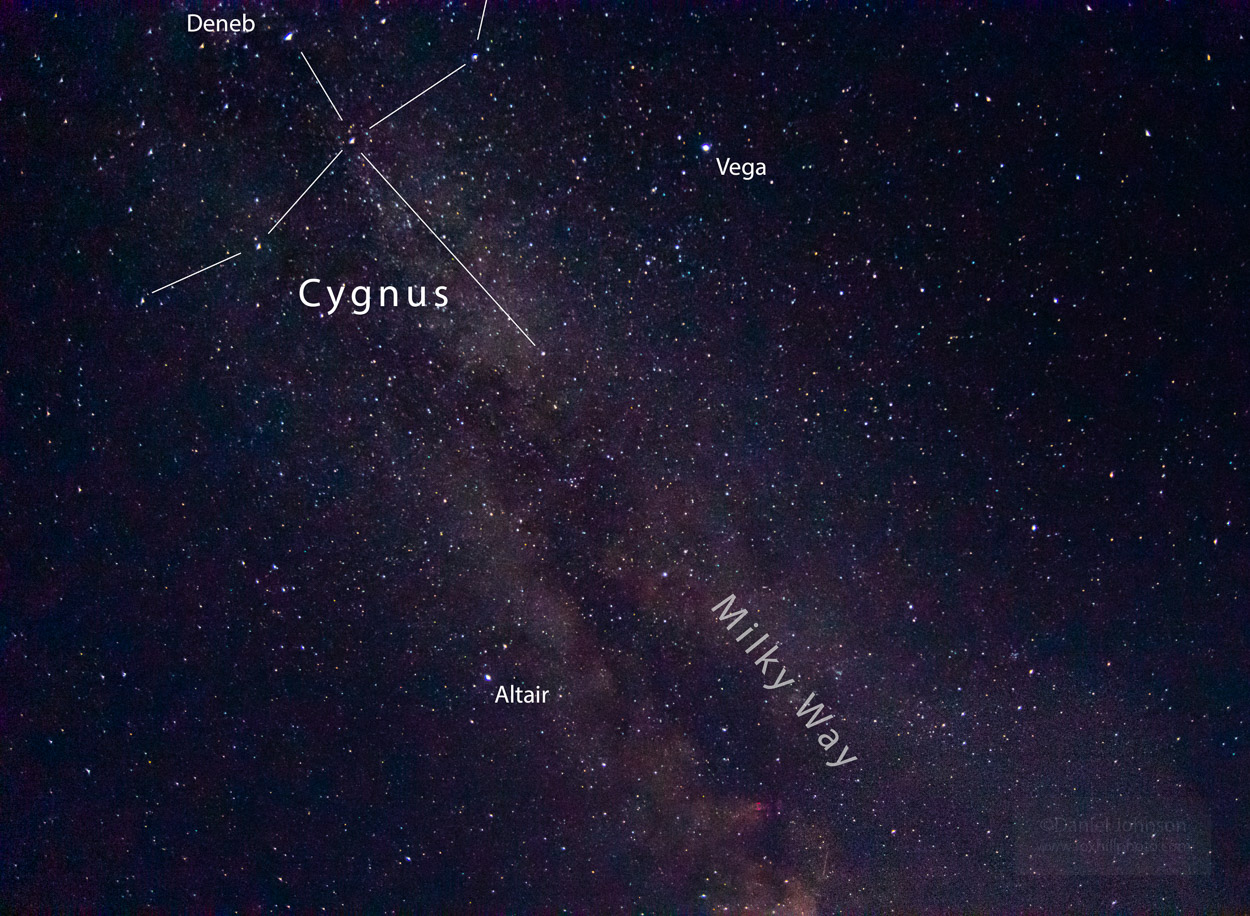
■ The big Northern Cross in Cygnus, topped by Deneb, is nearly upright in the west-northwest after nightfall. Another hour or so and it's standing on the horizon. How straight up it stands depends on your latitude.
THURSDAY, JANUARY 8
■ Sirius rises around the end of twilight now. Orion's three-star Belt points down almost to its rising place. Which is changeless as seen from a given location for several human lifetimes.
Just after Sirius clears the horizon, it twinkles surprisingly slowly and deeply through the thick layers of low atmosphere. And if you've ever watched Sirius rise from an airplane window at cruising altitude, you may have been struck by its doubly deep and slow "twinkling." This happens because you're seeing Sirius through almost twice as much lower atmosphere. The light from the star skims near Earth's surface where a ground observer would be, then continues on through more of the lower atmosphere and up again to the airplane.
Sirius twinkles faster and more shallowly as it gains altitude. Its flashes of color also moderate, blending into shimmering whiteness as it climbs to shine through thinner air.
All stars show these effects, but the brilliance of Sirius makes them more obvious.
FRIDAY, JANUARY 9
■ Here it is getting near to the coldest very bottom of the year, but the Summer Star, Vega, is still barely hanging in there. Look for it twinkling over the northwest horizon during and shortly after nightfall. The farther north you are the higher it will be. If you're as far south as Florida, it's already gone.
SATURDAY, JANUARY 10
■ Jupiter is at opposition tonight, opposite the Sun as seen from Earth. It rises at sunset and blazes in Gemini near Pollux and Castor all night. Jupiter is a big 47 arcseconds wide across its equator as this week; it's very nearly this big all January. See "Jupiter Rules!" in the January Sky & Telescope, page 48, including a map of its dark belts and bright zones.
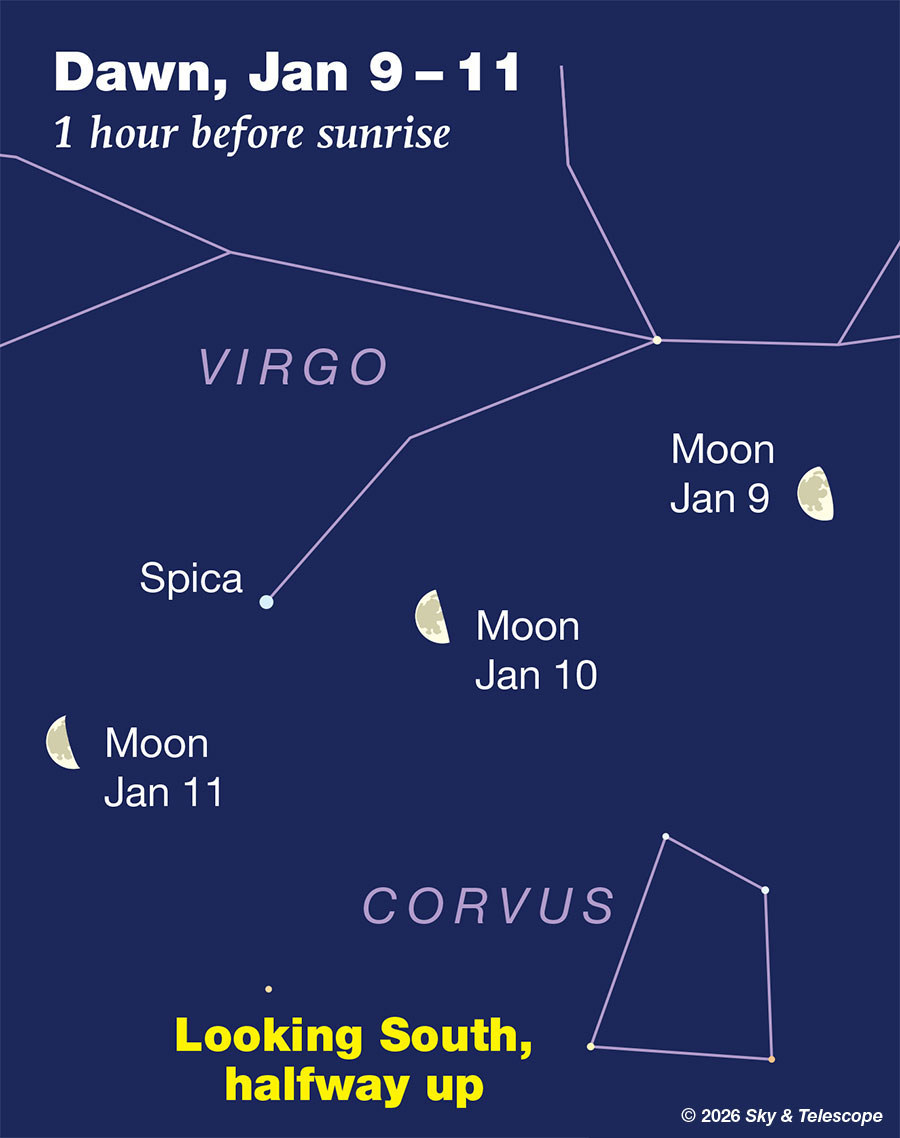
■ Last-quarter Moon (exactly last quarter at 10:48 a.m. this morning EST). By the time the Moon rises around 1 a.m. tonight (on the morning of the 11th), look for its terminator to be slightly concave.
Above the Moon when it rises on the 11th, by three or four finger-widths at arm's length, will be springtime Spica making its cold, post-midnight January appearance. By dawn the Moon will be high in the south with Spica to its upper right, as shown above.
SUNDAY, JANUARY 11
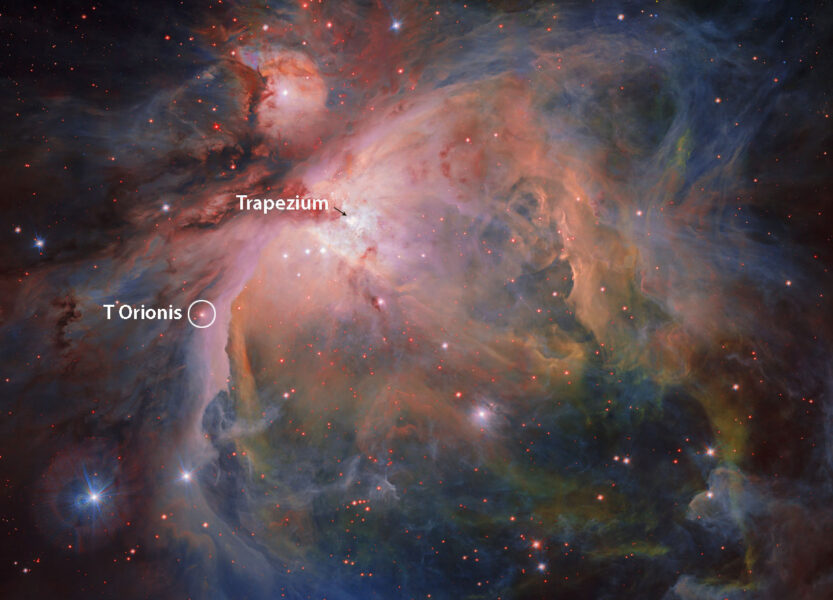
■ How often have you looked at the Great Orion Nebula in your telescope? Think you've seen all your scope can show? Well then, do you check in on T Orionis?
This very young variable star in the nebula is still gravitationally contracting and accreting clumpy matter on its way toward life on the Main Sequence. For now it appears as a hot subgiant. Normal hydrogen fusion has probably not yet caught fire in its core.
ESO / G. Beccari
T Ori is having a wild babyhood, as new stars do. Its irregular variability, trackable in amateur scopes across a matter of weeks, results from changes in its accretion of blobby material and shadowing by its circumstellar dust disk. It usually ranges between magnitude 10.2 and 11.0 but has been seen as bright as 9.6 and as faint as 12.5.
T Orionis lies just 10 arcminutes southeast of the Trapezium quartet at the heart of the nebula, as shown above. For lots more about this class of stars, and a finder chart for T with comparison-star magnitudes, see Bob King's Catch Birth Flickers of Budding Suns.
This Week's Planet Roundup
Mercury, Venus, and Mars are all hidden behind the glare of the Sun.
Jupiter (magnitude –2.7, in eastern Gemini), comes to opposition on January 10th. It now rises in the east-northeast around sunset, dominates the eastern sky in early evening, then the high southeast. Castor and Pollux shine nearby. Jupiter is highest in the south and telescopically sharpest around midnight. It's a big 47 arcseconds wide (big for a planet, anyway).
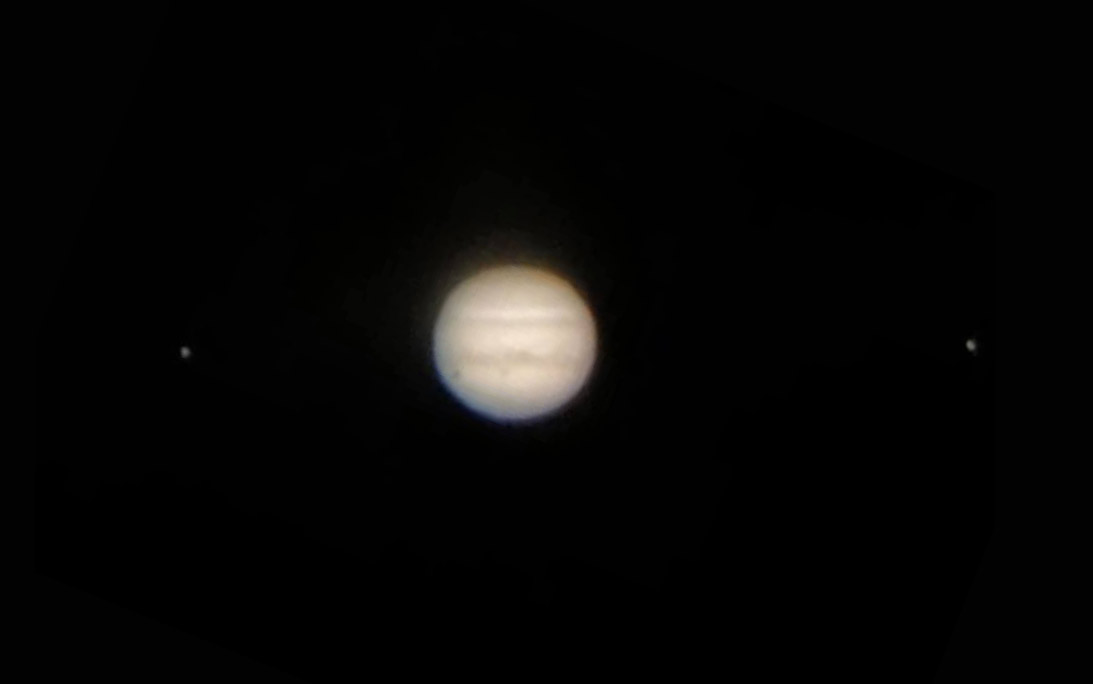
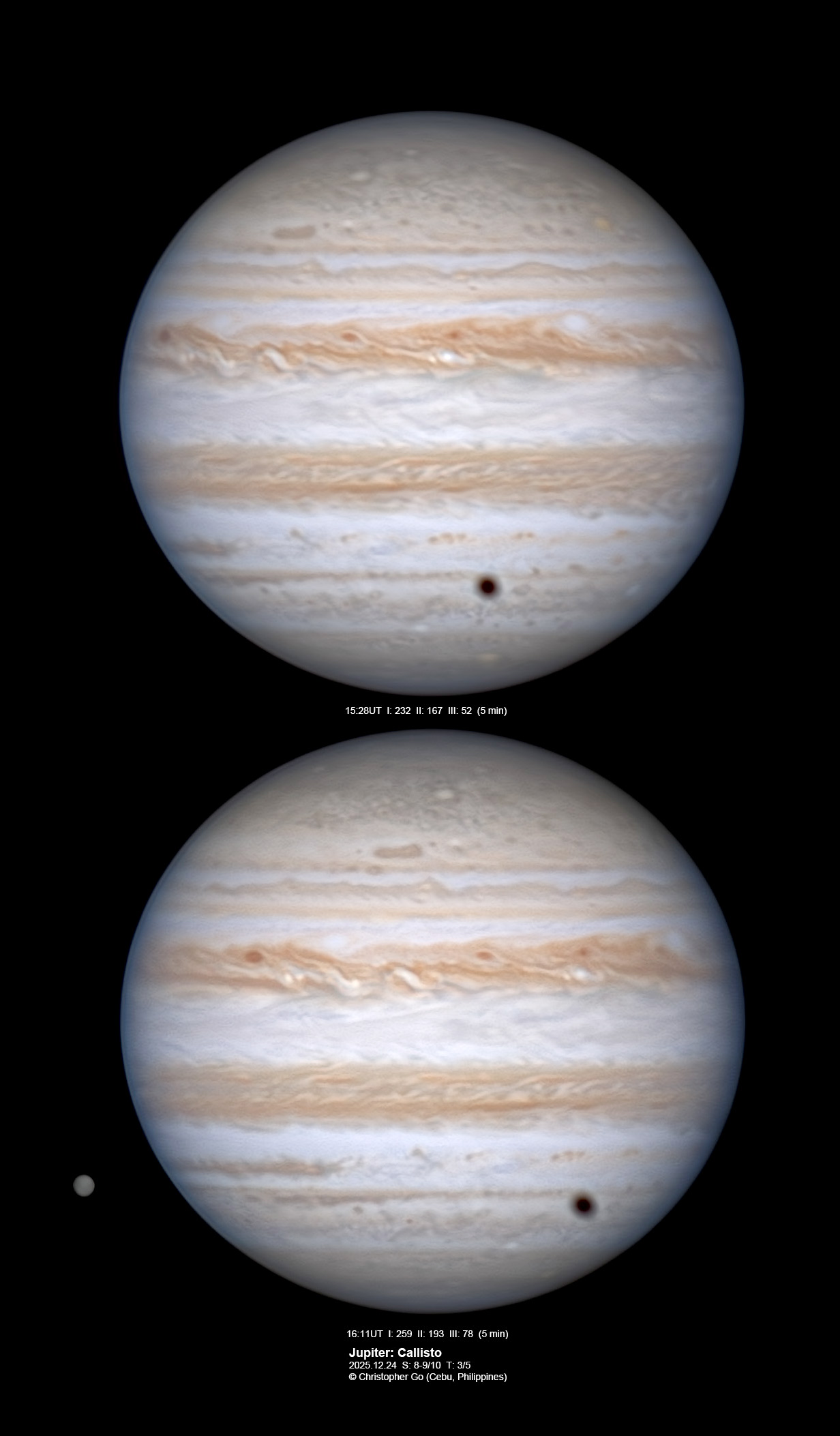
Go writes, "It is interesting to see that Callisto's shadow has a penumbra!" This results from Callisto being quite a bit farther from Jupiter than the other three Galilean satellites are.
Saturn (magnitude +1.2, at the Aquarius-Pisces border) is the brightest dot high in the southwest at nightfall. It's lower left of the Great Square of Pegasus. Saturn descends through the evening and sets in the west around 1o or 11 p.m.
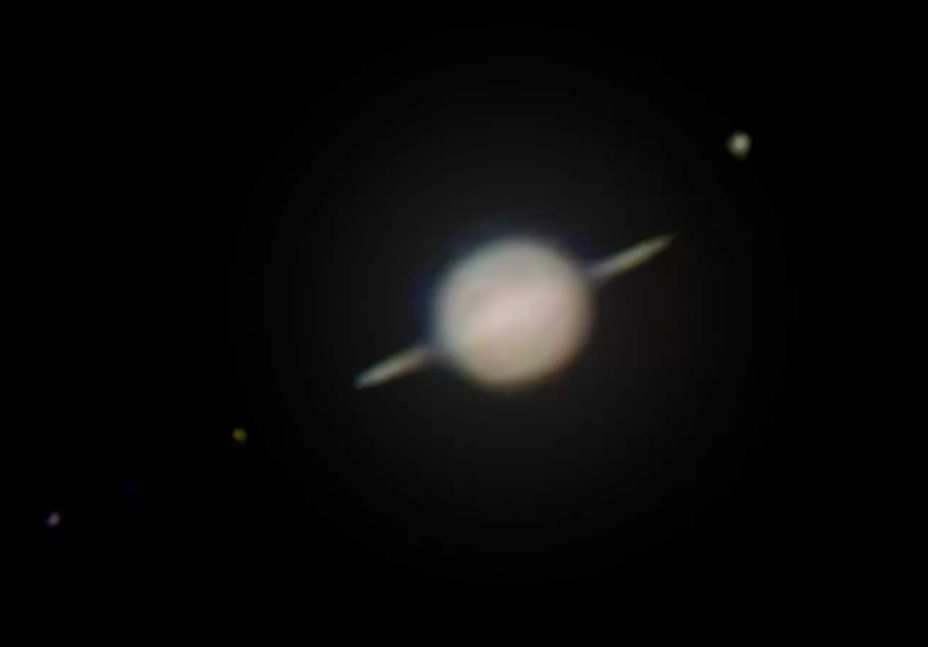
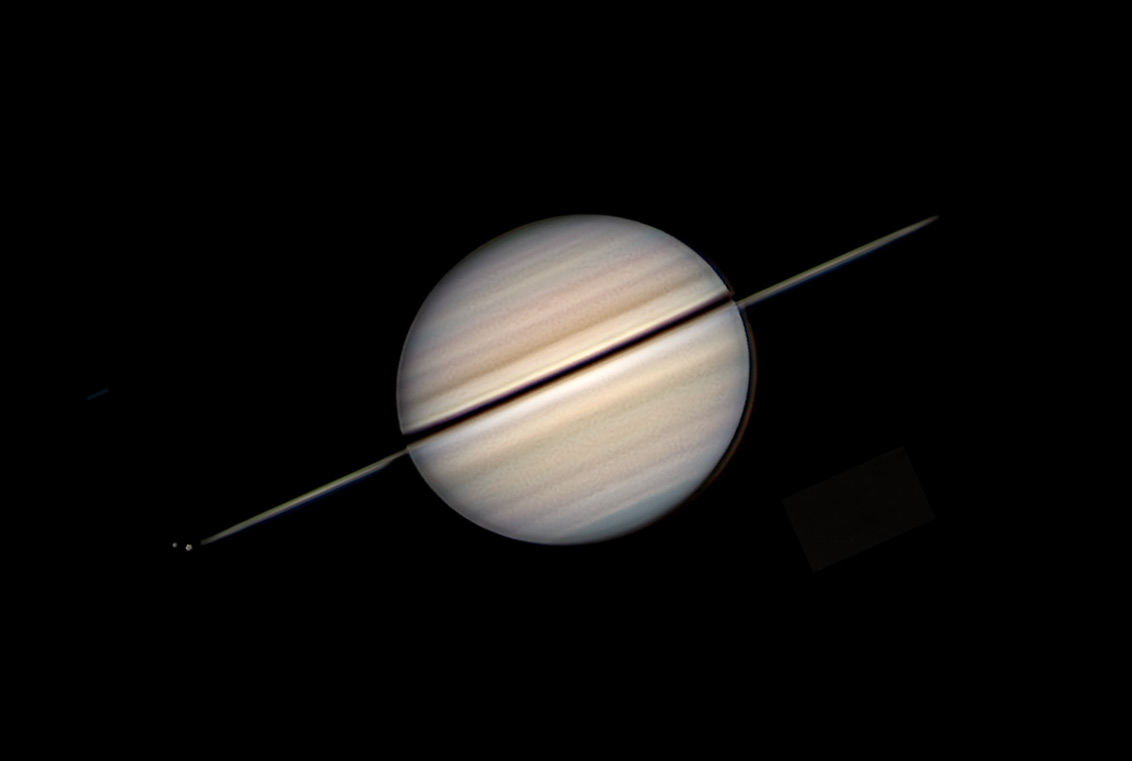
In a telescope Saturn's rings are still very thin but starting to open up. They're now tilted a full 1° to our line of sight. The rings' thin black shadow on Saturn's globe is slowly becoming a little wider too.
Uranus (magnitude 5.6, in Taurus 5° south of the Pleiades) waits high in the southeast these evenings. At high power in a telescope it's a tiny but definitely non-stellar dot, 3.8 arcseconds wide. You'll need a detailed finder chart to identify it among similar-looking faint stars, such as the chart in the November Sky & Telescope, page 49.
Neptune is a telescopic "star" of magnitude 7.8, a dim speck just 2.3 arcseconds wide 4° above Saturn. For Neptune you'll need an even more detailed finder chart.
All descriptions that relate to your horizon — including the words up, down, right, and left — are written for the world's mid-northern latitudes. Descriptions and graphics that also depend on longitude (mainly Moon positions) are for North America. Eastern Standard Time (EST) is Universal Time minus 5 hours. UT is also known as UTC, GMT, or Z time.
Want to become a better astronomer? Learn your way around the constellations. They're the key to locating everything fainter and deeper to hunt with binoculars or a telescope.
This is an outdoor nature hobby. For a more detailed constellation guide covering the whole evening sky, use the big monthly map in the center of each issue of Sky & Telescope, the essential magazine of astronomy.
For the attitude every amateur astronomer needs, read Jennifer Willis's Modest Expectations Give Rise to Delight.
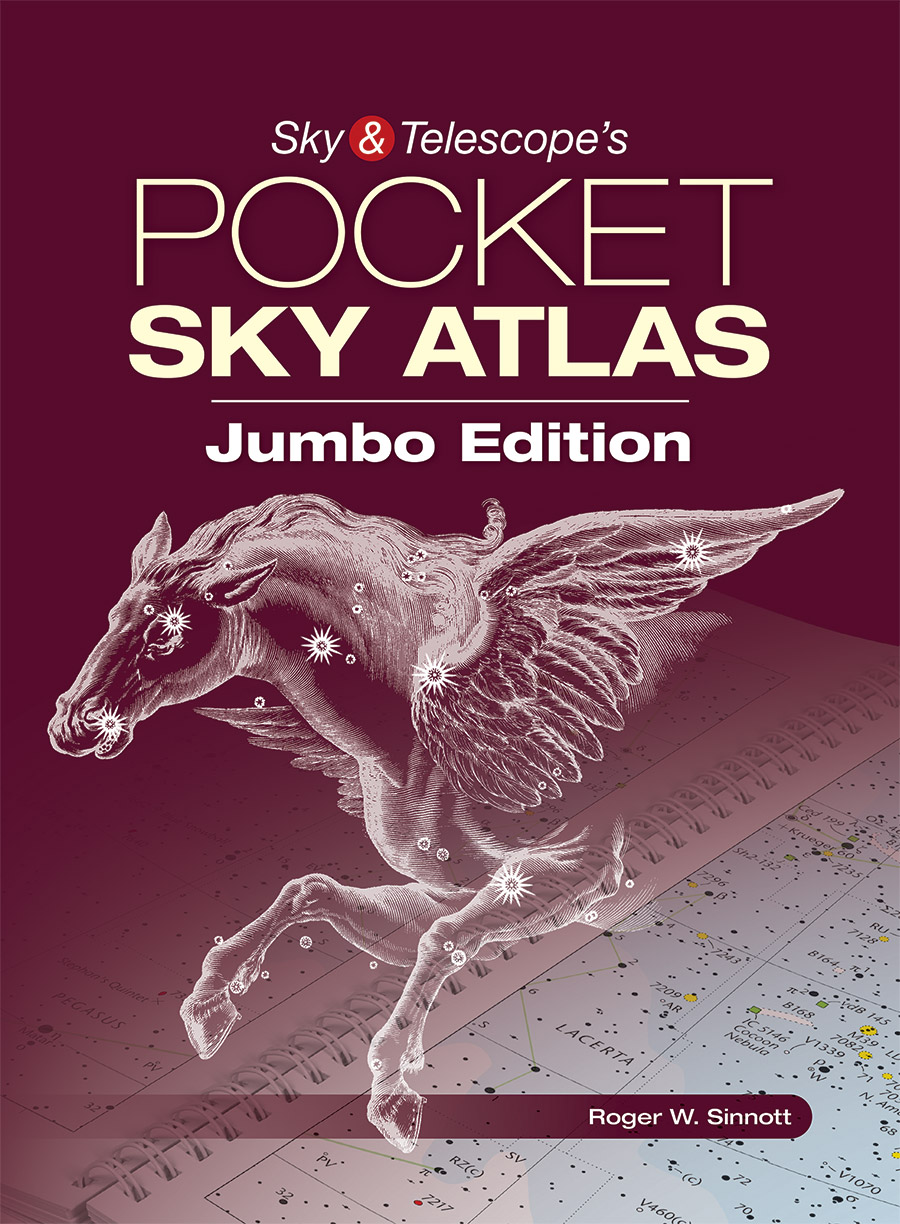
Once you get a telescope, to put it to good use you'll want a much more detailed, large-scale sky atlas (set of charts). The basic standard is the Pocket Sky Atlas, in either the original or Jumbo Edition. Both show all 30,000 stars to magnitude 7.6, and 1,500 deep-sky targets — star clusters, nebulae, and galaxies — to search out among them.
Next up is the larger and deeper Sky Atlas 2000.0, plotting stars to magnitude 8.5; nearly three times as many, as well as many more deep-sky objects. It's currently out of print, but maybe you can find one used.
The next up, once you know your way around well, are the even larger Interstellarum Deep-Sky Atlas (with 201,000+ stars to magnitude 9.5 and 14,000 deep-sky objects selected to be detectable by eye in very large amateur telescopes), and Uranometria 2000.0 (332,000 stars to mag 9.75, and 10,300 deep-sky objects).
Read How to Use a Star Chart with a Telescope. It applies just as much to electronic charts on your phone or tablet — which many observers find handier and more versatile, if perhaps less well designed, than charts on paper.
You'll also want a good deep-sky guidebook. A beloved old classic is the three-volume Burnham's Celestial Handbook. It was my bedside reading for years. An impressive more modern one is the big Night Sky Observer's Guide set (2+ volumes) by Kepple and Sanner. The pinnacle for total astro-geeks is the new Annals of the Deep Sky series, currently at 11 volumes as it works its way forward through the constellations alphabetically. So far it's up to H.
Can computerized telescopes replace charts? Well, I used to say this:
"Not for beginners, I don't think, unless you prefer spending your time getting finicky technology to work rather than learning how to explore through the sky yourself. As Terence Dickinson and Alan Dyer say in their Backyard Astronomer's Guide, 'A full appreciation of the universe cannot come without developing the skills to find things in the sky and understanding how the sky works. This knowledge comes only by spending time under the stars with star maps in hand and a curious mind.' Without these, 'the sky never becomes a friendly place.' "
Well, things change. The technology has continued to improve and become more user-friendly — particularly with software that can now recognize telescopic star fields to determine exactly where the telescope is pointed — finally bypassing all aiming imperfections in the mount, tripod, gears, bearings and other mechanics, or in the user's skill in setting up.
The latest revolution is the rise of small, imaging-only "smartscopes." These take advantage of not only today's pointing technology, but also the vastly better capabilities of imaging chips and processing compared to the human retina and visual cortex. The most sophisticated image stacking and processing can also come built in. The result is reasonably decent deep-sky imaging from shockingly small, low-priced units. The image may be viewable on your phone or computer as it builds up in real time. Small smartscopes can enable direct contributions to citizen-science projects.
These are changing the hobby at the entry level. For more see Richard Wright's "The Rise of the Smart Telescopes" in the November 2025 Sky & Telescope. And read the magazine's review of this especially small one.
If you get a larger, more conventional computerized scope that allows direct visual use, make sure that its drives can be disengaged so you can swing it around and point it readily by hand when you want to, rather than only slowly by the electric motors (which eat batteries).
 Audio sky tour. Out under the evening sky with your
earbuds in place, listen to Kelly Beatty's monthly
podcast tour of the naked-eye heavens above. It's free.
"The dangers of not thinking clearly are much greater now than ever before. It's not that there's something new in our way of thinking, it's that credulous and confused thinking can be much more lethal in ways it was never before."
— Carl Sagan, 1996
"Facts are stubborn things; and whatever may be our wishes, our inclinations, or the dictates of our passion, they cannot alter the state of facts and evidence."
— John Adams, 1770
About Alan MacRobert
Alan M. MacRobert became an avid Sky & Telescope subscriber in 1966 at age 14, joined the editorial staff in 1982, and is now a senior contributing editor, semi-retired. He played a role in practically every part of the magazine and the company's other products for more than a generation, both on the amateur-observing side and the science-reporting side. In 1994 a book collection of his observing how-tos and telescopic sky tours was published as Star Hopping for Backyard Astronomers. He has produced This Week's Sky at a Glance online every week since 1989.



Comments
You must be logged in to post a comment.