 SUNSET:

 0
0FRIDAY, JANUARY 3
■ Crescent Moon and Venus. Once again the Moon, in its monthly orbit of Earth, comes around to shine near Venus during and after dusk; see below. These are the two brightest celestial objects after the Sun. They'll be 3° apart at the end of twilight when seen from the East Coast, 4° or 5° apart by the time of dusk on the West Coast. If you've missed previous photo opportunities for this pretty pair, here's another chance.

■ And as Gary Seronik notes in the January Sky & Telescope, this afternoon the Moon-Venus pairing presents a fine time to spot Venus in the daytime naked-eye. It can be surprisingly easy if you have sharp or well corrected vision. The trick is landing your eye on Venus's exact spot in the blue sky.
If you're in North America, "At about 3:30 p.m. local time the Moon is due south on the meridian," writes Seronik. "Once you've spotted the Moon, train your binoculars on it to get a sharp focus. Now, move the pale crescent to the left side of your field of view. Venus should pop into view near the right edge."
Now look at that spot without the binoculars. "If you have a very transparent sky [meaning deep blue], the planet is surprisingly easy to see" once your gaze lands on it. Keep trying.
SATURDAY, JANUARY 4
■ Now the thickening Moon shines upper left of Saturn, as shown above. They're 2° or 3° apart as seen from East Coast, 4° as seen from the West Coast. For Iceland and much of Europe the Moon occults Saturn.
■ Algol, the prototype eclipsing variable star, should be at its minimum brightness, magnitude 3.4 instead of its usual 2.1, for about two hours centered on 11:42 p.m. EST; 8:42 p.m. PST. Algol takes an additional several hours to fade and to rebrighten.
SUNDAY, JANUARY 5
■ In the cold nights of early January, the bowl of the Little Dipper hangs straight down from Polaris sometime around 8 or 9 p.m. — as if (per Leslie Peltier) from a nail on the cold north wall of the sky.
The brightest star of the Little Dipper's dim bowl is Kochab, marking the bowl's lip. It's the equal of Polaris. Kochab passes precisely below Polaris around 8 p.m., depending on how far east or west you live in your time zone. Polaris is 430 light-years away, Kochab is 130.
MONDAY, JANUARY 6
■ First-quarter Moon (exactly first-quarter at 6:56 p.m. EST). Find the Great Square of Pegasus to the Moon's upper right shortly after dark, and directly right of the Moon later. A diagonal through the Square points at the Moon (for evening in North America).
TUESDAY, JANUARY 7
■ After dinnertime now, the enormous Andromeda-Pegasus complex runs from near the zenith down toward the western horizon. Just west of the zenith, spot Andromeda's high foot: 2nd-magnitude Gamma Andromedae (Almach), slightly orange. Andromeda is standing on her head. About halfway down from the zenith to the west horizon is the Great Square of Pegasus, balancing on one corner. Andromeda's head is its top corner.
From its bottom corner run the stars outlining Pegasus's neck and head, ending at his nose: 2nd-magnitude Enif, due west. It too is slightly orange.
■ Algol should be at minimum brightness for a couple hours centered on 8:31 p.m. EST.
WEDNESDAY, JANUARY 8
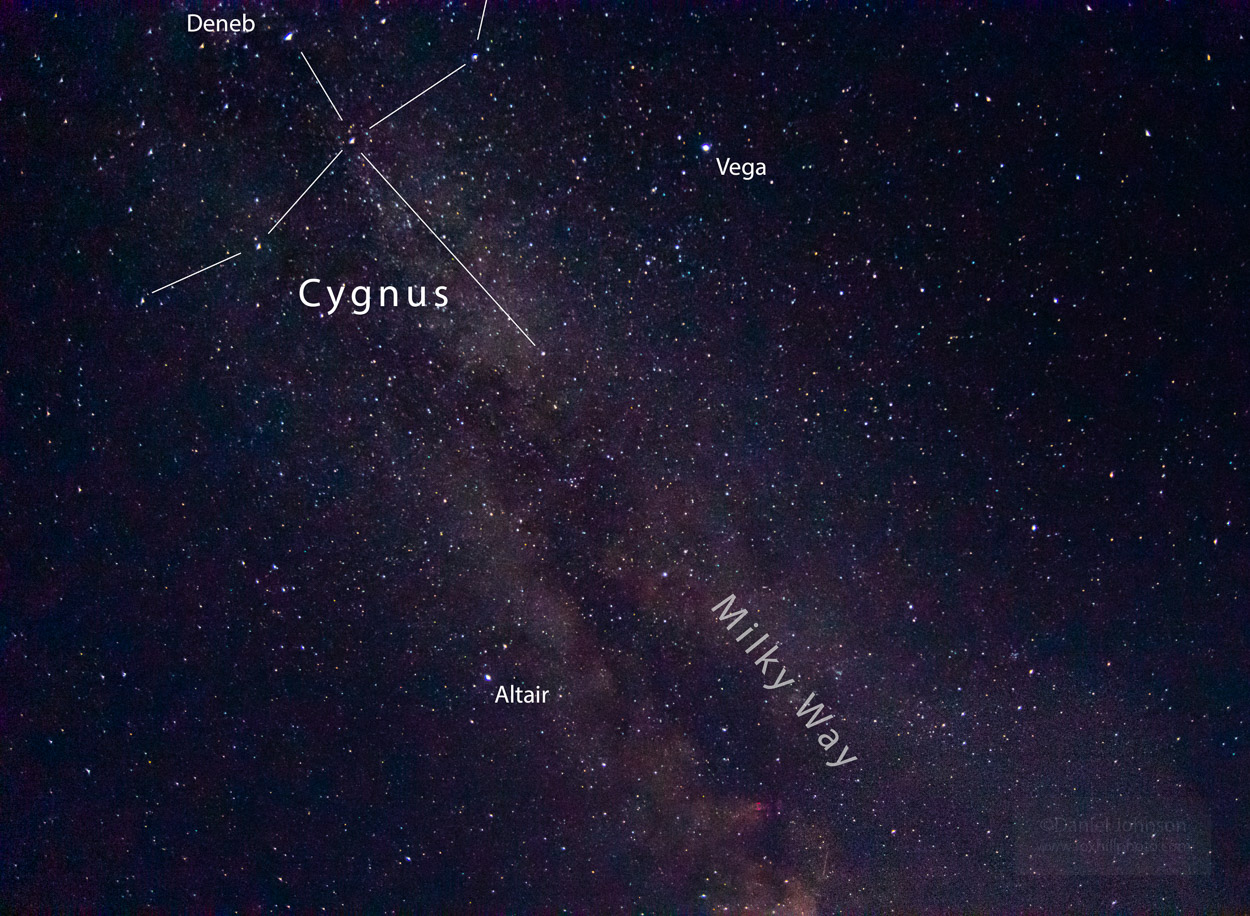
■ The big Northern Cross in Cygnus, topped by Deneb, is nearly upright in the west-northwest right after full darkness falls. Another hour or so and it's standing on the horizon. How straight up it stands depends on your latitude.
THURSDAY, JANUARY 9
■ The Moon occults several of the Pleiades early this evening for North America; later in the night for Europe. The stars will snap out of view on the dark limb of the 82% sunlit waxing gibbous Moon, then reappear from behind the bright limb up to an hour or more later. Eastern and central North America will get the most events. Farther west, it will still be daylight or bright twilight for some of them.
Binoculars may serve for a few of the disappearances, but a telescope will be much better. The reappearances on the bright limb may be difficult even with a telescope depending on the quality of the seeing.
The brightest Pleiad is Alcyone (Eta Tauri), magnitude 2.8. Map and timetables for its disappearance and reappearance. Also for Electra (17 Tauri), Merope (23 Tauri), and Atlas (27 Tauri). For each star, the first two tables, with predictions for hundreds of cities, are long. The first table gives the times of the star's disappearance behind the Moon's dark limb; the second gives its reappearance out from behind the Moon's bright limb. Scroll to be sure you're using the correct table; watch for the new heading as you scroll down. The first two letters in each entry are the country abbreviation (CA is Canada, not California). The times are in UT (GMT) January 10th. UT is 5 hours ahead of Eastern Standard Time, 6 hours ahead of CST, 7 ahead of MST, and 8 ahead of PST.
For instance: For New York City, Alcyone disappears at 8:18 p.m. EST in darkness (the Sun's altitude is not given because it's irrelevant). But for Denver, Alcyone disappears at 5:35 p.m. MST in early-mid twilight with the Sun only 8° below the horizon. The event has no listings for West Coast cities, where the sky will be much too bright.

FRIDAY, JANUARY 10
■ Now the Moon shines in line with Jupiter and Aldebaran, as shown above. How exactly in line? That will depend on your time and location. Watch the straightness of the line change hour by hour. Every hour the Moon moves by nearly its own diameter eastward against the stars.
SATURDAY, JANUARY 11
■ Now the Moon, two days from full, forms a triangle with Beta and fainter Zeta Tauri, the Bull's horntip stars, as shown above.
SUNDAY, JANUARY 12
■ At this coldest time of the year, Sirius rises around the end of twilight. Orion's three-star Belt points down almost to its rising place. After Sirius clears the horizon, it twinkles slowly and deeply through the thick layers of low atmosphere, then faster and more shallowly as it gains altitude. Its flashes of color also moderate and blend into shimmering whiteness as it climbs to shine through thinner air.
This Week's Planet Roundup
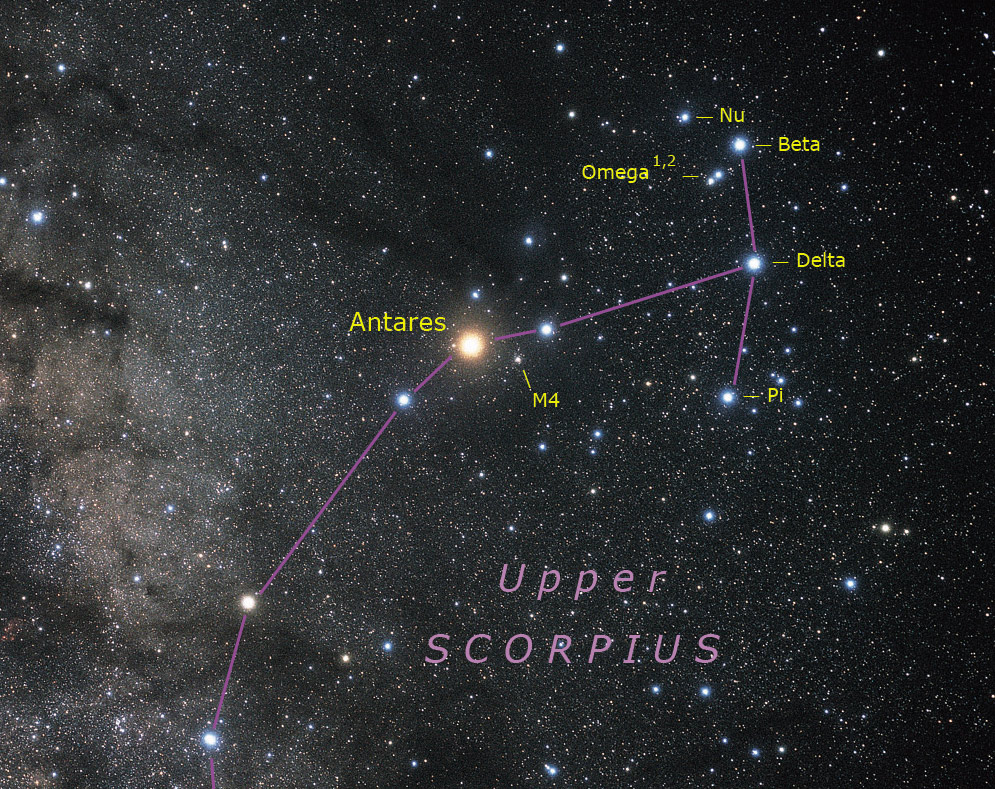
Mercury, magnitude –0.3, is coming down from one of its best dawn apparitions. Look for it low in the southeast about 45 minutes before sunrise. (Don't confuse it with fainter Antares about two fists to its upper right.)
Venus (magnitude –4.6, in Aquarius) shines very high and bright as the "Evening Star" in the southwest during twilight, and lower in the west-southwest as evening grows late. Venus doesn't set until about 2½ hours after dark. It forms a long triangle with Saturn to its upper left and Fomalhaut much farther to their lower left.
Get your telescope on Venus early in twilight. This week it appears very close to half-lit, at or just past dichotomy. Venus is enlarging week by week as it swings toward us while waning in phase. It now measures 24 or 25 arcseconds from pole to pole.
Mars (magnitude –1.4, near the Cancer-Gemini border) rises glaringly orange in the east-northeast around the end of twilight, below Castor and Pollux. Watch Mars as it shifts position night by night and lines up perfectly with those two stars on January 18th.
Mars shows best in a telescope by late evening or midnight, when it's very high toward the southeast or south. It is now 14.5 arcseconds in apparent diameter and will touch 14.6 when closest to Earth on January 12th. Mars comes to opposition three days later on the 15th. This is a rather distant opposition for Mars. It's near the aphelion of its fairly elliptical orbit: the orbit's farthest point from the Sun.
A map of the major Martian surface features is in the January Sky & Telescope, page 48, in Bob King's article "Mars is in Fine Form." To find which side of Mars will be facing you at the time you'll observe, use our Mars Profiler tool.
See also Tom Dobbins's "The Shifting Sands of Mars" on page 52 of the January issue.

South is up. Thaumasia and Solis Lacus are at top. Tithonius is the largest dark area in the big dark prong just below Solis Lacus. The North Polar Cap is rimmed with dark. Mars was 14.0 arcsec wide.
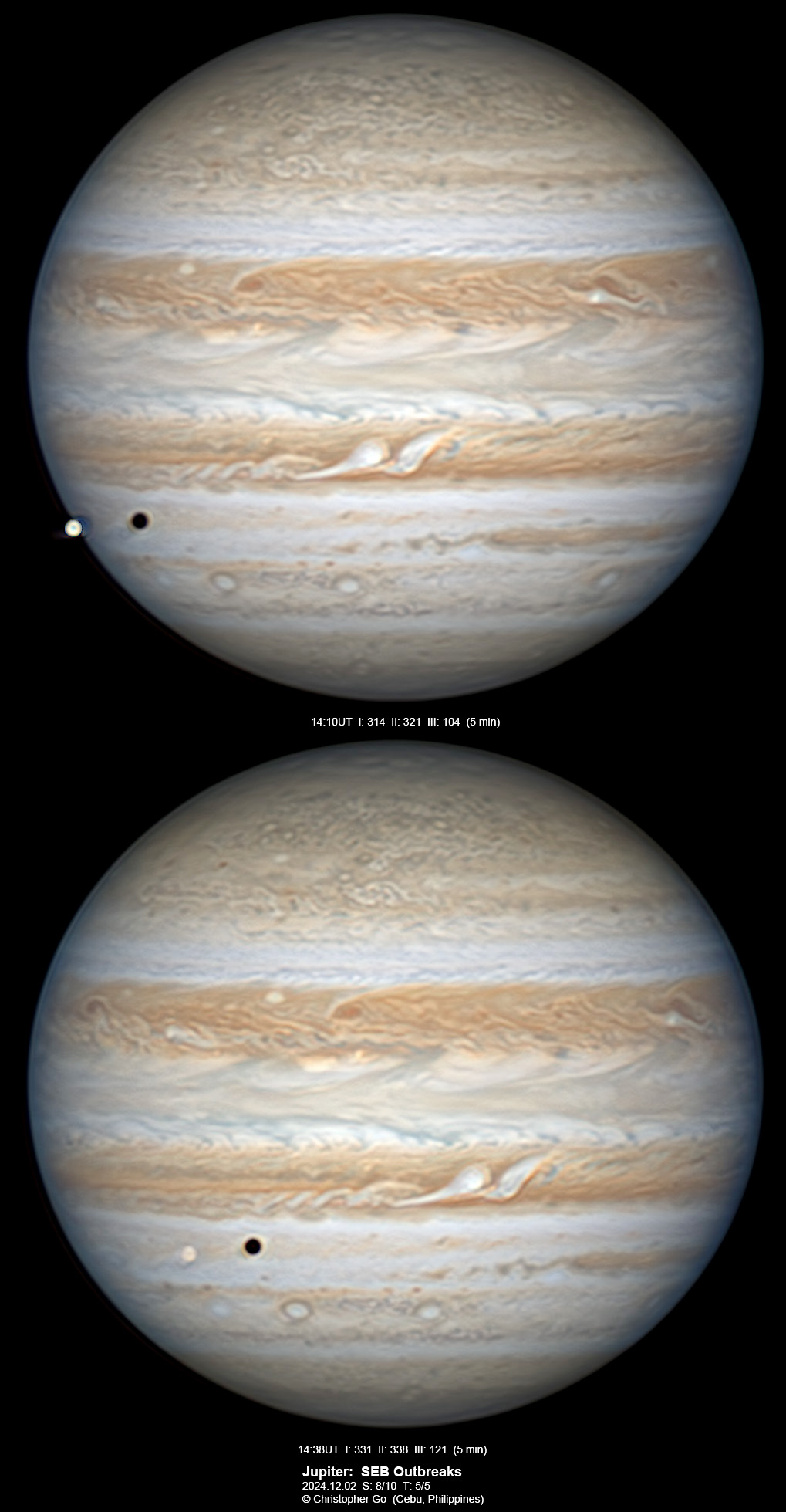
Jupiter, a month past its own opposition, shines at a bright magnitude –2.6 in Taurus. It dominates the high east to south during evening, with fainter, Mars-colored Aldebaran and the Pleiades nearby. Jupiter still is a good 46 arcseconds wide.
Saturn, magnitude +1.1 in Aquarius, glows in the southwest after dark, upper left of Venus and closing in on it fast. Saturn is 14° from Venus on January 3rd and 7° from it by January 10th. They'll pass each other at conjunction on January 18th, 2.2° apart.

Uranus (magnitude 5.7, at the Taurus-Aries border) is very high during evening, 18° west of Jupiter. You'll need a good finder chart to tell it from the similar-looking surrounding stars. See last November's Sky & Telescope, page 49.
Neptune (tougher at magnitude 7.9, under the Circlet of Pisces) is fairly high in the southwest after dark, upper left of Saturn and Venus. Again you'll need a sufficient finder chart.
All descriptions that relate to your horizon — including the words up, down, right, and left — are written for the world's mid-northern latitudes. Descriptions and graphics that also depend on longitude (mainly Moon positions) are for North America.
Eastern Standard Time (EST) is Universal Time minus 5 hours. UT is also known as UTC, GMT, or Z time.
Want to become a better astronomer? Learn your way around the constellations. They're the key to locating everything fainter and deeper to hunt with binoculars or a telescope.
This is an outdoor nature hobby. For a more detailed constellation guide covering the whole evening sky, use the big monthly map in the center of each issue of Sky & Telescope, the essential magazine of astronomy.
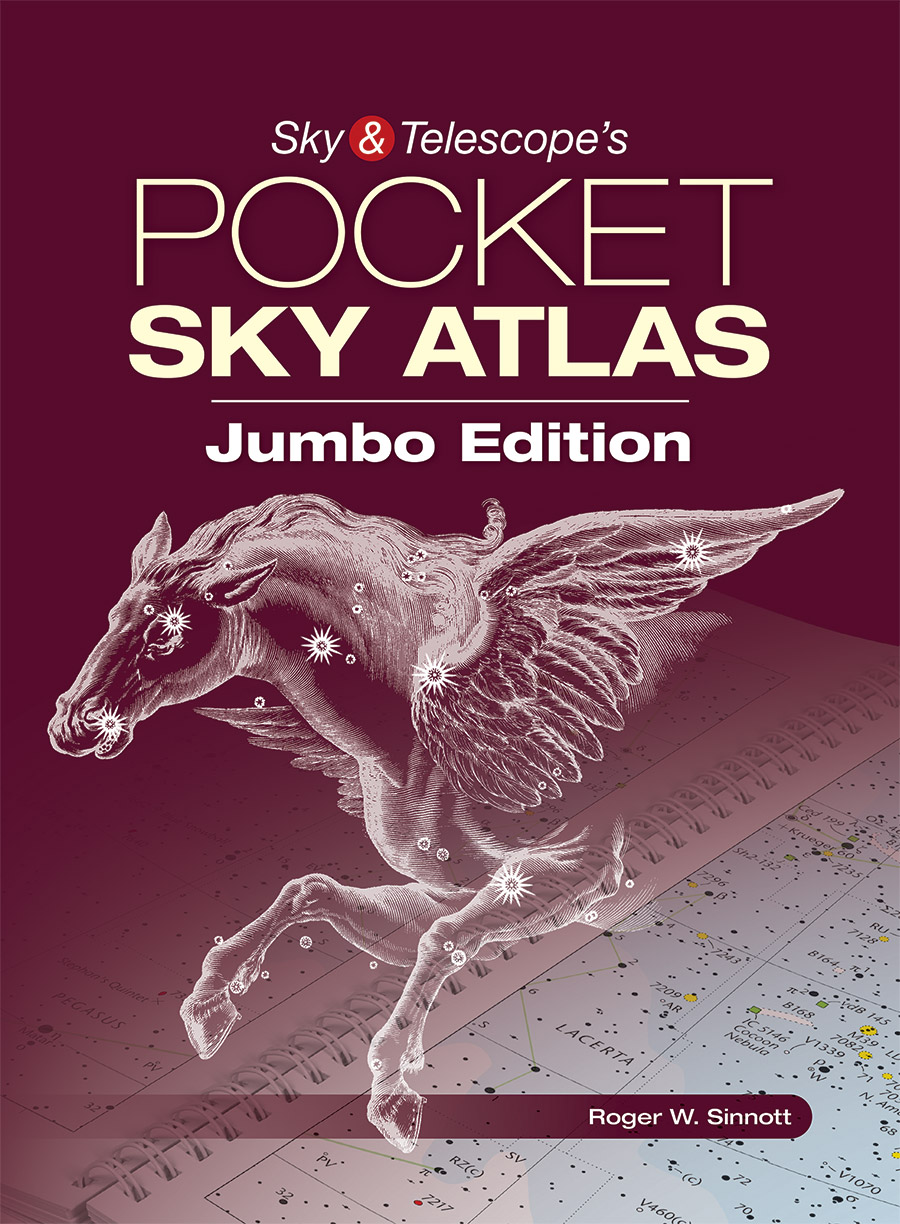
Once you get a telescope, to put it to good use you'll need a much more detailed, large-scale sky atlas (set of charts). The basic standard is the Pocket Sky Atlas, in either the original or Jumbo Edition. Both show all 30,000 stars to magnitude 7.6, and 1,500 deep-sky targets — star clusters, nebulae, and galaxies — to search out among them.
Next up is the larger and deeper Sky Atlas 2000.0, plotting stars to magnitude 8.5; nearly three times as many, as well as many more deep-sky objects. It's currently out of print, but maybe you can find one used.
The next up, once you know your way around well, are the even larger Interstellarum atlas (201,000+ stars to magnitude 9.5, and 14,000 deep-sky objects selected to be detectable by eye in large amateur telescopes), andUranometria 2000.0 (332,000 stars to mag 9.75, and 10,300 deep-sky objects). And read How to Use a Star Chart with a Telescope. It applies just as much to charts on your phone or tablet as to charts on paper.
You'll also want a good deep-sky guidebook. A beloved old classic is the three-volume Burnham's Celestial Handbook. An impressive more modern one is the big Night Sky Observer's Guide set (2+ volumes) by Kepple and Sanner. The pinnacle for total astro-geeks is the new Annals of the Deep Sky series, currently at 11 volumes as it works its way forward through the constellations alphabetically. So far it's up to H.
Can computerized telescopes replace charts? Not for beginners I don't think, and not for scopes on mounts and tripods that are less than top-quality mechanically. Unless, that is, you prefer spending your time getting finicky technology to work rather than learning how to explore the sky. As Terence Dickinson and Alan Dyer say in their Backyard Astronomer's Guide, "A full appreciation of the universe cannot come without developing the skills to find things in the sky and understanding how the sky works. This knowledge comes only by spending time under the stars with star maps in hand and a curious mind." Without these, "the sky never becomes a friendly place."
If you do get a computerized scope, make sure that its drives can be disengaged so you can swing it around and point it readily by hand when you want to, rather than only slowly by the electric motors (which eat batteries).
However, finding faint telescopic objects the old-fashioned way with charts isn't simple either. Do learn the essential tricks at How to Use a Star Chart with a Telescope.
 Audio sky tour. Out under the evening sky with your
earbuds in place, listen to Kelly Beatty's monthly
podcast tour of the naked-eye heavens above. It's free.
"The dangers of not thinking clearly are much greater now than ever before. It's not that there's something new in our way of thinking, it's that credulous and confused thinking can be much more lethal in ways it was never before."
— Carl Sagan, 1996
"Facts are stubborn things."
— John Adams, 1770
About Alan MacRobert
Alan M. MacRobert became an avid Sky & Telescope subscriber in 1966 at age 14, joined the editorial staff in 1982, and is now a senior contributing editor, semi-retired. He played a role in practically every part of the magazine and the company's other products for more than a generation, both on the amateur-observing side and the science-reporting side. In 1994 a book collection of his observing how-tos and telescopic sky tours was published as Star Hopping for Backyard Astronomers. He has produced This Week's Sky at a Glance online every week since 1989.



Comments
You must be logged in to post a comment.