 SUNSET:

 3
3FRIDAY, JUNE 6
■ After dark, Vega shines as the brightest star high in the east. Barely lower left of it is 4th-magnitude Epsilon Lyrae, the Double-Double. Epsilon forms one corner of a roughly equilateral triangle with Vega and Zeta Lyrae, as shown below. The triangle is less than 2° on a side, hardly the width of your thumb at arm's length.

Binoculars easily resolve Epsilon. And a 4-inch telescope at 120× or more should resolve each of Epsilon's two components into a tight pair.
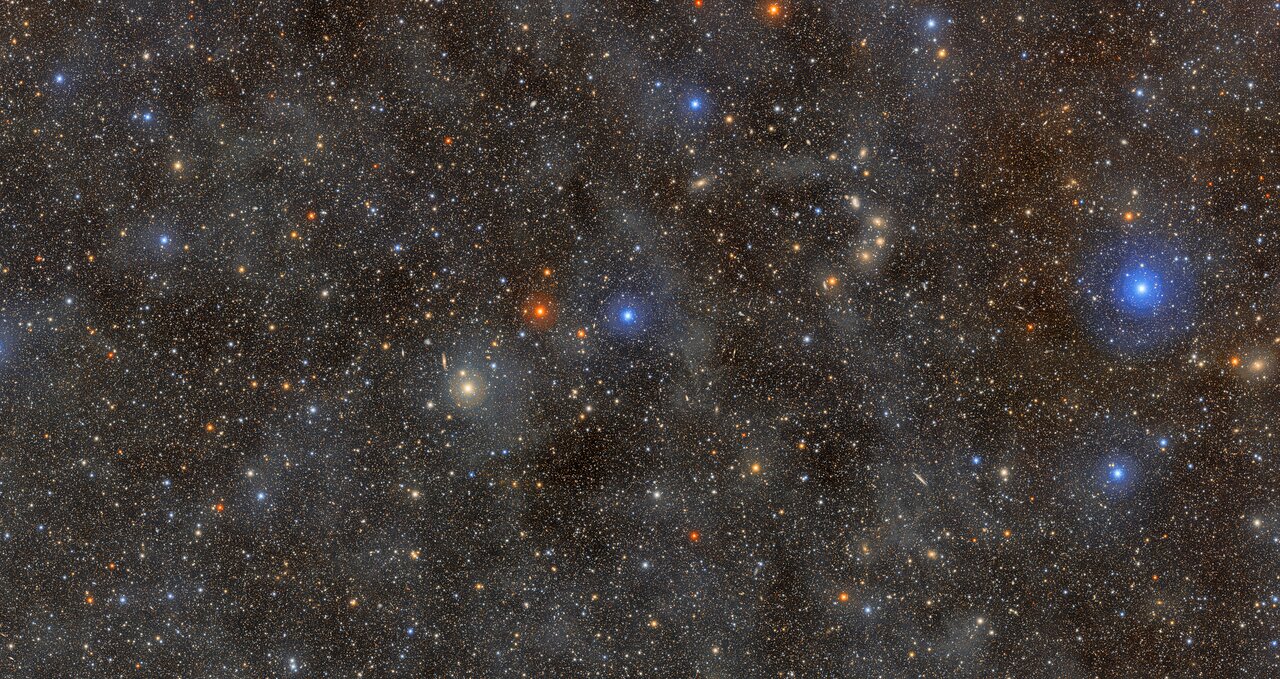
Zeta Lyrae is also a double star for binoculars, but much tougher. It's unresolved in the photo above but is plainly an unequal pair in nearly any telescope.
Delta Lyrae, below Zeta, is a much wider and easier pair, gold and blue.
SATURDAY, JUNE 7
■ The Big Dipper hangs high in the northwest at nightfall. The Dipper's Pointers, currently its bottom two stars, point lower right toward Polaris. Above Polaris, and looking very similar to it, is Kochab, the lip of the faint Little Dipper's bowl. Kochab passes exactly over Polaris around 9:30 or 10 p.m., depending on how far east or west you live in your time zone. Check by comparing them to a vertical line, such as the edge of a building.
SUNDAY, JUNE 8
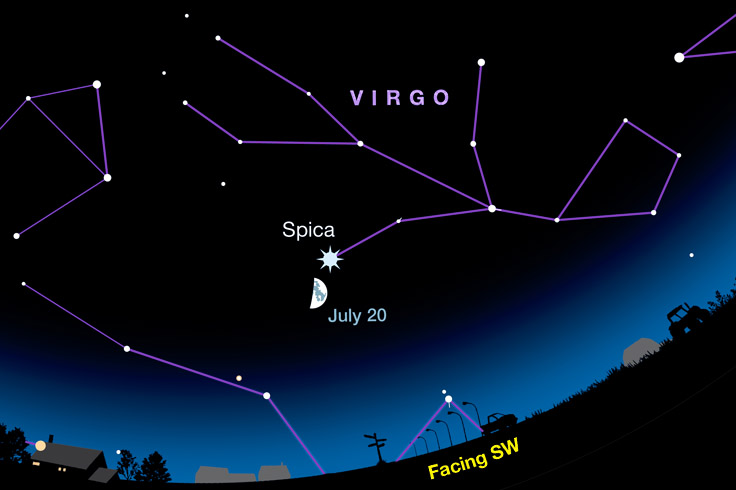
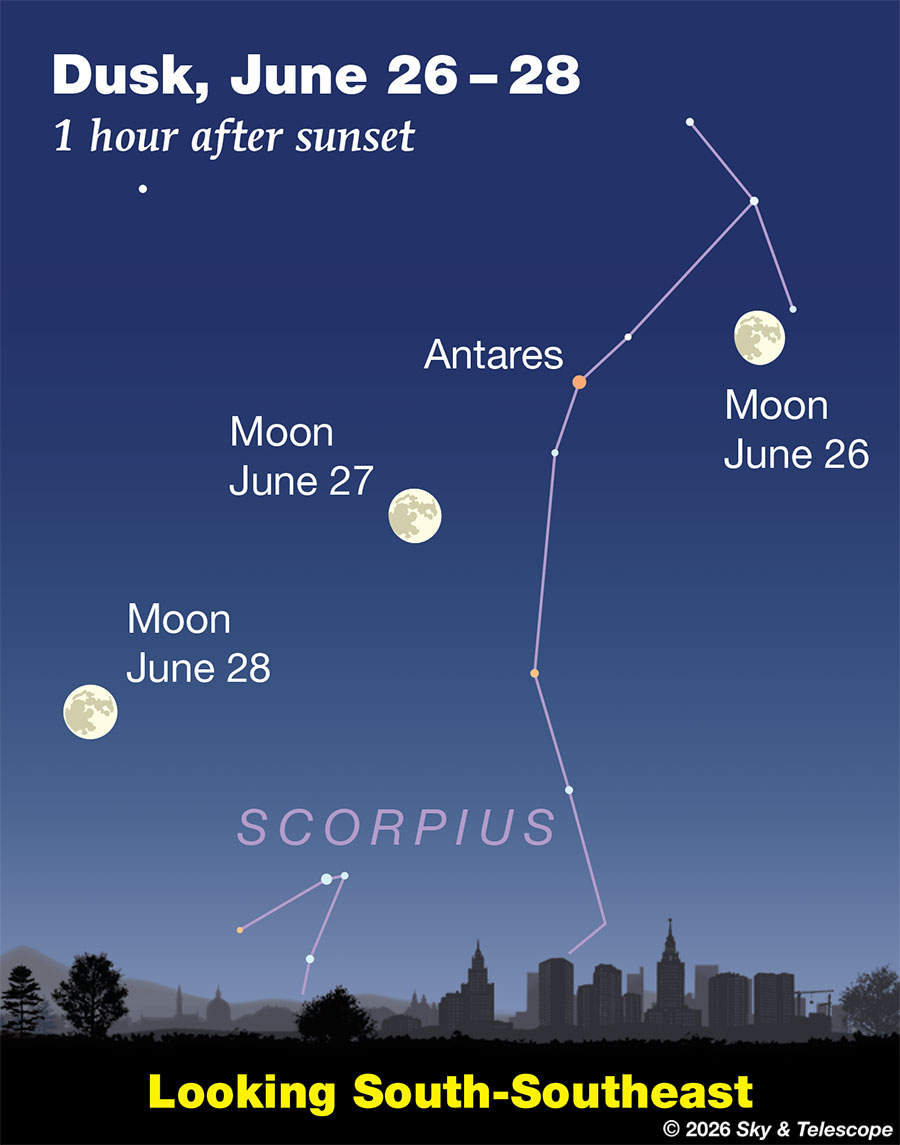
■ The nearly full Moon (it'll be full on Tuesday night the 10th) shines well to the upper right of Antares this evening, as shown below. This is the view in twilight. As night advances, the scene moves higher and tips to the right toward the south.

MONDAY, JUNE 9
■ Bright Arcturus, magnitude 0, shines pale yellow-orange very high overhead toward the south these evenings. The kite shape of Boötes, its constellation, now extends upward from Arcturus. The kite is narrow, slightly bent, and 23° long: about two fists at arm's length.
■ And on the opposite side of the celestial pole... To most of us, "Cassiopeia" means "Cold!" Late fall and winter are when it stands high overhead (for mid-northern latitudes). But even on warm June evenings, Cassiopeia still lurks low. As twilight fades out, look for it down near the north horizon: a wide, upright W. The farther north you are the higher it'll appear, but even as far south as San Diego and Atlanta, all of its stars will be above the horizon.
TUESDAY, JUNE 10
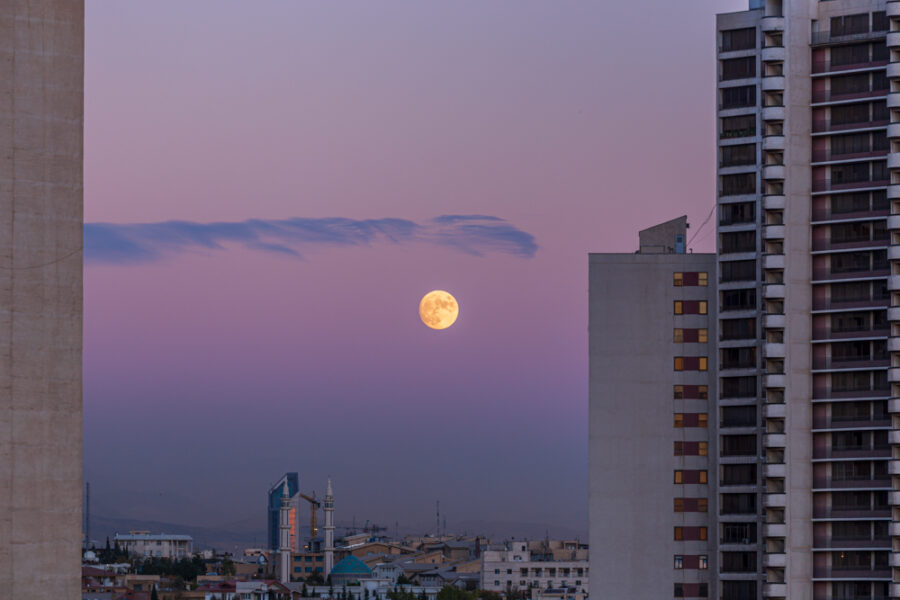
■ Full Moon (exactly full at 3:44 a.m. Wednesday morning EDT). The Moon, in southernmost Ophiuchus, rises around sunset almost due southeast (depending on your latitude). By the time nightfall is complete, the Moon has moved over to the south-southeast but is still rather low. Look for orange Antares shining almost a fist to its upper right, and for the stars of the head of Scorpius a little farther upper right.
The full Moon of June is traditionally called the honey moon. Maybe this was because it is often yellow, even deep yellow or orange. There are two reasons for this. First, summer air is often humid, humid means hazy, and haze reddens the Sun, Moon, and stars, especially when they're seen through the thick air low above the horizon.
Second, a full Moon in most of June rides its lowest across the sky through the night. The full Moon is of course opposite the Sun, and around the June solstice the Sun passes highest across the sky through the day.
Parisa Bajelan
The opposite effect happens in December — when the Sun crosses the sky lowest, the full Moon crosses the sky highest. Moreover, cold December air is usually drier.
WEDNESDAY, JUNE 11
■ Even now as summer nears, look very low in the north-northwest during late twilight for wintry Capella very out of season. The farther north you are, the less low Capella will appear. For the South it's just gone. But if you're as far north as Montreal or either of the Portlands (Oregon or Maine), Capella is actually circumpolar.
THURSDAY, JUNE 12
■ Have you ever seen Alpha Centauri? At declination –61° our brilliant, magnitude-zero neighbor is permanently out of sight if you're north of latitude 29°. But if you're at the latitude of San Antonio, Orlando, or points south, Alpha Cen skims just above your true southern horizon for a little while late these evenings.
When to look? When Alpha Librae, the lower-right of Libra's two brightest stars, is due south over your landscape. That's about 9:30 or 10 p.m. now (depending on where you live east-west in your time zone). Drop your gaze 45° straight down from Alpha Lib.
FRIDAY, JUNE 13
■ Bright Arcturus, very high toward the south these evenings, and Spica, about three fists at arm's length below it, form an almost perfectly equilateral triangle with dimmer Denebola, Leo's 2nd-magnitude tail tip, off to their right. All three sides of the triangle are close to 35° long (35.3°, 35.1°, and 32.8°). Sky & Telescope columnist George Lovi named this the Spring Triangle (in the March 1974 issue), to go with those of summer and winter. For such a near-perfect equilateral, I say the name ought to be revived.

SATURDAY, JUNE 14
■ As we count down the last seven days to official summer (the solstice comes on the night of June 21-22), the Summer Triangle stands high and proud in the east after dark. Its top star is bright Vega. Deneb is the brightest star to Vega's lower left, by 2 or 3 fists at arm's length. Look for Altair farther to Vega's lower right. Altair looks midway in brightness between Vega and Deneb.
If you have a dark enough sky, the Milky Way runs across the bottom of the Summer Triangle from side to side.
SUNDAY, JUNE 15
■ Titan casts its shadow on Saturn tonight! Only every 15 years does Titan, Saturn's largest moon, cross Saturn's face from Earth's viewpoint — and, more visibly, cast its tiny black shadow onto Saturn' globe. A new series of these events is under way. They will continue every 16 days until October.
Tonight Titan's shadow crosses Saturn's disk from 8:21 UT to 14:00 UT June 16th. That's from 3:21 a.m. to 8:00 a.m. June 16th Central Daylight Time, or 1:21 a.m. to 6:00 a.m. Pacific Daylight Time June 16. Because Saturn is only up in view before and during dawn, this means western North America is again favored. See Bob King's Titan Shadow Transit Season Underway.
This Week's Planet Roundup
Mercury and Jupiter hide way down in the glow of sunset. Jupiter is magnitude –1.9, Mercury is about –1.0, so early in the week Jupiter is the one you'll pick up first (Mercury at that time is a couple degrees to its right or lower right). But Jupiter fast sinks away day by day, while Mercury hangs in there.
Venus, brilliant at magnitude –4.3, rises in the east-northeast just before the beginning of dawn. Once Venus is up in the clear you can't miss it. . . until the sky grows too bright. How long can you follow Venus farther up until it's lost in the growing light of day?
In a telescope, Venus's shrinking globe (about 21 arcseconds pole to pole) appears just about half lit.
Mars (magnitude +1.4, in Leo) shines in the west right after dark. Mars is drawing nearer to Regulus every night. They're still nearly equal in brightness. On June 6th Mars is still 9° to Regulus's lower right, but by the 13th they close to just 2°. They'll have a close conjunction on June 16th and 17th, passing 0.8° apart.
In a telescope Mars is just a fuzzy little blob 5 arcseconds in diameter. But that's definitely more extended than pointlike Regulus.
Saturn (magnitude +1.1, at the border of Aquarius and Pisces) rises around 1 or 2 a.m. In early dawn, find it three fists at arm's length upper right of Venus.
If you get your telescope on Saturn in the dawn, expect a fuzzy little ball with a surprisingly low surface brightness, very slightly oval, with signs of a toothpick stuck though it diagonally. The toothpick is Saturn's rings; we see them nearly edge-on this year.
Uranus is out of sight low in the dawn.
Neptune, a telescopic "star" at magnitude 7.9, lurks in the background of Saturn about 1° to its upper left (celestial north) just before dawn begins. All this year, use the finder chart for Neptune with respect to Saturn in the June Sky & Telescope, page 51. Using a pencil, put a dot on the path of each planet for your date.
All descriptions that relate to your horizon — including the words up, down, right, and left — are written for the world's mid-northern latitudes. Descriptions and graphics that also depend on longitude (mainly Moon positions) are for North America.
Eastern Daylight Time (EDT) is Universal Time minus 4 hours. UT is also known as UTC, GMT, or Z time.
Want to become a better astronomer? Learn your way around the constellations. They're the key to locating everything fainter and deeper to hunt with binoculars or a telescope.
This is an outdoor nature hobby. For a more detailed constellation guide covering the whole evening sky, use the big monthly map in the center of each issue of Sky & Telescope, the essential magazine of astronomy.
For the attitude every amateur astronomer needs, read Jennifer Willis's Modest Expectations Give Rise to Delight.
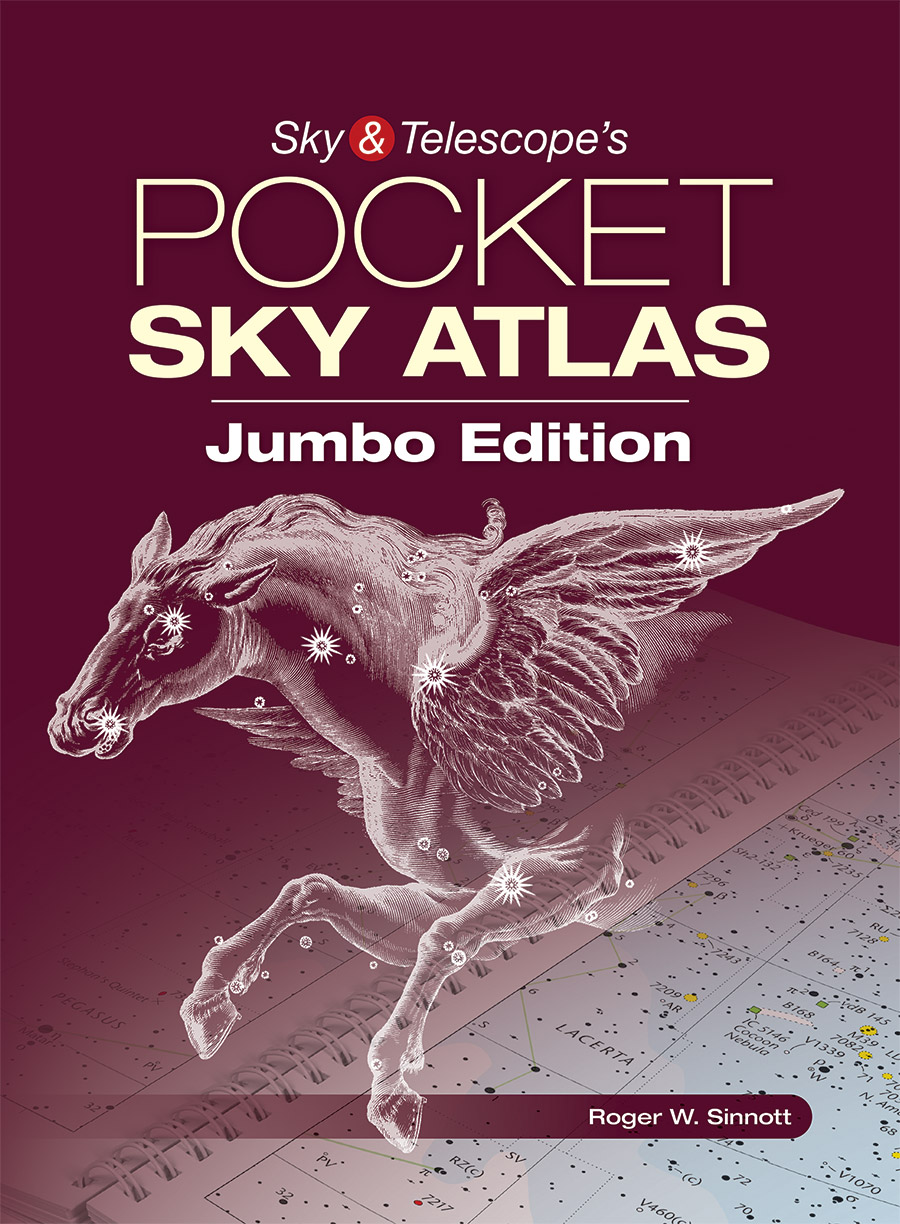
Once you get a telescope, to put it to good use you'll need a much more detailed, large-scale sky atlas (set of charts). The basic standard is the Pocket Sky Atlas, in either the original or Jumbo Edition. Both show all 30,000 stars to magnitude 7.6, and 1,500 deep-sky targets — star clusters, nebulae, and galaxies — to search out among them.
Next up is the larger and deeper Sky Atlas 2000.0, plotting stars to magnitude 8.5; nearly three times as many, as well as many more deep-sky objects. It's currently out of print, but maybe you can find one used.
The next up, once you know your way around well, are the even larger Interstellarum atlas (with 201,000+ stars to magnitude 9.5 and 14,000 deep-sky objects selected to be detectable by eye in large amateur telescopes), and Uranometria 2000.0 (332,000 stars to mag 9.75, and 10,300 deep-sky objects). And read How to Use a Star Chart with a Telescope. It applies just as much to charts on your phone or tablet as to charts on paper.
You'll also want a good deep-sky guidebook. A beloved old classic is the three-volume Burnham's Celestial Handbook. An impressive more modern one is the big Night Sky Observer's Guide set (2+ volumes) by Kepple and Sanner. The pinnacle for total astro-geeks is the new Annals of the Deep Sky series, currently at 11 volumes as it works its way forward through the constellations alphabetically. So far it's up to H.
Can computerized telescopes replace charts? Not for beginners I don't think, and not for scopes on mounts and tripods that are less than top-quality mechanically. Unless, that is, you prefer spending your time getting technology to work rather than learning how to explore the sky. As Terence Dickinson and Alan Dyer say in their Backyard Astronomer's Guide, "A full appreciation of the universe cannot come without developing the skills to find things in the sky and understanding how the sky works. This knowledge comes only by spending time under the stars with star maps in hand and a curious mind." Without these, "the sky never becomes a friendly place."
If you do get a computerized scope, make sure that its drives can be disengaged so you can swing it around and point it readily by hand when you want to, rather than only slowly by the electric motors (which eat batteries).
However, finding faint telescopic objects the old-fashioned way with charts isn't simple either. Do learn the essential tricks at How to Use a Star Chart with a Telescope.
 Audio sky tour. Out under the evening sky with your
earbuds in place, listen to Kelly Beatty's monthly
podcast tour of the naked-eye heavens above. It's free.
"The dangers of not thinking clearly are much greater now than ever before. It's not that there's something new in our way of thinking, it's that credulous and confused thinking can be much more lethal in ways it was never before."
— Carl Sagan, 1996
"Facts are stubborn things; and whatever may be our wishes, our inclinations, or the dictates of our passion, they cannot alter the state of facts and evidence."
— John Adams, 1770
About Alan MacRobert
Alan M. MacRobert became an avid Sky & Telescope subscriber in 1966 at age 14, joined the editorial staff in 1982, and is now a senior contributing editor, semi-retired. He played a role in practically every part of the magazine and the company's other products for more than a generation, both on the amateur-observing side and the science-reporting side. In 1994 a book collection of his observing how-tos and telescopic sky tours was published as Star Hopping for Backyard Astronomers. He has produced This Week's Sky at a Glance online every week since 1989.


Comments
misha17
June 6, 2025 at 2:32 pm
This week has the earliest sunrise for Northern Hemisphere viewers.
It occurs a week or so before the actual Summrr Solstice due to the Sun's uneven apparent daily motion across the sky.
Next week the sunrise will occur a minute or two later each day, but sunsets will also continue to occur later each day to compensate, so the night of the Solstice is the shortest actual night measured sunset-to-sunrise. After the Solstice the time of sunset will continue to occur later for about 10 days, but the later sunrise times will "pick up speed" to make night shorter overall.
You must be logged in to post a comment.
misha17
June 6, 2025 at 8:51 pm
Re: "TUESDAY, JUNE 10
■ Full Moon (exactly full at 3:44 a.m. Wednesday morning EDT). The Moon, in southernmost Ophiuchus, rises around sunset almost due southeast (depending on your latitude). By the time nightfall is complete, the Moon has moved over to the south-southeast but is still rather low. Look for orange Antares shining almost a fist to its upper right, and for the stars of the head of Scorpius a little farther upper right. ...
... a full Moon in most of June rides its lowest across the sky through the night. The full Moon is of course opposite the Sun, and around the June solstice the Sun passes highest across the sky through the day."
1. I wrote a comment in last week's column that the Spica occultation series is winding down. On the other hand, the Antares occultation series only about halfway through it's multi-year cycle. It started in August 2023 with occultations visible initially in the Northern Hemisphere; this week's occultation is visible over most of Australia, New Zealand, and the southern-central Pacific Ocean while it is still daytime in the U.S. on June 10th.
2. Besides the June Full Moon's low altitude as it passes near the Winter Solstice point, it is even further lower than usual by about 5 degrees since the lowest point of the Moon's orbital tilt lies near the Solstice point (the orbital low point coincided with the Solstice point back in January ). The Moon's declination will be about 28 degrees South of the Celestial Equator on the nights of June 10th and 11th.
Besides the low altitude when it transits at "lunar noon" around 1am Daylight Time, the moonrise and moonset points will be about as far south as they get in the orbital tilt's 18-year cycle (the "lunar standstill").
Griffith Observatory will stream the lunar moonrise at 9pm PDT on June 11th.
(Link: https://griffithobservatory.org/extreme-moon-the-major-lunar-standstills-of-2024-2025/ ). The Moon will be about 21 hours past full, but will be closer to the Winter Solstice point than it is on the night of June 10th.
You must be logged in to post a comment.
mary beth
June 11, 2025 at 12:44 am
Thanks for the link. I'm going to try to watch it tomorrow evening. It was a beautiful moon tonight in Texas. Thankfully, it was clear enough to see for at least an hour now it's cloudy, but I did get to see it.
You must be logged in to post a comment.
You must be logged in to post a comment.