SUNSET:


Make the Most of January's Total Lunar Eclipse
An unusual dawn total lunar eclipse presents special challenges and great photo opportunities. Here's what you need to know to make the most of it.
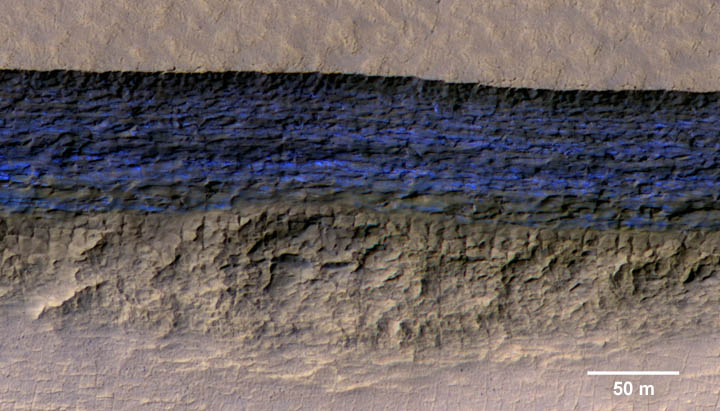
Water Ice Found Exposed in Martian Cliffs
Thick sheets of water ice, some barely buried beneath the surface and likely more than 100 meters thick, have been spotted on several Martian cliff faces.

NASA Unveils New Power Source for Space Exploration
The Kilopower fission reactor will offer a more efficient and more powerful portable power source for solar system exploration.

Michigan Meteorite Tally Multiplies
They look like leftover gravel from a freshly laid asphalt road, but the black stones that spattered across the snow in the wake of the January 16th Michigan fireball were anything but terrestrial. They belonged to a tiny asteroid on a recent foray to the outer asteroid belt but now…

Extra Stars Might Downsize Exoplanets
Follow-up studies of candidates planetary systems found by NASA’s Kepler mission suggest that companion stars make some worlds appear smaller than they really are.

Hunters Recover Meteorites From Michigan Fireball
A spectacular fireball seen by hundreds of people from Iowa to Ontario delivered precious samples from the asteroid belt to the lake country of southern Michigan Tuesday night.

60-Second Astro News: Black Holes Galore
Supermassive black holes are difficult to observe and measure, yet they have profound effects on their host galaxies. Read up on the latest black hole discoveries presented at the Washington D.C. meeting of the American Astronomical Society.

Dark Energy Survey Releases First Three Years of Data
Results from the first data release of the Dark Energy Survey include eleven new stellar streams in the Milky Way galaxy.

Mira Makes January Nights "Wonderful"
Mira, one of the easiest-to-observe pulsating variable stars, reaches peak brightness this month. Don't be shy, come look her in the eye.

Galaxies Show Order in Chaotic Young Universe
New observations of galaxies in a universe just 800 million years old show that they’ve already settled into rotating disks. They must have evolved quickly to display such surprising maturity.

Some Plants Grow Well in Martian Soil
Astrobiology students cultivated leafy greens, sweet potatoes, and even hops in simulated Martian dirt.

Ringed Disks Don’t Always Mean Planets
Astronomers presenting at the winter American Astronomical Society meeting caution that the features often pointed to as evidence of growing natal planets could form on their own.

Comet Discoverer Thomas Bopp (1949–2018)
An unassuming amateur astronomer forever linked to one of the greatest comets in modern history has passed away.

Mysterious Cosmic Bursts Traced to Extreme Environment
A repeating fast radio burst first detected in 2012 likely formed within a potent magnetic field — opening up the ambiguity of what caused the mysterious burst.

Metal-rich Stars Host Closer Planets
Iron-rich stars host planets on closer orbits than their iron-poor siblings, astronomers find. The results could help reveal how planets form.
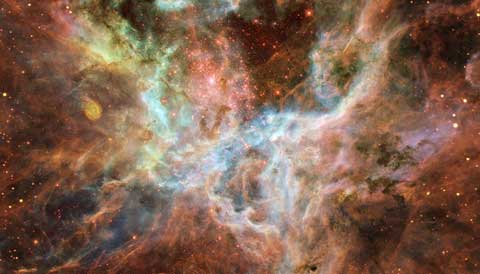
Hefty Stars Prompt Birth Debate
A new study found more massive stars than expected in an intensely star-forming region. The results beg the question whether the process of star formation really is universal.

More Planets in the Hyades Cluster
A few weeks ago, Astrobites reported on a Neptune-sized planet discovered orbiting a star in the Hyades cluster. A separate study submitted at the same time, however, reveals that there may be even more planets lurking in this system.

Sun Might Have Formed in Giant Star's Bubble
A new theory of the solar system’s formation suggests that it formed within the shell of a wind-blown bubble surrounding a dead star.

New Observations of the "Most Mysterious Star in the Galaxy"
New data on Boyajian's Star show that dust — not an alien megastructure — is probably the cause of this star's mysterious behavior.

Mars Flies By Jupiter in a Close Dawn Conjunction
The new year opens with the magnificent pairing of the solar system's largest planet with one of its smallest.