 SUNSET:

 0
0A Christmas Eve pass will take the Parker Solar Probe closer to the Sun than ever before.
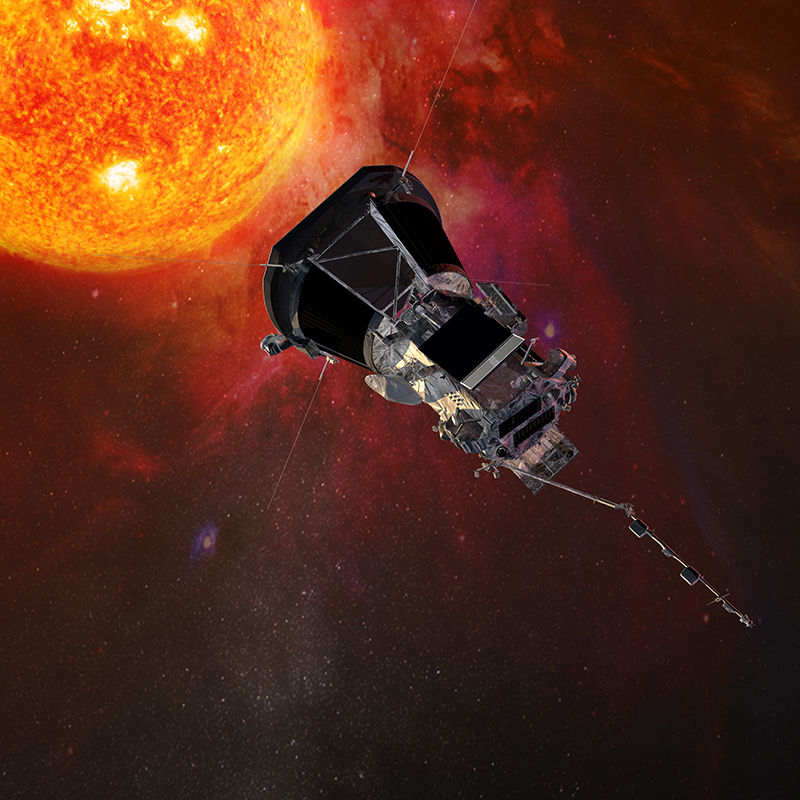
NASA’s Parker Solar Probe is about to go where no spacecraft has gone before. A final flyby of Venus last month has sped up Parker for the mission’s next solar perihelion, set to occur on December 24 at 6:40 EST / 11:40 UT. At just 6.2 million km (3.9 million miles) from the solar surface — about nine times the Sun's radius — this perihelion will be the closest for the mission. Parker is breaking its own record to once again become the closest human-made object to ever approach the Sun.
This flyby is the 22nd of 24 perihelia planned for the seven-year mission, and since the 8th of these close passes, the mission has truly been "touching the Sun" as it flies through the part of the solar atmosphere dominated by our star's crackling magnetic field. During these close approaches, the mission is totally autonomous in taking measurements; it should start transmitting data back to Earth within a week after this pass, though it has the capability to carry out operations on its own for up to two months if needed.
"NASA's Heliophysics System Observatory will be working together to get as many measurements as possible during Parker Solar Probe's perihelion pass," says Nicholeen Viall (NASA-Goddard Spaceflight Center). "Ground-based telescopes will often try to get observations of the Sun in and around the same time of perihelion too for joint science, if weather cooperates."
The instrument package taking these measurements is nestled behind the mission's Thermal Protection System, a sunshade that on this pass will withstand temperatures up to 1,800°F (1,000°C). The instruments remain tucked safely behind it at room temperature. The system was purposely over-designed, tested to a searing 2,500°F.
NASA’s STEREO A, a mission that also orbits the Sun from near Earth's vantage point, is also set to follow the space weather environment to provide a wider context for what Parker sees.
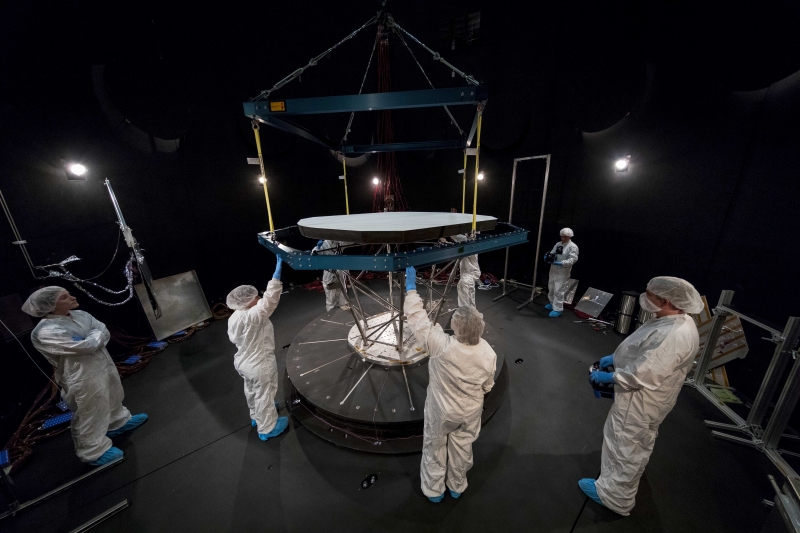
Johns Hopkins University APL
The mission was launched on August 12, 2018, to study the solar wind and corona. Ironically, sailing close to the Sun is as tough as leaving the solar system altogether, necessitating several planetary flybys. Now, moving at 191 kilometers per second (427,000 mph), Parker is going fast enough to travel from Earth to the Moon in just 30 minutes. That’s a new record for the fastest human made object.
Parker is set to do some amazing solar science. For the first time, we have a mission up close to the Sun during solar maximum — when the Sun is reaching a peak of activity for Solar Cycle 25. This perihelion will thus offer different types of solar wind and other activity than what's typically seen during the Sun's quieter years.
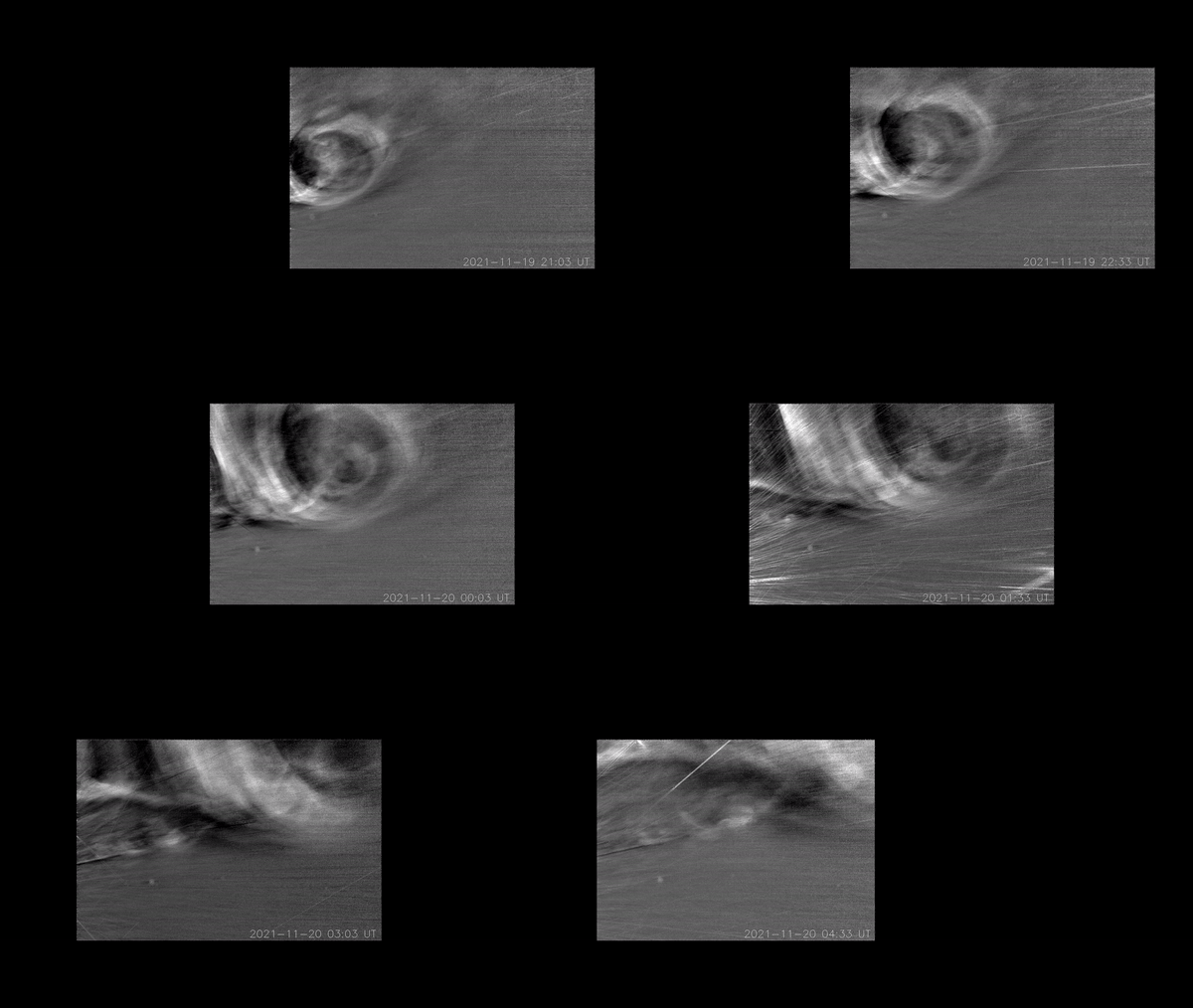
NASA / JHUAPL
"Since Parker Solar Probe is travelling so fast at closest approach, that means it rapidly takes measurements from a wide portion of longitudes around the Sun, and we can study the Sun's spatial structures as we rapidly fly through them," says Viall. "In contrast, most of our prior measurements taken near 1 AU have to wait for the Sun to rotate in order to measure different longitudes of the Sun."
The Wide-Field Imager for the Parker Solar Probe (WISPR) instrument also takes measurements that shed light on the possible origins of the Geminid meteors, which peak annually in December.
“WISPR sees the train of debris from 3200 Phaethon, and how this train of debris formed in the first place,” says Nour Rawafi (Johns Hopkins University Applied Physics Laboratory).
Parker's science discoveries began with its very first orbit, when it saw direct evidence for a long-postulated dust-free zone close into the Sun. Parker made the first rotational measurements of the solar wind and witnessed switchbacks in the solar particles' motions and magnetic field. But its work isn't done yet. The mission team is continuing to use Parker data to trace the origin of the solar wind as well as the mysterious mechanism that heats the Sun's outermost atmosphere known as the corona. Thus, while the primary mission only takes Parker through two more swings by the Sun (the last will occur in June 2025), Rawafi notes that the team is planning a proposal to extend the mission.
Sun-Observing Missions
Parker is just one of a flotilla of Sun-observing missions that are active during the maximum of Solar Cycle 25. There’s a whole heliophysics fleet out there, including the European Space Agency’s Solar Orbiter, ESA’s recently launched Proba 3 coronagraph mission, and India’s Aditya L1 mission.
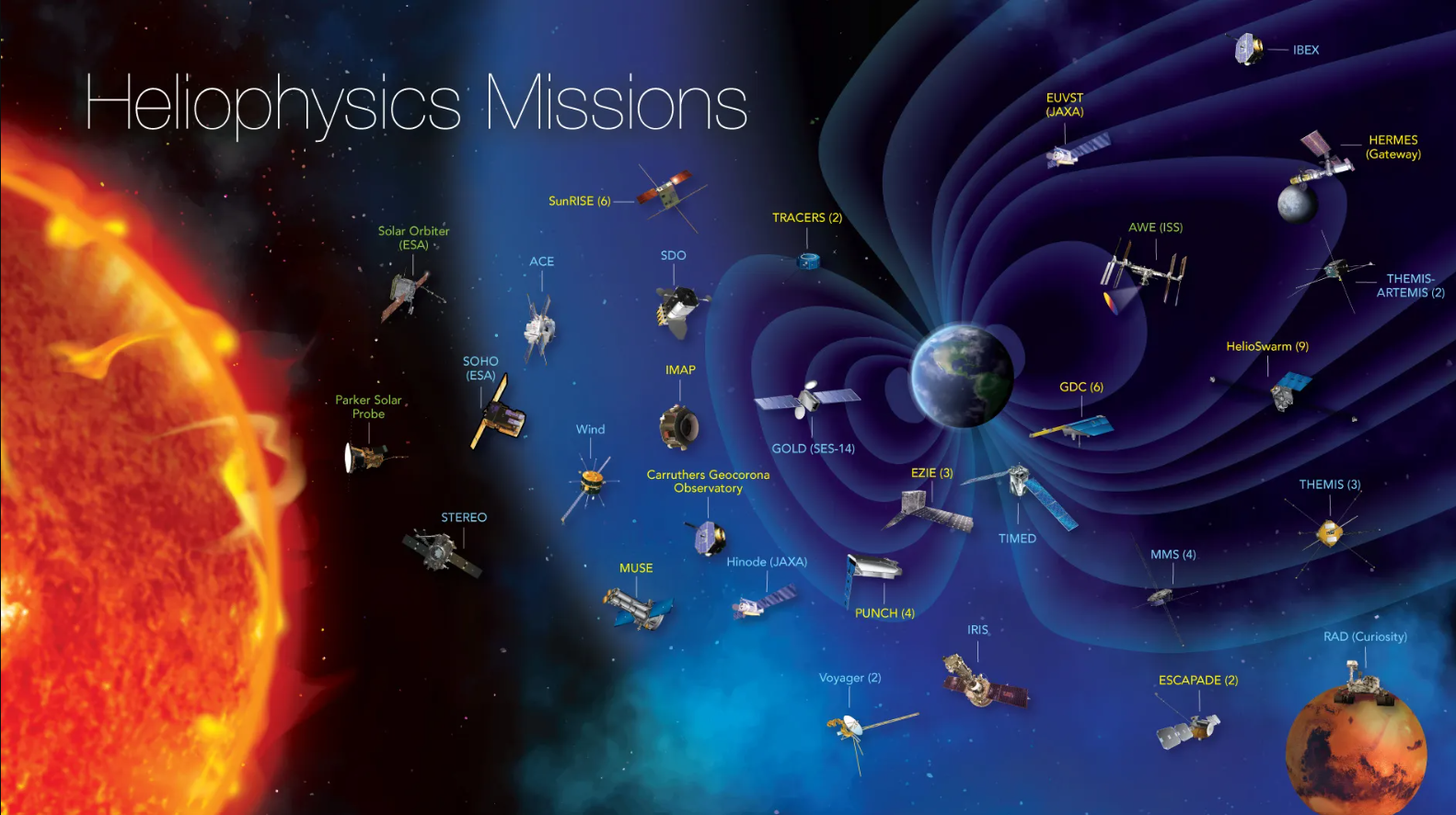
NASA / JPL
Closer to Earth, NASA’s Solar Dynamics Orbiter (SDO) and IRIS (Interface Region Imaging Spectrograph) are still observing the Sun, even as repairs are ongoing for the Stanford University data center that recently experienced flooding due to a broken pipe.
Coming up, NASA’s Polarimeter to Unify the Corona and the Heliosphere (PUNCH) mission is due to launch in February; it will see the whole Sun in context. The Coronal Diagnostic Experiment (CODEX) also just launched for the International Space Station, where it's currently undergoing commissioning. CODEX will produce science starting next year as it observes space weather from Earth orbit.
It’s great to see another milestone for the Parker Solar Probe mission come to pass, as we probe the mysteries of our tempestuous star.
About David Dickinson
David Dickinson is a freelance science writer, high school science teacher, retired enlisted U.S. Air Force veteran and avid stargazer. He currently resides with his wife Myscha in Bristol, Tennessee. David also writes science fiction in his spare time. He posts as @AstroDave on BlueSky about space news and sky-watching worldwide.



Comments
You must be logged in to post a comment.