 SUNSET:

 1
1The “planet parade” isn’t over yet — the waxing Moon will pair with the planets in the coming week, with a pretty Venus-Moon pairing on February 1st.

Bob King
Don’t worry — you’ve still got time to see all the planets. Not only that, but in the coming 10 days the waxing Moon will pair up with all of them, starting with Saturn on January 31st and finishing up with Mars on February 9th. Granted, the Moon passes all the night-sky planets every month, but they're often split between morning and evening skies, not splayed across a single sky and visible in one fell swoop. Plus, you can hop on the planet train early during evening twilight — no need to get up at 2 a.m. for this show.
The only one not making an appearance is Mercury, which remains swaddled in the solar glare in the morning sky; it won’t emerge at dusk until late February. Just as the innermost planet charges into the evening sky, Saturn bows out. With luck, pluck, and binoculars on a tripod, you might be able to extricate the ringed planet from the twilight glare alongside Mercury on February 24th. Then you’d have bragging rights to seeing all eight planets (Earth included).

Stellarium with additions by Bob King
See the Planets
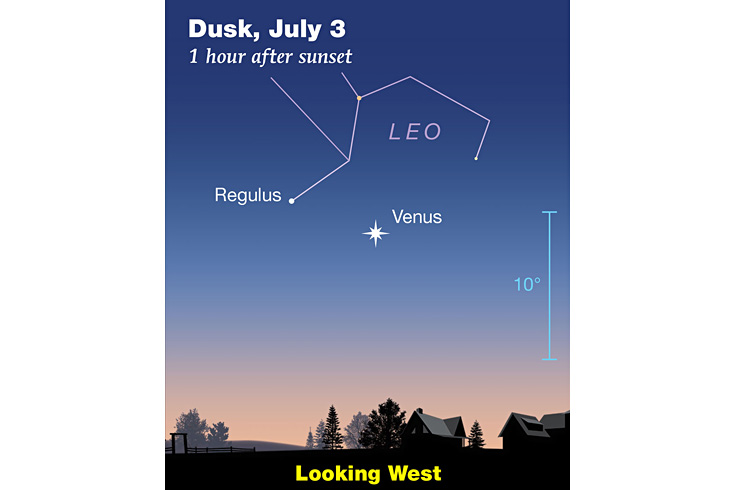
I teach community astronomy classes. A week ago our group gathered on a subzero night to observe the planets with the naked eye and telescope. We started our quest at dusk with Venus and its dimmer “companion,” Saturn, in the southwestern sky. Not long after, a couple students asked about the brilliant, pale-lemon colored star high in the southern sky. Someone called out “Jupiter!”

Bob King
The king of the planets beamed from Taurus just above Aldebaran and the Hyades star cluster. Through the telescope, the four bright moons were split two on either side of Jupiter like a royal entourage. Then, turning to face east, we all got a kick out of seeing Mars playing tag with Pollux and Castor in Gemini, the Twins. Their constantly changing configuration as Mars slips westward in retrograde motion has made for must-see viewing every clear night. Fellow amateur astronomer and friend Suresh Sreenivasan of Hopkins, Minnesota, compared it to a game of celestial tic-tac-toe.
Find the Ice Giants
The dimmer planets Uranus and Neptune both required a little help from the telescope. So I prepared finder charts and star-hopped to each in turn. It’s easy to make a chart using the free Stellarium program on a desktop computer. I set the time, search for and center the object, screen-grab the view, and save it. Before printing it out, I invert the image so the stars are black dots on a white background to save on toner. You can also go paperless by using a star atlas app and navigating to the object with your smartphone.

Stellarium
To track down Uranus, I began at the Pleiades and worked my way to a small stellar asterism about 8° to the cluster’s southwest. A minute later, I spotted it in the 8×50 finderscope. Even at the modest magnification of 60×, everyone remarked on the planet's distinctive blue hue. Increasing the magnification to 168× expanded the miniscule point of light into a distinctive disk.

Stellarium with additions by Bob King
Just one planet to go! To round up Neptune we waited until the end of dusk, when the sky was fully dark. My guide this time was Venus — it's not often you get to use the brightest planet to find the faintest! Even from our light-polluted site, Neptune was a breeze in the 10-inch Dob, with a rich blue color and an even tinier globe. In the span of about an hour, we had traveled from Venus, 87 million kilometers from home, all the way to Neptune, more than 4.5 billion kilometers beyond. It was an exhilarating journey made more so by the bitter cold.
Moon-Planet Pairings

Bob King
The upcoming Moon-planet pairings are listed below. All will be visible during mid-to-late evening twilight — just follow the Moon to know where to look. For observers in the Americas, the most striking coupling occurs on February 1st, when the thin crescent appears just 2° below Venus, the brightest of the planets.
- Friday, Jan. 31 — Saturn
- Saturday, Feb. 1 — Venus and Neptune
- Wednesday, Feb. 5 — Uranus
- Thursday, Feb. 6 — Jupiter
- Sunday, Feb. 9 — Mars

If you've yet to spend an evening with our planetary neighbors, don't hesitate, especially now with the lunar bonus in play. Seeing all six gives an observer a holistic feel for the size and diversity of our planetary brothers and sisters. Four are plainly visible with the unaided eye, while Uranus and Neptune are easy to track down with a phone app like Sky Safari or Stellarium Mobile. Another of my favorite tools is the interactive Stellarium Web Online Star Map. Type the planet's name in the search box, then use your mouse to click-and-drag or zoom in. And don't forget Sky & Telescope's excellent Interactive Sky Chart.
We all got a little cold that night, but we left feeling happy and satisfied after our romp through the solar system.
About Bob King
I love the sky (day and night) and have been a skywatcher and amateur astronomer since childhood. I'm also a long-time member of the American Association of Variable Star Observers (AAVSO) and Astronomical League. I pen the Astro Bob blog and have written four books: Night Sky with the Naked Eye (2016); Wonders of the Night Sky You Must See Before You Die (2018) and Urban Legends from Space (2019) and Magnificent Aurora, published in 2024. The universe invites us on an adventure every single night. To accept the invitation, we only need look up.



Comments
aladean
March 4, 2025 at 3:20 am
Witnessing the celestial dance of planets alongside the crescent moon is a humbling reminder of the vastness of our universe and our own personal journeys. ✨ Just as the stars guide travelers through the night, having a personal compass( https://aladean.com/products/path-of-god-compass) can symbolize our inner guidance and faith. For those seeking a meaningful keepsake, the Path of God Compass offers both functional navigation and spiritual inspiration.
You must be logged in to post a comment.
You must be logged in to post a comment.